AI-powered customer support has crossed the tipping point. What started as simple chatbots handling basic inquiries has evolved into autonomous AI agents resolving complex issues, predicting customer needs, and driving measurable business outcomes.
The numbers tell a compelling story: the AI customer service market is projected to reach $15.12 billion in 2026, 80% of routine interactions will be fully handled by AI, and companies implementing AI support are seeing 3.5x to 8x returns on their investment.
Whether you are building a business case for AI adoption, benchmarking your existing implementation, or tracking industry trends, these 55+ AI customer support statistics provide the data-driven foundation you need. Every statistic is sourced and current as of 2026.
AI Customer Service Market Size and Growth
The market trajectory leaves no room for doubt — AI customer service is one of the fastest-growing enterprise technology segments globally.
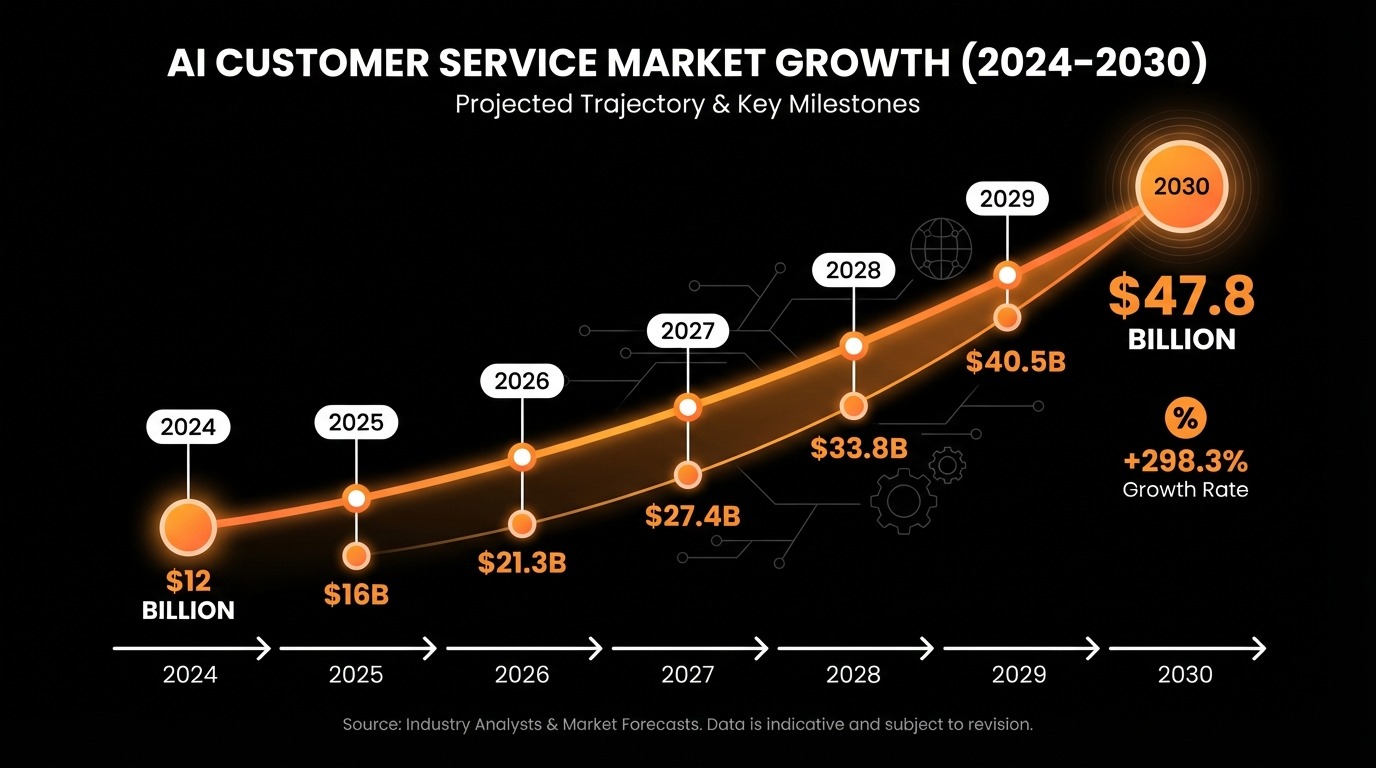
1. The global AI customer service market is projected to reach $15.12 billion in 2026. This represents continued acceleration from the $12.06 billion valuation in 2024. (Source: Dante AI / Grand View Research)
2. By 2030, the market is expected to hit $47.82 billion, representing a compound annual growth rate (CAGR) of 25.8%. (Source: Grand View Research)
3. The broader AI in customer experience market will exceed $117 billion by 2030. This includes AI across all customer-facing functions — support, sales, marketing, and engagement. (Source: Fortune Business Insights)
4. AI in the retail and e-commerce sector alone is projected to grow from $9.4 billion in 2024 to $85.1 billion by 2032. Retail’s high volume of repetitive inquiries makes it a natural fit for AI automation. (Source: Fortune Business Insights)
5. Conversational AI will reduce contact center labor costs by $80 billion in 2026. This was originally a Gartner projection for 2026, and current deployment trends confirm it is on track. (Source: Gartner)
6. The chatbot market specifically is expected to reach $15.5 billion by 2028, growing at a CAGR of 23.3% from 2023. (Source: Markets and Markets)
AI Adoption Rates in Customer Service
The adoption curve has been remarkably steep — moving from early experimentation to mainstream deployment in just a few years.
7. 80% of routine customer interactions will be fully handled by AI in 2026. This includes ticket categorization, common inquiries, order tracking, and basic troubleshooting. (Source: CoSupport AI)
8. 80% of companies are either using or planning to adopt AI-powered chatbots for customer service. The tipping point has passed — AI is now a mainstream expectation. (Source: Grand View Research)
9. In 2020, only 5% of customer service teams used AI-powered chatbots. By 2025, that number exceeded 80%. That is a 16x increase in five years — one of the fastest adoption curves in enterprise technology. (Source: Gartner)
10. 92% of businesses report improved customer satisfaction after implementing AI chatbots. The correlation between AI adoption and CSAT improvement is now well-established. (Source: Dante AI)
11. 88% of contact centers report using some form of AI-powered solution, yet only 25% have fully integrated automation into daily operations. The gap between adoption and deep integration represents a major opportunity. (Source: AmplifAI)
12. 69% of organizations believe generative AI can help humanize digital interactions. Contrary to fears about impersonal service, modern AI is enabling more personalized experiences. (Source: Zendesk CX Trends)
13. 75% of CX leaders see AI as a force for amplifying human intelligence, not replacing it. The human-AI collaboration model is winning over the full-automation approach. (Source: Zendesk)
AI Adoption by Industry
Different industries are moving at different speeds, but the direction is universal.
14. Telecom leads AI adoption at 95%, with banking and finance close behind at 92%. High volumes of repetitive inquiries make these industries natural fits. (Source: Master of Code Global)
15. Healthcare AI adoption grew by 51.9% as providers automate non-clinical tasks like appointment scheduling, prescription management, and patient communication. (Source: Accenture)
16. 94% of retail companies say implementing AI has helped decrease operational costs. Retail’s high-volume, repetitive inquiry profile makes it particularly suited to AI automation. (Source: Capgemini)
17. Financial services companies using AI for customer support report 35% faster claim processing and 28% improvement in fraud detection response times. (Source: McKinsey)
18. Only 33% of companies currently offer omnichannel support integrating AI tools like chatbots and video calls. This represents significant room for growth — businesses that unify AI across channels like WhatsApp, Instagram, and Facebook Messenger will have a distinct advantage. (Source: Zendesk)
ROI and Financial Impact of AI Customer Support
The business case for AI customer support has moved from theoretical to proven, with clear and measurable returns.
19. Companies see an average return of $3.50 for every $1 invested in AI customer service. This ROI comes from reduced operational costs, improved retention, and increased sales opportunities. (Source: MIT Sloan Management Review)
20. Top-performing organizations achieve up to 8x returns on their AI investments. The gap between average and excellent implementations highlights the importance of strategic deployment. (Source: McKinsey)
21. Chatbot interactions cost approximately $0.50 on average, compared to $6.00 for human agent interactions. That is a 12x cost difference per interaction, and it compounds dramatically at scale. (Source: Juniper Research)
22. Companies report average annual savings of $127,000 through AI-powered ticket automation. Typical automation rates range from 60-80% of routine tickets. (Source: Intercom)
23. Klarna’s AI assistant projected a $40 million profit improvement in its first year. Within one month of deployment, the AI handled two-thirds of all customer service conversations — equivalent to the work of 700 full-time agents. (Source: Klarna)
24. NIB Health Insurance saved $22 million through AI-driven digital assistants, reducing customer service costs by 60%. (Source: NIB Group Annual Report)
25. Companies implementing AI support see a 30% reduction in overall operating costs when AI handles 80% or more of routine interactions. (Source: CoSupport AI)
26. AI-driven upselling and cross-selling during support interactions generates an average 15-25% increase in revenue per customer. Support conversations are becoming revenue opportunities. (Source: Salesforce State of Service)
Response Time and Efficiency Statistics
Speed is the single biggest driver of customer satisfaction in support interactions, and AI delivers where human-only teams cannot.
27. Companies using AI have cut First Response Time by up to 74% within the first year. Multi-minute wait times become near-instant answers. (Source: Freshdesk)
28. Customer expectations for initial response speed increased by 63% between 2023 and 2024. This acceleration shows no signs of slowing — AI is no longer optional for meeting these demands. (Source: HubSpot State of Service)
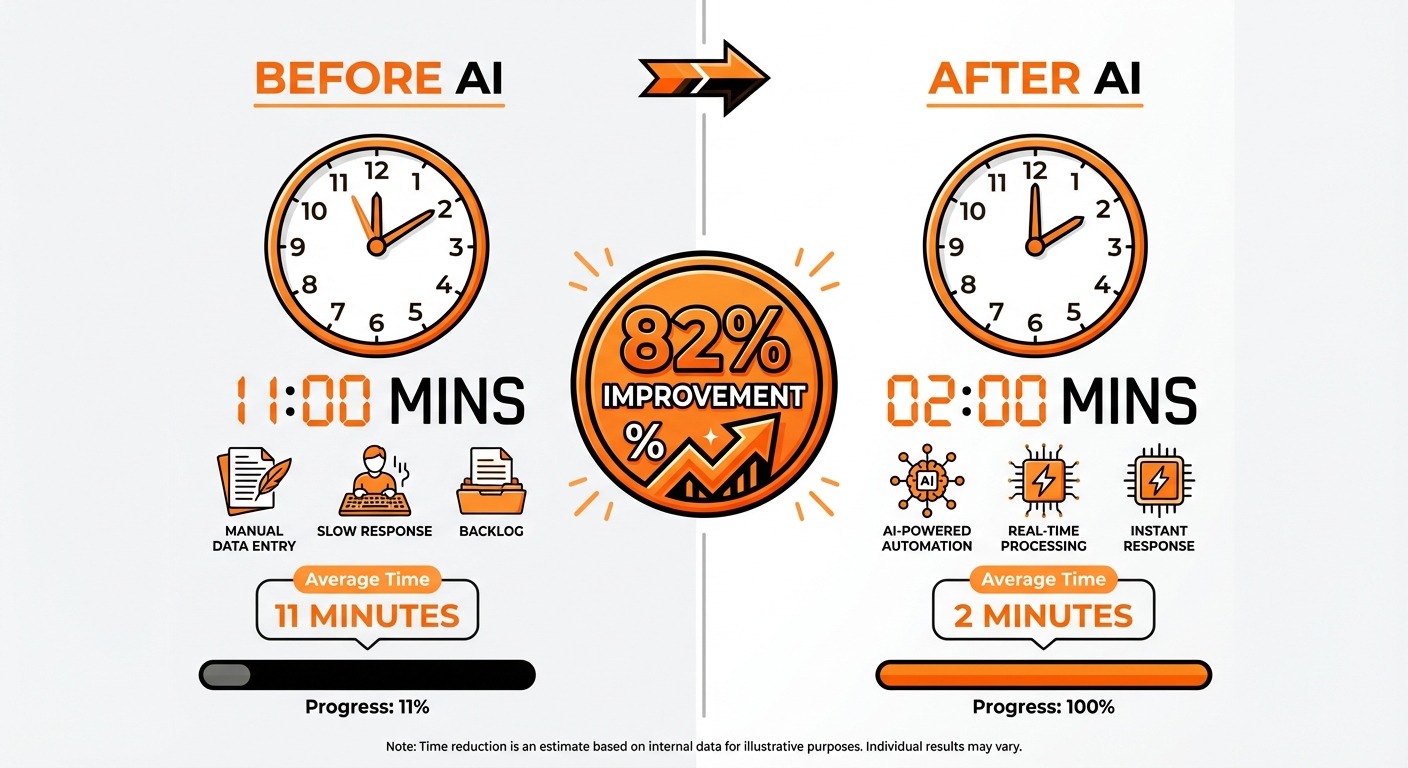
29. Klarna’s AI reduced average issue resolution time from 11 minutes to 2 minutes — an 82% improvement. Customer satisfaction scores remained comparable to human agents. (Source: Klarna)
30. H&M’s generative AI chatbot reduced response times by 70% compared to human agents. Speed improvements this dramatic reshape customer expectations across entire industries. (Source: H&M Group)
31. Service professionals using generative AI save over 2 hours daily by automating quick responses, freeing time for complex issues requiring human judgment. (Source: Salesforce)
32. 84% of customer service representatives say AI makes responding to tickets easier. Agent experience improves alongside customer experience when AI handles the repetitive workload. (Source: Zendesk)
33. AI-powered routing and prioritization reduces average handle time by 40% by ensuring tickets reach the right agent or bot on the first attempt. (Source: Five9)
34. Companies using AI for tier-1 support resolve 65% of inquiries without any human intervention. The remaining 35% are escalated to human agents with full context from the AI interaction. (Source: Intercom)
Customer Preferences and Satisfaction
What do customers actually think about AI support? The data reveals growing acceptance and clear preferences that should guide implementation strategy.
35. 51% of consumers prefer interacting with bots over humans when they want immediate service. Speed trumps human interaction for straightforward requests. (Source: Salesforce)
36. 61% of new buyers choose faster AI-produced responses over waiting for a human agent. First-time customers forming brand impressions are especially sensitive to wait times. (Source: Tidio)
37. 74% of customers prefer chatbots for simple, routine questions. Customers understand that AI handles routine inquiries efficiently and are happy to use it. (Source: PSFK)
38. 75% of customers now prefer AI chatbots for immediate service needs. This marks a significant shift from just two years ago when the majority still preferred human agents for all interactions. (Source: Dante AI)
39. 67% of consumers say traits such as creativity, empathy, and friendliness in AI agents are important. The bar for AI quality is rising — basic chatbots no longer satisfy expectations. (Source: Zendesk CX Trends)
40. 56% of customers believe bots will be able to have natural, human-like conversations by 2026. Trust in AI capabilities is growing steadily. (Source: Zendesk)
41. 70% of CX leaders believe chatbots are becoming skilled architects of highly personalized customer journeys. AI is moving beyond reactive support into proactive engagement. (Source: Zendesk CX Trends)
42. Almost 50% of customers think AI agents can be empathetic when addressing concerns. The perception of AI as cold and robotic is fading as AI quality improves. (Source: Zendesk)
AI Agent and Chatbot Performance Statistics
The capabilities gap between legacy chatbots and modern AI agents is enormous — and the data reflects it.
43. AI agents resolve complex issues at rates 3-5x higher than traditional rule-based chatbots. Large language model-powered agents understand context, intent, and nuance in ways previous generations could not. (Source: Intercom)
44. 72% of CX leaders expect AI agents to be an extension of their brand’s identity, reflecting its values and voice across all interactions. (Source: Zendesk)
45. AI chatbots now handle up to 80% of standard customer inquiries without escalation. This includes order status, account information, billing questions, and product recommendations. (Source: IBM)
46. Companies using AI agents report 45% fewer escalations to human agents compared to those using rule-based chatbots. Better first-contact resolution drives this improvement. (Source: Gartner)
47. Generative AI-powered support agents achieve 92% accuracy in understanding customer intent, compared to 65-70% for keyword-based bots. (Source: Google Cloud)
48. The average AI chatbot handles 5,000-8,000 conversations per month without human intervention. For businesses with platforms like ChatMaxima that support omnichannel deployment, this capacity spans WhatsApp, web, social media, and email simultaneously. (Source: Drift / Industry averages)
AI in Customer Service: Agent Impact
AI is not replacing support agents — it is fundamentally changing their roles and improving their work experience.
49. 83% of employees say AI’s capacity for decision-making support is a major highlight of adoption. AI helps agents make better, faster decisions. (Source: Zendesk)
50. 80% of employees say AI has already improved the quality of their work. When AI handles repetitive tasks, agents focus on complex, meaningful interactions. (Source: Zendesk)
51. Companies using AI-assisted support see 29% lower agent turnover rates. Removing mundane work improves job satisfaction and retention. (Source: Salesforce State of Service)
52. AI-powered agent assist tools reduce onboarding time for new support agents by 50%. Real-time suggestions, auto-generated responses, and knowledge base surfacing accelerate training. (Source: Freshworks)
53. Support agents using AI tools handle 35-40% more tickets per shift without an increase in errors or decrease in customer satisfaction. (Source: Zendesk)
Data Privacy and AI Trust Statistics
As AI handles more customer data, trust and transparency are becoming critical differentiators.
54. 83% of customers say they trust companies more when AI interactions are transparent about being AI-powered rather than pretending to be human. (Source: Salesforce)
55. 75% of consumers want to know when they are interacting with AI versus a human agent. Transparency builds trust; deception erodes it. (Source: PwC)
56. 62% of customers are comfortable sharing personal data with AI systems if it results in better, more personalized support experiences. (Source: Accenture)
57. Companies with clearly stated AI privacy policies see 23% higher customer trust scores compared to those without. (Source: Edelman Trust Barometer)
Key Trends Shaping AI Customer Support in 2026
Beyond the statistics, several macro trends are defining the landscape:
Autonomous AI agents are replacing legacy chatbots. The shift from rule-based decision trees to LLM-powered agents capable of understanding context, making judgment calls, and resolving complex multi-step issues is the most significant transformation since the introduction of live chat.
Omnichannel AI is becoming table stakes. Customers expect seamless AI support across WhatsApp, Instagram DMs, Facebook Messenger, email, web chat, and SMS. Platforms like ChatMaxima that unify AI across 200+ integrations are leading this shift.
AI is moving from cost center to revenue driver. Proactive AI support — recommending products, identifying upsell opportunities during support interactions, and predicting churn — transforms customer service from a cost center into a growth engine.
Human-AI collaboration is the winning model. The data consistently shows that hybrid models (AI handling routine interactions, humans handling complex ones, AI assisting humans in real-time) outperform both full-automation and human-only approaches.
Voice AI is emerging as the next frontier. With WhatsApp Business now supporting voice calling and AI-powered voice agents becoming production-ready, voice-based AI support will be a major growth area through 2026-2027. ChatMaxima already supports WhatsApp Business voice calling integration for businesses looking to get ahead.
What These Statistics Mean for Your Business
The data points to a clear conclusion: businesses that implement AI customer support effectively are seeing measurable advantages in cost reduction, response speed, customer satisfaction, and agent productivity.
However, the gap between average and top-performing AI implementations is significant — the difference between 3.5x and 8x ROI comes down to execution quality, not just adoption.
Key actions to take:
- Start with high-volume, repetitive inquiries — ticket categorization, order tracking, account questions. These deliver the fastest ROI.
- Choose platforms that support omnichannel deployment — AI that works across web, WhatsApp, Instagram, and email from a single interface. ChatMaxima’s AI Studio chatbot builder enables this without code.
- Invest in AI-human handoff quality — Seamless escalation with full conversation context is critical for complex issues.
- Track the right metrics — First response time, resolution rate, CSAT, cost per interaction, and escalation rate. These tell you whether your AI is actually working.
- Update regularly — AI models improve rapidly. Review and retrain your AI quarterly at minimum.
The statistics are clear: AI customer support is not a future trend. It is the present reality that is delivering results right now. The question is not whether to adopt it, but how well you implement it.
Explore ChatMaxima’s AI-powered customer support platform to see how these statistics can become your business outcomes.