
Chatbot Customer Service That Improves 7 Support KPIs
Move from ticket volume firefighting to measurable support performance. ChatMaxima helps teams cut first response time, improve SLA hit-rate, and raise CSAT with a bot plus human handoff system that agents actually adopt.

Track the Metrics That Actually Move Support Performance
Most chatbot pages talk about automation volume. This framework focuses on the 7 service outcomes your support leaders already report every week. Each KPI connects directly to customer experience, team efficiency, and contract compliance.
Step 1 - First Response Time (FRT)
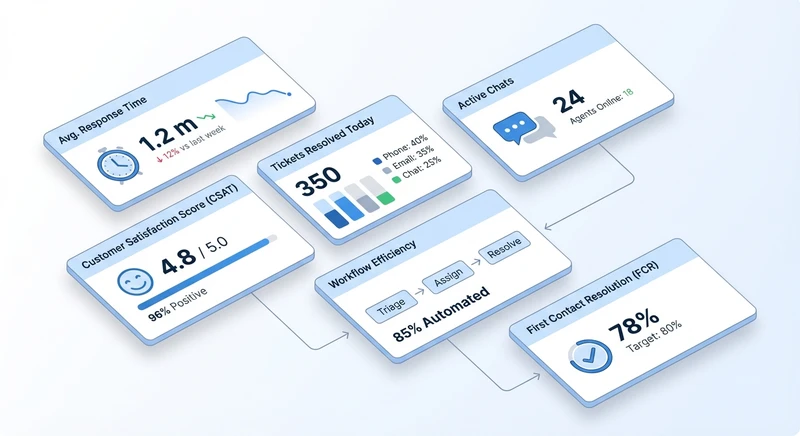
Sets customer confidence in the first minute. ChatMaxima sends instant AI acknowledgment and intent capture across web chat, WhatsApp, and social channels.
Step 2 - Average Handle Time (AHT)
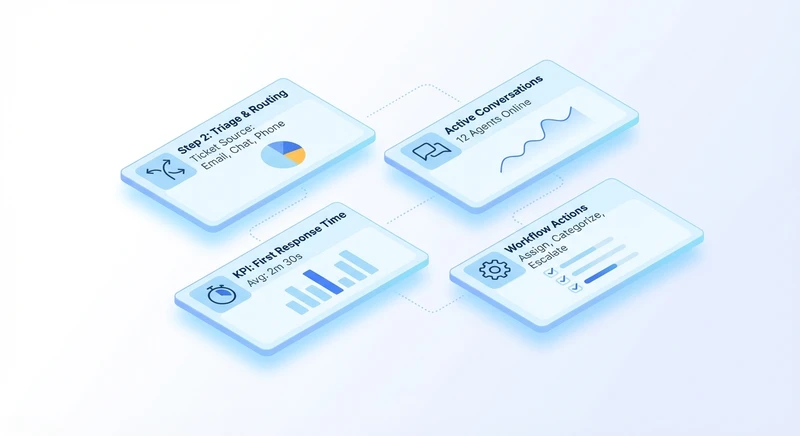
Controls queue pressure and staffing load. Agents get conversation summaries and suggested actions inside the team inbox.
Step 3 - Resolution Time
Reflects full issue lifecycle speed. Bots resolve repeat intents early and route edge cases with complete context.
Step 4 - Deflection %
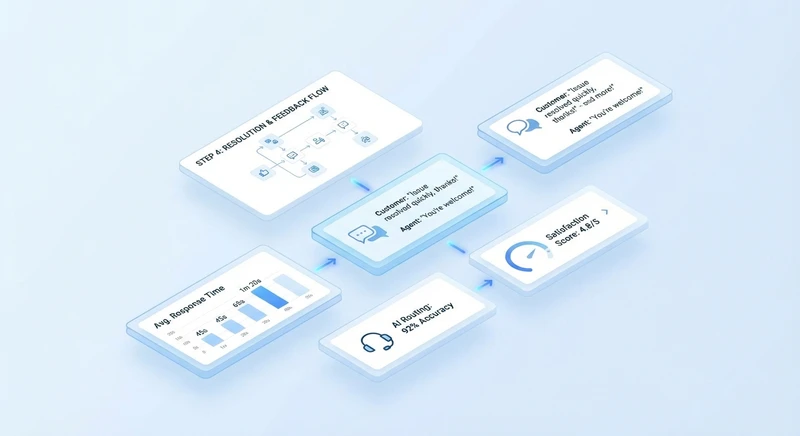
Measures avoidable ticket volume removed from queues. Knowledge-led AI handles high-frequency intents before agent handoff.
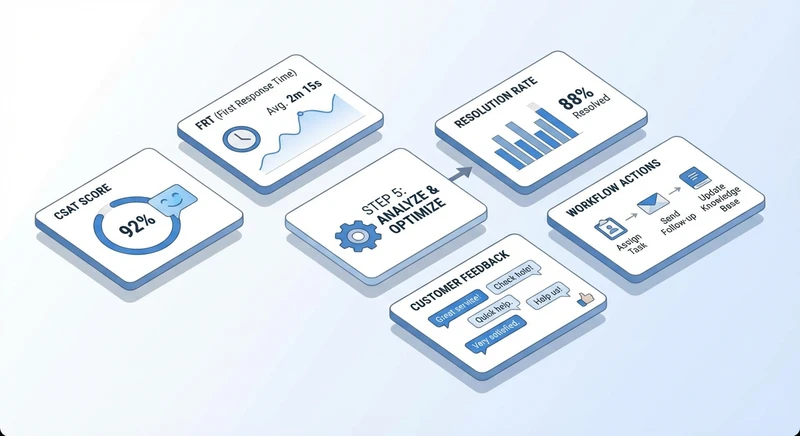
Step 5 - CSAT
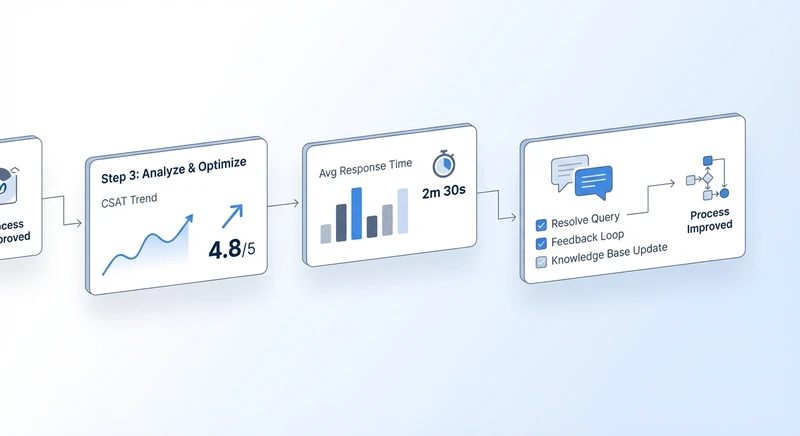
Captures customer experience quality. Faster first replies plus clean handoff workflows protect experience during peak load.
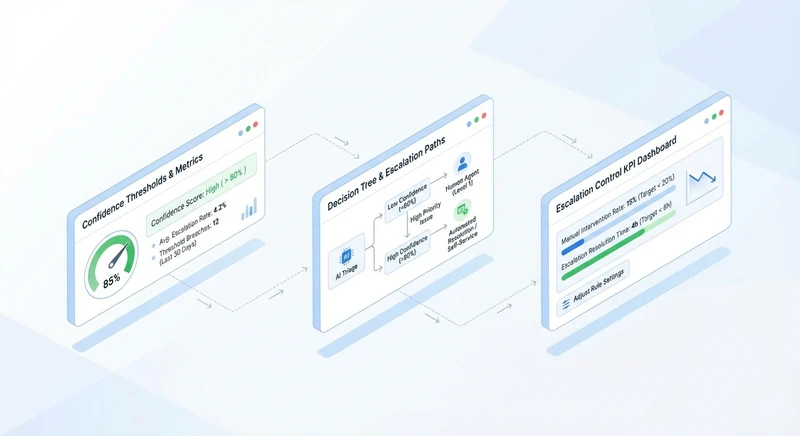
Step 6 - Escalation %
Shows whether bot boundaries are tuned correctly. Intent-level confidence thresholds prevent unnecessary escalation.
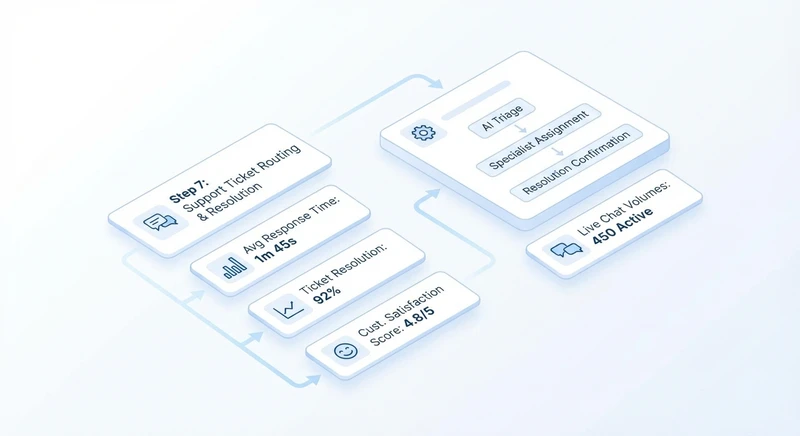
Step 7 - SLA Hit-rate
Directly impacts renewals and compliance. Priority routing plus AI triage reduces breach risk during high-volume windows.
What a 90 Day Support Transformation Looks Like
Real numbers from teams that moved from reactive ticket handling to structured KPI-driven support operations. These benchmarks reflect a mid-market SaaS support team running ChatMaxima across web chat and WhatsApp.
Baseline
FRT: 12m 40s
CSAT: 3.8 / 5
SLA: 71%
Triage Stabilized
FRT: 3m 20s
Deflection: 22%
Escalation: 36%
Handoff Optimized
AHT: 6m 10s
Resolution: 12h
CSAT: 4.3 / 5
Performance Engine
FRT: 38s
Deflection: 41%
CSAT: 4.6 / 5
SLA: 94%
Speed Gains
FRT: 12m 40s → 38s
AHT: 8m 10s → 5m 30s
Quality Gains
CSAT: 3.8/5 → 4.6/5
Escalation: 46% → 23%
Reliability Gains
SLA hit-rate: 71% → 94%
Resolution: 31h → 7h 20m
Design a Handoff Workflow Agents Trust
The gap between bot and human is where most customer experience breaks down. A clean handoff workflow gives agents the context they need to resolve issues on the first touch, without asking the customer to repeat themselves.
AI triage and intent classification
The bot identifies urgency, customer tier, and issue type in seconds.
Resolve known intents immediately
Order status, policy, and account FAQs are resolved through guided steps from chatbot builder knowledge flows.
Escalate edge cases with context
The handoff packet includes transcript summary, sentiment, and required fields for agent action.
Assist agent in real time
AI suggestions reduce handling time while preserving human judgment for complex issues.
How to Get Real Adoption in 12 Weeks
Deploying AI is the easy part. Getting support agents to actually trust and use it takes a phased rollout with clear guardrails, coaching loops, and measurable checkpoints every week.
Baseline and Guardrails
Capture baseline KPI values and enable automation only for low-risk intents. Define what must always escalate to humans.
Controlled Rollout
Add intents in batches, run daily escalation reviews, and align bot behavior to actual QA outcomes.
Coaching Loop
Build reply macros from top performing agent interactions and tune bot prompts weekly.
KPI Operating Rhythm
Run weekly KPI reviews with team leads. Use template packs for fast expansion into adjacent intents.
Build a Support Performance Engine with ChatMaxima
If your team is measured on service outcomes, start with KPI discipline, clear handoff rules, and agent adoption workflows. ChatMaxima gives you the foundation to do that at scale.
Start with ChatMaxima Read Support Ops GuidesFrequently Asked Questions
Common questions from support operations teams evaluating chatbot-assisted customer service with a KPI-first approach.
Start with a weekly baseline for FRT, AHT, Resolution Time, Deflection, CSAT, Escalation, and SLA hit-rate. Lock KPI definitions for the first 30 days, then review trends weekly with one owner from support operations and one owner from team leads.
Yes. Resolve only high-confidence intents with the bot and escalate exceptions quickly with full context. Deflection hurts CSAT only when teams force automation into complex or sensitive queries.
Include customer goal, attempted steps, sentiment, priority, and structured fields like order ID or account ID. This removes repeated questions, cuts AHT, and improves first-contact resolution.
Most teams show early adoption in 2 to 3 weeks when workflows are simple and QA feedback is consistent. Strong adoption typically stabilizes in one quarter with coaching and measurable scorecards.
Use intent-based confidence thresholds, not one global threshold. For example, password reset can run at higher automation confidence than billing disputes or cancellations.
Yes. Keep one KPI framework and one escalation policy across website chat, WhatsApp, Instagram, and Facebook Messenger. Channel differences matter less when routing and handoff standards are centralized.
Support operations should own KPI definitions, reporting cadence, and quality standards. Team leads should own execution, coaching, and corrective action when trends move in the wrong direction.
Phase 1: baseline and intent mapping. Phase 2: bot plus handoff launch for top 10 intents. Phase 3: threshold tuning and agent coaching. Phase 4: KPI review and expansion to additional channels.