Government agencies around the world are racing to deploy AI chatbots that can handle everything from tax inquiries to healthcare navigation, and the results are reshaping how citizens interact with public institutions. What started as simple FAQ bots on government websites has evolved into sophisticated, multilingual conversational AI systems capable of processing complex requests across dozens of languages, operating on feature phones in rural India, and reducing bureaucratic processing times from weeks to minutes in the Middle East. In 2026, the question is no longer whether governments should adopt AI chatbots, but how quickly they can scale what already works.
This global analysis examines the most significant government AI chatbot initiatives across four regions: India, North America, Europe, and the Middle East. Each region brings a distinct approach shaped by its unique challenges, from India’s need for multilingual access across 22 official languages to the UAE’s ambition for zero-bureaucracy citizen interactions. For businesses building or selling chatbot solutions, understanding these government-driven trends is critical because public sector adoption sets the standard for compliance, accessibility, and scale that private sector buyers increasingly expect.
The Global Shift Toward AI-Powered Government Services
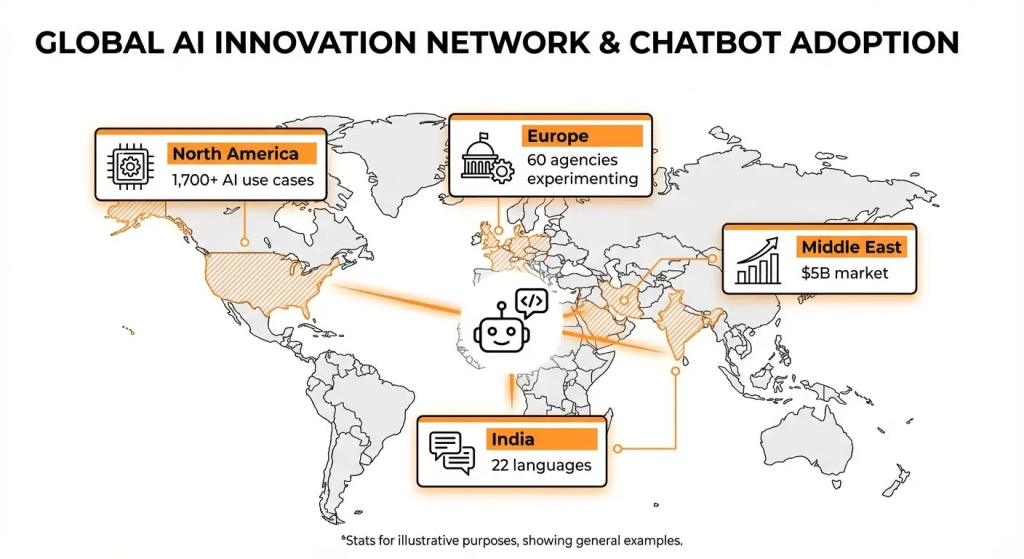
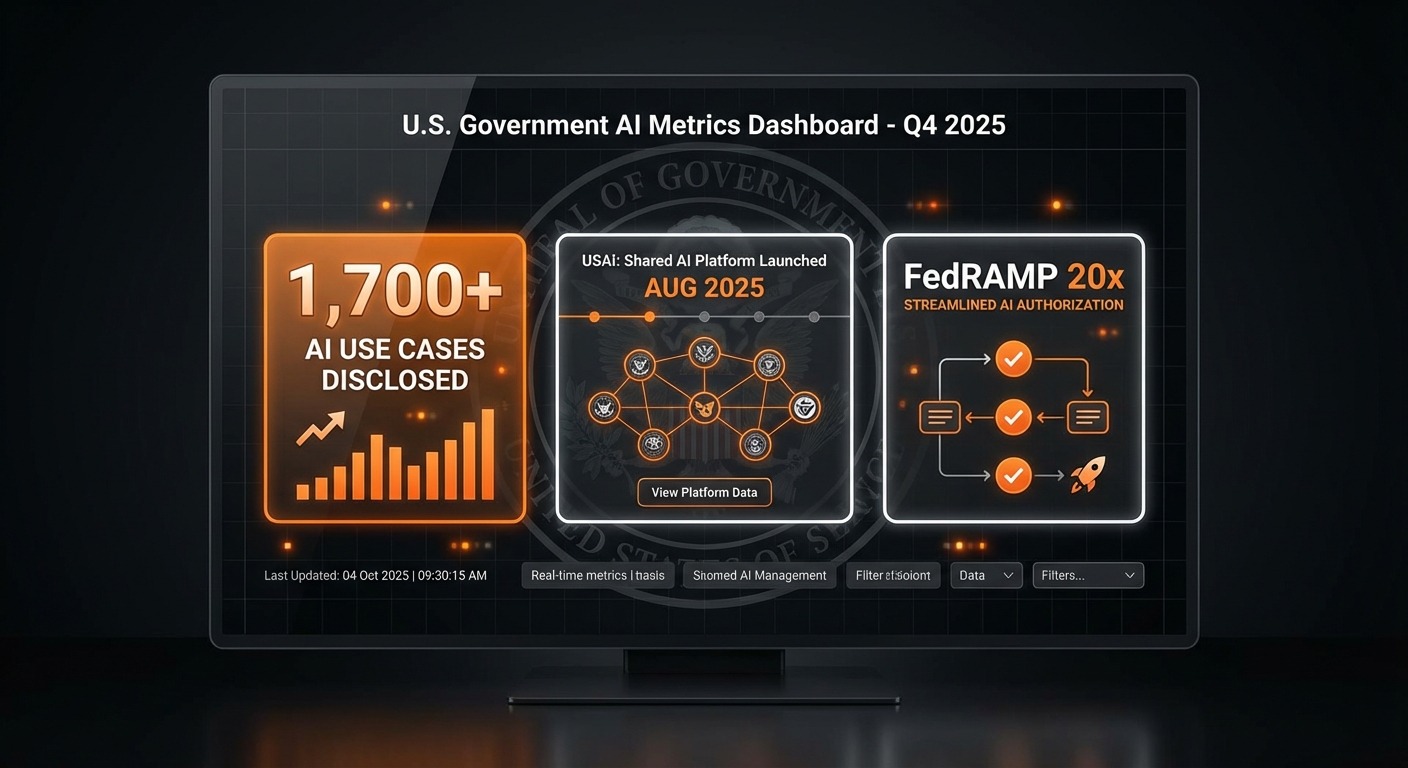
The scale of government AI adoption in 2026 is staggering. The U.S. federal government alone disclosed over 1,700 AI use cases by the end of 2024, with agencies more than doubling their previous count. Estonia has approximately 60 public administrations experimenting with AI. The Middle East and Africa conversational AI market is soaring, with the AI customer service segment valued at USD 5 billion. These numbers reflect a fundamental shift: governments are no longer piloting AI chatbots in isolated departments but deploying them as core infrastructure for citizen engagement.
What is driving this acceleration? Three forces converge in 2026. First, citizen expectations have permanently shifted after years of interacting with commercial AI assistants. People now expect government services to offer the same conversational, instant access they get from their bank or favorite retailer. Second, the cost equation has flipped: maintaining large call centers and physical service offices is now more expensive than deploying AI-powered alternatives that handle routine inquiries around the clock. Third, the rise of sovereign AI initiatives, particularly in India and the Middle East, means governments can build and control their own AI models rather than depending entirely on foreign technology providers.
India: The Sovereign AI Revolution Reaching Every Citizen
India’s approach to government AI chatbots is arguably the most ambitious on the planet, and it centers on a concept called sovereign AI. Rather than relying on models built by OpenAI, Google, or Anthropic, the Government of India under its IndiaAI Mission selected Sarvam AI in April 2025 to build an indigenous Large Language Model from scratch. Sarvam receives dedicated compute resources from the government, and the results have been remarkable: at the India AI Impact Summit on February 19, 2026, Sarvam launched a 105-billion parameter model that outperforms ChatGPT and Gemini on India-specific benchmarks, despite being 667 times smaller and built with only $41 million in funding.
Why does sovereign AI matter for government chatbots? Because India has 22 official languages and over a billion citizens who need access to government services, many of them through voice on basic feature phones rather than text on smartphones. Sarvam’s models are designed specifically for this reality: they support all 22 Indian languages, are optimized for voice interaction, and can run on edge devices that require only megabytes of storage and work offline. Through a partnership with HMD (formerly Nokia), Sarvam has enabled a conversational AI assistant on feature phones where users simply press a dedicated AI button to get guidance on government schemes in their local language. This is not a chatbot for the tech-savvy; it is a chatbot for the farmer in rural Maharashtra who needs to know if she qualifies for a crop insurance subsidy.
The implications extend far beyond phone calls. Sarvam’s partnership with Qualcomm created the “Sovereign AI Experience Suite” that runs across phones, PCs, laptops, cars, and IoT devices. Edge AI models that take only megabytes and run on existing processors mean government chatbot access does not require internet connectivity, solving one of the biggest barriers to digital government in developing nations. Alongside Sarvam, other Indian AI companies like Gnani AI and BharatGen (also launched at the same summit) are building the ecosystem that will power India’s next generation of government chatbot solutions.
India’s IT Minister Ashwini Vaishnaw captured the ambition clearly: “We are confident Sarvam’s models will be competitive with global models.” (TechCrunch, Bloomberg, Sarvam AI) For businesses serving the Indian public sector, this means the technology stack is shifting rapidly toward indigenous models, and chatbot platforms that can integrate with these sovereign AI systems will have a significant competitive advantage.
North America: Federal Innovation Meets State-Level Experimentation
The United States federal government’s approach to AI chatbots in 2026 is characterized by a dual dynamic: centralized platforms that reduce barriers for agencies, and decentralized experimentation at the state level that produces some of the most innovative citizen-facing applications.
Federal Government Initiatives
At the federal level, several landmark developments define the current landscape. The FDA launched “Elsa” in 2025, a commercial LLM designed to increase employee productivity and speed up internal workflows. While Elsa is not citizen-facing, it represents a critical trend: government agencies using AI chatbots internally before deploying them externally, building institutional comfort with the technology. The General Services Administration (GSA) has been testing chatbots for answering common inquiries about federal programs and providing drafting assistance to staff, signaling that even administrative backbone agencies see conversational AI as essential infrastructure.
The most significant federal development is USAi, launched in August 2025 as the government’s first shared platform for experimenting with AI models at no up-front cost for agencies. USAi removes the procurement barrier that previously kept smaller agencies from accessing AI tools, effectively democratizing chatbot experimentation across the federal government. Combined with FedRAMP 20x, launched in 2025 to streamline authorization for AI cloud providers, and the Trump Administration’s AI Action Plan from July 2025 aimed at accelerating AI innovation and building American AI infrastructure, the regulatory and technical foundation for widespread government chatbot deployment is firmly in place. (GSA.gov, FedScoop)
So, how are government agencies actually using AI chatbots at the federal level in 2026? The pattern is consistent: agencies start with internal productivity tools (drafting, summarization, knowledge retrieval), then expand to citizen-facing applications once they have validated accuracy and compliance. With states now mandated to disclose AI usage by 2026, transparency is becoming a built-in feature rather than an afterthought.
State and Local Government
The real innovation in North American government chatbots is happening at the state and local level. California is deploying AI-driven tax and benefits assistant tools that help residents navigate complex eligibility requirements through natural conversation rather than intimidating paper forms. StateTech Magazine reported in February 2026 that state and local agencies are increasingly using agentic AI, systems that do not just answer questions but actively automate workflows and complete tasks on behalf of citizens and government employees.
This shift toward agentic AI in government mirrors what is happening in the private sector, and it creates opportunities for chatbot platforms that support omnichannel deployment. Citizens expect to start a conversation on a website, continue it via SMS, and receive follow-up through email, all without repeating themselves. Brookings Institution research from August 2025 highlights that states across the country are legislating on AI with diverging approaches, creating a patchwork of requirements that any chatbot vendor serving the public sector must navigate carefully.
Europe: Conversational Government Goes Mainstream
Europe’s government chatbot landscape in 2026 is defined by two standout initiatives that represent fundamentally different but equally compelling approaches: the UK’s GOV.UK chatbot and Estonia’s Burokratt project.
UK Government Digital Service: GOV.UK Enters the Chat
The UK Government Digital Service (GDS) published a vision blog post in December 2025 titled “GOV.UK has entered the Chat,” announcing plans to add an AI chatbot to the GOV.UK app and website by early 2026. The Register confirmed in December 2025 that the rollout would begin with the GOV.UK app before expanding across the entire GOV.UK web presence. This is significant because GOV.UK is one of the most visited government websites in the world, serving as the single digital front door for virtually all UK government services.
The UK AI Opportunities Action Plan, updated in January 2026 with a “One Year On” progress report, provides clear strategic direction for Britain’s AI development. The Tony Blair Institute published analysis in January 2026 arguing that the UK needs a comprehensive reform agenda harnessing AI for personalized, preventative public services. Practical applications are already underway: the UK is working with the DVLA to use AI to reduce waiting times and backlogs for driver licensing, and the NHS is exploring AI applications in healthcare informed by Health Foundation research.
What makes the UK approach notable is its ambition for conversational government at scale. Rather than deploying chatbots in individual departments, GDS is building a unified conversational layer across all of government. For businesses that provide customer support automation, the UK model demonstrates how a single chatbot platform can serve as the front end for hundreds of different services and departments.
Estonia: Burokratt and Open-Source Government AI
Estonia continues to lead in digital government innovation with Burokratt, a unified chatbot system designed to work across all public services. What makes Burokratt unique is its open-source approach: the entire system is publicly available, allowing other governments to adopt, modify, and deploy it. With approximately 60 public administrations experimenting with AI, Estonia is proving that even small countries can punch far above their weight in government technology when they commit to interoperability and openness.
The EU AI Act is adding another dimension to European government chatbot deployment by driving governance frameworks that mandate transparency, fairness, and accountability in AI systems. For chatbot vendors, this means that solutions deployed in European government contexts must include audit trails, explainability features, and bias monitoring, capabilities that are increasingly becoming table stakes globally.
[IMAGE: 3D isometric illustration of a stylized European cityscape with the UK Parliament and a modern Estonian building connected by flowing data streams to citizen smartphone screens showing chatbot conversations. Clean lines, orange and teal accent colors on white background. Labels show “GOV.UK Chatbot” and “Burokratt Open Source”. Modern, architectural feel. NO purple, NO violet.]
Middle East: From Pilot Projects to Zero-Bureaucracy Ambitions
The UAE and Saudi Arabia have moved decisively from AI pilots to full-scale deployment, with an explicit goal that would have seemed fantastical five years ago: zero-bureaucracy citizen interactions. In 2026, both nations are transitioning to agentic, background-level government services where AI does not just answer questions but proactively completes tasks, anticipates needs, and processes requests that previously required in-person visits and stacks of paperwork.
The technology backbone for this transformation includes ALLAM, an advanced Arabic language AI model purpose-built for government chatbots. ALLAM addresses a critical gap that global AI models have historically struggled with: fluent, culturally appropriate Arabic language processing across the diverse dialects spoken from Morocco to Oman. Government chatbots powered by ALLAM deliver 24/7 instant service, and the impact on processing times has been dramatic, reducing what previously took weeks to just minutes.
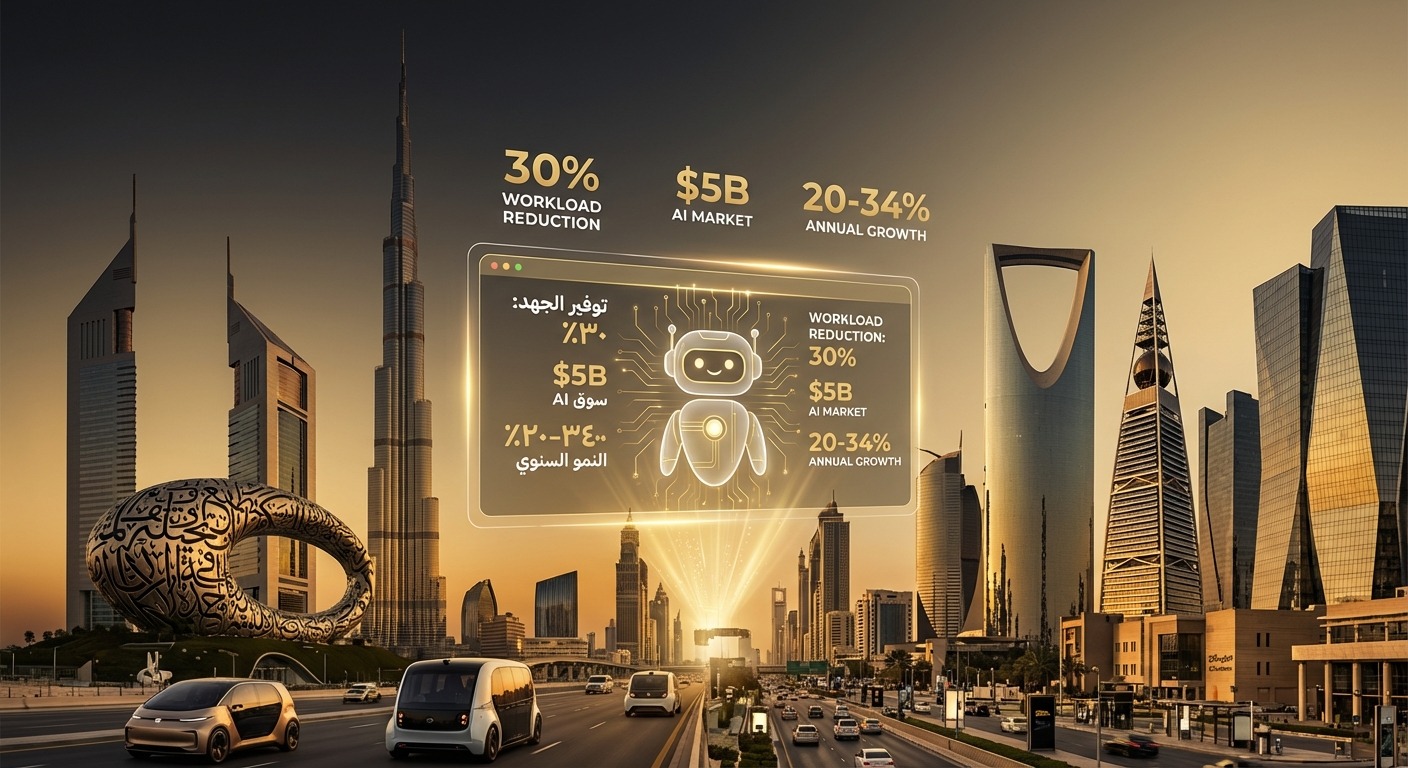
The business case is compelling. PwC reports that AI’s economic contribution is growing 20 to 34 percent per year across the region, with the fastest growth in the UAE followed by Saudi Arabia. Over 30 percent reduction in manual government workload has been achieved by 2026 through AI automation. Deloitte’s 2026 predictions highlight three converging trends transforming Saudi Arabia and UAE: agentic AI (systems that act autonomously), physical AI (robotics and IoT integration), and sovereign AI (domestically controlled models). Both countries now rank among the world’s top nations for public AI adoption, and the Middle East AI customer service market is valued at USD 5 billion.
For businesses evaluating the Middle East market, the opportunity is substantial. The conversational AI market across the Middle East and Africa is soaring according to UnivDatos research from February 2026. Government agencies in these countries are not just buying chatbot technology; they are investing in complete AI-powered platforms that integrate with national identity systems, payment infrastructure, and multilingual service delivery. Companies that can offer integration capabilities with regional systems and Arabic language fluency will find strong demand.
What Government AI Chatbot Adoption Means for Businesses
The patterns emerging from government AI chatbot deployments in 2026 carry direct implications for every business that builds, sells, or uses conversational AI technology.
Multilingual and Voice-First Are No Longer Optional
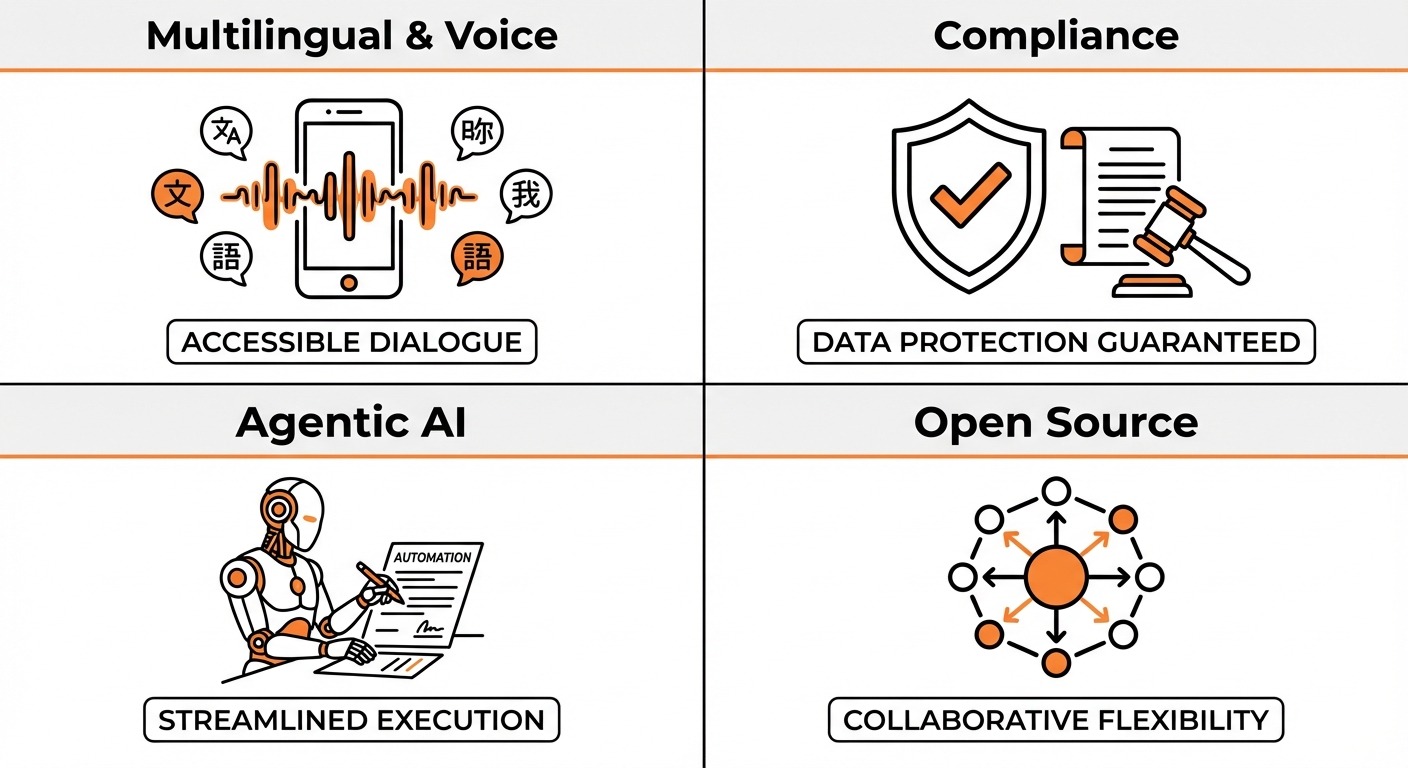
India’s sovereign AI movement makes it clear: the future of chatbots is multilingual and voice-first. Sarvam’s models supporting 22 languages and running on feature phones set a new baseline. If a government chatbot in India can handle voice queries in Kannada on a basic Nokia phone without internet, commercial chatbots will face the same expectations from enterprise buyers serving diverse populations. Businesses deploying chatbots for customer engagement need to prioritize multilingual support and voice capabilities now, not as a future roadmap item.
Compliance and Transparency Are Built-In Requirements
The EU AI Act, U.S. state-level AI disclosure mandates, and FedRAMP authorization requirements are creating a global compliance baseline. Government chatbot vendors must provide audit trails, bias monitoring, and transparent AI decision-making. These requirements will cascade into the private sector as enterprise buyers adopt government-grade compliance standards for their own chatbot deployments. Any platform that treats compliance as an afterthought will struggle in regulated industries.
Agentic AI Changes the Value Proposition
The Middle East’s push toward zero-bureaucracy and North America’s state-level experimentation with agentic AI signal a shift from chatbots that answer questions to systems that complete tasks. Government agencies want chatbots that can check eligibility, submit applications, schedule appointments, and process payments, all within a single conversation. This agentic capability is what distinguishes a modern AI chatbot platform from a simple Q&A tool, and it is rapidly becoming the expectation rather than the exception.
Open Source and Interoperability Drive Adoption
Estonia’s Burokratt project demonstrates that open-source, interoperable chatbot systems can gain adoption faster than proprietary alternatives in government contexts. Organizations evaluating chatbot platforms should prioritize solutions that offer API-first architecture, CRM integrations, and the flexibility to connect with existing government infrastructure. Platforms like ChatMaxima that provide extensive integration capabilities with tools like Salesforce, HubSpot, and custom APIs are better positioned for government and enterprise deployments.
How ChatMaxima Supports Government and Enterprise Chatbot Deployments
The trends driving government AI chatbot adoption, multilingual support, omnichannel deployment, workflow automation, and CRM integration, are exactly the capabilities that ChatMaxima delivers for businesses of all sizes. Whether you are a government contractor building citizen-facing solutions or an enterprise inspired by public sector innovation, ChatMaxima provides the foundation you need.
ChatMaxima’s omnichannel team inbox centralizes conversations from WhatsApp, Facebook Messenger, Instagram, Telegram, email, and web chat into a single interface, mirroring the unified service delivery model that governments worldwide are adopting. The platform’s AI Studio chatbot builder enables visual, no-code creation of conversational workflows that can handle complex multi-step processes, from eligibility checks to appointment scheduling, without requiring engineering resources.
For organizations that need to integrate chatbot interactions with existing systems, ChatMaxima offers native connections to HubSpot, Salesforce, Google Sheets, and over 200 other tools through Zapier. The platform’s reporting and analytics capabilities provide the transparency and audit trails that government-influenced compliance standards increasingly demand.
Government agencies are proving that AI chatbots work at scale, across languages, channels, and complex service domains. The technology is mature, the citizen demand is real, and the business opportunity for companies that can deliver these solutions is enormous. Explore how ChatMaxima can help you build the next generation of conversational AI experiences by visiting our pricing page or scheduling a demo.