“What if the AI makes mistakes?”
It’s the first objection most business owners raise when considering chatbot automation. And honestly, it’s a fair concern. No one wants to deploy a system that sends wrong information to customers or damages hard-earned relationships.
But here’s a better question: what if your overwhelmed team is already making more mistakes than any AI ever would?
Last month, a business owner shared his hesitation about implementing AI for customer inquiries. His concern was straightforward: “AI might give wrong information to my customers.” Rather than dismissing his worry, I asked him three simple questions. His answers changed his perspective entirely.
The Three Questions That Change Everything
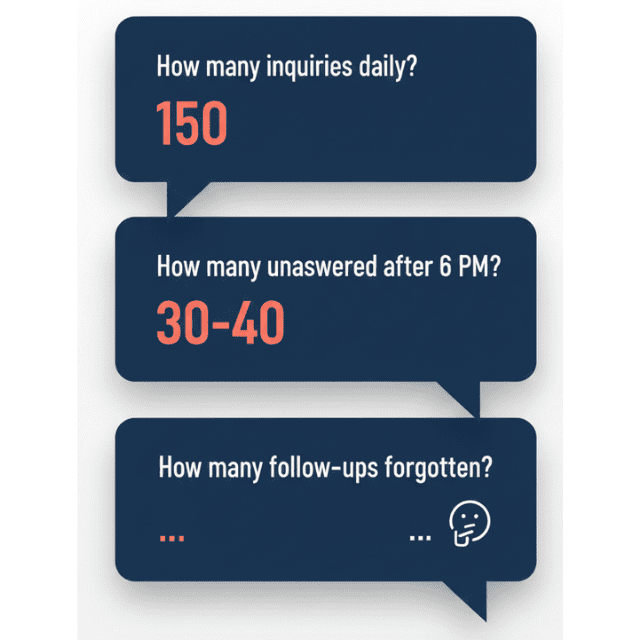
Question 1: How many inquiries does your team handle daily?
“Around 150,” he said.
Question 2: How many go unanswered after 6 PM?
“Maybe 30-40… we catch up the next morning.”
Question 3: How many follow-ups get forgotten when things get busy?
Long pause. “More than I’d like to admit.”
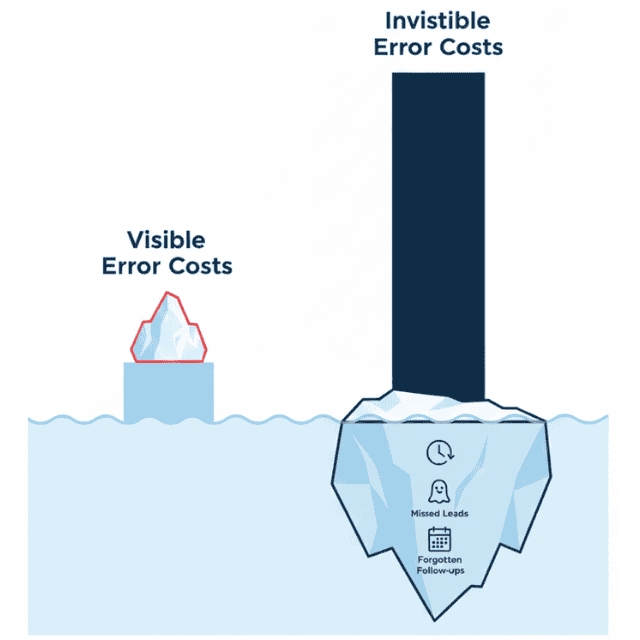
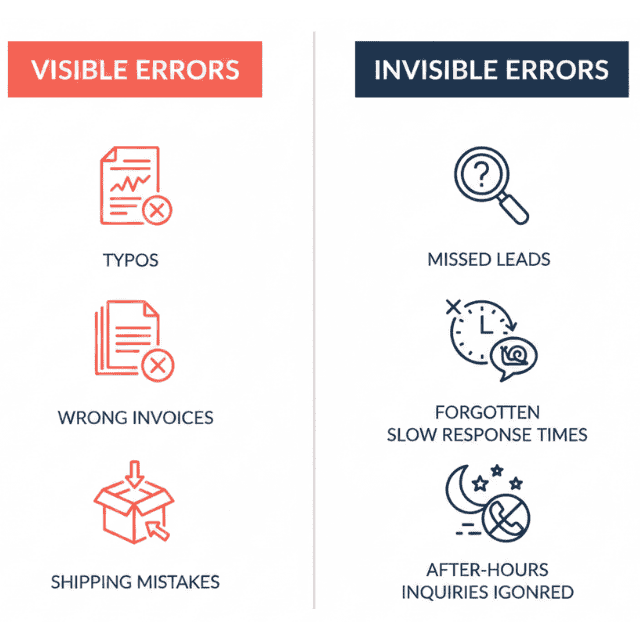
This conversation revealed something important. His team wasn’t making “mistakes” in the traditional sense. They weren’t quoting wrong prices or giving incorrect product information. They were making invisible mistakes, the kind that never show up in error reports but quietly drain revenue every single day.
The Invisible Mistakes Nobody Tracks
When we think about errors, we picture obvious failures: a typo in an email, a wrong figure in a quote, an incorrect shipping address. These mistakes are visible, trackable, and fixable.
But the most expensive mistakes in customer service are the ones nobody notices because they happen in the gaps.
The lead who waited four hours and went to a competitor. They found your website at 11 AM, sent an inquiry, and heard nothing until 3 PM. By then, they’d already spoken to two other companies and made their decision. You never knew you lost them because they never complained. They simply disappeared.
The customer who asked a question at 10 PM and never heard back. They were ready to buy that night. By morning, the impulse had passed. Or worse, they found someone who did respond at 10 PM.
The follow-up that slipped through because Monday was chaos. Your sales rep meant to call back that interested prospect. But the weekend brought 47 new inquiries, and by Tuesday, that hot lead had gone cold. No one flagged it as an error because no one remembered it was supposed to happen.
The wrong price quoted because the spreadsheet wasn’t updated. The product price changed last week, but the sales team is still working from an outdated sheet. Three customers got quoted the old price. Now you’re either honouring a margin-killing discount or having an awkward conversation that damages trust.
These aren’t the kinds of errors that trigger incident reports. But collectively, they cost more than any chatbot hallucination ever would.
The Comparison Problem: AI vs Perfection
Here’s where most businesses get the evaluation wrong. When considering AI automation, they compare the chatbot’s potential mistakes against a theoretical perfect human response.
“What if the AI gives wrong information?” assumes that humans always give correct information.
“What if the AI sounds robotic?” assumes that humans always sound warm and engaged.
“What if the AI frustrates customers?” assumes that humans never frustrate customers.
This isn’t a fair comparison. It’s comparing AI’s reality against an idealised version of human performance that doesn’t exist in practice.
The honest comparison isn’t AI vs perfection. It’s AI vs reality.
And reality looks like this: a team of people handling 150 conversations daily while simultaneously managing phone calls, updating CRM records, attending meetings, responding to emails, dealing with internal requests, and trying to remember which prospects need follow-ups. They’re doing their best, but they’re human. Things slip. Mistakes happen. And most of those mistakes never get counted because they’re invisible.
What a Well-Trained AI Actually Delivers
When you implement a properly configured AI chatbot, you’re not getting a perfect system. You’re getting a consistently reliable one. The difference matters.
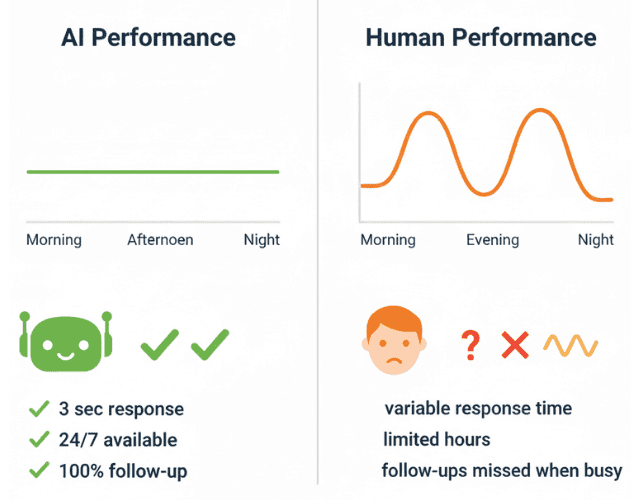
Response time: 3 seconds, not 3 hours. The AI doesn’t need to finish another conversation first. It doesn’t need to look up information. It doesn’t need a coffee break. Every inquiry gets immediate attention, regardless of volume or timing.
Follow-up reliability: 100%. If the system is configured to follow up with leads after 24 hours, it follows up after 24 hours. Not 24 hours unless Monday is busy. Not 24 hours unless someone forgot. Every single time.
Emotional consistency: no bad days. The AI provides the same patient, helpful response to the 150th inquiry of the day as it did to the first. It doesn’t get tired. It doesn’t get frustrated. It doesn’t snap at the customer who asks the same question for the tenth time.
Knowledge accuracy: always current. When you update product information in the system, every conversation from that moment forward reflects the new data. No outdated spreadsheets. No “I think the price is…” uncertainty.
Availability: genuine 24/7. Not 24/7 with a caveat. Not 24/7 but slower after hours. Actual round-the-clock responsiveness at the same quality level.
Does AI Make Mistakes? Yes. Here’s Why It Still Wins.
Let’s address the elephant in the room directly. AI chatbots can and do make mistakes. They might occasionally misunderstand a query. They might provide a response that doesn’t quite fit the context. In rare cases, they might even generate incorrect information.
These mistakes are real, and dismissing them would be dishonest.
But here’s the critical calculation most businesses miss: the error rate of a well-trained AI is typically far lower than the effective error rate of an overwhelmed human team, especially when you count the invisible mistakes.
Consider this scenario. Your AI chatbot has a 2% error rate, meaning 2 out of every 100 conversations include some kind of mistake. That sounds concerning until you calculate your team’s invisible error rate.
Out of 150 daily inquiries, your team misses 35 after-hours messages (23%), forgets 10 follow-ups during busy periods (7%), and provides slightly outdated information on 5 conversations because the spreadsheet wasn’t current (3%). That’s a combined invisible error rate of 33%, and none of these show up in any quality report.
The AI’s visible 2% error rate is easier to spot, easier to track, and easier to fix. The team’s 33% invisible error rate silently compounds, costing you leads, sales, and customer relationships without anyone noticing.
The Real Question You Should Be Asking
The question was never “Is AI perfect?” No technology is perfect, and anyone selling you perfection is being dishonest.
The right question is: “Is AI better than the chaos we’re running today?”
For most businesses handling significant inquiry volumes with limited staff, the answer is yes. And it’s not even close.
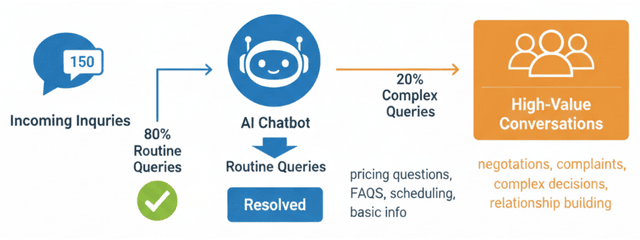
This doesn’t mean AI replaces your team. It means AI handles the predictable, repetitive, high-volume work that currently overwhelms your team. Your people then focus on the complex, nuanced, relationship-building work that genuinely requires human judgment and empathy.
The result isn’t a choice between AI mistakes and human excellence. It’s a choice between AI handling routine inquiries reliably while humans focus on high-value conversations, or humans trying to do everything and inevitably dropping balls.
How to Minimise AI Mistakes (Yes, It’s Possible)
If you’re moving forward with AI automation, you can dramatically reduce error rates through proper implementation. These aren’t theoretical suggestions; they’re practical steps that make measurable differences.
Train on your actual data. Generic chatbots make generic mistakes. An AI trained specifically on your products, services, pricing, and common customer questions performs far better than an off-the-shelf solution. Upload your FAQ documents, product catalogues, and past conversation logs to build a system that understands your business.
Set clear boundaries. Configure your AI to recognise when a query is outside its confident knowledge zone. Rather than guessing, it should smoothly hand off to a human agent. “Let me connect you with someone who can help with that specific question” is always better than a wrong answer.
Update information proactively. AI accuracy depends on current data. When prices change, when products update, when policies shift, update the AI’s knowledge base immediately. Unlike humans who might miss the memo, the AI will use the new information in every subsequent conversation.
Monitor and refine continuously. Review conversation logs weekly. Identify patterns where the AI struggles. Refine responses and add training data based on real interactions. The AI improves over time if you invest in ongoing optimisation.
Be transparent with customers. Let customers know they’re talking to an AI assistant that can hand off to humans for complex issues. Most customers appreciate the honesty and the instant response. Many prefer it.
The Cost of Inaction
Here’s the uncomfortable truth that wraps this all together. While you’re debating whether AI might make mistakes, your competitors are implementing automation that captures leads at 2 AM, follows up with perfect consistency, and never forgets a conversation.
Every day you wait is another day of invisible mistakes compounding. Another 35 after-hours inquiries going unanswered. Another 10 follow-ups slipping through the cracks. Another handful of customers getting outdated information.
The fear of AI mistakes is understandable. But the cost of human limitations, when you honestly account for the invisible errors, is almost always higher.
The Bottom Line
You’re not choosing between a flawed AI and a flawless team. You’re choosing between visible, trackable, improvable AI errors and invisible, untracked, compounding human gaps.
A well-trained AI doesn’t need to be perfect. It needs to be better than the chaos. For most businesses, that bar is surprisingly easy to clear.
The question isn’t whether AI makes mistakes. The question is whether you’re ready to stop making the invisible ones.
Ready to see how AI automation can reduce both visible and invisible errors in your customer conversations? Start your free trial or book a demo to experience ChatMaxima’s intelligent automation firsthand.