
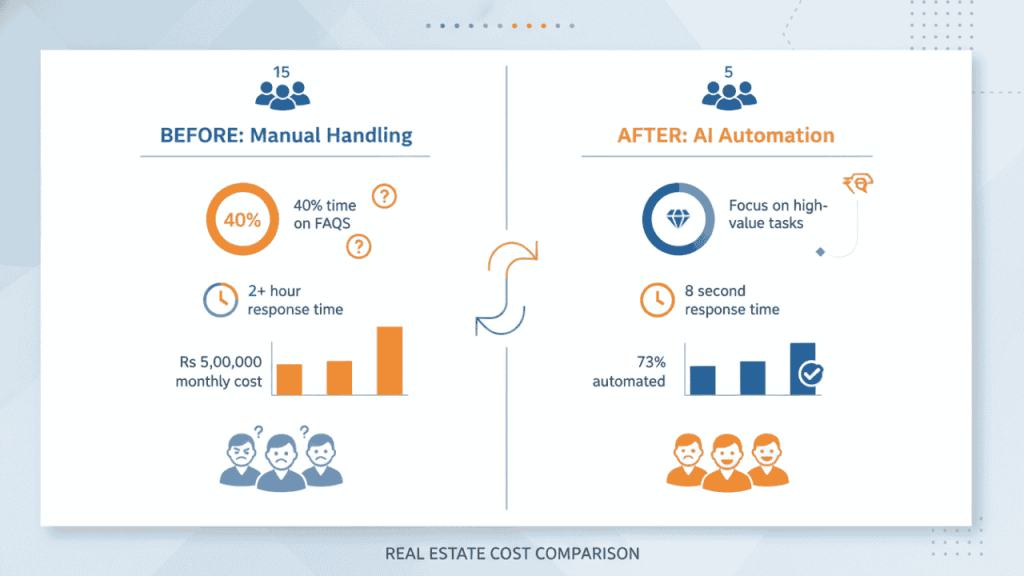
Fifteen agents. Eight hours a day. The same twenty questions. On repeat.
This was the reality for a mid-sized real estate company until they discovered that their biggest operational drain wasn’t coming from marketing spend or lead acquisition. It was coming from something far more mundane. Every day, their sales team fielded hundreds of identical inquiries: “What’s the price of the 3BHK in Sector 45?” “Is parking included?” “Can I schedule a site visit?”
The cost of these repetitive conversations? Over ₹5,00,000 ($6,000) every single month, not in technology or advertising, but in human hours spent answering questions that could easily be automated. Here’s how they turned this operational headache into a competitive advantage.
The Challenge: When Your Best Salespeople Become Expensive FAQ Machines
The company’s situation will sound familiar to anyone in real estate. Their agents were stretched impossibly thin, juggling property showings, client negotiations, and paperwork, all while being tethered to their phones answering basic queries.
The math was brutal. With 15 agents spending roughly 40% of their workday handling routine inquiries, the company was essentially paying premium salaries for FAQ responses. Worse still, the system was failing from every angle. During peak hours, response times ballooned to two hours or more. Leads that came in at 10 PM sat untouched until the next morning. By which time, competitors had already swooped in. And agents, frustrated by the monotony, were burning out faster than the company could hire replacements.
The breaking point came when they analysed their missed opportunity cost. Every lead that went cold represented not just a lost sale, but wasted marketing spend that brought that lead to their door in the first place. They weren’t just bleeding money on salaries. They were haemorrhaging potential revenue.
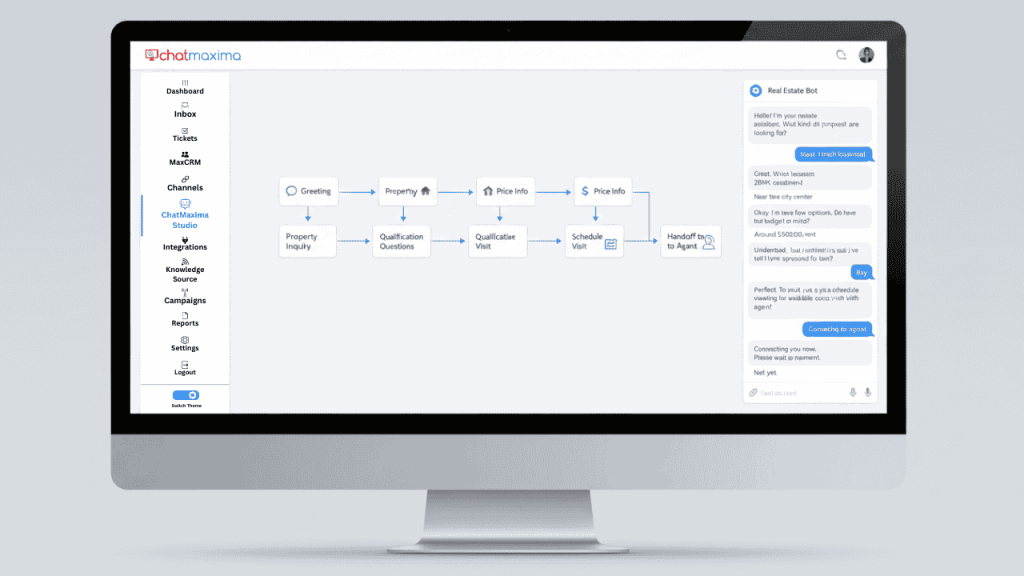
The Solution: One AI, Trained on Property Inventory, Available 24/7
The company implemented ChatMaxima’s AI automation across their three primary customer touchpoints: WhatsApp, Instagram, and Facebook. Rather than a generic chatbot spitting out canned responses, they built an intelligent system trained specifically on their property inventory.
The implementation focused on three core capabilities. First, instant property information. When a prospect asked about a specific unit, the AI could immediately pull pricing, amenities, floor plans, and availability: the same information that used to require an agent to check spreadsheets and get back to the customer. Second, intelligent qualification: before connecting leads with human agents, the chatbot gathered crucial information: budget range, preferred locations, timeline for purchase, and financing status. Third, seamless scheduling. The AI integrated with the team’s calendars to book site visits directly, eliminating the back-and-forth that typically delays appointments.
What made the difference was the handoff protocol. The AI didn’t try to replace salespeople: it prepared prospects for them. By the time a lead reached a human agent, the agent already knew the customer’s budget, preferences, and timeline. No more cold discovery calls. No more wasted time on unqualified leads.
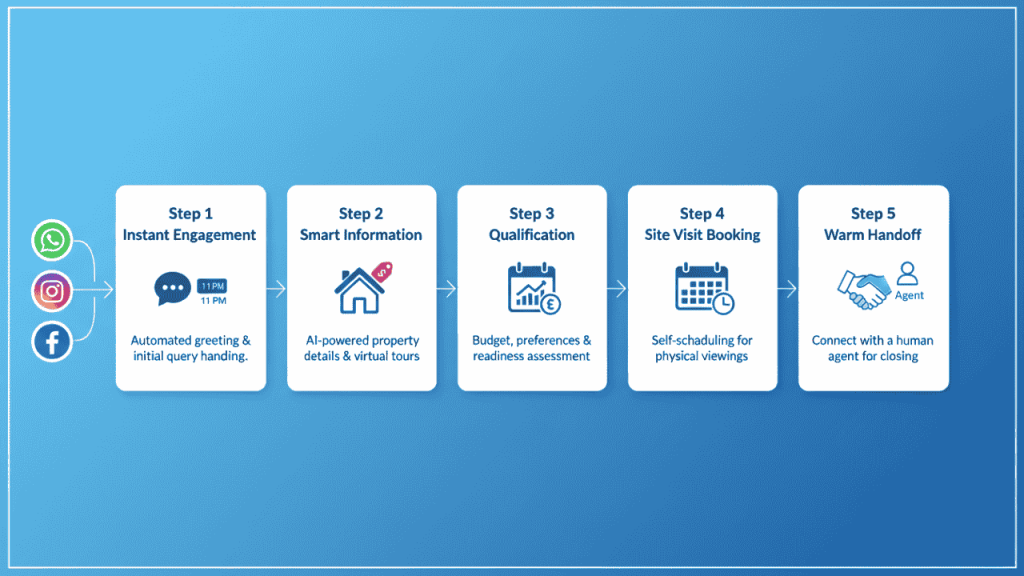
How It Works: The Anatomy of an Automated Property Inquiry
Understanding the customer journey through this system reveals why it works so effectively.
Step 1: Instant Engagement A prospect sees a property listing on Instagram and sends a direct message at 11 PM asking about the 2BHK apartment. Within seconds, not hours, the AI responds with a greeting and asks what specific information they need.
Step 2: Smart Information Delivery The prospect asks about pricing. The AI pulls the exact details: ₹85 lakhs base price, parking included, society maintenance ₹4,500/month, and possession by Q3 2025. It follows up by asking if they’d like to see the floor plan or virtual tour.
Step 3: Progressive Qualification As the conversation continues, the AI naturally gathers qualifying information. Is the prospect pre-approved for a loan? Are they looking for investment or self-use? What’s their preferred move-in timeline? Each question feels conversational, not like filling out a form.
Step 4: Site Visit Booking When the prospect expresses interest in visiting, the AI presents available time slots from the calendar. The prospect selects Saturday at 3 PM, enters their name and phone number, and The booking is confirmed instantly, complete with location details and parking instructions.
Step 5: Warm Handoff The assigned sales agent receives a complete conversation summary: the prospect is a first-time homebuyer with pre-approved financing of ₹90 lakhs, interested in the 2BHK for self-use, and available to close within 60 days. The agent walks into the site visit prepared, not blind.
The Results: What Changed in 30 Days
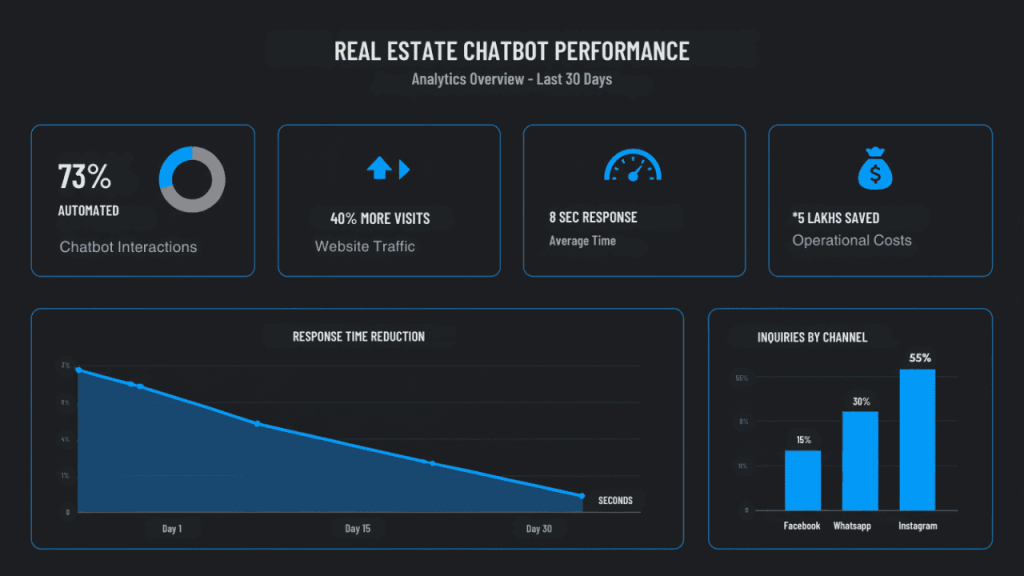
The transformation wasn’t gradual. It was immediate. Within the first month of deployment, the numbers told a compelling story.
73% of inquiries handled without human intervention. Three out of every four customer queries, including pricing questions, amenity details, and availability checks, were resolved entirely by the AI. Human agents only engaged when genuine expertise was needed.
Site visit bookings increased by 40%. The friction of scheduling had been a hidden conversion killer. When prospects could book visits at 2 AM without waiting for business hours, they did. More importantly, they didn’t have time to cool off or get distracted by competitors.
Response time dropped from 2 hours to 8 seconds. This single metric represented the biggest shift. In real estate, speed matters enormously. The first agent to respond captures the lead in most cases. By being available instantly, around the clock, the company stopped losing leads to faster competitors.
10 agents reassigned to high-value activities. Rather than layoffs, the company redeployed two-thirds of their team to activities that actually required human skills: property showings, price negotiations, relationship building, and closing calls.
The monthly savings exceeded ₹5,00,000 ($6,000). But here’s what surprised the leadership team most: conversion rates didn’t just hold steady. They improved.
Why Conversion Rates Went Up
The improvement in conversion rates puzzled the team initially. How could removing human contact improve sales? The answer lay in understanding what the AI actually removed.
The AI never missed a 2 AM lead. Real estate prospects often browse listings late at night. Previously, those midnight inquiries sat unanswered until morning. By which time, many prospects had moved on. The AI engaged every single lead the moment they reached out.
The AI never forgot to follow up. Human agents, juggling dozens of conversations, inevitably dropped the ball on follow-ups. The AI maintained a systematic approach: checking in with prospects who’d shown interest but hadn’t booked visits, sending property updates when new units matching their criteria became available.
The AI never had a bad day. Every prospect received the same professional, helpful, patient response, whether it was the first inquiry of the day or the five hundredth. No frustration, no rushed answers, no inconsistent information.
Qualified leads closed faster. When agents did engage, they weren’t wasting time on tyre-kickers or prospects with mismatched budgets. The pre-qualification meant higher-quality conversations from the first human touchpoint.
Key Benefits: Beyond the Cost Savings
While the financial impact grabbed headlines internally, the operational benefits proved equally valuable.
Agent satisfaction improved dramatically. The team’s best closers were no longer stuck answering “Is parking included?” for the hundredth time. They spent their days doing what they were hired to do, and what they were good at. Burnout decreased, and the company saw improved retention among top performers.
Customer experience became consistent. Every prospect received accurate, complete information regardless of which channel they used or what time they reached out. No more conflicting details from different agents. No more “Let me check and get back to you.”
Data quality transformed. The AI captured structured data from every conversation: contact details, preferences, timelines, objections. This information fed into the CRM automatically, enabling better marketing segmentation and follow-up strategies.
Scalability became possible. During property launches, when inquiry volumes spike dramatically, the company no longer needed to hire temporary staff. The AI absorbed the surge without performance degradation.
Implementation: Getting Started with Property Inquiry Automation
For real estate companies considering a similar approach, the implementation path with ChatMaxima follows a straightforward process.
Week 1: Foundation Setup Connect your messaging channels (WhatsApp Business API, Facebook Page, and Instagram Business account) to ChatMaxima’s unified inbox. This single step ensures no conversation falls through the cracks, regardless of where prospects reach out.
Week 2: Property Database Integration Upload your property inventory or connect your existing property management system. The AI needs access to current pricing, availability, amenities, and media assets to provide accurate responses.
Week 3: Conversation Flow Design Using ChatMaxima’s no-code builder, design the inquiry handling flow. Start with the most common questions your team currently handles, then build branching logic for qualification and scheduling.
Week 4: Testing and Launch Run the chatbot alongside human agents initially, reviewing conversations and refining responses. Once accuracy meets your standards, gradually shift more conversations to AI handling.
The entire deployment typically takes under a month, with ROI visible from day one as agents reclaim hours previously lost to repetitive queries.
The Lesson: Redefining What Your Sales Team Should Be Doing
This real estate company’s experience illuminates a broader truth about sales team productivity. The question isn’t whether AI will replace salespeople. It’s whether businesses will continue wasting their salespeople on tasks that don’t require human judgment, empathy, or expertise.
Every hour your top closer spends explaining parking policies is an hour they’re not building relationships with serious buyers. Every minute your agents spend typing out floor plan details is a minute they’re not negotiating deals. The choice isn’t between human and AI. It’s about deploying each where they create the most value.
AI handles volume, consistency, and availability. Humans handle nuance, trust, and complex problem-solving. The companies that figure out this division of labour will outcompete those still treating their salespeople as expensive answering machines.
Still Have Your Best Salespeople Answering “What’s the Price?”
If you recognise your own operation in this story (talented agents buried in routine inquiries, leads going cold overnight, the same questions answered hundreds of times weekly), the problem isn’t your team. It’s your process.
ChatMaxima’s AI automation gives your sales team the freedom to focus on what they do best: building relationships and closing deals. The technology handles the rest.
Ready to see what AI-powered property inquiry automation could do for your real estate business? Start your free trial or book a demo to see ChatMaxima in action with your actual property listings.