Every few months, a new headline claims AI is about to replace most human jobs. The predictions are dramatic, the fear is real, and the data is usually thin. Anthropic, the company behind the Claude AI model, decided to tackle this question differently. Instead of guessing what AI could theoretically do, they measured what AI is actually doing right now in real workplaces.
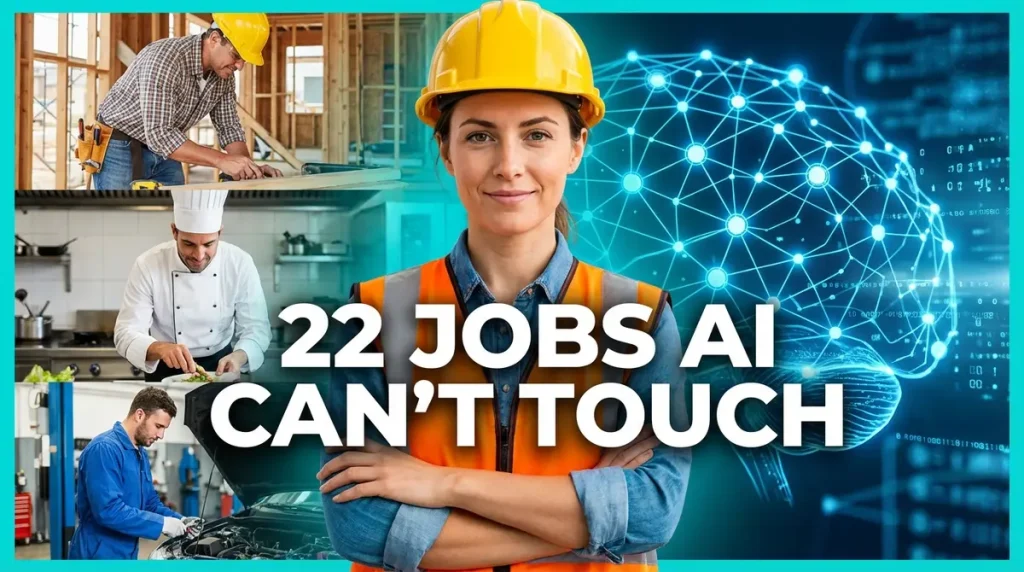
Their March 2026 research paper introduces a new metric called “observed exposure” and identifies 22 career categories where AI adoption remains close to zero. The findings paint a far more nuanced picture than the doomsday headlines suggest.
How Anthropic Measured AI’s Real Impact on Jobs
Most AI-and-employment studies rely on theoretical capability. Researchers look at a job description and ask: “Could an AI model do this task?” The problem is that “could” and “does” are vastly different things.
Anthropic took a different approach with their “observed exposure” metric. They combined three data sources to build a more accurate picture:
-
- O*NET database containing detailed task breakdowns for roughly 800 US occupations
- Real usage data from Claude, showing what professionals actually use AI for at work
- Theoretical exposure estimates from prior academic research by Eloundou et al.
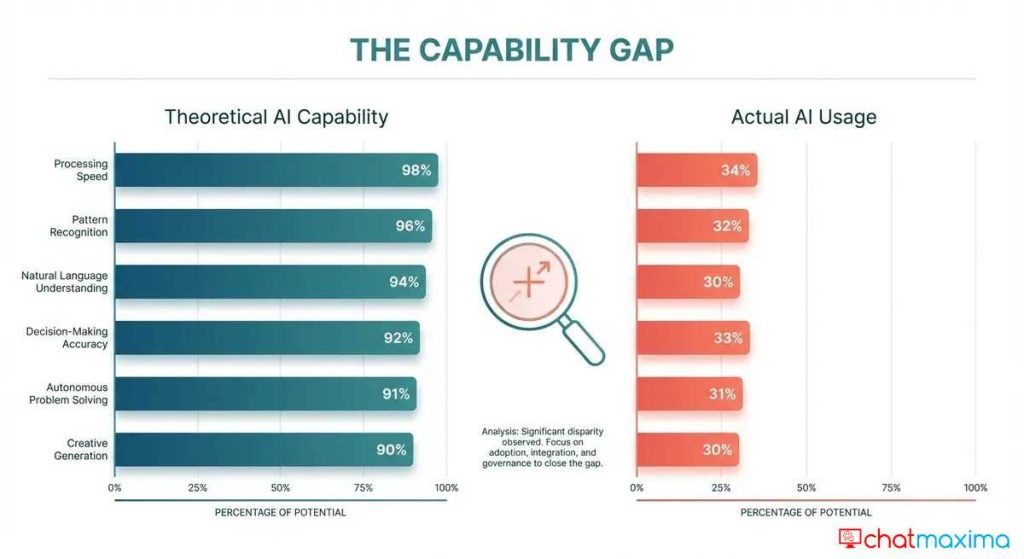
The core finding is striking. In the Computer and Math field, AI could theoretically assist with 94% of tasks. But actual usage on Claude covers only about 33%. That gap between potential and practice exists across nearly every industry.
Why does theoretical capability so dramatically overstate real-world adoption? Several factors are at play. Legal constraints prevent AI from performing certain regulated tasks. Specific software requirements create friction. Human verification steps slow deployment. And many organizations simply have not yet integrated AI into their workflows.
Anthropic weighted their measure to reflect real economic impact. Fully automated tasks received full weight in the analysis, while tasks where AI merely assists a human worker received half weight. This distinction matters because augmentation (AI helping a human) affects employment very differently than full automation (AI replacing a human).
The 22 Career Categories That Remain Protected

Based on Anthropic’s observed exposure data, these 22 career categories show the lowest AI involvement. The workers in these fields appeared too infrequently in Claude’s professional usage data to meet even the minimum threshold for measurement. In practical terms, AI is not being used for their core work tasks.
Physical Trades and Construction
-
- Carpenters
- Roofers
- Plumbers
- General construction workers
These roles demand hands-on manipulation of physical materials in unpredictable environments. A language model cannot swing a hammer, fit a pipe, or adjust its approach based on the specific condition of a building site.
Agriculture and Outdoor Work
-
- Farm workers and ranch hands
- Arborists and tree care specialists
Agricultural work involves operating heavy machinery across uneven terrain, making real-time decisions about soil, weather, and crop conditions, and performing physically demanding tasks that require spatial awareness.
Food Service
-
- Cooks of all types
- Bartenders
- Dishwashers
Cooking requires tactile skill, taste, timing, and the ability to manage multiple physical processes simultaneously. Even the most advanced AI cannot flip a steak, adjust seasoning on the fly, or clean a kitchen at closing time.
Hospitality and Maintenance
-
- Housekeepers and attendants
- Dressing room attendants
- Maintenance and repair technicians
- Motorcycle and equipment mechanics
These roles require physical inspection, manual dexterity, and problem-solving in unpredictable environments. A mechanic diagnosing an engine issue needs to see, hear, and feel the machine in ways that are impossible for a text-based AI.
Personal Services
-
- Hair stylists
- Massage therapists
- Tattoo artists
Personal care professions involve direct physical contact, aesthetic judgment tailored to individual clients, and a level of trust and interpersonal connection that cannot be automated.
Safety and Supervision
-
- Security guards
- Crowd control personnel
- Ski patrol
- Lifeguards
These roles require real-time physical presence, the ability to respond to emergencies instantly, and situational awareness across complex, dynamic environments.
Transportation
-
- Drivers and transportation workers
Despite ongoing self-driving vehicle development, real-world driving involves countless edge cases, regulatory hurdles, and liability questions that keep human drivers firmly in their roles.
Installation and Repair
-
- HVAC technicians, electricians, and similar installation and repair roles
These professionals work in unique physical spaces, troubleshoot problems that require visual and tactile inspection, and follow safety protocols that demand human judgment.
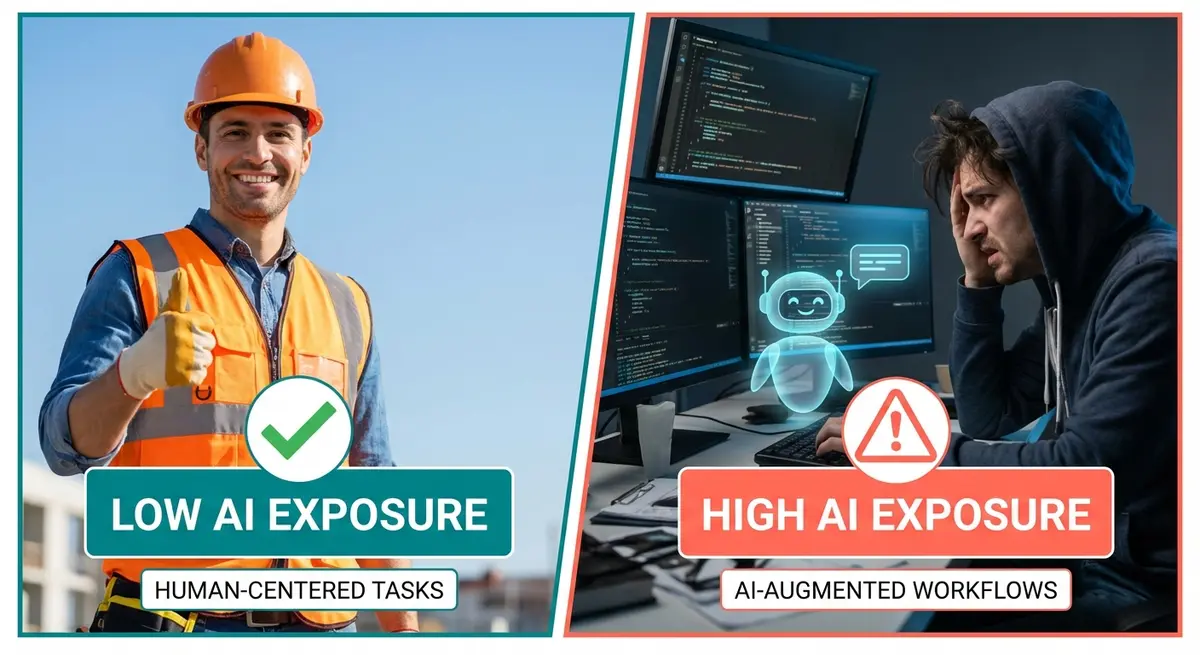
The common thread across all 22 categories is clear: these jobs require physical presence, real-world interaction, and hands-on decision-making that current AI systems simply cannot replicate.
Which Jobs Face the Highest AI Exposure
On the opposite end of Anthropic’s spectrum, three occupations stand out with the highest current AI involvement:
Computer Programmers – approximately 75% task coverage. The rise of AI coding assistants has been dramatic. Tools that auto-complete code, debug errors, and generate entire functions from natural language prompts have made programming the most AI-augmented profession by a wide margin. This does not mean programmers are being replaced. Rather, their workflow now includes substantial AI assistance at almost every step.
Customer Service Representatives – significant API-driven automation. This is where platforms like ChatMaxima’s AI-powered chatbot platform come into play. Companies increasingly use AI chatbots to handle routine customer queries, process returns, answer FAQs, and route complex issues to human agents. The automation is largely in repetitive, text-based interactions, not in the empathetic, problem-solving conversations that still require human touch.
Data Entry Keyers – approximately 67% task coverage. Reading documents and entering structured information into databases is precisely the type of task that large language models handle well. AI can parse invoices, extract data from forms, and populate spreadsheets faster and more accurately than manual data entry.
The pattern is unmistakable. Jobs dominated by digital, text-based, and repetitive tasks face the highest AI exposure. Jobs requiring physical work, creative judgment, or real-world presence face the lowest.
No Mass Unemployment – But Subtle Shifts Are Happening
One of the most reassuring findings from Anthropic’s research is that there has been no systematic increase in unemployment for workers in highly exposed occupations since late 2022, when the current wave of AI tools became widely available.
However, the data does show more gradual changes beneath the surface:
-
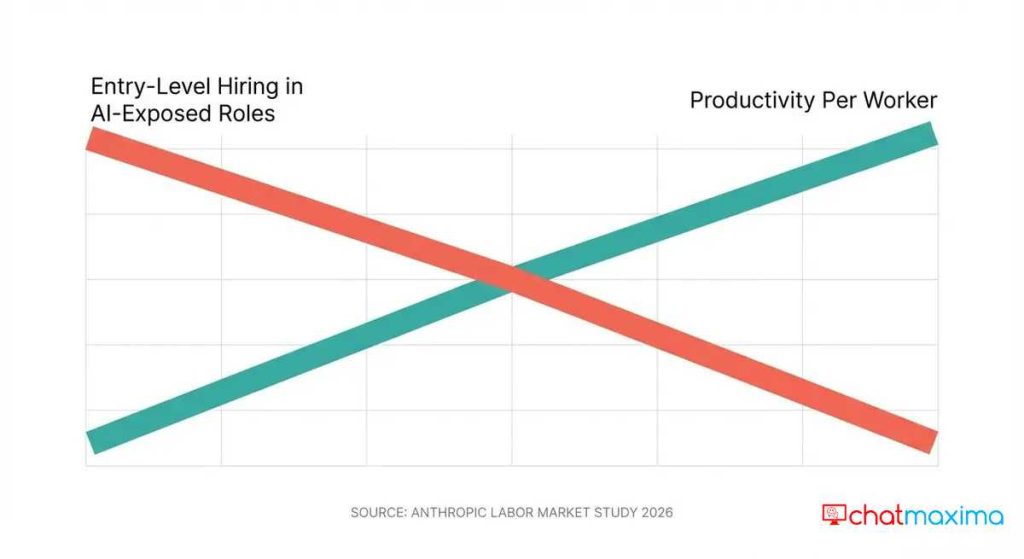
- Slower hiring for younger workers in AI-exposed occupations. Companies may be bringing on fewer entry-level employees when AI can handle tasks that juniors used to perform.
- Increased productivity per worker as AI tools handle more of the routine workload.
- Shifting skill requirements where employers expect workers to know how to use AI tools effectively.
The Bureau of Labor Statistics projections also show a correlation: occupations with higher observed exposure are projected to grow less through 2034. This does not mean these jobs disappear, but growth rates slow compared to less exposed fields.
Workers in the most exposed professions also tend to share certain demographics. They are more likely to be older, female, more educated, and higher-paid. This challenges the common assumption that AI primarily threatens low-skill, low-wage work.
What This Means for Businesses Using AI
For business owners, Anthropic’s research reinforces a critical principle: AI works best as an augmentation tool, not a wholesale replacement strategy.
The companies seeing the most value from AI are using it to handle specific, well-defined tasks while keeping humans in charge of judgment calls, relationship building, and complex problem-solving. This is exactly the model behind modern omnichannel AI chatbot platforms that route conversations intelligently between automated responses and human agents.
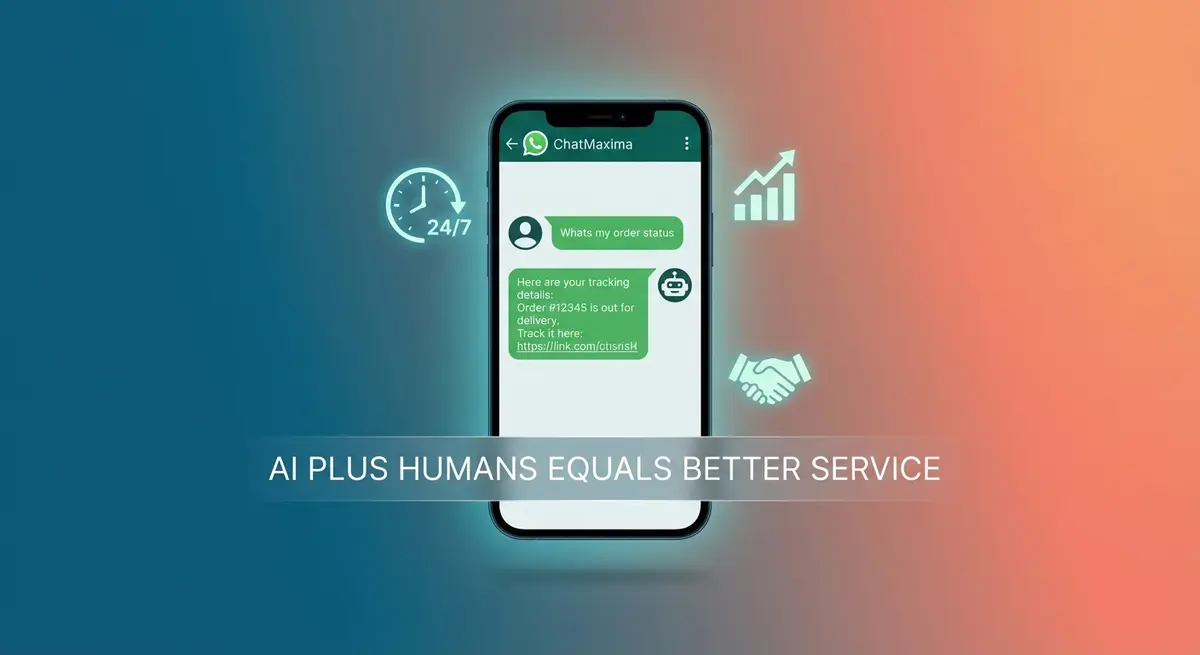
Consider how this applies to customer communication. A business using WhatsApp automation tools can deploy AI chatbots that instantly answer common questions, qualify leads, book appointments, and process simple requests around the clock. When a conversation requires nuance, empathy, or specialized knowledge, the system hands off to a human team member who picks up the conversation with full context.
This approach mirrors Anthropic’s findings precisely. The routine, text-based, repetitive interactions get handled by AI. The complex, relationship-driven, judgment-intensive interactions stay with humans. Both the technology and the workforce become more productive as a result.
Businesses that integrate AI through platforms like ChatMaxima are not eliminating customer service roles. They are making those roles more focused, more rewarding, and more impactful. The humans who previously spent 80% of their day answering the same five questions can now spend that time solving unique problems and building customer relationships that drive loyalty and revenue.
How to Position Your Business for the AI-Augmented Workforce
The path forward is not about choosing between AI and humans. It is about deploying each where they perform best:
-
- Automate repetitive, text-based tasks such as answering FAQs, routing inquiries, collecting lead information, and sending order updates. Tools like ChatMaxima’s chatbot service make this accessible without requiring any coding knowledge.
- Keep humans in charge of high-stakes interactions including complex sales conversations, complaint resolution, strategic planning, and anything requiring emotional intelligence.
- Invest in training so your team knows how to work alongside AI tools effectively. The most valuable employees in 2026 are not those who avoid AI but those who know how to direct it.
- Use data to find the right balance by tracking which conversations AI handles well and where human intervention improves outcomes. Platforms with built-in reporting and analytics make this straightforward.
The businesses that thrive through the AI transition will not be the ones that automate everything or resist automation entirely. They will be the ones that find the optimal blend of AI efficiency and human expertise for their specific industry and customer base.
Key Takeaways From Anthropic’s Research
Anthropic’s study provides the most data-driven picture yet of how AI is affecting the workforce. The headline number (22 safe career categories) tells only part of the story. Here is what matters most:
-
- The gap between AI capability and AI adoption is enormous. Even in the most AI-friendly fields, actual usage covers only a fraction of what is technically possible.
- Physical, hands-on, and in-person jobs remain firmly in human hands. No amount of language model improvement changes the fact that AI cannot perform physical work.
- Digital, text-based roles face real exposure. Programming, customer service, and data entry lead the list for good reason.
- No mass job losses have materialized since the AI boom began in late 2022, though hiring patterns are shifting.
- AI augments more than it replaces. The dominant pattern is workers using AI to become more productive, not AI eliminating workers entirely.
- Smart businesses combine AI and human strengths. This is not optional speculation but the strategy that the data supports.
The AI revolution is real, but it looks far less like a sudden disruption and far more like a gradual transformation. For the 22 career categories Anthropic identified, that transformation may never arrive. For everyone else, the question is not whether to adopt AI but how to deploy it in a way that makes both the technology and your people more effective.
Source: Anthropic – Labor Market Impacts of AI: A New Measure and Early Evidence, March 2026