
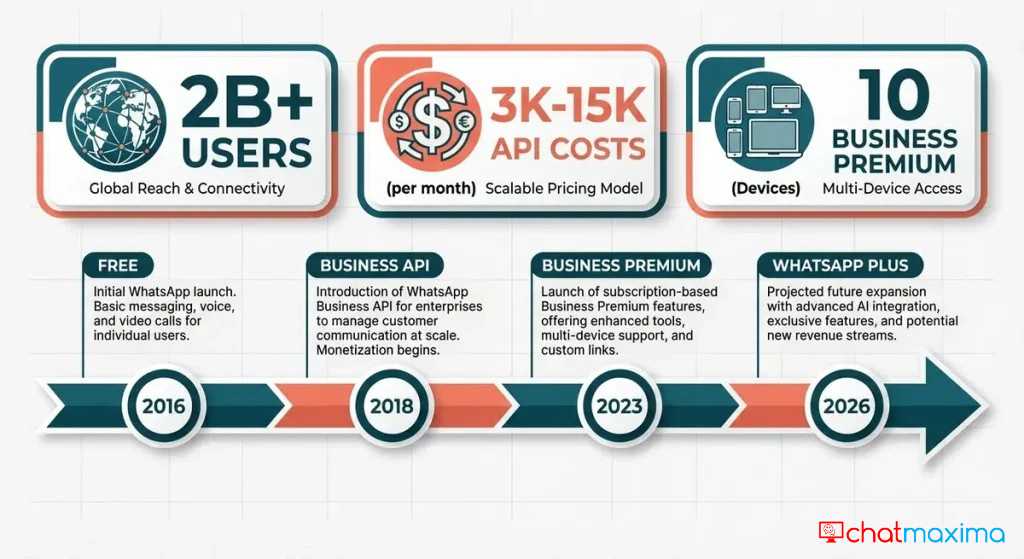
WhatsApp has been completely free for a decade. Since Meta dropped the old $1 per year fee back in 2016, over two billion users have enjoyed unlimited messaging, voice calls, video calls, and media sharing without paying anything.
That era may be ending – at least partially.
In early March 2026, WABetaInfo uncovered references to a new premium subscription tier called “WhatsApp Plus” in both the iOS and Android codebases. Android Police independently confirmed the discovery. The subscription adds cosmetic and convenience features on top of the free WhatsApp experience, and it signals a significant shift in how Meta plans to generate revenue from its most popular messaging platform.
For businesses that rely on WhatsApp to communicate with customers, this development carries implications that go well beyond custom app icons and ringtones.
What WhatsApp Plus Actually Includes
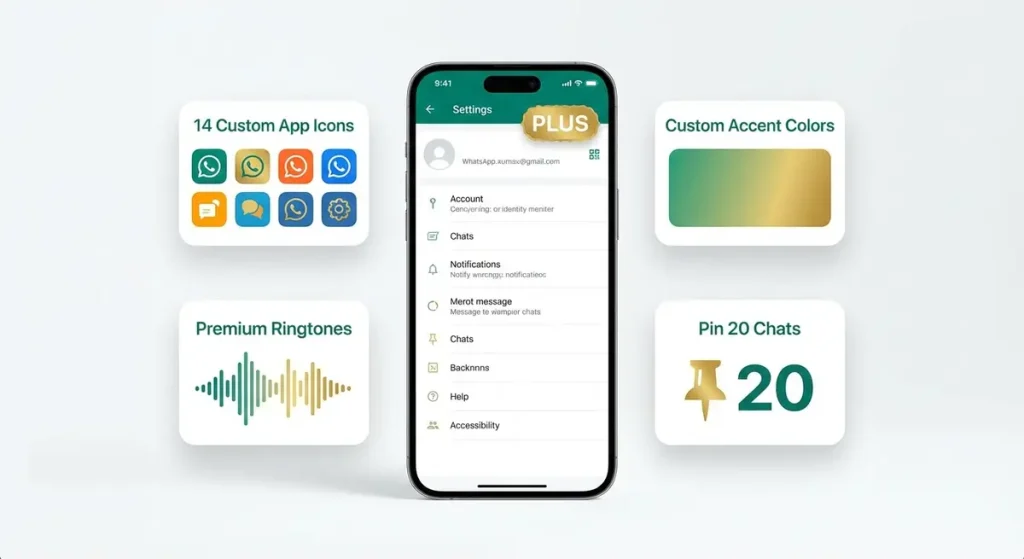
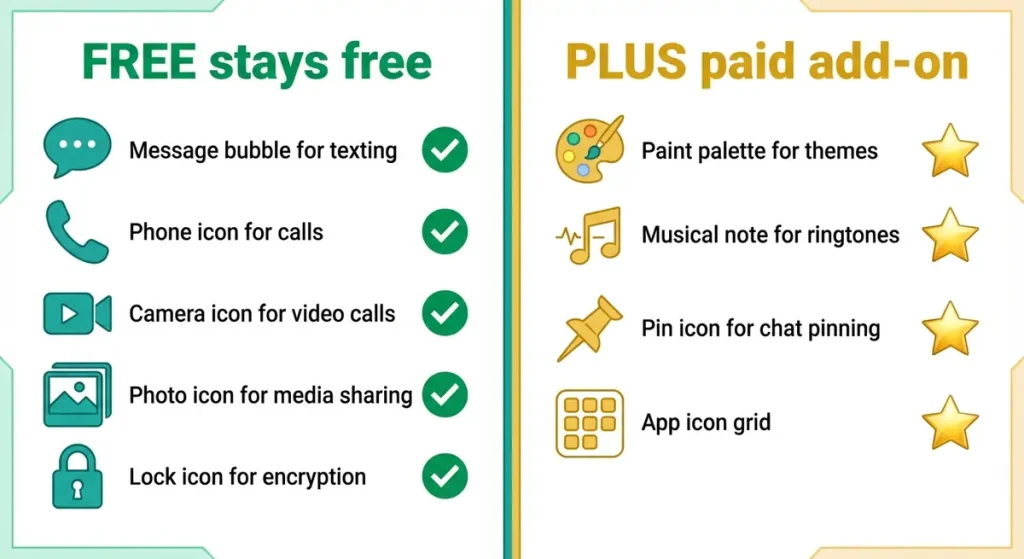
Based on the leaked information from WABetaInfo and confirmed by Android Police, WhatsApp Plus is an optional paid subscription that adds the following features:
-
- 14 custom app icons that let users personalize how WhatsApp appears on their home screen
- Custom accent colors and themes for moving beyond the default green interface
- Exclusive ringtones and stickers including premium sound packs and expression sets
- Ability to pin up to 20 chats compared to the current limit of just 3
Of these features, the expanded chat pinning is the one with genuine practical value. Anyone juggling multiple conversations across work, family, and social groups knows the frustration of being limited to three pinned chats. Jumping from 3 to 20 is a meaningful upgrade for power users.
The rest of the package leans heavily toward personalization and aesthetics. Custom icons, themes, and ringtones are nice-to-have features but they do not change the fundamental messaging experience.
Meta has not confirmed pricing for WhatsApp Plus. Given that the features are primarily cosmetic, industry analysts expect something in the $2 to $5 per month range, placing it alongside Telegram Premium ($4.99 per month) in the subscription messaging tier.
It is also worth noting that WhatsApp Plus is still in development. There is no confirmed launch date, and Meta could ultimately decide not to release it at all. But the fact that it has appeared in both iOS and Android codebases suggests serious intent.
What Stays Completely Free
This is the part that matters most for the two billion people who use WhatsApp daily. According to the WABetaInfo report, every core WhatsApp feature remains entirely free:
-
- Text messaging (individual and group)
- Voice calls and video calls
- Media sharing (photos, videos, documents)
- Status updates
- Group chats
- End-to-end encryption
- All existing functionality
WhatsApp Plus is strictly an add-on layer. It does not gate any current functionality behind a paywall. Users who never subscribe to WhatsApp Plus will continue using WhatsApp exactly as they do today, with no restrictions, no ads in chats, and no loss of features.
This distinction matters because the reaction to WhatsApp Plus in early coverage has been more negative than the actual change warrants. The Pocket-lint article that broke the story framed it as a reason to uninstall WhatsApp entirely. In reality, WhatsApp Plus changes nothing for users who are happy with the free experience.
Why This Actually Matters for Businesses
While WhatsApp Plus targets individual consumers, the bigger story is what it reveals about Meta’s strategic direction for WhatsApp monetization. Businesses should pay attention to three key developments.
Meta Is Building Multiple WhatsApp Revenue Streams
WhatsApp Plus is the latest step in Meta’s long-term plan to make WhatsApp profitable. The progression is clear:
In 2018, Meta launched the WhatsApp Business API, charging businesses per conversation for customer communication at scale. The API now represents a significant revenue stream, with enterprise costs ranging from $3,000 to $15,000 per month depending on message volume.
In 2023, Meta introduced WhatsApp Business Premium for small and medium businesses using the WhatsApp Business App. This paid tier includes multi-device support for up to 10 linked devices, custom short links, chat assignment for routing conversations to specific team members, and basic web page creation within WhatsApp.
In 2026, WhatsApp Plus extends monetization to regular consumers for the first time since the $1 annual fee was dropped.
Each step represents Meta getting more comfortable charging for WhatsApp services. For businesses, this means more investment flowing into WhatsApp development, more features being built, and a more capable platform for customer engagement.
WhatsApp Business Premium vs WhatsApp Plus – Know the Difference
Many business owners confuse these two products, and the distinction is important.
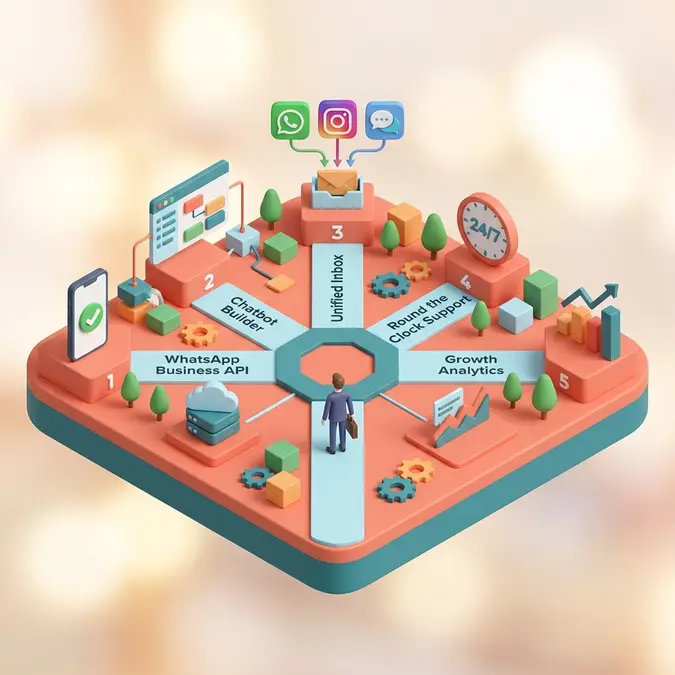
WhatsApp Business on ChatMaxima serves as a channel for companies to manage customer conversations at scale. The WhatsApp Business API, which platforms like ChatMaxima connect to, provides the infrastructure for automated messaging, chatbot deployment, broadcast campaigns, and CRM integrations.
WhatsApp Business Premium is a paid upgrade to the basic WhatsApp Business App, aimed at small businesses that manage conversations directly within the app. It costs roughly five to ten euros per month.
WhatsApp Plus, by contrast, is aimed at individual consumers who want cosmetic customization. It has nothing to do with business messaging features.
The key insight: if you are running a business that communicates with customers through WhatsApp, WhatsApp Plus is not what you need. What you need is a proper WhatsApp Business API integration through a platform like ChatMaxima that can handle automation, multi-agent support, and intelligent routing.
Customer Expectations Are Rising With the Platform
As WhatsApp adds premium tiers and becomes a richer, more polished platform, user expectations follow. People who pay for a premium WhatsApp experience are going to expect premium interactions with businesses too.
Slow reply times, generic responses, and inability to handle basic queries will stand out even more when the app itself feels more capable and refined. Businesses that still rely on a single person manually responding to WhatsApp messages will fall behind those that deploy AI-powered automation.
This is where AI chatbots built on ChatMaxima make a practical difference. A well-configured chatbot handles the routine volume – order status checks, FAQ answers, appointment scheduling, basic product questions – while routing complex or sensitive conversations to human team members who can provide the personal touch that matters.
The Bigger Picture – Messaging Apps Are All Monetizing
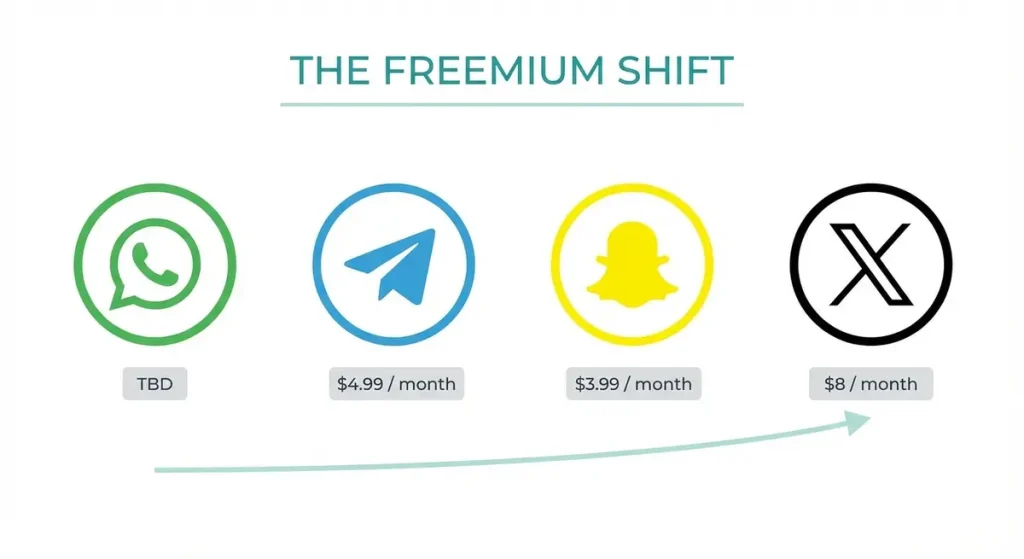
WhatsApp is not blazing a new trail here. It is following a well-established pattern across the messaging and social media industry:
-
- Telegram Premium launched in June 2022 at $4.99 per month, offering faster downloads, exclusive stickers, and increased limits
- Snapchat+ launched in June 2022 at $3.99 per month with exclusive features and customization
- X (formerly Twitter) Premium charges $8 per month for verified badges, longer posts, and algorithmic boost
- Discord Nitro has charged $9.99 per month for years, offering better streaming, larger uploads, and custom emoji
The pattern is consistent: free messaging apps are adding premium tiers while keeping core features free. This is the freemium model that has driven SaaS business growth for over a decade, now arriving in consumer messaging.
For businesses, this trend is actually positive news. When platforms generate revenue, they invest in development. When they invest in development, business-facing tools improve. The WhatsApp Business API has gotten dramatically better since Meta started monetizing it, and that trajectory will likely accelerate as more revenue flows in from WhatsApp Plus and other premium offerings.
The businesses positioned to benefit the most are those already set up with proper omnichannel communication infrastructure. When WhatsApp rolls out new business features (and they will), companies with existing chatbot integrations and automated workflows will be able to adopt those features immediately rather than scrambling to build from scratch.
What Businesses Should Do Right Now
Whether or not WhatsApp Plus launches exactly as leaked, Meta’s direction is unmistakable. WhatsApp is becoming a revenue platform, which means it is becoming a more feature-rich and more competitive channel for business communication. Here is how to position your business ahead of these changes:
Get on the WhatsApp Business API if you have not already. The basic WhatsApp Business App has limitations that become painfully obvious as your customer volume grows. A proper API integration through a WhatsApp automation platform gives you chatbot deployment, broadcast messaging, team inbox functionality, and CRM integration that scales with your business.
Automate your most common customer interactions. Identify the top 10 questions your customers ask on WhatsApp and build automated responses for each one. This does not require coding expertise. Platforms like ChatMaxima offer visual chatbot builders where you can create conversation flows by dragging and dropping blocks.
Build an omnichannel presence. Do not put all your customer communication eggs in the WhatsApp basket. Be present on WhatsApp, Instagram, web chat, Facebook Messenger, and whatever channels your customers prefer. An omnichannel team inbox lets your team manage all these conversations from a single dashboard without switching between apps.
Monitor your WhatsApp API costs. As Meta adds more revenue streams, pricing adjustments to the Business API are always possible. Track your per-conversation costs, optimize your chatbot flows to resolve queries efficiently, and use WhatsApp API pricing tools to forecast your monthly spend.
Prepare for new WhatsApp business features. Meta has been steadily releasing new capabilities including WhatsApp Flows (in-app forms and transactions), WhatsApp Calling for business, and enhanced catalog features. Having a flexible platform integration means you can adopt these features quickly as they become available.
The Bottom Line
WhatsApp Plus is a cosmetic subscription that most users probably will not pay for. Custom icons and premium stickers are not exactly must-have features. But the subscription itself is less important than what it signals: Meta is serious about building WhatsApp into a revenue-generating platform, and that means more investment, more features, and a more competitive landscape for business communication.
The free WhatsApp experience is not going anywhere. Your customers will still be on WhatsApp whether or not they subscribe to Plus. The question is not whether WhatsApp remains relevant for business communication (it absolutely does) but whether your business is set up to handle that communication effectively with the right mix of AI automation and human expertise.
The smart move is to get your WhatsApp customer experience dialed in now, with AI chatbots and automation through ChatMaxima, before the platform gets even more competitive and customer expectations rise even higher.
Sources: WABetaInfo, Android Police, Pocket-lint, March 2026