Gartner projects that 80% of customer support organizations will adopt generative AI by 2025 – and that agentic AI will autonomously resolve 80% of issues without human intervention by 2029. That is not a distant forecast. It is happening right now, and AI customer support is replacing ticketing systems at companies of every size.
If your team is still routing customer questions through ticket queues, assigning ticket IDs, and waiting for agents to manually triage requests – you are not just behind. You are burning money on a model that was never designed for the speed customers expect in 2026.
This post breaks down exactly why the ticketing paradigm is collapsing, what AI-first support actually means in practice, and how a company with 10 to 200 people can make the switch without a six-month implementation project.
The Problem With Ticketing Systems
Customers Are Numbers, Not Conversations
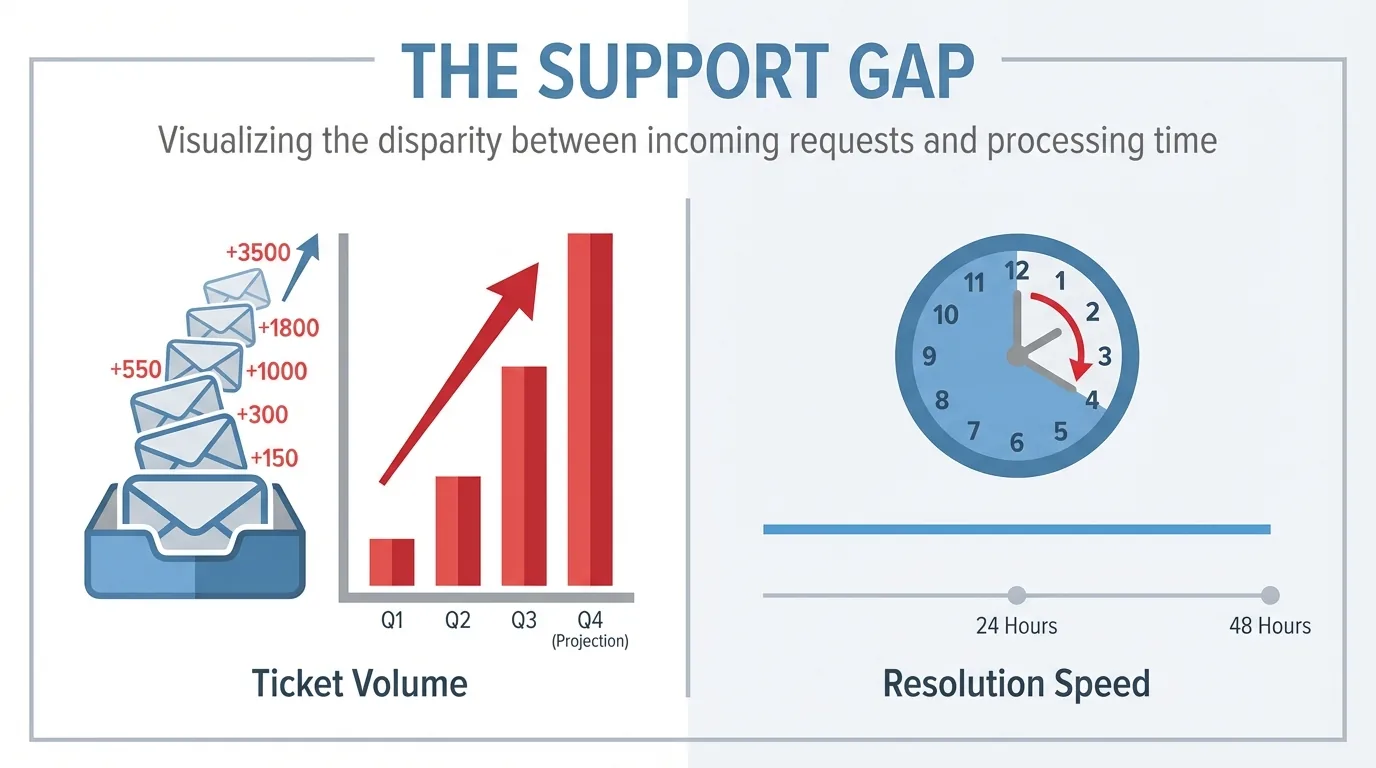
When a customer submits a support ticket, they are immediately reduced to a number in a queue. They get an auto-response telling them their issue has been received. Then they wait – sometimes hours, sometimes days – for a human to read, categorize, and respond to their request.
The average ticket resolution time across SMBs is 24 to 48 hours. For a customer who locked themselves out of their account at 11 PM or encountered a billing error before a board meeting, that wait is unacceptable. The ticket system was never built to meet the customer where they are. It was built to organize workload for agents.
The Hidden Cost of Manual Triage
Every ticket that enters the queue requires a human to read it, route it to the right team, and decide its priority. Manual ticket handling costs an average of $22 per interaction – a figure from Forrester Research that most support managers underestimate because the labor cost is buried in salaries rather than line-itemed.
On top of direct cost, 30 to 40% of tickets are misrouted on the first assignment, requiring re-triage and adding hours to resolution time. That misrouting rate generates frustration on both sides: customers repeat themselves, and agents waste time on issues outside their expertise.
Scaling Costs Are Linear and Brutal
The fundamental flaw in the ticketing model is that it scales linearly with headcount. More customers means more tickets. More tickets means more agents. More agents means higher payroll, training overhead, and management complexity.
A company growing from 50 to 150 customers per day does not need a clever optimization – it needs to triple its support team under the ticketing model. That is unsustainable for any company under 200 people trying to grow without burning cash on headcount that could go into product or sales.
What “AI-First Customer Support” Actually Means

Conversation Over Ticket
AI-first support replaces the ticket as the atomic unit of customer interaction. Instead of creating a record that gets processed later, the customer gets an immediate, contextual conversation – whether they reach out via live chat, WhatsApp, email, or social media.
The AI does not just match keywords to canned responses. Modern conversational AI customer service platforms understand intent, maintain context across the entire conversation, and take action – resetting passwords, checking order status, processing returns – without a human in the loop.
Proactive, Not Reactive
The most important shift is from reactive to proactive. Traditional ticketing systems wait for problems to arrive. An AI-first platform can identify when a user is about to have a problem – a subscription about to expire, a failed payment about to process, a shipment about to be delayed – and reach out before the customer ever needs to contact support.
Proactive customer support AI eliminates tickets before they are created. That is not just a cost saving. It is a fundamentally different relationship with your customers.
Always Learning, Always Improving
Every conversation an AI-first system handles becomes training data. The system learns which answers resolve issues, which escalation paths work, and where confusion patterns emerge. A ticketing system never gets smarter. An AI-first platform does.
5 Ways AI-First Outperforms Ticketing Systems
1. Instant Resolution at Any Hour
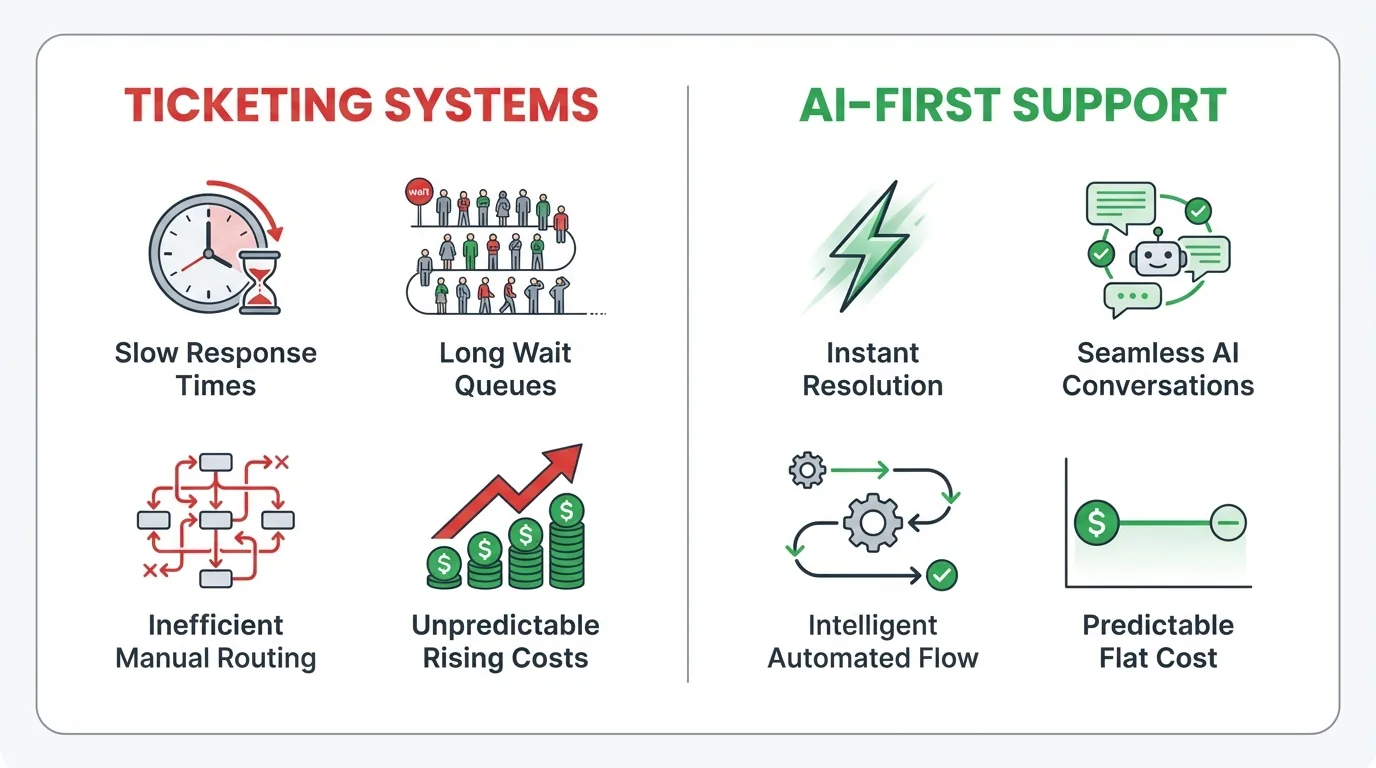
Ticketing systems have business hours. AI-first platforms do not. 60 to 80% of routine customer inquiries can be resolved by AI without human intervention – and those resolutions happen in seconds, at 3 AM on a Sunday, without adding a single dollar to payroll.
2. Context That Follows the Customer
One of the most infuriating experiences in customer support is repeating yourself to a new agent. AI-first systems maintain a continuous conversation history across every channel. A customer who asks a question on your website chat and then follows up via WhatsApp gets picked up exactly where they left off – not re-routed to the back of a new queue with a new ticket ID.
This is what omnichannel AI support actually means. Not just being present on multiple channels, but maintaining unified context continuity so the customer never has to repeat themselves.
3. Ticket Deflection at Scale
Ticket deflection AI means the system resolves customer questions before they ever become tickets requiring human attention. Every deflected ticket saves $22 in handling cost. An AI that deflects 500 tickets per month – a modest number for a growing SaaS or e-commerce company – saves $11,000 per month in support labor alone.
4. Proactive Outreach That Prevents Escalations
Instead of waiting for an angry customer to open a ticket about a billing failure, an AI-first platform detects the failed payment and initiates a conversation: “We noticed your payment did not go through – here is how to update your details in 60 seconds.” Preventing the escalation costs a fraction of resolving it.
5. Flat-Cost Scaling
This is the structural advantage that ticketing systems can never replicate. AI-first support costs do not scale linearly with ticket volume. Whether your AI handles 100 conversations or 10,000 conversations in a month, your platform cost stays the same. The marginal cost of the 10,001st conversation is effectively zero.
The Real ROI of AI Customer Support

The $22 vs. $0.02 Calculation
Manual ticket handling costs $22 per interaction. Automated customer support via an AI platform like ChatMaxima costs approximately $0.02 per conversation on the entry-level $19/month plan. That is a 1,100x cost differential.
For a company handling 500 support interactions per month:
- Manual ticketing cost: 500 x $22 = $11,000/month
- AI-first cost: $19/month platform fee + minimal overhead = under $50/month
The math is not subtle. See the ChatMaxima pricing plans for the full breakdown – including what each tier handles at scale.
The Klarna Proof Point
Klarna’s AI implementation is the most-cited enterprise case study for a reason. Klarna’s AI assistant handled 67% of all customer service inquiries within its first month of full deployment – the equivalent of 700 full-time agents. The result was a $40 million improvement in profit in a single year.
Klarna is a fintech giant, but the underlying math applies at any scale. If your AI handles two-thirds of your support volume without human involvement, you are not optimizing a cost center – you are restructuring it entirely.
90-Day ROI for SMBs
Most AI-first platforms show positive ROI within 60 to 90 days for companies in the 10 to 200 employee range. The break-even point is straightforward: once your AI deflects enough tickets to offset the platform cost, every additional deflection is pure margin recovery.
For a company on ChatMaxima’s $19/month plan, the platform pays for itself after deflecting fewer than one ticket per month at the $22 manual cost benchmark. Everything beyond that single deflection is profit.
Why Intercom, Zendesk, Tidio, and Drift Are Struggling

Built for Tickets First
Zendesk, Intercom, Tidio, and Drift were all built during an era when tickets were the primary unit of customer support. They have added AI features as bolt-ons – chatbots layered on top of ticket queues, automation rules wired into existing workflows – but the underlying architecture is still ticket-first.
That matters because the AI capabilities are constrained by the ticketing infrastructure they sit on. When the AI cannot resolve something, it creates a ticket. The fallback is always the queue.
Per-Seat Pricing That Punishes Growth
Every major legacy platform charges per seat. Zendesk charges per agent. Intercom charges per seat. Drift charges per seat. This means your support costs grow directly with your team size – creating a perverse incentive to keep teams small and queues long, or to overpay as you scale.
If you are frustrated with Zendesk’s cost structure, the ChatMaxima alternatives comparison breaks down exactly how flat-rate AI-first pricing changes the economics.
The Intercom Problem
Intercom built one of the best B2B messaging experiences in the market – and then began layering in AI without rethinking its pricing model. The result is an expensive platform where AI features sit behind premium tiers that most SMBs cannot justify.
If you are evaluating Intercom alternatives, the ChatMaxima vs Intercom comparison covers the feature and cost delta in detail.
Tidio’s Ceiling
Tidio is a popular entry point for e-commerce businesses because it is affordable and easy to set up. But it hits a ceiling quickly. Tidio’s AI capabilities are limited, its omnichannel context management is shallow, and its pricing jumps sharply as you scale beyond basic use cases.
The ChatMaxima vs Tidio breakdown is worth reading if you are outgrowing Tidio’s feature set.
Drift’s Identity Crisis
Drift positioned itself as a conversational marketing platform, not a support platform – and that tension shows. Its AI is optimized for lead capture, not for resolving support issues at volume. Companies that use Drift for support find themselves working around the product, not with it.
The ChatMaxima vs Drift comparison covers why support-native AI platforms outperform marketing-first chatbot tools for actual customer service.
How to Migrate From a Ticketing System to AI-First Support

This is the section no competitor has written. Every AI-first vendor will tell you why you should switch. Almost none of them tell you how. Here is a practical 5-step migration playbook for a company with 10 to 200 employees.
Step 1: Audit Your Ticket Volume and Categories (Week 1)
Before touching any technology, export 90 days of tickets from your current system. Categorize them by type: password resets, billing questions, how-to questions, bug reports, escalations, and account changes.
You will almost certainly find that 60 to 70% of your ticket volume falls into 5 to 8 repeatable categories. Those are your deflection targets. The remaining 30 to 40% – complex bugs, sensitive billing disputes, enterprise escalations – will stay with your human team.
Step 2: Build Your Knowledge Base (Week 1-2)
An AI-first platform is only as good as the knowledge it can draw from. Before going live, build a structured knowledge base that covers your top 20 most-common questions. This does not need to be exhaustive – it needs to be accurate and current.
Pull answers from your existing documentation, your best-performing email templates, and your most experienced agent’s mental model. If you do not have a knowledge base, start with the 20 questions your team answers most often.
Step 3: Configure Your AI Workflows (Week 2-3)
Map your most common ticket categories to AI conversation flows. Start with the highest-volume, lowest-complexity categories first – password resets, order status checks, plan upgrade questions, basic how-to requests.
Do not try to automate everything in week one. Build confidence with your highest-deflection-potential flows, measure the results, and expand from there. ChatMaxima’s chatbot template marketplace includes pre-built flows for common support scenarios that cut setup time significantly.
Step 4: Connect Your Channels (Week 3)
Route your existing support channels – website chat, WhatsApp, email, and social inboxes – through your AI-first platform. This is where context continuity becomes real: a customer who started a conversation on your website and follows up on WhatsApp is recognized as the same person with the same context.
Check the ChatMaxima integrations page for the full list of supported channels and CRM connections. Native integrations matter here – a poorly integrated channel breaks the context continuity that makes AI-first support valuable.
Step 5: Run Parallel for 30 Days, Then Cut Over (Week 4-8)
Do not shut down your ticketing system on day one. Run your AI-first platform in parallel for 30 days. Measure deflection rates, escalation rates, customer satisfaction scores, and resolution times. When your AI is handling at least 50% of volume with satisfaction scores equal to or better than your human team, you are ready to make tickets a fallback, not a default.
Most teams reach this threshold within 30 to 45 days of going live with properly configured flows.
What to Look For in an AI-First Customer Support Platform

Not all AI help desk software is built the same. Here are the capabilities that separate genuinely AI-first platforms from ticketing systems with a chatbot bolted on.
Omnichannel Context Continuity
The platform must maintain unified conversation history across every channel. This is not the same as “supporting multiple channels.” Any tool can route messages from multiple places. True omnichannel AI support means the AI knows what happened on every channel and never asks the customer to repeat themselves.
Ask any vendor you evaluate: “If a customer starts a conversation on our website and follows up on WhatsApp three hours later, does the AI have context from the first conversation?” If the answer is anything other than yes, the omnichannel claim is marketing copy.
Native Knowledge Base Integration
The AI needs to pull answers from your documentation without requiring custom API work. A native knowledge base that the AI queries in real time – not a static FAQ page – is the difference between helpful and useless.
The knowledge base should also learn. When customers ask questions that fall outside current coverage, the system should flag those gaps so you can fill them.
Flat-Rate Pricing
Per-seat pricing recreates the linear scaling problem you are trying to escape. Flat-rate pricing – where your monthly cost does not change based on conversation volume or team size – is the structural requirement for AI-first economics to work.
This is a genuine competitive differentiator. Most legacy platforms have not made this shift because it would require rebuilding their entire pricing model.
Human Escalation That Preserves Context
When the AI cannot resolve something, the escalation to a human agent must carry the full conversation context. The human should never need to ask “What seems to be the problem today?” – they should already know.
Escalations without context are the most common failure mode of hybrid AI-ticketing systems. The handoff quality is as important as the AI capability itself.
Integrations With Your Existing Stack
Your AI-first platform needs to connect with your CRM, your e-commerce platform, your billing system, and your helpdesk – not to route tickets into them, but to pull customer data and take action on behalf of customers. An AI that cannot look up an order, reset a password, or check a subscription status is a sophisticated FAQ, not a support agent.
AI-First Customer Support Is Replacing Ticketing Systems – Start Now
The shift is not coming. It is here. The AI help desk software market is growing from $8.14 billion in 2025 to $24.93 billion by 2029 – a trajectory driven by companies that have done the math and realized that ticketing-based support is a structural cost they can eliminate.
AI customer support is replacing ticketing systems because it resolves more issues, faster, at a fraction of the cost, without scaling headcount. The Klarna results are not an outlier – they are the direction every support organization is heading.
For companies in the 10 to 200 employee range, the window to act is now. Waiting another quarter means another quarter of $22-per-ticket labor costs, another quarter of misrouted tickets and 24-hour resolution times, and another quarter of falling behind competitors who have already made the switch.
The migration is not complex if you follow the right sequence. Audit your tickets. Build your knowledge base. Configure your top flows. Connect your channels. Run parallel for 30 days. The entire process takes 6 to 8 weeks, not 6 to 8 months.
ChatMaxima is built from the ground up as an AI-first platform – not a ticketing system with a chatbot added. Flat-rate pricing. Omnichannel context continuity. Native knowledge base integration. Human escalation that preserves full conversation history. Pre-built flows for the most common support scenarios available in the chatbot marketplace.
If you are comparing options, the alternatives page shows exactly how ChatMaxima stacks up against Zendesk, Intercom, Freshdesk, and Tidio across cost, features, and scalability.
The ticketing era is ending. The only question is whether your team leads the transition or reacts to it.
Sources: Gartner Customer Service & Support Research (2025); Forrester Total Economic Impact studies; Klarna AI Press Release (2024); Grand View Research AI Help Desk Market Report (2025).