Adam Wathan’s post about Tailwind CSS stopped me mid-scroll last week. Not because it was surprising. Because it confirmed something I’ve been watching unfold for months.
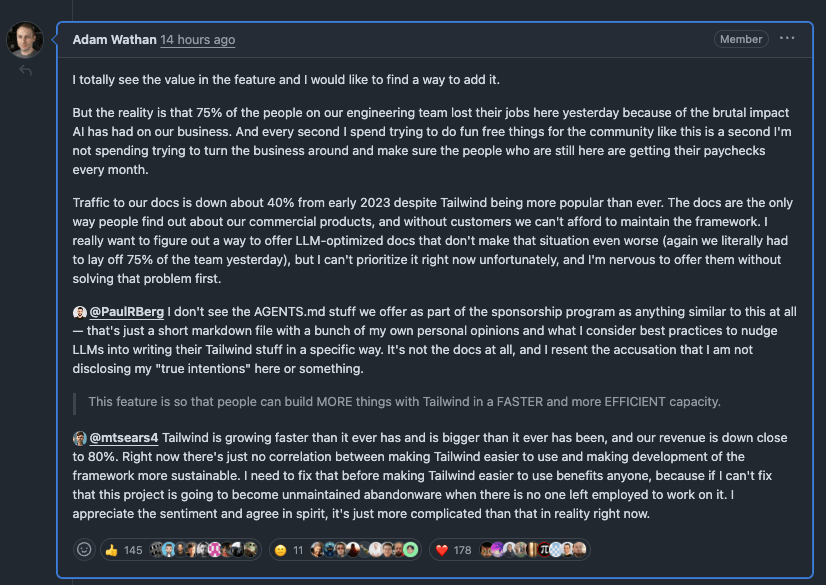
Tailwind is more popular than ever. Revenue is down 80%. He just laid off 75% of his engineering team.
Let that sink in. A product achieving peak adoption is simultaneously experiencing revenue collapse. This isn’t a business failure. It’s the first major casualty of a fundamental shift in how value flows through the internet.
And if you’re building a SaaS company, you need to pay attention.
The Bridge That AI Burned Down
For two decades, the freemium playbook was gospel. Build something valuable for free. Create documentation and educational content. Let people discover you through search. Convert a percentage into paying customers.
The model worked because it controlled the entire journey. Free users landed on your site, read your docs, explored your ecosystem, and eventually hit the ceiling where they needed to pay.
AI didn’t just disrupt this funnel. It obliterated it.
Here’s what happened to Tailwind: documentation traffic dropped 40% since early 2023. That’s not a gradual decline. That’s the floor falling out. People aren’t reading docs anymore. They’re asking ChatGPT how to center a div with Tailwind, getting a perfect answer, and never visiting tailwindcss.com.
The AI learned from those docs. Now it serves that knowledge directly to users. The creator gets nothing.
Adam put it perfectly: “There’s no correlation between making Tailwind easier to use and making development of the framework more sustainable.”
Translation: Your product’s success is now decoupled from your business’s survival.
Why This Terrifies Me as a Founder
I’ve been building software products for years. Before ChatMaxima, I built BrandMaxima, a social media intelligence platform tracking 100 million accounts. I’ve watched business models evolve, but this shift feels different.
The scary part isn’t that AI is better at answering questions. It’s that AI sits between your product and your customers, extracting value without passing anything back.
Think about what freemium businesses actually sell. They don’t sell the product. They sell the journey from free to paid. The documentation, tutorials, community forums, and support channels. All of it existed to build trust and demonstrate value until the user was ready to convert.
AI compressed that journey into a single prompt. The trust-building is gone. The value demonstration happens elsewhere. The conversion path is severed.
If your business relies on any of these, you’re exposed:
Free content as a discovery channel. AI scrapes it, serves it, and users never visit your site.
Documentation as a sales funnel. Users get answers from AI assistants that trained on your docs.
Community goodwill converting to customers. The goodwill remains, but the conversion mechanism is broken.
Open source as a path to enterprise sales. Companies use your code while AI teaches their developers how to implement it. They never need your premium support.
The Businesses That Will Survive
I’ve spent the last few months thinking about this from the ChatMaxima perspective. We’re in conversational AI, which means we’re building with the same technology that’s disrupting these models. That gives us a front-row seat to what works and what doesn’t.
Here’s what I’ve concluded: the survivors won’t be the companies that fight AI. They’ll be the ones that make AI irrelevant to their core value proposition.
First, value must be in the execution, not the knowledge. Tailwind’s problem is that its value is essentially knowledge: knowing which classes to use and how to combine them. AI is exceptionally good at delivering knowledge. But it’s terrible at doing things. Products that execute actions rather than provide information have a natural moat.
This is why we built ChatMaxima around actual automation, not just information about automation. When a customer’s WhatsApp chatbot handles 500 support tickets overnight, that’s execution. AI can explain how chatbots work. It can’t replace the chatbot actually running.
Second, the moat must be in the network, not the tool. Single-player tools are vulnerable. The value exists in one place and can be replicated or bypassed. But network effects create value that compounds with each additional user. AI can’t replicate a network.
For us, that network is the connection between businesses and their customers across WhatsApp, Instagram, Facebook, and web chat. Every conversation that flows through our platform makes the network more valuable. No amount of AI explanation can replicate that infrastructure.
Third, revenue must be tied to outcomes, not access. The freemium model charged for access to premium features. But if AI can teach users to accomplish their goals without those features, access becomes worthless. The businesses that survive will charge for outcomes: results delivered, problems solved, revenue generated.
What I’m Telling Other Founders
When founders ask me about this shift, I give them three questions to evaluate their exposure:
Can an AI explain your product’s value proposition? If yes, you’re vulnerable. The explanation will reach users before you do.
Does your product require ongoing execution? If the value is delivered once or exists as static knowledge, AI can intermediate. If it requires continuous operation, you’re safer.
Is your pricing tied to outcomes or features? Feature-based pricing assumes users need access. Outcome-based pricing assumes users want results. The second is much harder for AI to disrupt.
The uncomfortable truth is that most SaaS businesses will answer these questions poorly. That’s not a criticism. The freemium playbook worked for so long that we all optimized for it. Now we need to unlearn those habits.
Is Freemium Dead?
I don’t think freemium is dead. But “free as a marketing strategy” might be.
The version of freemium that survived this shift looks different. Free tiers will exist for trial and onboarding, not discovery. The discovery will happen elsewhere: through AI recommendations, through integrations, through network effects that pull users in.
The companies that thrive will be the ones that stop thinking of free as a funnel and start thinking of it as a playground. A place where users experience value before committing. Not a place where users extract value without ever converting.
At ChatMaxima, we’ve structured our model around this principle. Free trials let businesses experience what it’s like to have every customer conversation unified in one place. But the value scales with usage: with conversations handled, with automations running, with integrations connecting. You can’t extract that from an AI explanation.
The Warning Shot Has Been Fired
Adam Wathan’s post isn’t just a story about one company. It’s a forecast of what’s coming for hundreds of businesses built on the same assumptions.
If you’re relying on free content to drive paid conversions, consider this your warning shot. The bridge between “people love your product” and “people pay for your product” is crumbling. AI accelerated the collapse.
The founders who act now will have time to rebuild. The ones who wait for the revenue cliff will find themselves in Adam’s position: wildly successful by every metric except the one that keeps the lights on.
I’m curious to hear from other founders navigating this shift. Is freemium evolving or dying? What new models are you seeing work?
The conversation matters more than ever. Because if we figure this out together, we all have a better chance of building businesses that survive the AI transition.