The chatbot marketplace has arrived — and it’s no longer theoretical.
In early 2026, the concept of browsing, publishing, and deploying chatbots from a centralized storefront went from industry wishlist to reality. The ChatMaxima AI Chatbot Marketplace is now live, letting anyone create and publish conversational chatbots, voice chatbots, and integrations — for free or for profit. It’s the app store model, applied to conversational AI.
Whether you’re a small business owner looking to automate customer support or a developer wanting to monetize your chatbot expertise, understanding how chatbot marketplaces work is now a competitive necessity. This guide covers everything: how they work, what features matter, how to evaluate platforms, and how to get started — with real examples from a marketplace you can use today.
What Is a Chatbot Marketplace?
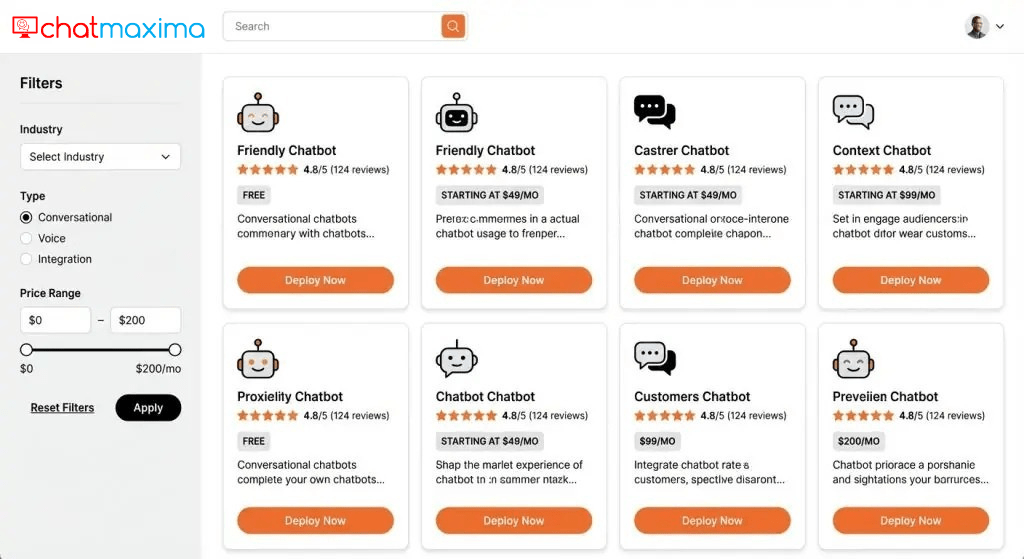
A chatbot marketplace is a digital platform where businesses discover, compare, and deploy chatbot solutions — and where creators publish and distribute those solutions to a global audience. Think of it as an app store built specifically for conversational AI.
The traditional approach to chatbot deployment required hiring developers, spending months on custom builds, and dealing with ongoing maintenance. Chatbot marketplaces disrupt that model by offering:
Pre-Built Chatbots Ready to Deploy: Browse conversational chatbots and voice chatbots built for specific use cases — customer support, lead generation, appointment booking, ecommerce assistance — and deploy them in hours instead of weeks.
A Creator Ecosystem: Developers and agencies can build chatbots and publish them to the marketplace, offering them for free or setting their own prices. This creates a growing library of solutions that improves over time.
Integration Marketplaces: Beyond chatbots themselves, marketplaces like ChatMaxima’s also host integrations — connectors to CRM systems, payment processors, help desks, and other business tools that extend what your chatbot can do.
Flexible Pricing Models: From free community-built bots to premium enterprise solutions, the marketplace model lets you start at zero and scale up as you need more sophisticated capabilities.
The two-sided marketplace model is what makes this powerful. Solution creators gain distribution to thousands of potential customers. Businesses gain access to a curated, ever-expanding library of vetted chatbot solutions. And the marketplace itself gets better with every new listing.
The ChatMaxima AI Chatbot Marketplace: What’s Now Possible
The ChatMaxima AI Chatbot Marketplace represents a concrete example of where the industry is heading — and it’s already live.
Here’s what makes it distinctive:
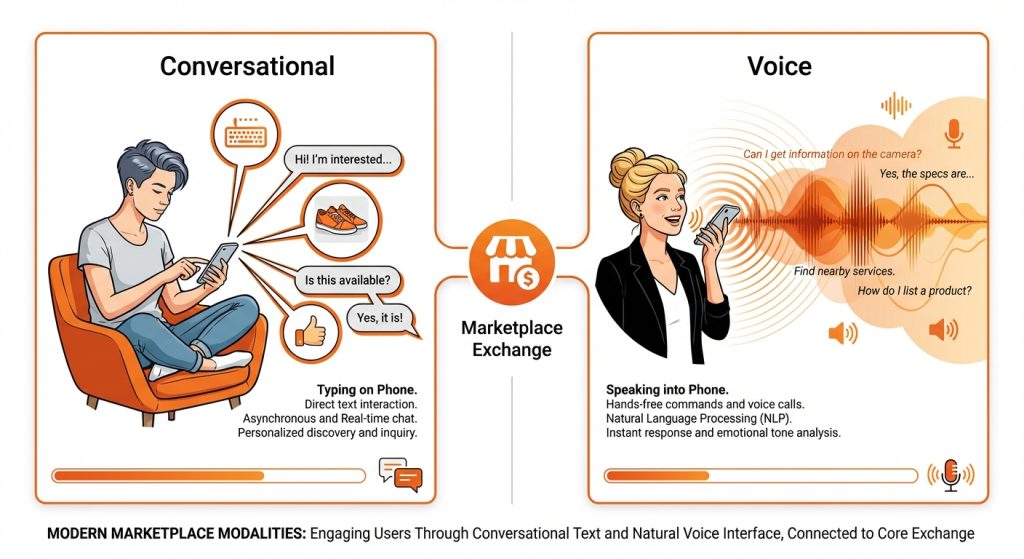
Conversational Chatbots
Creators can build and publish text-based chatbots designed for specific business scenarios. Imagine browsing a marketplace and finding:
-
- A customer support bot pre-trained on common SaaS help desk patterns, ready to handle password resets, billing questions, and feature inquiries
- A lead qualification bot that asks the right questions, scores prospects, and routes hot leads to your sales team
- An ecommerce shopping assistant that guides visitors through product catalogs, answers sizing questions, and recovers abandoned carts
- A real estate inquiry bot that captures buyer preferences, schedules viewings, and provides property information 24/7
- An appointment booking bot for clinics, salons, or consulting firms — integrated with calendar systems
Each of these can be listed as free or paid, letting creators monetize their expertise while businesses skip months of development work.
Voice Chatbots
Voice is no longer a future feature — it’s a marketplace category. The ChatMaxima Marketplace supports voice chatbots that handle spoken interactions, opening up use cases like:
-
- Phone-based customer service that resolves common queries without a human agent
- Voice-enabled ordering systems for restaurants and delivery services
- Interactive voice assistants for healthcare appointment management
- Multilingual voice bots that detect language and respond naturally
Voice chatbots in the marketplace follow the same publish-and-deploy model as text bots, making sophisticated voice AI accessible without building from scratch.
Integrations
Beyond chatbots, the marketplace also hosts integrations — pre-built connectors that extend chatbot capabilities. These might include:
-
- CRM sync modules (Salesforce, HubSpot, Zoho)
- Payment processing connectors (Stripe, PayPal)
- Calendar integrations (Google Calendar, Calendly)
- Help desk bridges (Zendesk, Freshdesk)
- Custom webhook handlers for specific platforms
ChatMaxima’s existing integration ecosystem already supports deep connections across business tools, and the marketplace model expands this by letting third-party developers contribute their own connectors.
The Monetization Model
This is the piece that turns a chatbot directory into a true marketplace. Creators can:
-
- Publish for free — to build reputation, gather users, and demonstrate expertise
- Set paid pricing — subscription or one-time fees for premium bots and integrations
- Offer freemium models — basic functionality free, advanced features paid
For businesses, this means a growing ecosystem of solutions where market forces drive quality. Popular bots rise to the top. Poorly designed ones get filtered out by ratings and reviews. The marketplace gets smarter over time.
Key Features to Look for in a Chatbot Marketplace
Not all chatbot marketplaces deliver equal value. Here’s what separates platforms that drive ROI from those that gather digital dust.
Multi-Channel Deployment
Your customers interact across multiple touchpoints — website, WhatsApp, Facebook Messenger, Instagram, email, and more. A strong chatbot marketplace should offer solutions that work seamlessly across all these channels from a single dashboard.
Look for platforms that support omnichannel orchestration, where a conversation started on your website can continue via WhatsApp without losing context. This continuity prevents the frustration of customers repeating information across channels.
No-Code Bot Builders
Technical barriers shouldn’t prevent effective automation. The best chatbot marketplaces include visual bot builders with drag-and-drop interfaces that let non-technical team members create, modify, and publish conversation flows.
These builders typically feature:
Visual Flow Designers: Create conversation branches using flowchart-style interfaces where you can see the entire customer journey at a glance.
Conditional Logic: Set up if/then rules that adapt responses based on user inputs, time of day, customer history, or any other data point.
A/B Testing Capabilities: Test different conversation approaches to optimize conversion rates and satisfaction scores.
Version Control: Roll back changes if a new flow isn’t performing as expected.
AI and Natural Language Processing
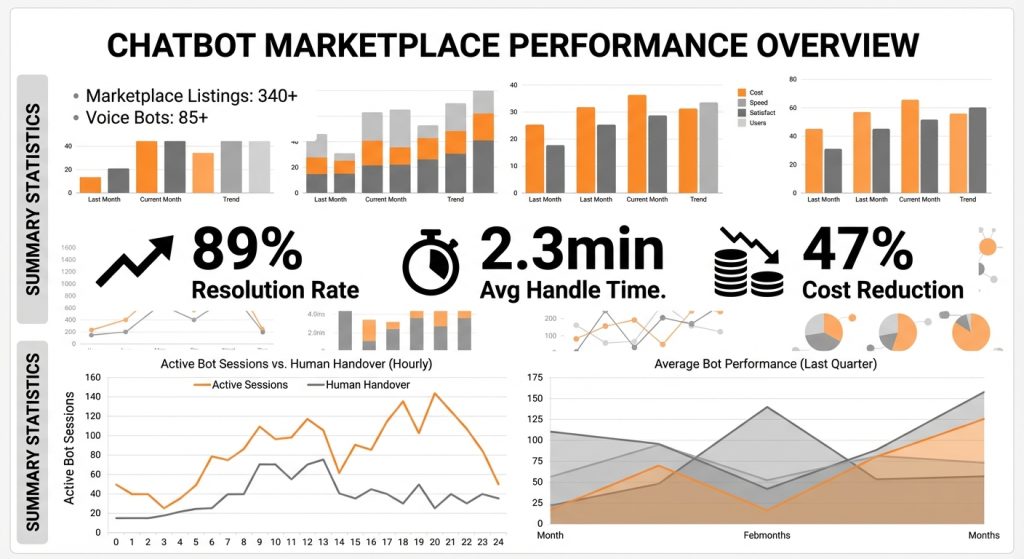
The gap between rule-based chatbots and AI-powered conversational agents has widened dramatically in 2026. Modern chatbot marketplaces should offer access to advanced NLP capabilities:
Intent Recognition: Understanding what users actually want, even when they phrase questions unexpectedly.
Entity Extraction: Identifying key information like dates, names, product categories, and locations from natural conversation.
Sentiment Analysis: Detecting frustration or confusion and escalating to human agents before situations deteriorate.
Multilingual Support: Serving global audiences by automatically detecting language preferences and responding appropriately.
When evaluating AI capabilities, test with real customer queries from your business. Generic performance claims matter less than how the solution handles your specific scenarios.
Integration Depth
A chatbot operating in isolation delivers limited value. The most powerful implementations connect deeply with your existing business systems to access customer data, trigger workflows, and update records in real-time.
Priority integrations to verify:
-
- CRM Systems: Sync conversations with Salesforce, HubSpot, or Zoho for complete interaction histories
- Help Desk Tools: Auto-create support tickets with full conversation context
- Payment Processors: Process transactions without leaving the conversation
- Analytics Platforms: Track chatbot performance alongside other business KPIs
- Calendar Systems: Let customers book appointments through conversational interfaces
The ChatMaxima platform offers deep integrations across multiple business tools, and its marketplace extends this further by letting third-party developers publish integration connectors that anyone can use.
How Chatbot Marketplaces Compare to Custom Development
The decision between marketplace solutions and custom development is one of the most significant strategic choices businesses face.
Time to Market
Custom chatbot development typically requires 3-6 months. Chatbot marketplace solutions compress this to days or hours:
-
- Browse the marketplace for a chatbot matching your use case
- Deploy and customize conversation flows using visual builders
- Connect integrations through guided setup
- Test with a small user group
- Launch to your full customer base
This speed advantage is critical when responding to market opportunities or seasonal demand spikes.

Cost Structures
Custom chatbot development carries substantial upfront costs — developer salaries ($80-150/hr), design resources, project management, and ongoing maintenance. A mid-complexity chatbot often exceeds $50,000-75,000 in the first year.
Chatbot marketplace pricing operates on predictable subscription models:
Starter Plans: $0-49/month for basic chatbots with limited conversation volume.
Professional Tiers: $99-299/month for advanced features, higher limits, and priority support.
Enterprise Packages: $500+/month for white-labeling, dedicated infrastructure, and custom SLAs.
And with marketplaces like ChatMaxima’s, there’s another option: deploying a free community-built chatbot and paying only for the platform hosting. This dramatically lowers the barrier to entry for small businesses.
Platforms like ChatMaxima offer transparent capacity limits at each tier, enabling accurate cost forecasting as usage grows.
Flexibility and Control
Custom development offers complete control but demands ownership responsibility — maintaining code, patching vulnerabilities, and adapting to platform changes.
Chatbot marketplaces trade some flexibility for convenience and continuous improvement. You’re constrained by the platform’s capabilities, but you benefit from security updates, new features, and an expanding marketplace of solutions built by other creators.
Top Use Cases Driving Chatbot Marketplace Adoption
Here’s how businesses are using chatbot marketplaces — and the kinds of solutions you can find (or publish) on platforms like the ChatMaxima Marketplace.
Customer Support Automation
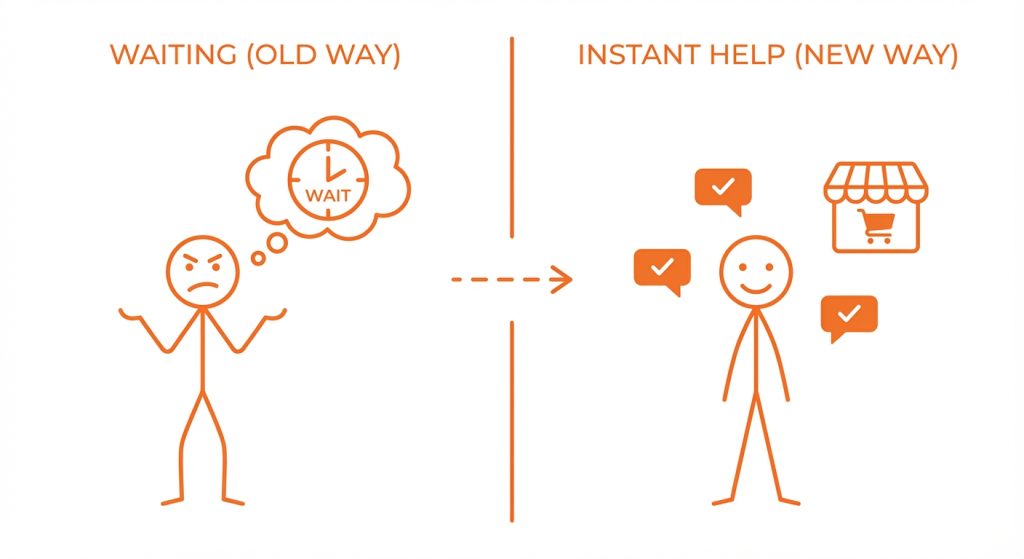
The most popular category in any chatbot marketplace. Well-designed support chatbots resolve 60-80% of common questions about:
-
- Account status and order tracking
- Password resets and login assistance
- Product specifications and compatibility
- Return policies and warranty information
- Business hours and location details
On the ChatMaxima Marketplace, you might find support bots tailored for SaaS companies, ecommerce brands, or service businesses — each pre-built with industry-specific conversation flows that you can customize and deploy.
Lead Generation and Qualification
Sales teams waste hours on unqualified leads. Chatbot marketplace solutions automate the qualification process by:
Engaging Visitors Proactively: Triggering conversations when visitors spend time on high-intent pages.
Asking Qualifying Questions: Collecting information about budget, timeline, and decision-making authority through natural conversation.
Scoring and Routing Leads: Assigning priority scores and routing hot prospects directly to sales representatives.
Scheduling Demos: Letting qualified leads book meetings directly through the chatbot.
A lead gen bot from the marketplace can increase sales team productivity by 35-50% while ensuring reps spend time only with prospects likely to convert.
Appointment Booking
Service businesses lose revenue to scheduling friction. Marketplace chatbots integrate with calendar systems to display real-time availability, handle timezone conversions, send confirmations, manage rescheduling, and reduce no-shows with reminders.
Businesses implementing appointment chatbots typically see booking completion rates increase 25-40% compared to phone or email scheduling.
Ecommerce Assistance
Online shoppers face choice overload. Ecommerce chatbots from the marketplace act as virtual shopping assistants that guide product discovery, answer questions, recover abandoned carts, suggest complementary products, and process transactions — all through conversational interfaces.
Ecommerce brands using marketplace chatbots typically see 10-25% increases in conversion rates and 15-30% improvements in average order value.
Voice-First Experiences
With voice chatbots now available in marketplaces, businesses are deploying:
-
- Phone support automation that handles tier-1 inquiries without a human
- Voice ordering systems for food service and retail
- Interactive voice response (IVR) replacements that actually understand natural language
- Accessibility-focused voice bots that serve customers who prefer speaking over typing
This category is growing fast on the ChatMaxima Marketplace, where voice bot creators can reach businesses that previously couldn’t afford custom voice AI development.
Evaluating Chatbot Marketplace Platforms: What to Test
Before committing to a platform, conduct hands-on testing under real-world conditions.
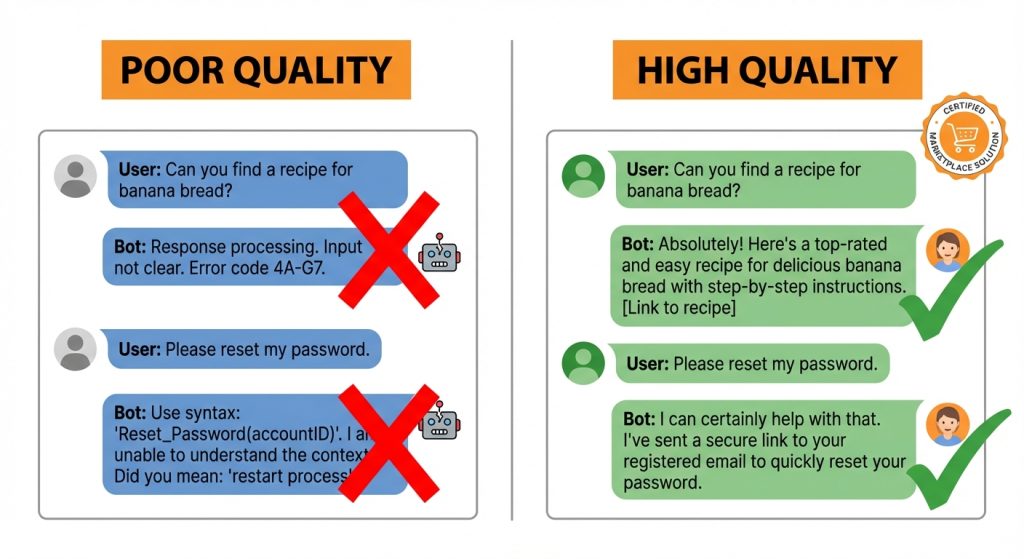
Conversation Quality Assessment
Sign up for a free trial and deploy a chatbot focused on one of your actual use cases. Test it with:
Real Customer Questions: Pull 20-30 actual questions from your support tickets or sales inquiries and see how accurately the chatbot responds.
Edge Cases: Deliberately try to break it with ambiguous questions, typos, slang, and unexpected conversation paths.
Context Retention: Assess whether the chatbot maintains context across multiple exchanges.
Response Times: Measure speed, especially during complex integrations.
Quality chatbots should handle 70-80% of test questions accurately during initial setup, with room for improvement through training.
Integration Testing
Many platforms advertise hundreds of integrations, but quality varies. During evaluation:
-
- Test critical integrations end-to-end with your actual CRM, help desk, or other tools
- Check sync frequency — real-time matters more for sales than support
- Validate data mapping between chatbot fields and connected systems
- Assess error handling when external systems become unavailable
Scalability and Performance
Test with increasing conversation volumes to understand platform limits:
-
- Concurrent conversation capacity
- Monthly message limits
- Response time under load
- API rate limits for integrations
Support and Documentation Quality
Evaluate support by actually testing it:
-
- Submit questions through multiple channels and measure response times
- Review documentation for depth and clarity
- Explore community resources — active communities indicate healthy platforms
- Check SLA commitments for enterprise plans
Common Chatbot Marketplace Pitfalls to Avoid
Overcomplicating Initial Deployments
The most common failure: launching chatbots that try to handle too many use cases simultaneously. This creates training complexity, maintenance burden, user confusion, and delayed launches.
The better approach:
-
- Identify your most frequent inquiry or highest-value conversion point
- Find a marketplace chatbot focused on that scenario (or build one)
- Deploy to a subset of users
- Optimize based on real performance data
- Expand to additional use cases after proving initial success
Neglecting Conversation Design
Technical teams focus on integrations and logic while overlooking conversation design fundamentals. Effective chatbot conversations need:
-
- Clear purpose statements in opening messages
- Guided input options (buttons over free-form text when possible)
- Human handoff triggers when users need a real person
- Personality consistency throughout all interactions
- Error recovery paths that help users get back on track
Ignoring Analytics and Optimization
Launching a chatbot is the beginning, not the end. Monitor:
-
- Containment rate: Conversations resolved without human intervention
- Drop-off points: Where users abandon interactions
- Intent recognition accuracy: How often the chatbot understands correctly
- User satisfaction scores: Direct feedback from customers
- Conversion metrics: Desired actions completed
Schedule monthly reviews and implement small improvements. Active optimization typically improves containment rates 15-25% over six months.
Underestimating Training Requirements
AI chatbots improve through training. Budget 2-4 hours weekly during the first three months for:
-
- Adding example phrases based on how real users phrase questions
- Teaching entity extraction for specific information types
- Refining conversation flows based on drop-off data
- Verifying integrations after updates
The Future of Chatbot Marketplaces
The chatbot marketplace model is still early, but the direction is clear — and platforms like the ChatMaxima Marketplace are building toward it in real time.
Creator Economies for AI: Just as Shopify enabled anyone to launch a store, chatbot marketplaces enable anyone to build and sell AI solutions. Expect a wave of specialized creators — agencies, freelancers, and industry experts — publishing niche chatbots for specific verticals.
Voice-First Expansion: Voice chatbots in the marketplace will expand from simple IVR replacements to fully conversational voice agents handling complex, multi-step interactions.
Industry Vertical Specialization: Generic templates will give way to deeply specialized solutions — healthcare chatbots that understand medical terminology, financial bots that handle compliance requirements, legal assistants that navigate jurisdictional nuances.
Proactive Engagement: Future chatbots will initiate conversations based on behavioral signals rather than waiting for users to ask questions.
Hyper-Personalization: Marketplace chatbots will leverage customer data to tailor conversations based on past interactions, preferences, and predicted needs.
Cross-Platform Portability: Deploy a chatbot from the marketplace to your website, WhatsApp, Instagram, and phone system — all from a single listing.
Businesses that engage with chatbot marketplaces early build institutional knowledge and competitive advantage as the ecosystem matures.
Getting Started with Your First Chatbot Marketplace Deployment
You have two paths, depending on which side of the marketplace you’re on.
If You’re a Business Looking to Deploy
-
- Identify your highest-impact use case — customer support, lead qualification, appointment scheduling, or product discovery
- Browse the ChatMaxima Marketplace for chatbots built for that scenario
- Deploy and customize — adjust conversation flows, connect integrations, add your branding
- Test with real customer questions before full launch
- Launch focused, then expand — one use case done well beats five done poorly
If You’re a Creator Looking to Publish
-
- Identify a gap — what industry or use case is underserved?
- Build a chatbot or integration using ChatMaxima’s platform
- Publish to the marketplace — choose free or paid pricing
- Iterate based on user feedback — ratings and reviews drive visibility
- Scale your catalog as you learn what the market needs
Whether you’re exploring alternatives to traditional live chat platforms or building your first AI-powered customer experience, the chatbot marketplace model makes sophisticated conversational AI accessible to businesses of every size — and turns chatbot expertise into a publishable, monetizable asset.
Start small. Measure obsessively. Optimize continuously. Scale what works.
Frequently Asked Questions
What is a chatbot marketplace?
A chatbot marketplace is a platform where businesses can discover, compare, and deploy pre-built chatbot solutions, and where creators can publish and distribute chatbots and integrations. The ChatMaxima AI Chatbot Marketplace is an example — it hosts conversational chatbots, voice chatbots, and integrations that users can deploy for free or purchase.
Can I sell chatbots on the ChatMaxima Marketplace?
Yes. The ChatMaxima Marketplace supports a creator model where you can build chatbots or integrations and publish them for free or set your own pricing. This lets developers, agencies, and industry experts monetize their conversational AI expertise.
What types of chatbots are available in a chatbot marketplace?
Typical categories include customer support bots, lead generation bots, ecommerce shopping assistants, appointment booking bots, voice chatbots for phone support, and industry-specific solutions for healthcare, real estate, finance, and more. The ChatMaxima Marketplace also hosts integrations that connect chatbots with CRM, payment, and calendar systems.
How much does it cost to use a chatbot from a marketplace?
Costs vary widely. Many marketplace chatbots are free, especially community-contributed solutions. Premium bots and integrations may have subscription or one-time fees set by their creators. Platform hosting costs typically range from free starter tiers to $500+/month for enterprise needs. See ChatMaxima pricing for platform details.
What’s the difference between a conversational chatbot and a voice chatbot?
A conversational chatbot handles text-based interactions — website chat, WhatsApp, Messenger, etc. A voice chatbot handles spoken interactions — phone calls, voice assistants, and audio-first experiences. The ChatMaxima Marketplace supports both types, letting businesses choose the right modality for their customers.
How do I choose the right chatbot from a marketplace?
Start with your use case, not features. Identify your most frequent customer inquiry or highest-value conversion point, then search the marketplace for solutions built for that specific scenario. Deploy a free trial, test with real customer questions, and evaluate based on conversation quality, integration depth, and response speed before committing.