Gartner projects AI will reduce contact center labor costs by $80 billion globally by 2026. That is not a rounding error. It is a structural shift in how businesses deliver customer support — and it is already happening.
Klarna deployed an AI agent in early 2024 that handled 2.3 million customer conversations in its first month — the equivalent of 700 full-time agents. Average resolution time dropped from 11 minutes to 2 minutes. The projected profit improvement: $40 million in a single year.
If you are still running a traditional contact center — or evaluating whether AI is worth the switch — this breakdown gives you the real numbers: what traditional contact centers actually cost, what AI delivers, and how ChatMaxima compares to every alternative on the market.
What a Traditional Contact Center Actually Costs
Most cost comparisons start with agent salaries and stop there. That undersells the problem significantly.
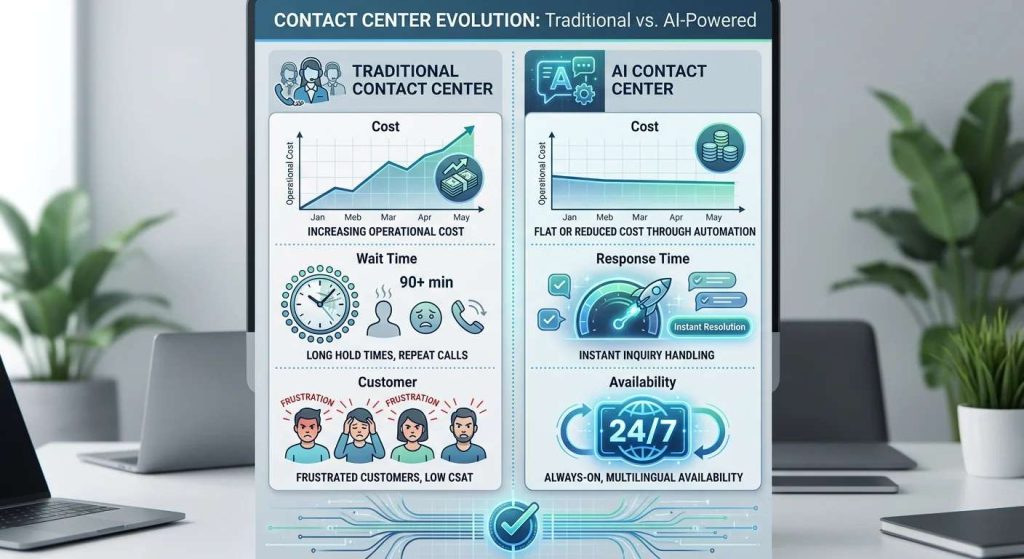
Base salary for a US contact center agent runs $35,810–$40,924 per year according to BLS data. But the fully loaded cost — once you add benefits, payroll taxes, equipment, software licenses, floor space, supervision, training, and IT support — lands between $60,000 and $80,000 per agent per year.
Outsource to the Philippines and the numbers drop, but do not disappear. Offshore agents run $12–$18 per hour, or $25,000–$37,000 annually. Add management overhead, QA, and the infrastructure required to run a remote center and you are still looking at a significant operational burden.
Labor is 60–70% of total contact center costs. The rest:
-
- Physical infrastructure: office space, utilities, workstations, headsets
- Telephony and telecom: PBX systems, trunking, call recording
- Software stack: CRM ($75–$150/user/mo), help desk ($50–$100/user/mo), call center software ($100–$325/agent/mo)
- Management: supervisors, QA analysts, workforce management
- Compliance: GDPR, PCI, HIPAA depending on industry
A 10-agent traditional contact center — a modest operation by any measure — costs $500,000–$750,000 per year in total. Scale to 100 agents and you are past $5 million before you negotiate a single enterprise software discount.
The Hidden Cost Nobody Budgets For: Turnover
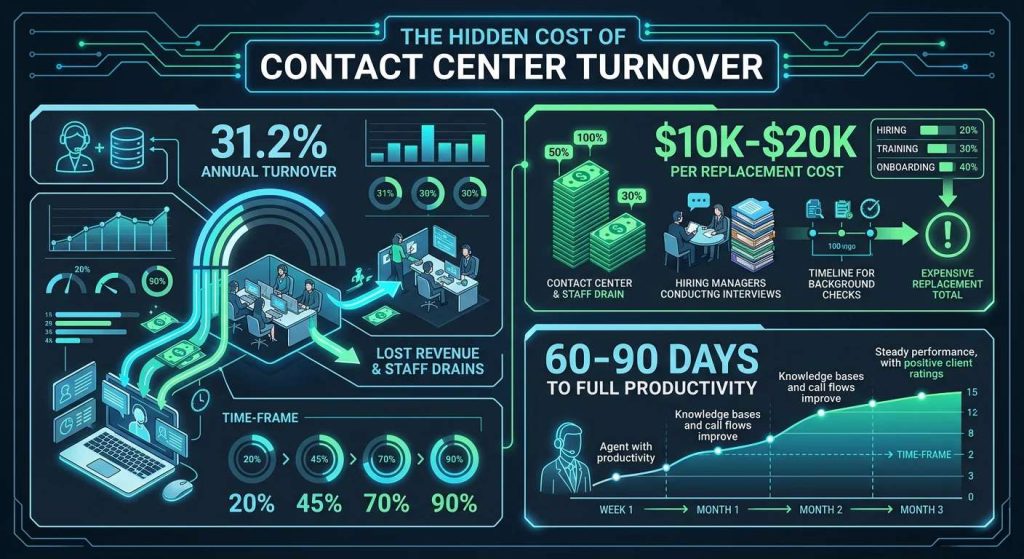
Contact center attrition is brutal. The industry average hit 31.2% annually in 2024 — meaning nearly one in three agents leaves every year.
Replacing an agent costs $10,000–$20,000 when you factor in recruitment, background checks, onboarding (3–6 weeks of training, 60–90 days to full productivity), and the productivity gap while the seat stays empty.
A 100-agent center at 31% turnover replaces roughly 31 agents per year. At $15,000 per replacement: $465,000 in annual turnover costs alone — before you count the customer experience damage from undertrained agents handling live calls.
Training costs $2,000–$4,000 per new hire just for initial onboarding. That does not include ongoing coaching, compliance refreshers, or the time supervisors spend mentoring new staff instead of managing quality.
Cost Per Interaction: Where the Waste Lives
Strip away the fixed costs and look at the transaction level. This is where the comparison becomes impossible to ignore.
Human-handled interactions in 2025:
-
- Voice call: $6–$12 per interaction (industry average $7.16)
- Live chat: $3–$5 per interaction
AI-handled interactions:
-
- AI voice: $0.20–$2.00 per interaction (83–97% cheaper)
- AI chat: $0.50–$0.70 per interaction (83–86% cheaper)
A business handling 50,000 chat interactions per month pays $150,000–$250,000 with human agents. The same volume through AI costs $25,000–$35,000. The gap is $115,000–$215,000 per month.
The reason AI contact center adoption is accelerating at 20–25% CAGR is not hype. The unit economics are genuinely different.
What Deflection Rates Mean for Your Budget
AI systems do not handle every conversation at the same cost — they eliminate a large portion of the load entirely. This is called deflection or containment: queries that get fully resolved without a human ever touching them.
Well-implemented AI achieves 60–80% deflection. Advanced deployments push 80–90%+.
Real benchmarks:
-
- Intercom Fin: 86% resolution rate across its customer base
- Gorgias (e-commerce focus): 60% containment for SMBs
- McKinsey clients with 5,000-agent centers: 14% more issues resolved per hour, 9% reduction in average handle time
If your contact center handles 10,000 conversations per month at $4 average cost per interaction, you are spending $40,000/month. With 75% AI deflection, you handle 7,500 conversations through AI at $0.60 each ($4,500) and 2,500 through humans at $4 each ($10,000). Total: $14,500/month instead of $40,000. Monthly savings: $25,500.
Annualized: $306,000 saved on a 10,000-conversation-per-month business.
What 70-90% of Your Queries Have in Common
The objection that always surfaces: “But what about complex issues that need human judgment?”
Valid concern. Irrelevant to the core math.
Analysis across industries consistently shows that 70–90% of contact center queries are routine — the kind that follow predictable patterns and have defined answers:
-
- Order status and tracking
- Password resets and account access
- Return and refund policies
- FAQ responses
- Appointment scheduling and modifications
- Payment and billing questions
- Basic troubleshooting (tier 1)
- Lead qualification
AI handles these perfectly. For the 10–30% of conversations that are complex, emotionally charged, or require genuine judgment, you escalate to a human — with full conversation context already captured.
The hybrid model is not a compromise. It is the optimal architecture: AI for high-volume routine work, humans for high-stakes exceptions.
Real-World Results: The Case Studies
These are not projections. These are reported outcomes from documented deployments.
Klarna (Buy Now Pay Later, global): AI handled 2.3 million conversations in month one — equivalent to 700 full-time agents. Resolution time dropped from 11 minutes to 2 minutes. Projected annual profit improvement: $40 million.
Multinational bank (McKinsey case): After AI deployment, wait times dropped 94%. Escalations to senior agents fell 37%. Net Promoter Score improved 23 points.
Highmark Health: AI assistant delivered $27.9 million in documented value from reduced handling costs and improved resolution rates.
McKinsey GenAI study across 5,000-agent centers: Productivity increased 14% (more issues resolved per hour), handle time decreased 9%. GenAI overall boosts customer service productivity 30–40% while reducing cost-to-serve 20–30%.
These are organizations with existing contact center infrastructure making the shift. The savings compound over time.
Customer Acceptance: What the Data Actually Shows
Some businesses hesitate because they assume customers hate bots. The data tells a different story.
74% of customers are satisfied with AI interactions globally. When AI fully resolves an issue — no escalation needed — satisfaction climbs above 90%.
For simple queries, AI CSAT scores run 70–87%, compared to 80–85% for humans. The gap is smaller than most people expect, and it closes fast as AI quality improves.
62% of customers prefer AI over waiting 15+ minutes for a human agent. That is the real comparison — not AI versus an instant human response, but AI versus the reality of queue times.
74% prefer chatbots specifically for simple queries. That aligns almost exactly with the 70–90% routine query proportion identified above.
The nuance: 89% of customers believe there should always be a human option available. The hybrid model satisfies this. Customers want AI for fast, simple resolutions — and humans when the stakes are higher.
Gen Z is 2x more comfortable with AI interactions than Baby Boomers. As your customer base skews younger, acceptance rates will continue rising.
ChatMaxima vs The Field: A Pricing Reality Check
The AI contact center market is crowded. Most platforms charge per seat, per resolution, or on enterprise contracts that bring their own complexity. Here is what the market actually looks like in 2026:
Legacy CCaaS (Cloud Contact Center as a Service):
-
- Five9: $175–$325/agent/month
- Genesys Cloud: $75–$155/agent/month
- NICE CXone: $71–$249/agent/month
- Talkdesk: $85–$145/agent/month
These are legacy telephony vendors adding AI features. Per-agent pricing means your costs scale directly with headcount — which defeats the purpose of automation.
AI-first platforms:
-
- Intercom (Fin AI): $74/seat + $0.99 per resolution. A 10-seat team resolving 2,000 conversations/month: $740 + $1,980 = $2,720/month
- Zendesk: $55–$169/agent/month + $1.50/AI resolution
- Drift: $2,500/month base before per-seat charges
ChatMaxima:
-
- Starter: $19/month
- Pro: $99/month
- Max: $299/month
- Ultra: $499/month
Team members included at every tier. No per-resolution fees. No per-agent charges that compound as your volume grows.
At the Starter tier, ChatMaxima costs less per year than a single day of one US contact center agent’s salary. At Pro — the tier most growing businesses operate at — you are still 3–10x cheaper than the comparable feature set from Intercom, Zendesk, or any legacy CCaaS platform.
See the full pricing breakdown and compare what each tier includes. If you are currently evaluating Intercom, the ChatMaxima vs Intercom comparison is worth reading before you sign anything. If Drift is on your shortlist, the Drift alternative breakdown runs the numbers head to head.
The Analyst Consensus
Independent research firms are not neutral on this question anymore. The direction is clear:
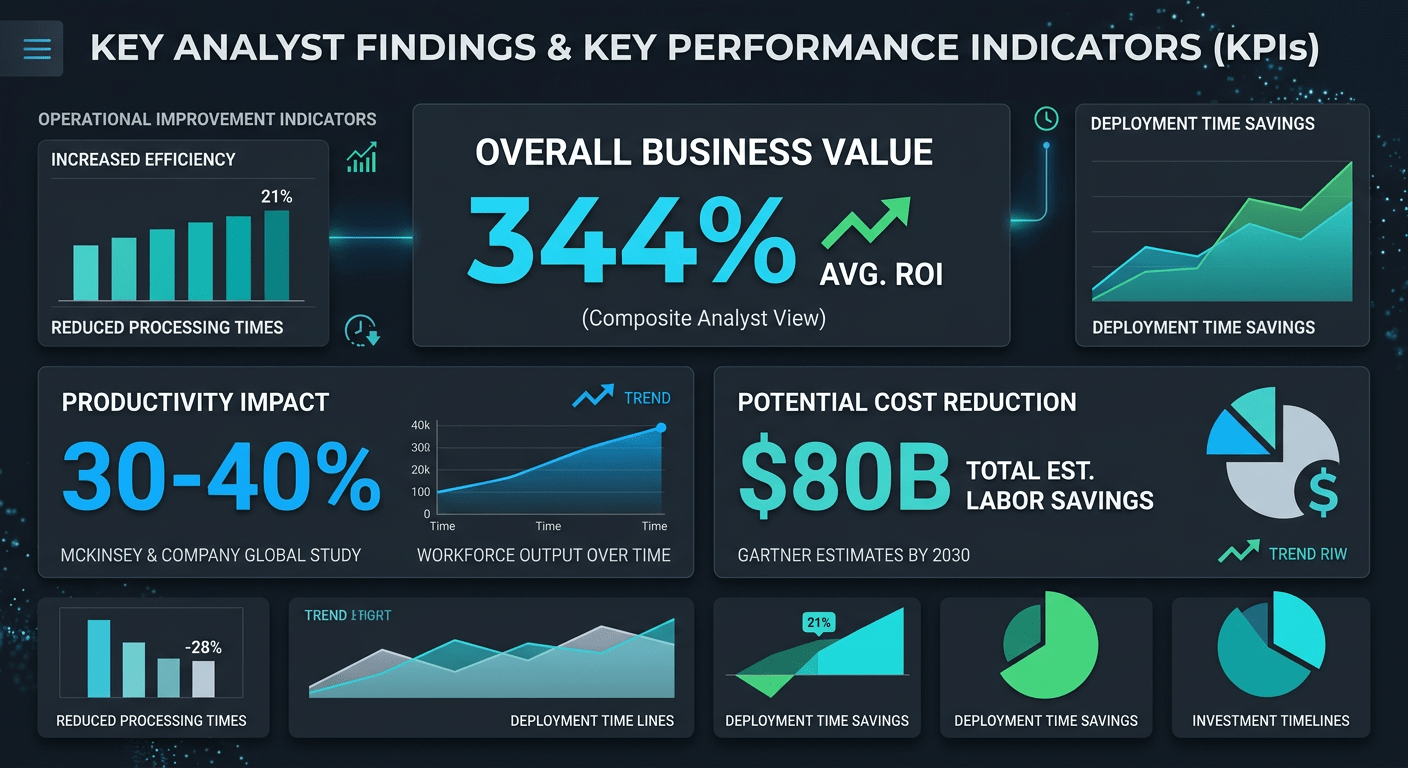
McKinsey: Generative AI boosts customer service productivity 30–40% and reduces cost-to-serve 20–30%.
Gartner: AI will reduce contact center labor costs by $80 billion by 2026. AI tools reduce per-conversation costs 30–70%.
Juniper Research: AI chatbots will save businesses $8 billion+ annually by 2026.
Forrester: 47% of customer service leaders are already investing in AI agents. Another 41% plan to do so within 24 months. A separate Gartner survey found 91% of CS leaders say they are under pressure to implement AI.
Average documented AI chatbot ROI across industries: 200–800%, with an average of 344% within 12 months of deployment.
This is not a niche technology experiment. It is mainstream infrastructure.
Implementation: Traditional vs AI
Traditional contact center buildouts are expensive for a reason — they require physical infrastructure, lengthy procurement cycles, agent hiring pipelines, and technology integrations that take months to configure.
Traditional setup timeline: 3–12 months
That includes real estate decisions, hardware procurement, telephony configuration, software implementation, hiring batches, training cohorts, and QA process development. Every month of delay has real cost: the support load still lands, and it lands on whatever inadequate system you are running today.
AI deployment timeline: Hours to days
With ChatMaxima, the path from signup to live deployment is:
-
- Configure your AI agent with your business context, tone, and knowledge base
- Connect your channels — website chat, WhatsApp, Facebook Messenger, Instagram, email
- Set escalation rules for when conversations should route to human agents
- Go live
No hardware. No leases. No onboarding cohorts. Your existing team manages escalations from the same interface they already use.
ChatMaxima connects to the tools you already run: Salesforce, HubSpot, Pipedrive, Shopify, WooCommerce, Zendesk, Freshdesk, Google Calendar. See the full integrations list for what plugs in natively.
The Right Migration Sequence
Replacing a traditional contact center does not require a one-day cutover. Most businesses that succeed with this transition use a phased approach that manages risk while proving value early.
Phase 1 — Off-hours and overflow (weeks 1–4): Deploy ChatMaxima for after-hours coverage and overflow during peak periods. Your human team continues normal operations. AI handles what would otherwise go to voicemail or queue abandonment. Measure containment rates and CSAT.
Phase 2 — Tier-1 automation (weeks 4–8): Let ChatMaxima handle routine inquiries during business hours. Human agents focus on escalations, complex cases, and relationship-critical accounts. Refine escalation triggers based on actual conversation data.
Phase 3 — Full hybrid operations (months 3–6): Optimize the AI-to-human ratio for your specific query mix. Most businesses find that 70–80% AI containment is achievable within 90 days of a well-configured deployment. Some reach 85–90% for query types that are highly structured.
Phase 4 — Infrastructure right-sizing: As AI handles more volume, reduce traditional infrastructure through natural attrition — not forced layoffs. Human agents shift toward higher-complexity work where they add more value and face less burnout.
This sequence lets you build confidence in AI performance before making irreversible infrastructure decisions. The ROI is typically visible within the first 30 days.
What You Are Actually Buying
The comparison often gets framed as AI versus humans. That is not the right frame.
The real question is: what is the most intelligent allocation of your customer service resources?
Human agents are expensive, inconsistent, and unavailable outside business hours. They burn out on repetitive queries. They make mistakes when fatigued. They leave — costing you $10,000–$20,000 per departure just to return to baseline.
AI handles the high-volume, repeatable work without variability, without turnover costs, and without shift premiums. It creates availability that contact centers cannot match without prohibitive cost. It gives your human team the bandwidth to focus on the work that actually requires judgment.
For businesses evaluating alternatives, the ChatMaxima alternatives page covers how the platform compares across key dimensions — not just price.
The Numbers at Scale
To make the comparison concrete at different business sizes:
Small business (1,000 conversations/month):
-
- Traditional (2 part-time agents): ~$60,000/year
- ChatMaxima Starter + 1 escalation agent (part-time): ~$18,000/year
- Annual savings: ~$42,000
Mid-market (10,000 conversations/month):
-
- Traditional (10 agents + supervisor): ~$600,000/year
- ChatMaxima Pro + 2 human agents for escalations: ~$98,000/year
- Annual savings: ~$502,000
Growth company (50,000 conversations/month):
-
- Traditional (45 agents + management): ~$2,700,000/year
- ChatMaxima Max + 8 specialist agents: ~$380,000/year
- Annual savings: ~$2,320,000
The percentage savings in the 78–86% range holds across scales because the fixed cost of ChatMaxima barely moves while traditional center costs scale linearly with headcount.
Where This Goes From Here
The AI contact center market hit $2.4–$4.2 billion in 2025 and is growing at 20–25% annually. That growth rate reflects real adoption, not speculation. 65% of support queries were resolved without human involvement in 2025 — a number that continues to rise as AI quality improves and more businesses cross the implementation threshold.
The businesses that are moving now are gaining compounding advantages: lower operating costs, better customer data, 24/7 availability, and the ability to scale support without proportional headcount increases. The ones waiting will face the same transition costs later — with competitors already operating at a structural cost advantage.
The math on traditional contact centers was always uncomfortable. In 2026, it is untenable.
Start With the Numbers That Matter to Your Business
The right starting point is your current monthly conversation volume and cost-per-contact. If you do not have those numbers, your billing data and current headcount will give you a working estimate.
With those inputs, the ROI calculation is straightforward — and the gap between what you are spending now and what you would spend on AI is usually large enough to make the decision obvious.
ChatMaxima’s pricing starts at $19/month with no per-agent fees and no per-resolution charges. The Pro plan at $99/month covers what most growing businesses need, including multi-channel deployment, team member access, and integrations with your existing stack.
The contact center you build around AI does not just cost less. It operates differently — always available, consistently quality, and scalable without the hiring, training, and turnover overhead that consumes traditional center budgets.
That is the shift worth making.