
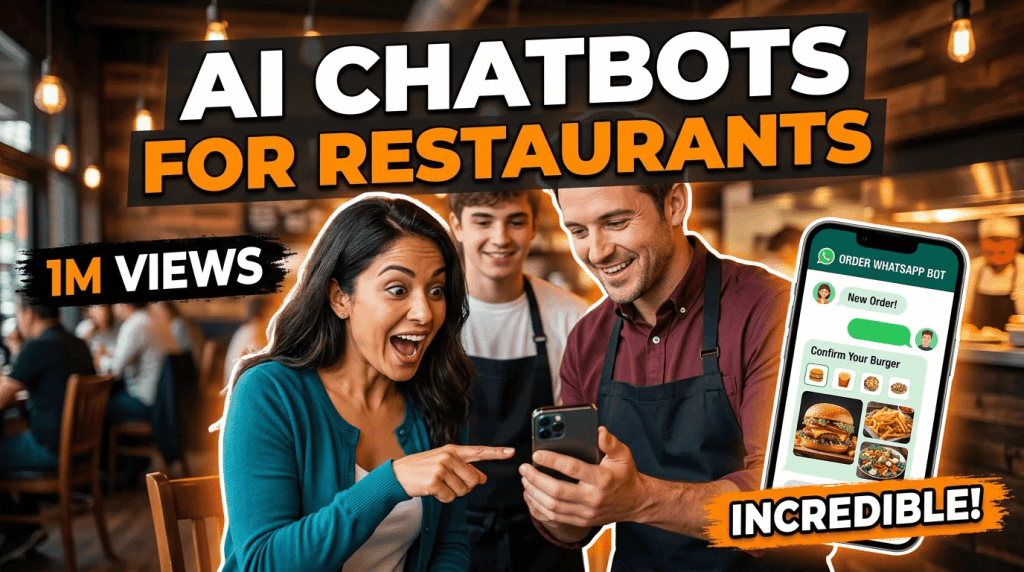
Burger King just strapped AI into its employees’ headsets. The fast food chain’s new chatbot, “Patty,” powered by OpenAI, now listens to drive-thru conversations in real time, according to The Guardian. It detects whether workers say “please” and “thank you,” monitors order accuracy, and coaches staff on meal prep. The pilot covers 500 US locations, with plans to roll it out nationwide by the end of 2026.
The reaction online has been swift: “dystopian,” “peak late-stage corporate behavior,” and worse. And honestly, the criticism isn’t unfounded. When your AI’s primary job is surveillance rather than service, pushback is inevitable.
But here’s the thing most people are missing. Burger King’s approach is just one way restaurants are using AI chatbots, and it’s arguably the least effective. While BK monitors employees, other restaurant chains are using AI chatbots to serve customers directly through WhatsApp, web chat, and messaging apps. And that approach is working far better.
How Leading Restaurant Chains Use AI Chatbots Today
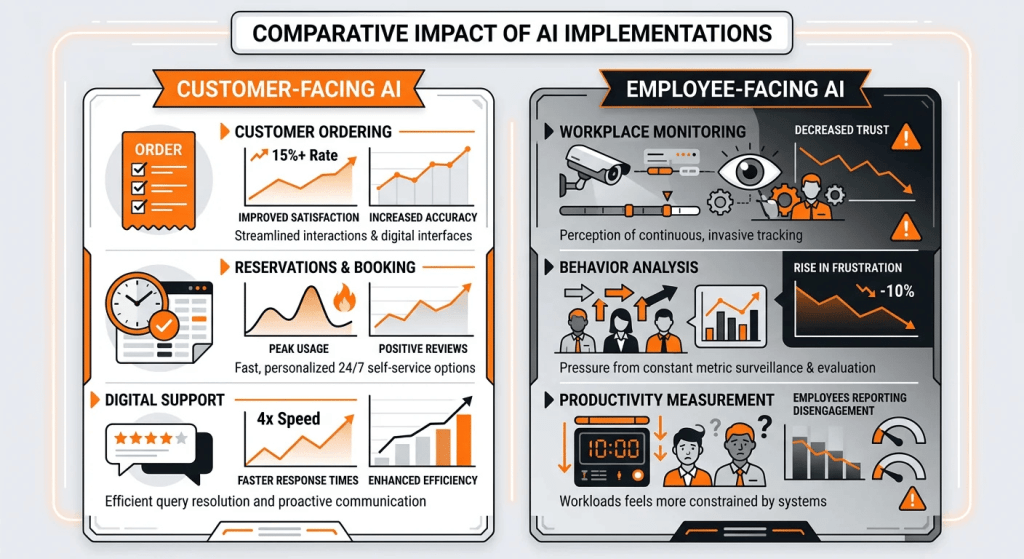
The restaurant industry’s AI chatbot landscape splits into two clear camps: employee-facing tools and customer-facing tools. The results tell a compelling story about which approach wins.
Customer-Facing AI Chatbots: The Winners
Domino’s “Dom” lets customers order pizza through Google Assistant, Alexa, Facebook Messenger, WhatsApp, and SMS. Customers track their orders in real time from dough to doorstep. No app download required for messaging channels. No phone call needed.
KFC India went all-in on WhatsApp for ordering. Customers browse the full menu, pick combos, customize their meals, and place orders without downloading a separate app. For a market where WhatsApp is the default communication tool, this was a brilliant move.
Starbucks’ “My Starbucks Barista” handles voice and text ordering, processes payments, manages rewards points, and delivers personalized suggestions based on order history. It knows your usual. It remembers you like oat milk. It suggests seasonal drinks based on your preferences.
Pizza Hut’s “Hutty” manages table bookings, menu browsing, and order placement through Messenger and X. BVK Biriyani, a smaller Indian restaurant chain, runs WhatsApp-based table booking and food pickup with their full menu accessible in chat.
Employee-Facing AI Chatbots: Mixed Results
Burger King’s “Patty” monitors employee behavior through headsets. Early reports suggest employee discomfort and public backlash that could hurt the brand.
McDonald’s “Ask Pickle” takes a softer employee-facing approach, serving as an operational assistant that helps staff troubleshoot in-restaurant equipment issues and find process information. But McDonald’s actually ended its customer-facing AI drive-thru experiment in 2024, pulling the technology from over 100 locations after accuracy problems.
The pattern is clear. Restaurants that point AI at customers to make ordering faster and more convenient are seeing adoption and growth. Restaurants that point AI at employees to monitor behavior are seeing resistance and PR problems.
The Drive-Thru AI Race: Who’s Winning
Before diving into the full range of chatbot use cases, it’s worth examining drive-thru AI specifically, since it’s dominated restaurant tech headlines throughout 2026.
Wendy’s FreshAI, built on Google Cloud, handles AI-powered drive-thru ordering with upsell suggestions. It processes natural language orders, handles modifications (“actually, make that a large”), and recommends add-ons based on what the customer ordered. Wendy’s continues expanding this to more locations.
White Castle partnered with SoundHound to deploy AI voice bots across drive-thru lanes, reducing wait times and freeing up staff for food preparation.
Taco Bell rolled out AI voice ordering at over 500 drive-thru locations in 2024, making it one of the largest deployments of voice AI in the quick-service restaurant industry.
These drive-thru solutions solve a real problem: labor shortages and long wait times. But they’re inherently limited to drive-thru restaurants with the infrastructure to support voice AI hardware.
For the vast majority of restaurants, including sit-down restaurants, local eateries, delivery-focused kitchens, and small chains, the real opportunity lies elsewhere: messaging-based AI chatbots that work on channels customers already use.
8 Ways Any Restaurant Can Use AI Chatbots
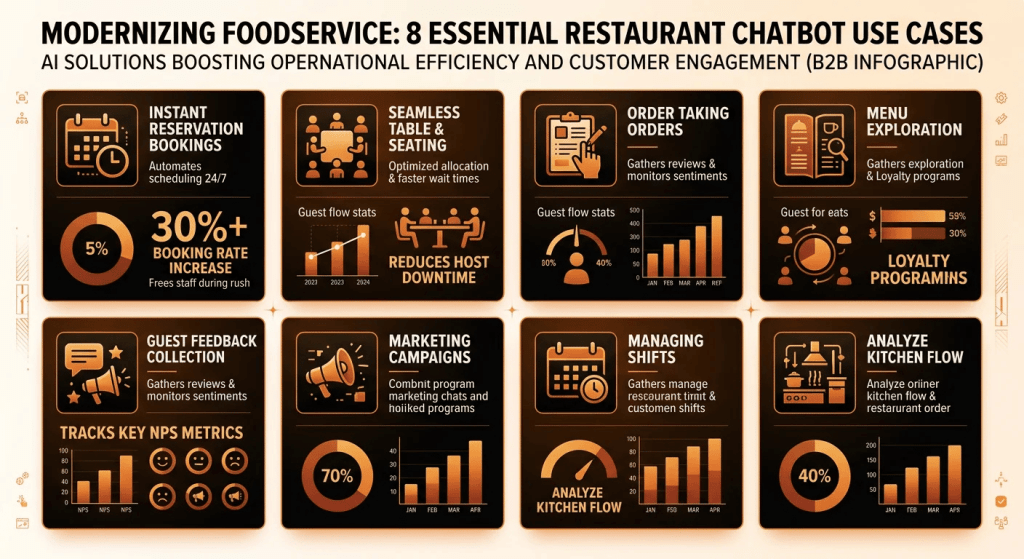
You don’t need to be a multinational chain to benefit from restaurant AI chatbots. Here are eight practical use cases, each with real examples and clear business impact, that work for restaurants of any size.
1. WhatsApp and Online Ordering
Customers browse your menu, customize their orders, and pay, all within a chat conversation. No app download. No account creation. No friction.
Real example: KFC India’s WhatsApp ordering lets customers view the full menu, select combos, and place orders without leaving the chat. Domino’s offers similar functionality across WhatsApp, Messenger, and SMS.
Business impact: Restaurants using chat-based ordering report higher order completion rates compared to app-based ordering, primarily because there’s no download barrier. When ordering is as easy as sending a message, more people order.
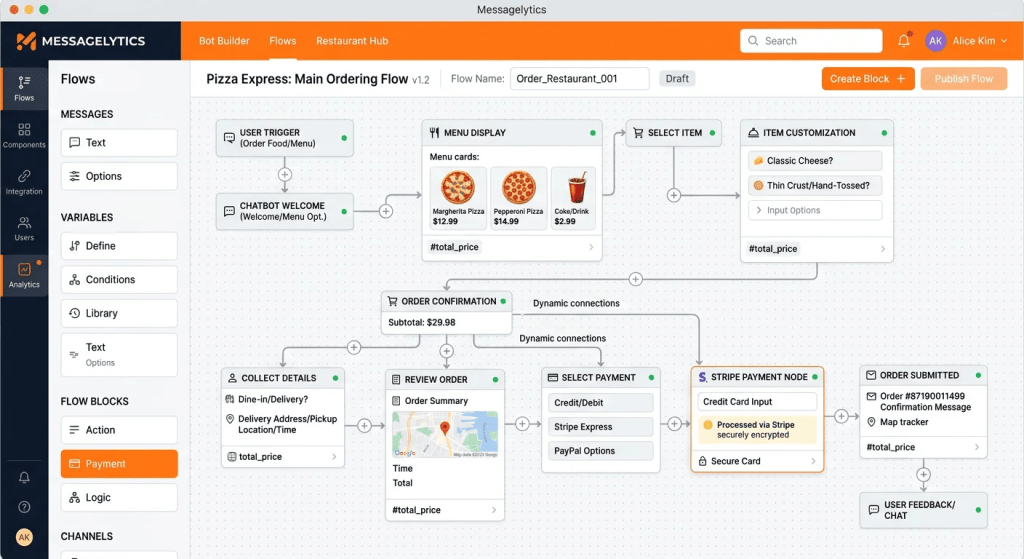
A no-code chatbot builder makes it possible to set up menu browsing and ordering flows without any technical expertise. You build the menu, define the ordering steps, and connect your payment gateway.
2. Reservation and Table Booking
AI chatbots handle table reservations 24/7 through WhatsApp and web chat. They collect party size, preferred time, special requests (high chair, wheelchair access, dietary needs), send confirmation messages, and fire off reminders before the reservation.
Real example: TGI Fridays uses chatbots for table bookings and customer engagement. BVK Biriyani runs their entire reservation system through WhatsApp chat.
Business impact: No-shows are a massive problem for restaurants. Automated reminders sent via WhatsApp 2 hours before a reservation significantly reduce no-show rates. Plus, your staff stops spending time on the phone managing bookings.
3. Drive-Thru Voice AI
For quick-service restaurants with drive-thru lanes, voice AI handles orders verbally, processes upsell suggestions, and reduces average service time.
Real example: Wendy’s FreshAI, White Castle’s SoundHound integration, and Taco Bell’s voice ordering across 500+ locations.
Business impact: Faster service times, consistent upselling (the AI never forgets to ask “would you like fries with that?”), and reduced labor costs at the window. The Food Institute reports that drive-thru AI is one of the top trends reshaping restaurants in 2026.
4. Customer Support and Complaint Handling
Wrong order? Missing item? Late delivery? An AI chatbot provides instant responses, processes refund requests, and escalates complex cases to human staff.
Real example: Major delivery-focused chains use chatbots as the first line of customer support, handling common issues like missing items, wrong orders, and delivery delays without requiring a human agent.
Business impact: Faster response times directly correlate with customer satisfaction. A customer who gets an immediate response and a quick resolution is far more likely to order again than one who waits 20 minutes on hold. Using an omnichannel inbox, your team sees every conversation across WhatsApp, web chat, and social media in one place, making escalations seamless.
5. Personalized Recommendations and Upselling
AI suggests menu items based on past orders, time of day, weather, and dietary preferences. Rainy Tuesday evening? The chatbot suggests soup and hot drinks. Friday night? It recommends family meal deals.
Real example: Starbucks’ “My Starbucks Barista” delivers personalized suggestions based on order history and preferences. Wendy’s FreshAI recommends add-ons and upgrades during drive-thru ordering.
Business impact: Personalized upselling increases average check size by 10-30%. Unlike human staff who may feel awkward pushing add-ons, AI chatbots recommend naturally and consistently. Every single interaction becomes an upsell opportunity.
6. Loyalty Program and Promotions
AI chatbots track reward points, apply discounts automatically, and send targeted promotional offers through WhatsApp. Birthday coming up? The customer gets a personalized offer. Haven’t ordered in 30 days? They get a win-back message with a discount code.
Real example: Starbucks integrates rewards management directly into its chatbot experience. Customers check points, redeem rewards, and receive personalized offers without opening a separate app.
Business impact: Loyalty programs drive repeat business, and AI chatbots make them frictionless. Customers don’t need to carry a punch card or remember to open an app. The chatbot handles everything within the conversation. For e-commerce and restaurant businesses, WhatsApp automation has proven to be the most effective channel for loyalty and promotional messaging.
7. Real-Time Order Tracking
“Where’s my order?” is the single most common question delivery restaurants receive. An AI chatbot answers it instantly with real-time kitchen-to-customer status updates.
Real example: Domino’s “Dom” provides live order tracking from dough preparation through delivery. Customers can check status anytime through the chatbot without calling the restaurant.
Business impact: Every “where’s my order?” call that the chatbot handles saves your staff 2-3 minutes. For a busy restaurant handling 50 delivery orders per night, that’s potentially 2+ hours of staff time recovered daily.
8. Multilingual Support
Serve your entire customer base without hiring multilingual staff. AI chatbots automatically detect language and respond accordingly, critical for restaurants in tourist areas, diverse neighborhoods, and global chains.
Real example: Global chains like Domino’s and Starbucks deploy chatbots that handle conversations in dozens of languages. Local restaurants in multilingual cities use AI chatbots to serve customers in their preferred language.
Business impact: Multilingual capability opens your restaurant to customer segments you might be losing due to language barriers. In tourist-heavy areas, this can meaningfully increase revenue without adding staff. With the right integrations, your chatbot connects to translation services and handles conversations in any language your customers speak.
Why WhatsApp Is the Best Channel for Restaurant AI
Every major restaurant chain has tried building their own app. Most have learned the hard truth: customers don’t want another app on their phone.
Domino’s, Starbucks, and Pizza Hut have spent millions on dedicated apps with built-in ordering, loyalty tracking, and AI features. These apps work well for their most loyal customers. But they miss the vast majority of casual customers who refuse to download yet another app for occasional use.
WhatsApp changes the equation entirely. Here’s why it’s emerging as the dominant channel for restaurant AI chatbots:
No download barrier. With over 2 billion active users globally, your customers already have WhatsApp installed. There’s zero friction between “I want to order food” and actually placing an order.
Everything in one chat. Menu browsing, ordering, payment, tracking, and support all happen within a single WhatsApp conversation. No switching between apps. No creating accounts. No remembering passwords.
It works for small restaurants, not just chains. KFC India and BVK Biriyani have proven the model works at different scales. A local restaurant with 50 seats can offer the same WhatsApp ordering experience as a global chain.
Higher engagement rates. WhatsApp messages see 98% open rates compared to 20% for email and even lower for push notifications from restaurant apps. When you send a promotional offer through WhatsApp, people actually see it.
Rich media support. Send menu images, food photos, location maps, and payment links directly in chat. The conversation is visual and interactive, not just text-based.
For restaurants looking to build a WhatsApp chatbot without code, the process has become remarkably simple. Modern platforms let you design conversation flows, upload menus, and go live in days, not months.
How to Set Up an AI Chatbot for Your Restaurant
Setting up a restaurant chatbot is no longer a technical project requiring developers and months of work. Here’s a practical step-by-step approach that any restaurant owner can follow.
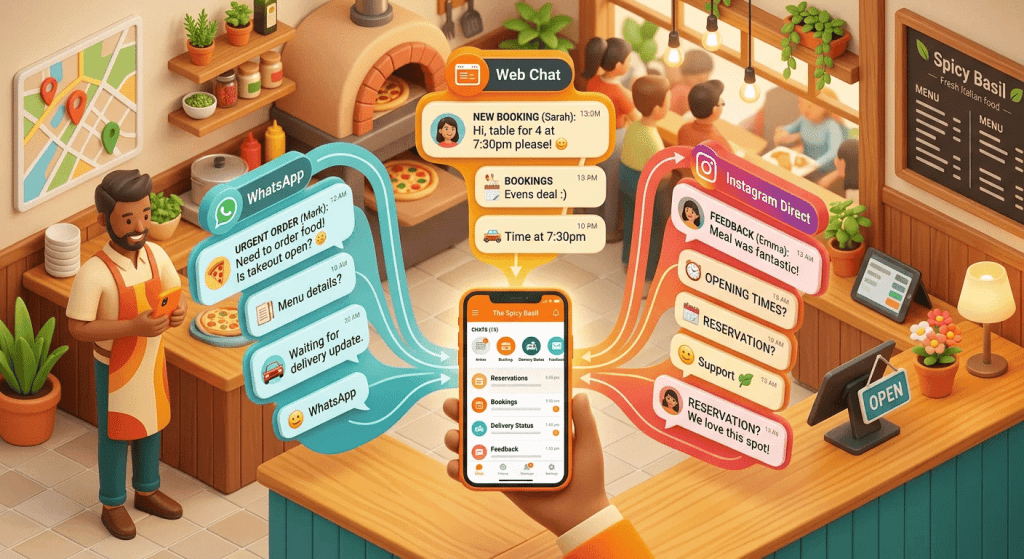
Step 1: Choose your channels. Start with WhatsApp if your customers are there (they probably are). Add web chat on your website. Consider Instagram if you have a strong social presence. The key is meeting customers where they already spend time. An omnichannel platform lets you manage all channels from one dashboard.
Step 2: Build your menu catalog in the chatbot. Upload your full menu with categories, items, descriptions, prices, and images. Include customization options (size, toppings, spice level, dietary filters). This becomes the foundation for your ordering flow.
Step 3: Set up ordering flows with payment integration. Design the conversation flow: greeting, menu browsing, item selection, customization, cart review, payment, and confirmation. Connect payment gateways so customers complete the entire transaction in chat.
Step 4: Add reservation management. Configure your chatbot to handle table bookings. Define available time slots, party size limits, and special request options. Set up automatic confirmation and reminder messages.
Step 5: Enable customer support automation. Program responses for common questions: hours, location, parking, allergen information, delivery zones, and order status. Set escalation paths so complex issues route to human staff.
A no-code chatbot builder handles all of this through a visual drag-and-drop interface. You design conversation flows like flowcharts, preview them, test them, and publish them across all your channels simultaneously. Restaurant-specific chatbot templates can accelerate setup even further, giving you a working foundation to customize rather than starting from scratch.
Employee AI vs Customer AI: Which Approach Wins?
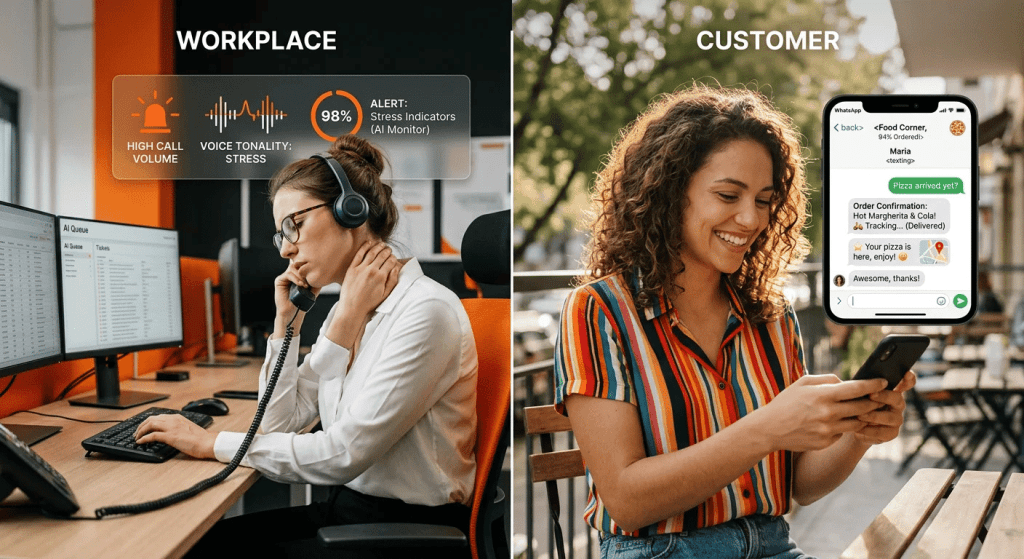
Burger King’s “Patty” represents one philosophy: use AI to monitor and optimize employee performance. The chatbot listens through headsets, scores politeness, tracks order accuracy, and provides coaching. In theory, this improves consistency. In practice, it creates a surveillance dynamic that employees and the public have rejected, as reported by The Guardian.
The alternative approach, which Domino’s, Starbucks, KFC, and others have adopted, uses AI to serve customers directly while freeing employees to focus on what humans do best: hospitality, food quality, and genuine customer connection.
This isn’t just a philosophical difference. It’s a strategic one with measurable outcomes.
Employee-monitoring AI creates problems:
-
- Staff distrust and morale issues
- Public backlash and negative press coverage
- Employee turnover, already the restaurant industry’s biggest cost
- A surveillance culture that contradicts hospitality values
Customer-serving AI creates value:
-
- Faster ordering and shorter wait times
- 24/7 availability without overtime costs
- Consistent upselling that increases revenue
- Better data on customer preferences and behavior
- Staff freed to focus on food quality and in-person service
The winning formula isn’t AI replacing humans. It’s AI handling the repetitive, high-volume tasks, taking orders, answering “where’s my order?”, managing reservations, so that your human staff can focus on the moments that actually matter: greeting regulars by name, handling a special dietary request with care, turning a complaint into a loyal customer.
As Fourth.com notes, the restaurants seeing the best results from AI in 2026 are those using it to enhance the customer experience, not to police their workforce.
The Bigger Picture: AI in Restaurants Is Just Getting Started
The conversation around restaurant AI chatbots in 2026 goes beyond any single brand or deployment. What we’re seeing is a fundamental shift in how restaurants interact with customers.
The trend toward conversational AI is accelerating across every industry, but restaurants are a particularly strong fit because the core interactions, ordering, booking, and asking questions, are naturally conversational.
Voice agents are expanding beyond drive-thrus into phone ordering and in-restaurant assistance. Vertical AI agents built specifically for food service outperform generic chatbots because they understand restaurant-specific context: menu structures, dietary restrictions, peak hours, and seasonal items.
The restaurants that will thrive aren’t necessarily the ones spending the most on AI. They’re the ones deploying AI where it makes the most sense: automating repetitive customer interactions so that their human team can deliver the warmth, creativity, and care that no chatbot can replicate.
What’s Next for Your Restaurant?
Whether you run a single-location bistro or a multi-unit chain, AI chatbots are no longer optional technology for the restaurant industry. The question isn’t whether to adopt them. It’s how fast you can get started and which approach you choose.
Start with WhatsApp. Build a simple ordering flow. Add reservations. Turn on customer support automation. Measure the results. Expand from there.
The tools exist today to launch a restaurant AI chatbot without writing a single line of code, without hiring developers, and without a six-figure budget. Explore ChatMaxima’s pricing to see how affordable it is to get started, or browse the chatbot marketplace for restaurant-ready templates you can customize and deploy today.
Your customers are already on WhatsApp. They’re already used to chatting with businesses. The only question is whether they’ll be chatting with your restaurant or your competitor’s.