Voice agents have crossed the threshold from novelty to necessity. Businesses that deployed voice AI in 2025 reported 40 to 60 percent reductions in average handle time and measurable gains in customer satisfaction, according to Gartner’s latest contact center forecast. The technology behind these results is no longer experimental. Providers like Retell AI, PolyAI, Bland AI, and ElevenLabs have made it possible to build production-grade voice agents that sound natural, understand context, and integrate with the tools your team already uses.
This guide walks through 10 concrete voice agent examples across support, sales, and operations. Each example covers what the agent does, the business impact you can expect, and the industries where it delivers the strongest results. Whether you are evaluating voice AI for the first time or looking to expand an existing deployment, these examples will give you a practical roadmap.
If you are already using text-based conversational AI applications and want to understand how voice fits into the picture, this is the right starting point.
Why Voice Agents Matter for Business Growth in 2026
ales-2026-gradient-modern-style-5-mm4xm6ijThree shifts have made voice agents viable at scale.
First, speech-to-text and text-to-speech quality crossed the human parity line. Models from ElevenLabs, Sarvam AI, and Google Dialogflow CX now produce voice output that callers struggle to distinguish from a live agent. Latency has dropped below 300 milliseconds in most production deployments, eliminating the awkward pauses that plagued earlier systems.
Second, large language models gave voice agents the ability to reason. Instead of following rigid decision trees, modern voice agents powered by models like OpenAI GPT or Google Gemini can interpret ambiguous requests, ask clarifying questions, and resolve issues that would have required a human two years ago.
Third, the cost equation flipped. Running a voice agent at scale now costs between $0.08 and $0.25 per minute of conversation. Compare that to $1.50 to $2.50 per minute for a human agent with benefits, training, and infrastructure overhead. For businesses handling thousands of calls per day, the savings are transformational.
The result is a new category of customer interaction that combines the convenience of self-service with the warmth of a real conversation. Companies across e-commerce, healthcare, financial services, and SaaS are deploying voice agents not as a cost-cutting measure alone, but as a genuine improvement to the customer experience.
Voice Agents for Customer Support (Examples 1 to 4)
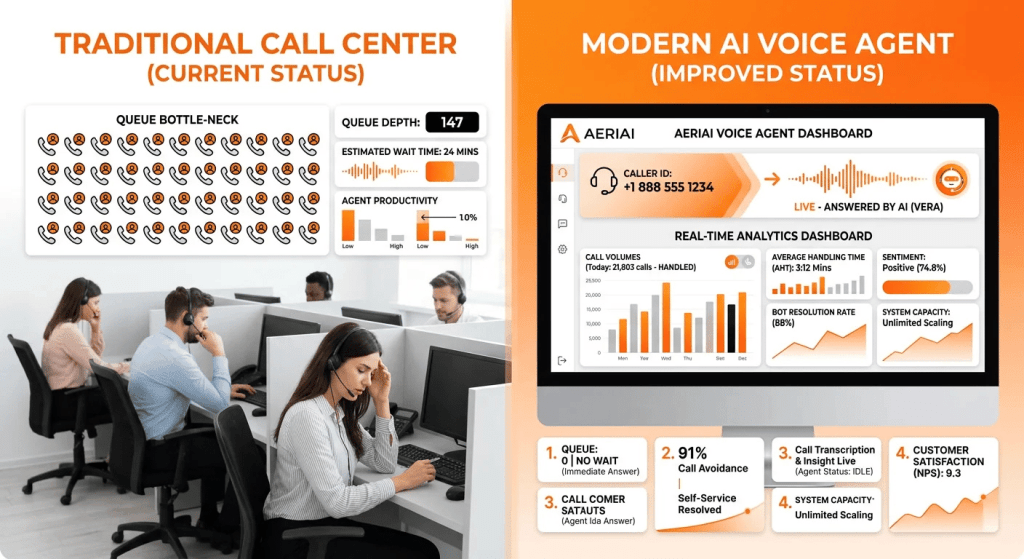
Customer support is where voice agents deliver the fastest, most measurable ROI. These four examples address the highest-volume, most repetitive interactions that drain your team’s time.
1. 24/7 FAQ and Tier-1 Resolution
What it does: A voice agent answers routine questions that make up the bulk of your call volume. Order status, billing inquiries, return policies, account updates, password resets. The agent authenticates the caller, pulls data from your CRM or order management system, and resolves the issue in a single interaction.
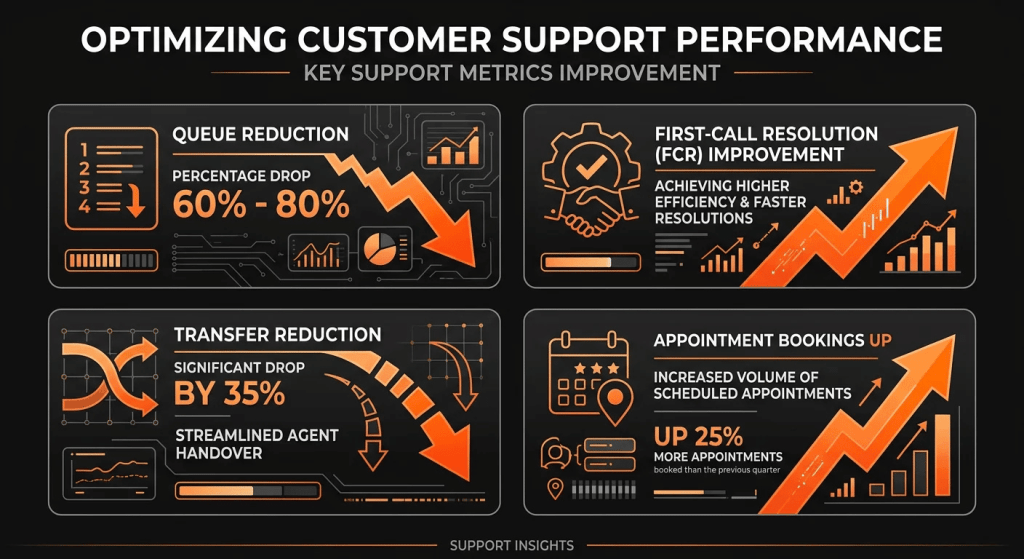
Business impact: Companies deploying FAQ voice agents report 60 to 80 percent reductions in queue volume for tier-1 issues. First-call resolution rates climb because the agent never forgets a process step or gives inconsistent information. Your human agents get freed up for complex, high-value interactions that actually require judgment.
Best for: E-commerce, SaaS, telecom, and any business with a high volume of repetitive inbound calls. Platforms like PolyAI and Intercom Fin Voice specialize in this category.
This use case pairs naturally with a chatbot customer service strategy. The voice agent handles callers who prefer speaking, while your text-based chatbot covers web and messaging channels through a unified omnichannel team inbox.
2. Intelligent Call Triage and Routing
What it does: Instead of forcing callers through a numbered IVR menu, a voice agent asks open-ended questions: “How can I help you today?” It authenticates the caller, captures the full context of their issue, generates a structured summary, and routes them to the right department or specialist with that summary attached.
Business impact: Average handle time drops because agents receive pre-qualified, pre-summarized calls instead of starting from scratch. Customer frustration decreases dramatically. One enterprise deployment by Air.ai reported a 35 percent reduction in transfers after replacing their IVR with an AI triage agent.
Best for: Healthcare systems, financial services, insurance companies, and any organization with multiple departments or service tiers. Google Dialogflow CX and Amazon Lex (via Amazon Bedrock) are popular choices for building triage flows with deep intent recognition.
3. Appointment Scheduling
What it does: The voice agent books, reschedules, and cancels appointments through natural conversation. It checks availability in real time against your calendar system, confirms the slot with the caller, sends confirmation via SMS or email, and handles rescheduling requests without human intervention.
Business impact: Scheduling voice agents recover revenue from missed appointments and after-hours booking requests. Healthcare practices using this approach have reported 15 to 25 percent increases in appointment bookings because patients can schedule at any time, not just during office hours. No-show rates also drop when the agent sends automated reminders.
Best for: Healthcare clinics, dental practices, salons, home service companies, and professional services. ChatMaxima’s AI Studio chatbot builder lets you create scheduling workflows that work across both voice and text channels, including WhatsApp.
4. After-Hours Support
What it does: When your team clocks out, the voice agent takes over. It captures incoming requests, logs detailed notes, escalates genuinely urgent issues to an on-call team member, and queues everything else for morning handoff. The agent can also provide basic troubleshooting, status updates, and estimated response times.
Business impact: Businesses lose leads and frustrate customers every hour they are unavailable. An after-hours voice agent ensures zero missed calls without the cost of staffing a night shift. Morning teams start their day with organized, prioritized queues instead of a pile of voicemails.
Best for: Professional services, property management, IT managed services, and any business where customers call outside standard hours. Bland AI and Retell AI both offer low-latency voice agents suitable for after-hours deployments.
Voice Agents for Sales (Examples 5 to 7)
Sales voice agents go beyond answering questions. They actively qualify prospects, handle objections, and move deals forward.
5. Inbound Lead Pre-Qualification
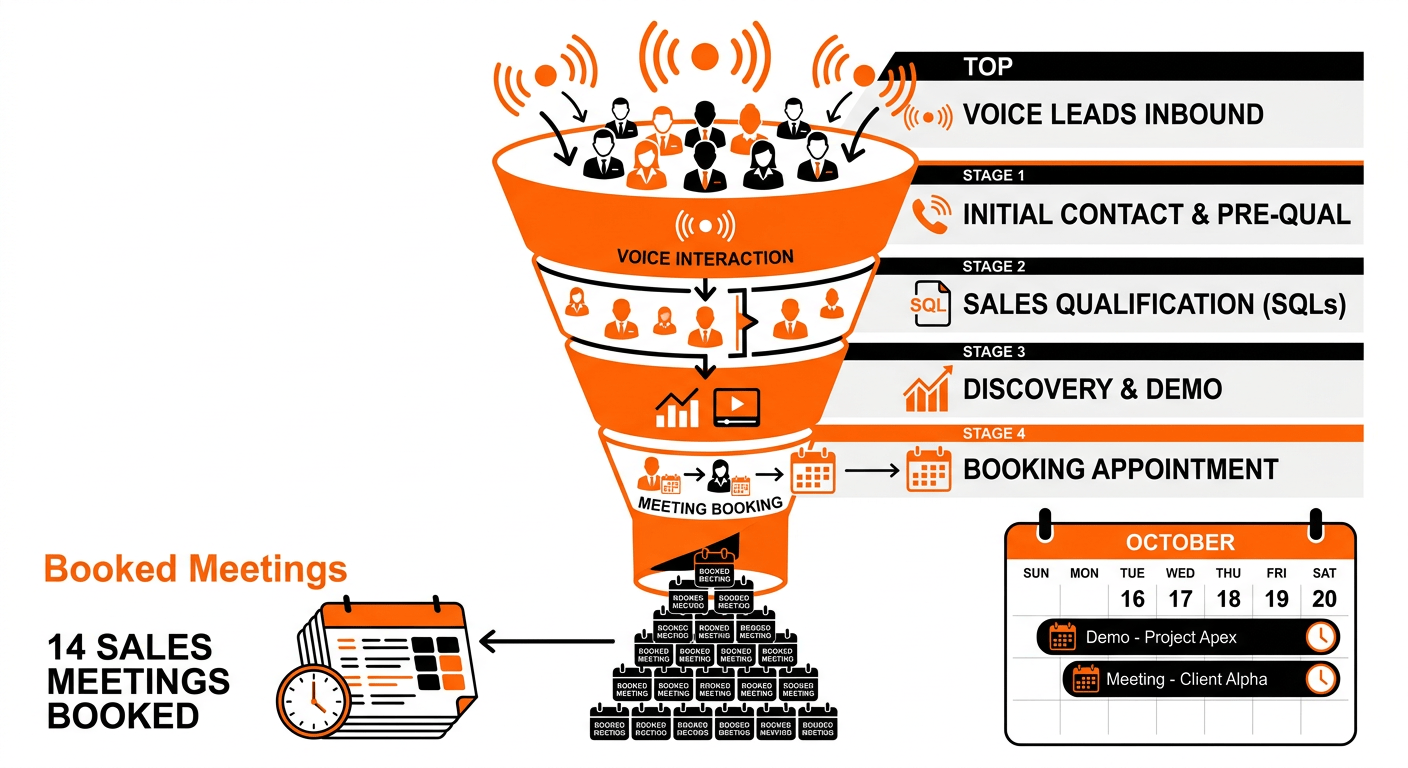
What it does: When a prospect calls in from a landing page, ad, or referral, the voice agent screens them before connecting to a sales rep. It collects budget range, timeline, decision-making authority, and specific needs. Hot leads get routed immediately with a full briefing. Cold leads get tagged for nurture sequences.
Business impact: Sales teams spend their time on prospects who are ready to buy instead of screening calls that go nowhere. Companies using AI pre-qualification report that reps spend 40 to 50 percent more time on qualified opportunities. Conversion rates from inbound calls improve because the handoff includes context that makes the first human conversation productive.
Best for: B2B SaaS, real estate, financial advisory, and insurance. This works especially well when combined with a text-based lead qualification chatbot that handles web visitors while the voice agent handles callers.
6. Outbound Sales Conversations
What it does: The voice agent autonomously dials prospects from a list, delivers a personalized pitch, qualifies interest, handles common objections, and books meetings for human reps. It adapts its approach based on the prospect’s responses and follows compliance rules for call timing and consent.
Business impact: Outbound voice agents can make 10 to 20 times more calls per day than a human SDR. They never have bad days, never skip follow-ups, and deliver consistent messaging. Air.ai and Bland AI have both demonstrated this use case at scale, with some customers reporting 3x increases in booked meetings per rep.
Best for: SaaS sales, recruiting, insurance, and any business with a high-volume outbound motion. The key is tight integration with your CRM and calendar so bookings flow seamlessly.
7. CRM Updates via Voice
What it does: Field sales reps call in or speak to a voice agent through a mobile app to update deal stages, log meeting notes, and record next steps. The agent parses the natural language input and updates the correct CRM records automatically.
Business impact: CRM data completeness jumps from a typical 30 percent to over 90 percent when reps can update by voice instead of typing on a phone. Sales managers get accurate pipeline data. Forecasting improves because the data reflects reality instead of what reps remember to enter at the end of the week.
Best for: Field sales teams in manufacturing, medical devices, real estate, and any industry where reps spend most of their day away from a desk. This integrates well with CRM platforms through ChatMaxima’s integrations with tools like HubSpot, Pipedrive, and Salesforce.
Voice Agents for Operations (Examples 8 to 10)
Operations voice agents handle the workflows that keep your business running smoothly behind the scenes.
8. Payment Reminders and Collections
What it does: The voice agent makes outbound calls to customers with overdue payments. It delivers a friendly, compliant reminder, offers payment options, can process payments over the phone, and logs the outcome. The agent follows all regulatory requirements for call timing, disclosure, and opt-out handling.
Business impact: Automated payment reminders recover revenue that would otherwise require expensive collection efforts or be written off entirely. Fintech companies using this approach report 15 to 30 percent improvements in collection rates compared to email-only reminders. The voice channel adds urgency and personal touch that text channels lack.
Best for: Fintech, insurance, SaaS with recurring billing, healthcare billing, and utilities. Compliance is critical here, so choose a provider with built-in regulatory guardrails.
9. Real-Time Agent Assist
What it does: Unlike the other examples, this voice agent does not talk to the customer directly. Instead, it listens to live calls between human agents and customers, then whispers guidance to the agent in real time. It surfaces compliance prompts (“You need to read the disclosure statement”), suggests objection-handling tactics, pulls up relevant knowledge base articles, and flags sentiment shifts.
Business impact: Agent assist voice AI reduces compliance violations, shortens handle times, and improves close rates for sales calls. New hires ramp faster because they have an AI coach on every call. Companies deploying agent assist report 20 to 30 percent improvements in first-call resolution and measurable reductions in compliance incidents.
Best for: Financial services, insurance, healthcare, and any regulated industry where compliance on calls is mandatory. This is also valuable for sales teams that need consistent objection handling across a large rep pool.
10. Multilingual Voice Support
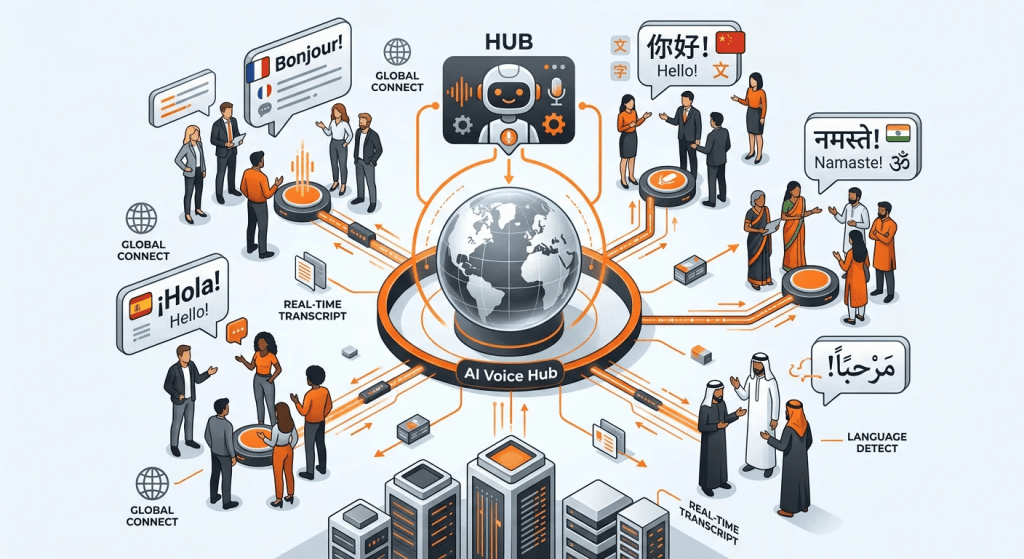
What it does: The voice agent serves customers in their native language without requiring you to hire multilingual staff. It detects the caller’s language automatically or lets them choose, then conducts the entire interaction in that language with natural pronunciation and cultural awareness.
Business impact: Multilingual voice agents unlock entire markets that were previously too expensive to serve. Sarvam AI supports 22 Indian languages with production-quality voice, making it possible for businesses to serve India’s linguistically diverse market from a single platform. PolyAI offers similar capabilities for European and Asian languages. Businesses expanding internationally report 30 to 50 percent increases in customer satisfaction scores among non-English-speaking customers.
Best for: Global e-commerce, travel and hospitality, government services, healthcare in multilingual regions, and any business expanding into new markets. This is one of the fastest-growing voice agent categories in 2026. ChatMaxima’s integration with Sarvam AI models makes it straightforward to add multilingual voice capabilities to your existing customer engagement workflows.
How to Choose the Right Voice Agent for Your Business
Not every voice agent deployment delivers results. The difference between success and wasted investment comes down to five decisions.
Start with your highest-volume, most repetitive interaction. Look at your call data. Which call types make up the largest percentage of your volume? That is where a voice agent will deliver the fastest ROI. For most businesses, this is FAQ resolution or appointment scheduling.
Evaluate latency, not just accuracy. A voice agent that takes two seconds to respond feels broken to callers. Target sub-500ms response times. Providers like Retell AI and ElevenLabs have optimized their infrastructure specifically for low-latency voice interactions.
Plan the handoff to humans. The best voice agents know when to transfer. Define clear escalation triggers: sentiment thresholds, complexity markers, and explicit customer requests to speak with a person. Seamless handoff is what separates good deployments from frustrating ones.
Integrate with your existing stack. A voice agent that cannot read from your CRM or write to your ticketing system creates more work than it saves. Look for native integrations or robust API access. Platforms like ChatMaxima offer 200+ integrations that connect voice and text channels to your existing tools.
Measure what matters. Track deflection rate, first-call resolution, average handle time, customer satisfaction, and cost per interaction. Set baselines before deployment so you can quantify the impact.
For teams already comparing platforms, our breakdown of the best Intercom alternatives includes voice-capable options worth evaluating.
Voice Agent Trends Shaping 2026
The voice agent landscape is evolving fast. Here are the trends that will define the next 12 months.
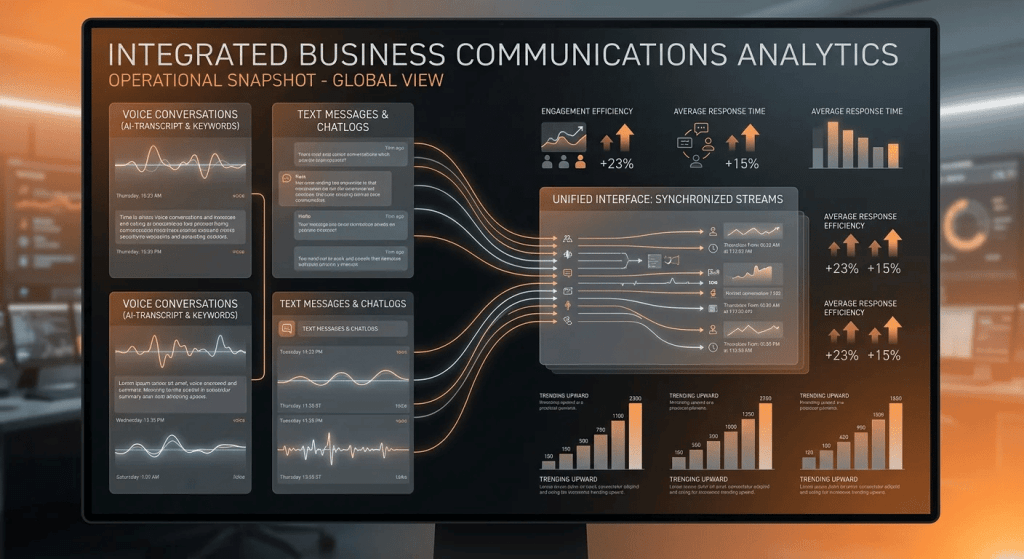
Multimodal agents are becoming standard. The line between voice agents and text chatbots is disappearing. Customers expect to start a conversation by voice, switch to text, and pick up where they left off. Platforms that unify voice and text interactions in a single omnichannel inbox will win over those that treat voice as a separate silo.
Vertical AI agents are outperforming general-purpose bots. Industry-specific voice agents trained on domain data consistently outperform generic deployments. A voice agent built for dental scheduling understands dental terminology, insurance verification flows, and patient communication norms in ways a horizontal agent never will.
Voice cloning and brand voice are going mainstream. ElevenLabs and other providers now offer custom voice creation that lets businesses deploy agents with a consistent, branded voice. This matters more than most teams realize because voice is a brand touchpoint.
Regional language support is exploding. Sarvam AI’s support for 22 Indian languages, combined with similar efforts for Southeast Asian, African, and Middle Eastern languages, is opening voice AI to markets that were previously text-only. The conversational AI models powering these deployments continue to improve in both accuracy and naturalness.
Pricing is shifting to outcome-based models. Instead of per-minute pricing, some providers are moving to per-resolution or per-booking pricing. This aligns vendor incentives with customer outcomes and makes ROI calculations more straightforward.
Compliance and security are catching up. As voice agents handle sensitive data in healthcare, finance, and insurance, providers are investing heavily in SOC 2 compliance, end-to-end encryption, and PCI-DSS certification for payment processing. Businesses should evaluate security posture as carefully as they evaluate voice quality.
Agent orchestration platforms are emerging. Rather than deploying a single voice agent, forward-thinking companies are building agent ecosystems where specialized voice agents handle different tasks and hand off to each other seamlessly. A caller might interact with a triage agent, then a scheduling agent, then a billing agent, all within a single call without repeating information.
Scale Your Business with the Right Voice Strategy
Voice agents are not a future technology. They are a present-day competitive advantage that thousands of businesses are already deploying across support, sales, and operations.
The 10 examples in this guide represent proven patterns, not theoretical possibilities. Companies using 24/7 FAQ agents are cutting queue volumes by 60 to 80 percent. Outbound sales voice agents are tripling meeting bookings. Multilingual deployments are opening entire markets that were previously out of reach.
The key is to start with one high-impact use case, measure results rigorously, and expand from there. Choose a platform that supports both voice and text channels so you can build a unified customer experience instead of managing disconnected tools.
ChatMaxima helps businesses deploy AI-powered agents across voice, WhatsApp, web chat, and more from a single platform. With support for leading AI models, 200+ integrations, and a no-code builder, you can go from concept to production in days, not months. Explore ChatMaxima’s pricing to find the plan that fits your team.