Your marketing is working. Your product is solid. Your team is trained and ready.
So why are leads still slipping away?
We had a hypothesis. To test it, we tracked over 100,000 customer conversations across businesses using ChatMaxima’s platform over the past several days. What we found confirms what many business owners suspect but few have quantified: the biggest gap in customer engagement isn’t quality. It’s timing.
The data tells a clear story. More than one in three customers reach out when your team has already gone home. And by the time your staff returns the next morning, a significant portion of those prospects have already moved on to competitors who responded faster.
This isn’t a report about chatbots or automation. It’s a report about when your customers actually need you, and what happens when you’re not there.
.
The Data: How 100,000+ Conversations Break Down by Time
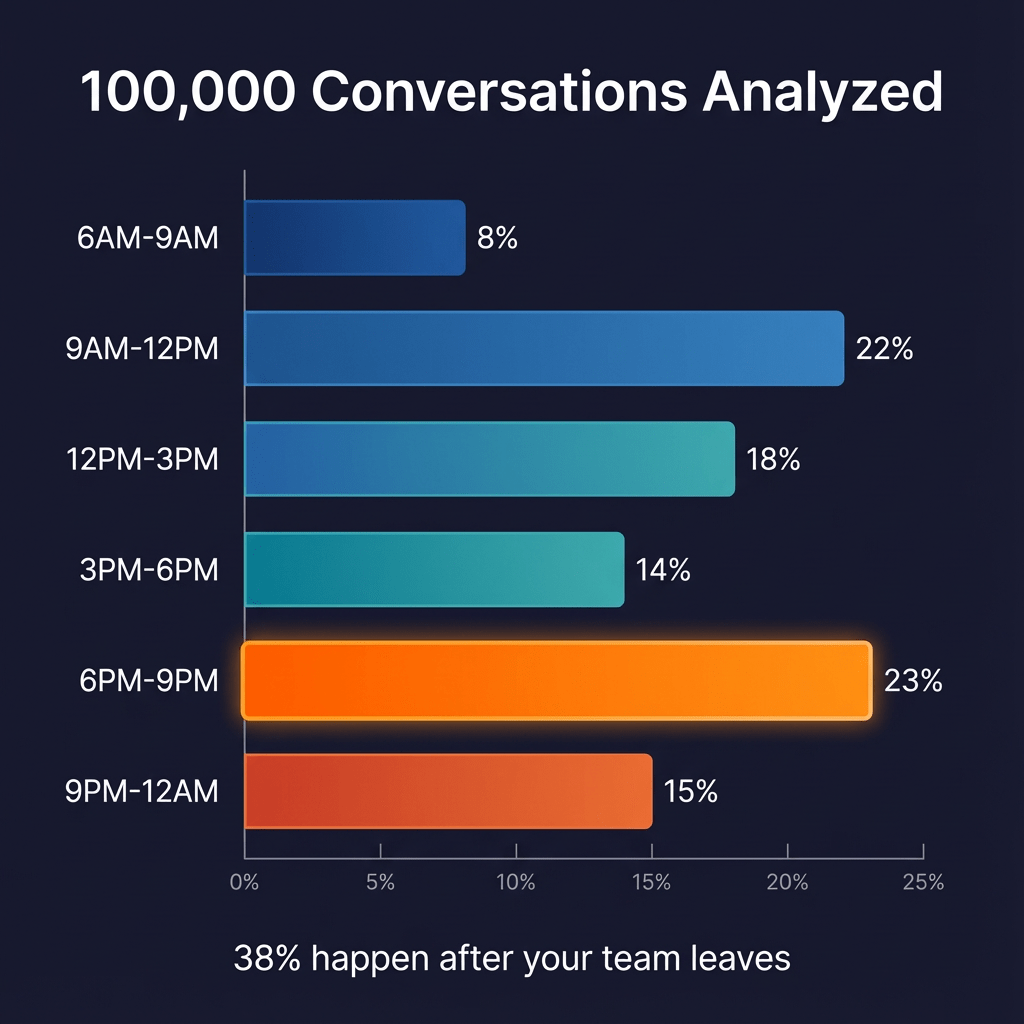
We segmented conversations into seven time blocks across a typical day. The results challenge the assumption that business happens during business hours.
6 AM to 9 AM: 8% of conversations
The early birds. These customers are checking their phones before heading to work or during their morning commute. They’re thinking about purchases, services, or questions that occurred to them overnight. Often, these are high-intent prospects who’ve been mulling over a decision.
9 AM to 12 PM: 22% of conversations
The morning rush. This is peak traditional business hours, and it shows. Your team is online, coffee in hand, ready to respond. This window captures customers who operate on standard schedules and reach out when they expect businesses to be available.
12 PM to 3 PM: 18% of conversations
Lunch break browsers. Customers step away from their own work, scroll through their phones, and send inquiries during their downtime. Your team is likely still available, though possibly at reduced capacity during their own lunch breaks.
3 PM to 6 PM: 14% of conversations
Afternoon wind-down. The workday is ending for many customers, and they’re wrapping up personal tasks before heading home. Your team is also winding down, possibly less responsive as they close out their own day.
6 PM to 9 PM: 19% of conversations
After work. Here’s where the gap begins. Customers are home, relaxed, and finally have time to research that product, ask that question, or make that inquiry they’ve been putting off. But your team? They clocked out at 5 or 6 PM.
9 PM to 12 AM: 12% of conversations
Night owls. These customers are browsing late, often on mobile devices, often in bed. They’re making decisions while watching TV, scrolling through options, comparing services. Your office has been dark for hours.
12 AM to 6 AM: 7% of conversations
Insomniacs, shift workers, and international time zones. A smaller but meaningful segment that operates on entirely different schedules. For businesses with global customers, this window represents daytime in other markets.
The Critical Finding: 38% of Conversations Happen After 6 PM
Let that number sink in.
More than one in three customer conversations happen after typical business hours end. That’s not a small edge case or an occasional late inquiry. That’s a fundamental pattern in customer behaviour.
When we combine the evening and night windows (6 PM to 6 AM), we’re looking at 38% of all customer engagement occurring when most businesses have nobody available to respond.
For a business receiving 100 inquiries daily, that means 38 potential customers are reaching out to an empty office. Some will wait patiently for a morning response. Many will not.
.
What Happens to After-Hours Messages?
Raw timing data only tells part of the story. We also examined customer expectations and behaviours when messages go unanswered.
60% of customers expect a reply within one hour.
Not within one business day. Not by the next morning. Within 60 minutes of sending their message. This expectation doesn’t adjust for your office hours. When a customer messages at 8 PM, they’re expecting a response by 9 PM.
23% of customers expect a reply within minutes.
Nearly a quarter of customers have been conditioned by instant digital experiences to expect near-immediate responses. They’re comparing your response time not to other businesses in your industry, but to every digital interaction they have, including social media, food delivery apps, and messaging platforms.
By morning, 40% have already messaged a competitor.
This is the number that should concern every business owner. When customers don’t hear back quickly, they don’t sit and wait. They search for alternatives. By the time your team arrives at 9 AM, four out of ten after-hours prospects have already initiated conversations with your competitors.
.
The Real Cost: You’re Losing Leads to the Clock
Most businesses focus their lead generation efforts on marketing. Better ads, more content, improved SEO, expanded reach. These investments drive traffic and generate inquiries.
But what’s the point of generating leads if 38% of them arrive when nobody’s there to catch them?
Consider a practical scenario. Your marketing generates 50 inquiries per day. That’s solid performance. But 19 of those inquiries (38%) come in after 6 PM. Your team responds the next morning, but by then, 8 of those prospects (40% of the after-hours group) have already contacted competitors.
That’s 8 leads lost daily. 56 per week. Over 240 per month. Not because your marketing failed. Not because your product wasn’t competitive. Simply because of timing.
Now calculate what those leads were worth. If your average customer value is ₹10,000, you’re looking at ₹24,00,000 in potential revenue walking out the door every month. If it’s ₹50,000 per customer, that number jumps to ₹1,20,00,000 monthly.
You’re not losing leads because of bad marketing. You’re losing them to the clock.
.
Why Customer Timing Has Shifted
This pattern isn’t random. Several factors have fundamentally changed when customers engage with businesses.
Mobile-first behaviour. Smartphones mean customers can reach out from anywhere, at any time. The couch at 10 PM is now a shopping environment. The bed at midnight is a research station. Physical business hours have become irrelevant to the customer holding a phone.
Work schedule fragmentation. The traditional 9-to-5 schedule applies to fewer people than ever. Remote work, gig economy roles, flexible arrangements, and shift work mean customers are available at all hours, and they expect businesses to meet them there.
Global connectivity. Even local businesses now receive inquiries from different time zones. A customer researching options while travelling, an expat looking for services back home, or simply someone whose schedule doesn’t match yours.
Competition has raised expectations. Some businesses have already solved the after-hours problem. Customers who experience instant responses from one company expect the same from every company. The bar has been raised whether you’ve noticed or not.
E-commerce conditioning. Amazon, Netflix, and every major digital platform have trained customers to expect instant, 24/7 service. That expectation bleeds into every interaction, including with businesses that operate on traditional schedules.
The Winning Businesses: “Online” at 11 PM Without Burning Out Staff
Here’s what separates businesses thriving in this environment from those leaking leads after hours.
The winners aren’t hiring night shifts. They’re not asking employees to be on-call until midnight. They’re not burning out their teams with unrealistic availability expectations.
They’ve figured out how to be “online” when customers need them without requiring humans to be physically present.
The solution varies by business, but the pattern is consistent: automated first response, intelligent routing, and human escalation only when necessary.
When a customer messages at 9 PM, they immediately receive acknowledgment that their inquiry was received. If the question is straightforward (pricing, availability, basic information), it gets answered instantly by an AI system trained on the business’s specific knowledge base. If the question requires human attention, the customer receives a clear timeline and the inquiry is prioritised for morning follow-up.
The result: customers feel heard immediately. Simple questions get resolved without waiting. Complex issues get human attention as soon as staff is available, with full context preserved.
.
Your Customers Don’t Care About Your Office Hours
This is the fundamental mindset shift required.
Customers don’t think about when you’re available. They think about when they’re available. Their schedule, their convenience, their timeline.
When a customer has time to research a purchase at 10 PM, they’re not going to note down their questions and wait until your office opens at 9 AM. They’re going to ask now. And if you don’t answer, they’ll find someone who does.
The businesses succeeding today have stopped asking “How can we serve customers better during our hours?” and started asking “How can we serve customers whenever they need us?”
This isn’t about being available 24/7 in the traditional sense. It’s about building systems that extend your presence beyond the physical limitations of human schedules.
The Question You Should Be Asking
Most businesses, when confronted with this data, ask: “Should we respond faster?”
That’s the wrong question. Faster response during business hours doesn’t solve the after-hours gap.
The right question is: “Who’s responding when we’re not?”
If the answer is “nobody,” you now know exactly what’s happening to 38% of your leads. They’re waiting through the night, growing colder by the hour, and a significant portion are finding competitors who figured out how to be there at 11 PM.
The solution isn’t about replacing your team. It’s about extending your team’s presence into the hours they can’t physically cover.
Implementing After-Hours Coverage: Practical Options
For businesses ready to address the after-hours gap, several approaches exist depending on scale, budget, and complexity of typical inquiries.
AI-Powered Chatbots (Recommended for Most Businesses)
Modern AI chatbots, when properly trained on your business’s specific information, can handle the majority of routine inquiries without human involvement. Pricing questions, availability checks, basic product information, appointment scheduling: these common queries can be resolved instantly at any hour.
The key is training. A generic chatbot frustrates customers. An AI trained on your actual products, services, FAQs, and customer patterns provides genuine value. Customers get immediate answers, and your team returns in the morning to find only the complex issues requiring human judgment.
Automated Acknowledgment and Routing
Even if full automation isn’t feasible for your business, automated acknowledgment dramatically improves customer experience. A simple message confirming receipt, providing a timeline for response, and offering alternative contact methods keeps customers engaged rather than seeking competitors.
Outsourced After-Hours Support
For businesses where human touch is essential for every interaction, outsourced support teams covering evening and night hours can fill the gap. This approach is costlier than automation but provides human responses around the clock.
Hybrid Approach
Many businesses find success combining AI for initial response and simple queries with human escalation for complex issues. The AI handles volume and immediate engagement while humans focus on conversations that genuinely require their expertise.
.
What ChatMaxima Customers Are Seeing
Businesses using ChatMaxima’s AI automation to cover after-hours inquiries report consistent patterns.
Average first response time drops from hours (waiting for morning) to seconds. After-hours lead capture rates increase as customers receive immediate engagement rather than silence. Morning workload for human teams decreases because routine queries have already been handled. Overall conversion rates improve because leads don’t go cold overnight.
The specific numbers vary by industry and implementation, but the direction is universal: covering the after-hours gap improves outcomes across every metric that matters.
The Bottom Line: Time Is the New Battleground
Customer acquisition has always been competitive. Businesses fight for attention, for traffic, for leads.
But increasingly, the battle isn’t about generating leads. It’s about catching them when they arrive.
Our data from 100,000+ conversations makes this clear: 38% of customer engagement happens after traditional business hours. The businesses capturing this opportunity are pulling ahead. Those ignoring it are watching leads walk to competitors who simply showed up when they didn’t.
Your customers don’t care about your office hours. They care about their schedule.
The question isn’t “Should we respond faster?” It’s “Who’s responding when we’re not?”
Ready to capture the 38% of conversations happening after hours? Start your free trial or book a demo to see how ChatMaxima’s AI automation keeps you “online” around the clock.