Two technologies are competing for your customer interactions — and the stakes are significant. AI voice agents and text chatbots have both matured dramatically over the past three years, and businesses are being forced to make a choice that directly affects revenue, customer satisfaction, and operational costs.
The voice agent market sits at $5.5 billion in 2026, growing at 35% CAGR. The text chatbot market is larger at $10–12 billion but expanding at a slower 23% CAGR. Both are scaling fast. Both deliver real ROI. But they are not interchangeable — and deploying the wrong one for the wrong use case is an expensive mistake.
This post breaks down the conversion data, cost economics, and industry-specific performance of AI voice agents vs text chatbots, so you can make a decision grounded in evidence rather than hype.
The Fundamental Difference Between Voice and Text AI
Voice agents and text chatbots often share the same underlying AI models — large language models that understand context and intent. But the delivery mechanism changes everything.
Text chatbots operate asynchronously. A user types a question, reads a response, and types again. The conversation is visual, persistent, and easy to pause and resume. Users can multitask while waiting for responses. There is no urgency, and there is very little emotional signal being transmitted.
Voice agents operate synchronously. A conversation happens in real time, with natural speech patterns, tone, and pacing. There is social pressure to respond. Silence feels uncomfortable. The emotional bandwidth of voice — tone, emphasis, pacing — is dramatically higher than text. This changes the nature of the interaction and, consequently, its outcomes.
These are not just technical differences. They produce measurably different behaviors in users, which is why conversion rates, customer satisfaction scores, and cost structures diverge so sharply between the two modalities.
The Conversion Numbers: What the Data Actually Shows
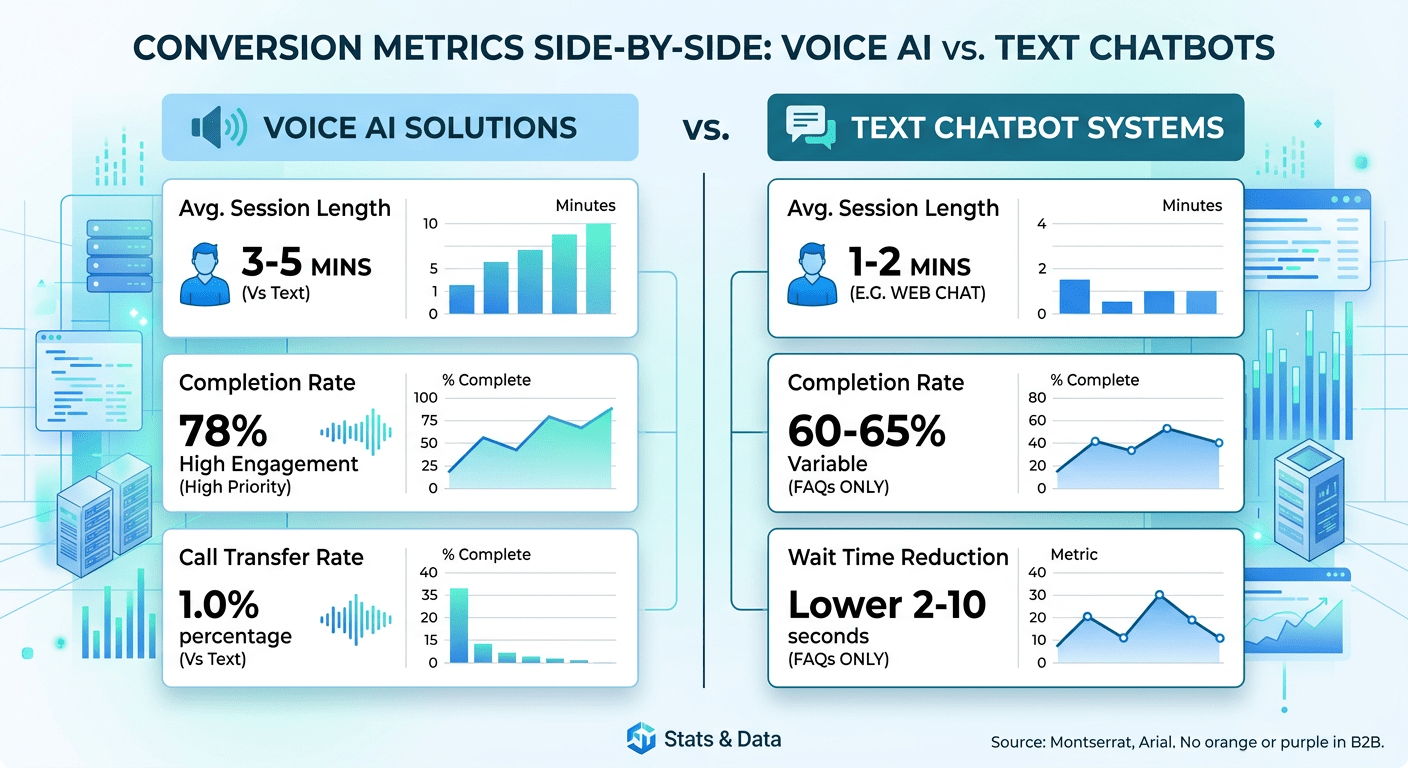
When it comes to raw conversion performance, AI voice agents vs text chatbots shows voice outperforming text in high-intent scenarios by a significant margin.
Voice agent conversion data:
-
- +36% improvement in meeting booking conversion rates
- +43% higher win rates in outbound sales contexts
- 37% faster sales cycles compared to text-based outreach
- 60–70% higher engagement rates versus equivalent text interactions
- Customer satisfaction scores averaging 4.2 out of 5
Text chatbot conversion data:
-
- 15–35% e-commerce conversion rates when deployed on product pages
- 2.4x more funnel conversions compared to traditional static contact forms
- Customer satisfaction scores averaging 3.8 out of 5
- 74% of users prefer bots for simple, routine queries over waiting for a human
These numbers tell a nuanced story. Voice agents win decisively in active, outbound, or high-stakes conversion scenarios. Text chatbots win in passive, high-volume, or query-handling contexts.
The question is not which technology converts better in absolute terms — it is which converts better for your specific use case.
Why Voice Drives Higher Engagement
The 60–70% engagement advantage of voice over text comes down to psychology. When a human voice — even a synthetic one — speaks to you, you respond instinctively. There is an implied social contract in voice conversation that text simply does not carry.
This is why outbound sales calls, even from AI agents, produce dramatically higher conversion rates than outbound text sequences. Voice is harder to ignore, harder to disengage from, and the emotional data transmitted creates faster trust.
The flip side: users who are not in the right mindset for a conversation — who are multitasking, in a public space, or dealing with a sensitive topic — will disengage from voice faster than they would from text. Context determines outcome.
Where AI Voice Agents Win
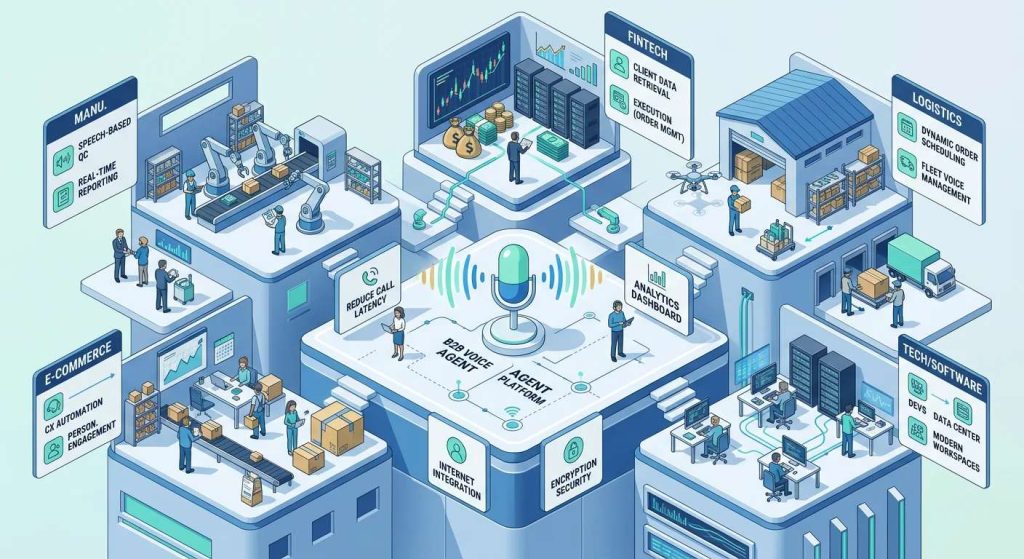
Voice agents have a decisive edge in specific contexts. Understanding these contexts prevents the costly mistake of deploying voice everywhere — which would actually hurt your conversion rates in the wrong scenarios.
Outbound Sales and Lead Qualification
This is the single strongest use case for voice AI. Outbound sales calls, appointment setting, and lead qualification over voice produce the most dramatic lift. The +43% win rate improvement and 37% faster sales cycle data comes primarily from this context.
Voice agents can make hundreds of calls simultaneously, with no fatigue, no inconsistency, and no bad days. For sales teams that previously relied on human SDRs for top-of-funnel outreach, AI voice agents typically reduce cost per qualified lead by 60–80%.
Real Estate
Real estate is a standout vertical for voice AI. Conversion rates of 15–22% on inbound property inquiries — significantly higher than text chatbot equivalents — make this one of the most ROI-positive deployments available.
When a prospect calls about a listing, a voice agent can handle qualification, answer property questions, and book a showing appointment in a single interaction. The synchronous nature of voice prevents the drop-off that occurs when text conversations are abandoned between messages.
Healthcare
Healthcare has seen some of the most compelling voice AI adoption data. 87% patient adoption rates for voice-based appointment scheduling and reminder systems, combined with 25% reductions in appointment no-shows, represent both revenue and clinical outcome improvements.
Patients — particularly older demographics — are more comfortable with a phone call than navigating a chatbot interface. For appointment reminders, follow-up calls, and medication adherence programs, voice agents are significantly more effective than equivalent text-based interventions.
Complex Issue Resolution
When customer issues require nuanced back-and-forth — troubleshooting, account disputes, refund escalations — voice resolves them faster. The bandwidth of spoken conversation allows an agent to gather context, ask clarifying questions, and reach resolution in a fraction of the turns required by text.
Text chatbots handling complex issues often need 8–15 message exchanges to reach the same resolution that voice can achieve in 2–3 minutes. For customers in urgent situations, that difference in resolution time directly impacts retention.
Accessibility and Hands-Free Environments
Voice AI is the only viable channel for users with visual impairments, users who are driving, or users in any hands-free environment. Deploying text-only channels in these contexts means losing these users entirely. Voice agents recapture this segment with high satisfaction scores — the 4.2/5 CSAT for voice AI reflects in part that it is the preferred modality for users where text is not accessible.
Where Text Chatbots Win
Text chatbots are not the inferior option — they are the dominant option for a large class of interactions, and the numbers prove it.
High-Volume FAQ Handling
Seventy-four percent of users prefer interacting with a chatbot for simple queries rather than waiting more than 15 minutes for a human agent. Text chatbots handle FAQ volume that would be prohibitively expensive to route through either human agents or voice AI.
A text chatbot can handle thousands of simultaneous conversations at virtually no marginal cost. At $0.01–$0.50 per interaction, the economics of high-volume text deployment are simply unmatched. Voice AI at $0.50–$3.00 per interaction is 10–100x more expensive at the same volume.
For businesses receiving thousands of repeat questions daily — shipping status, return policies, account resets — text chatbots deliver the best cost-per-resolution at scale.
E-Commerce Conversion
The 15–35% e-commerce conversion rate from text chatbots deployed on product pages represents a significant lift over the historical baseline of unaided browser-based shopping. When a customer is mid-session on a product page and a chatbot proactively addresses their objections — sizing questions, shipping timelines, return policies — the barrier to purchase drops measurably.
Voice in e-commerce is emerging (the voice commerce market is projected to grow from $62 billion in 2025 to over $250 billion by 2033), but text remains the dominant channel for in-session product page assistance. Users browsing on their phones are not in a voice conversation context — they want fast, visual, text-based answers.
Privacy-Sensitive Topics

For topics that users find sensitive — financial situations, health conditions, relationship issues, legal questions — text chatbots dramatically outperform voice. Users are more willing to disclose sensitive information in text, where they do not feel observed or judged by a voice interaction.
Mental health platforms, financial services, and legal tech companies consistently find higher engagement and completion rates with text versus voice for this reason. The asynchronous, private nature of text creates a lower-stakes disclosure environment.
Global Scale and Multilingual Deployment
Text chatbots scale globally with lower infrastructure overhead. While voice AI multilingual capabilities are improving rapidly, text chatbots have a more mature stack for handling diverse languages, scripts, and dialects at scale.
For businesses operating across 50+ languages, text chatbot deployment remains more cost-effective and more consistent in quality than equivalent voice AI deployment.
Async and Multi-Task Contexts
Text chatbot conversations persist. A user can start a conversation, get pulled away, return 20 minutes later, and continue from where they left off. Voice does not offer this flexibility. An abandoned voice interaction is a lost interaction.
For complex onboarding flows, multi-step processes, or any scenario where users need to gather information before responding, text chatbots are the appropriate tool. Forcing users into synchronous voice interactions for these scenarios increases abandonment rates sharply.
The Cost Economics: Making the Right Investment
The cost-per-interaction comparison is the most straightforward part of the decision:
ChannelCost Per InteractionHuman agent$5–$15Voice AI agent$0.50–$3.00Text chatbot (SaaS)$0.01–$0.50
For high-volume, low-complexity interactions, text chatbots deliver the best unit economics by a wide margin. A business handling 100,000 FAQ interactions per month at $0.05 per text chatbot interaction spends $5,000. The same volume via voice AI would cost $50,000–$300,000. The math is unambiguous.
For low-volume, high-value interactions — enterprise sales calls, complex support escalations, healthcare appointments — voice AI’s higher cost per interaction is justified by the conversion lift it produces. A +43% improvement in win rate on a $10,000 enterprise deal more than offsets a $2 call cost.
This means the correct question is not “which is cheaper?” but “which cost-per-conversion is lower for this specific interaction type?” Those are very different calculations, and confusing them leads to poor deployment decisions.
Industry Performance: Where Each Channel Leads
Different industries have found their optimal balance between voice and text AI at different points. Here is how the data breaks down across key sectors:
Sales and Revenue Operations: Voice AI dominates outbound. Text handles inbound lead nurturing and FAQ. Hybrid deployment is the standard in mature sales tech stacks.
E-Commerce: Text chatbots drive in-session conversion on product pages. Voice handles post-purchase support at a premium tier. Text is the primary channel for 90%+ of volume.
Healthcare: Voice leads for appointments, reminders, and follow-up. Text handles patient portal support and information requests. The 87% adoption rate for voice makes it the channel of choice for clinical interactions.
Real Estate: Voice AI leads for qualification and appointment booking. Text handles initial lead capture on listing pages. The 15–22% voice conversion rate makes it the preferred high-value channel.
Financial Services: Text dominates due to privacy sensitivity and audit trail requirements. Voice is used for outbound fraud alerts and account verification where speed matters more than privacy.
SaaS and Technology: Text chatbots handle the majority of support volume. Voice is deployed for enterprise customer success and churn prevention calls.
The Hybrid Verdict: Why the Best Answer Is Both
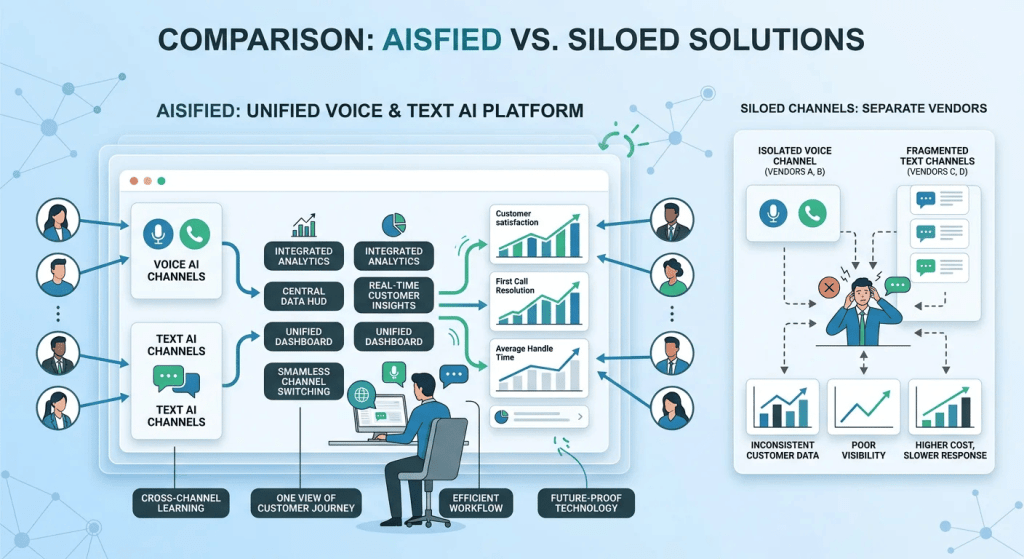
The “voice vs. text” framing is, in most business contexts, a false choice. The businesses achieving the best conversion rates and the lowest cost-per-resolution are deploying both — strategically, based on interaction type rather than channel preference.
The data supports a clear routing framework:
-
- High-value, outbound, complex, or time-sensitive interactions — Voice AI
- High-volume, inbound, simple, or privacy-sensitive interactions — Text chatbot
- Post-interaction follow-up and nurturing — Text
- Appointment setting and real-time qualification — Voice
Sixty-two percent of customers say they prefer interacting with a chatbot over waiting 15+ minutes for a human agent. But this preference is not uniform — it is context-dependent. A customer with an urgent billing dispute wants to speak to something immediately. A customer checking a shipping status wants a fast text response. The channel should match the need, not the other way around.
The emotional AI market is reaching $37.1 billion in 2026, driven in part by voice AI’s ability to detect sentiment, adjust tone, and respond to emotional cues in ways text cannot easily replicate. As this capability matures, voice AI will extend its advantage in high-stakes interactions further still. Businesses building hybrid channel infrastructure now are positioning ahead of this shift.
With 80% of businesses planning to integrate voice AI into customer service in the next 18 months, and 987 million global chatbot users already active, the question is not whether to invest in conversational AI — it is how to allocate that investment intelligently across channels.
How ChatMaxima Enables Both Voice and Text AI
ChatMaxima is one of the few platforms that gives businesses access to both AI voice agents and text chatbots from a single platform, without requiring separate vendor relationships or stitched-together integrations.
Through the ChatMaxima integrations marketplace, businesses can deploy text chatbots across web, WhatsApp, Facebook Messenger, and other channels — and layer in AI voice agents for outbound sales, appointment setting, and phone-based support. The practical advantage: you do not have to choose a modality based on what your vendor supports. You choose based on what your use case requires.
For businesses evaluating their options, the ChatMaxima pricing page shows plans starting at $19/month for Starter, $99/month for Pro, $299/month for Max, and $499/month for Ultra. That is 3–10x cheaper than comparable enterprise conversational AI platforms — which typically price voice AI as a premium add-on at substantial additional cost.
If you are currently using a single-channel platform and want to understand how a multi-modal alternative compares on features and price, the ChatMaxima alternatives comparison provides a detailed breakdown. For context on specific platforms, resources like the best Intercom alternative and best Drift alternative cover feature-by-feature comparisons against the leading players in the market.
Conclusion: Match the Channel to the Conversion Goal
The AI voice agents vs text chatbots debate does not have a universal winner. It has context-specific answers — and the businesses getting this right are treating it as a routing and strategy decision, not a binary technology choice.
Voice AI wins in outbound sales, real estate qualification, healthcare scheduling, complex issue resolution, and any scenario where emotional bandwidth and real-time engagement drive outcomes. If your primary conversion goal is meeting bookings, sales calls, or appointment confirmations, voice AI will outperform text by a substantial margin.
Text chatbots win in high-volume FAQ handling, e-commerce in-session support, privacy-sensitive topics, global multilingual scale, and any scenario where cost per interaction at volume matters more than per-interaction conversion lift. If your primary goal is deflecting support tickets, answering routine questions, or supporting async user journeys, text is the right tool.
For most businesses, the answer is a hybrid strategy — deploying each modality where its strengths align with the interaction type. The companies building this capability now, rather than waiting for the market to consolidate around a single winner, are capturing a compounding advantage in customer experience and conversion efficiency.
ChatMaxima is built for exactly this approach. You do not need two vendors, two integrations, and two billing relationships to run both. Start with the ChatMaxima pricing page to find the plan that matches your current interaction volume, and explore the integrations marketplace to see which channels and voice options fit your stack.
The question is not which converts better in the abstract. The question is which converts better for your specific customers, in your specific context, at your specific stage of growth. Now you have the data to answer it.