
The digital agency landscape has changed more in the past 18 months than in the previous decade. AI is no longer an add-on to the agency workflow – it is the workflow. Agencies that fail to build an intelligent, integrated tech stack in 2026 are not just leaving money on the table; they are becoming structurally uncompetitive.
According to Gartner, worldwide spending on AI will reach $2.52 trillion in 2026 – a 44% year-over-year increase. Of that investment, a significant share flows through agencies and the tools they use to serve clients. Meanwhile, 66% of global marketers now use AI daily, and 98% of organizations plan to maintain or increase their AI spending this year, per HubSpot’s 2025 AI Trends for Marketers report.
This guide breaks down every category of the modern agency tech stack – with verified pricing, practical comparisons, and a clear view of what agencies at different budget levels should be running in 2026.
Why 2026 Is a Turning Point for Agency Tech
For years, the agency software conversation centered on project management, CRM, and social scheduling. Those categories still matter, but the defining shift in 2026 is the emergence of AI as core infrastructure.
Gartner predicts that 40% of enterprise applications will embed task-specific AI agents by the end of 2026 – up from less than 5% in 2025. That means clients expect AI to be baked into every service an agency delivers: content creation, lead capture, customer engagement, analytics, and reporting.
Agencies that have adapted are seeing measurable results. HubSpot research shows that AI-powered hyper-personalization drives 82% higher conversion rates, 30% higher email open rates, and 50% higher click-through rates compared to standard campaigns. AI adoption also doubles production volume without adding headcount – a critical advantage in a market where margins are already under pressure.
The question for agency principals is no longer whether to build an AI stack, but which tools to select and how to connect them into a coherent, profitable system.
The 10 Categories Every Agency Tech Stack Needs
A complete agency stack in 2026 covers ten functional areas. Each category serves a distinct purpose, and gaps in any area create bottlenecks that cost clients – and the agency – money.
The ten categories are: Conversational AI and chatbots, CRM, project management, content creation (text), content creation (visual), video and voice AI, SEO, social media management, analytics and reporting, and automation and integration.
The most strategically important of these is conversational AI. It sits at the intersection of lead capture, client engagement, support automation, and sales – making it the highest-leverage investment in the entire stack. Every marketing campaign drives traffic; chatbots determine whether that traffic converts.
Category 1: Conversational AI and Chatbots
This is where the biggest pricing disparities exist, and where agencies most frequently overpay.
The agency chatbot problem: Most enterprise chatbot platforms were designed for large support teams, not for agencies managing 5, 10, or 50 clients from a single account. Per-seat pricing, per-AI-resolution fees, and per-channel surcharges make costs unpredictable and unscalable for agency business models.
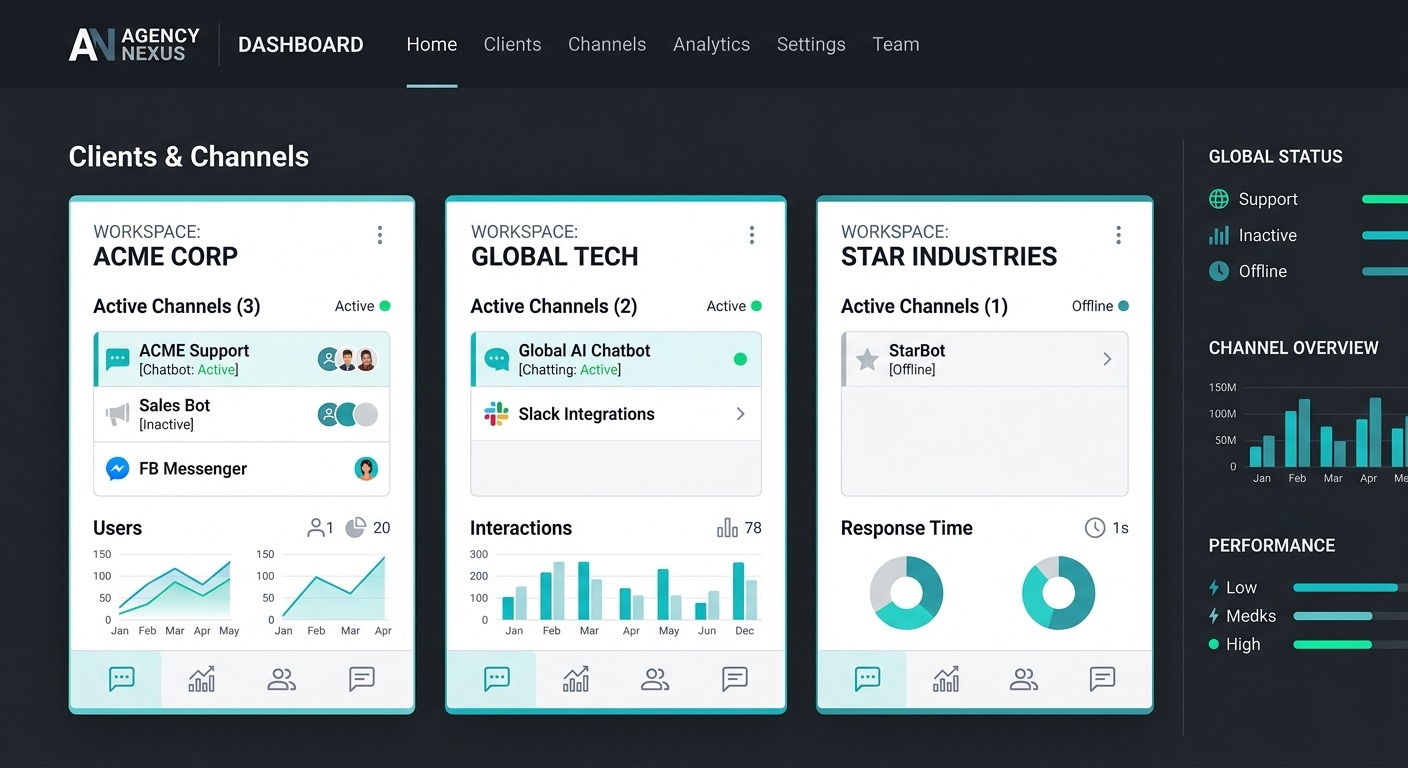
ChatMaxima solves this with architecture designed specifically for agencies. The Pro plan at $99/month provides five client workspaces, 15 team members, all messaging channels (WhatsApp, Instagram, Facebook Messenger, Telegram, Email, SMS, and web chat), and AI chatbots powered by OpenAI, Claude, Gemini, Deepseek, and Llama – at a flat rate with no per-message or per-resolution fees.
To put that in context: a five-seat Intercom Advanced deployment costs $85 per seat plus $0.99 per AI-resolved conversation. An agency running 1,000 AI resolutions per month across five clients pays $425 in seat fees plus $990 in AI resolution fees – $1,415 per month for functionality that ChatMaxima Pro delivers for $99.
For agencies ready to white-label and resell chatbot services, ChatMaxima Ultra at $499/month provides full platform white-labeling with a custom domain and logo. Agencies reselling at industry-standard rates of $200-$500 per client per month recover the tool cost from the first two or three clients, generating $1,500-$4,500 in monthly profit from the chatbot layer alone.
Tidio, Crisp, and ManyChat each have valid use cases. Tidio’s Growth plan ($59/seat/month) works for agencies with a single major client needing e-commerce support. ManyChat (from $15/month) excels at social DM automation for influencer-heavy campaigns. Crisp Plus ($295/month) offers unlimited AI resolutions but lacks the multi-workspace structure agencies need. None of them offer the combination of multi-workspace management, full omnichannel coverage, and flat-rate pricing that ChatMaxima provides at its price point.
Botpress, the developer-oriented option, starts at $89/month but adds unpredictable “AI Spend” charges on top. Implementation typically takes weeks rather than the 15-minute setup ChatMaxima delivers through its no-code interface – a significant cost factor when account managers need to onboard new clients quickly.
Category 2: CRM and Client Management
HubSpot CRM remains the agency industry standard, and for good reason. The free tier handles basic contacts and deals, making it accessible for bootstrap-stage agencies. The HubSpot Solutions Partner program provides agencies with co-selling opportunities and client referrals that offset software costs.
The pricing reality: HubSpot Marketing Hub Professional jumps to approximately $800/month (plus a $3,000 onboarding fee), and Service Hub Enterprise runs $150/seat/month with a minimum of ten seats. Agencies with complex client reporting needs frequently find themselves at the Professional tier faster than expected.
Monday.com has emerged as a compelling alternative for agencies that want CRM and project management in one tool. The CRM module at $12-$28/user/month integrates natively with Monday’s project boards, enabling instant deal-to-project conversion when a new client signs. For a five-person agency team, Monday.com Pro runs approximately $95/month – a significant saving compared to pairing a separate CRM with a separate project management tool.
Asana remains the best pure project management option for delivery-focused agencies, with Starter at $10.99/user/month providing timeline views, workflow automation, and 250 automations per month. Asana does not replace a CRM, so agencies using it typically pair it with HubSpot Free for contact management until volume justifies a paid CRM tier.
Category 3: Content Creation
Content creation spans three distinct sub-categories in 2026: text, visual design, and video and voice.
Text and Copywriting
Jasper AI leads for agencies managing multiple client brand voices. The Pro plan at $59/month (annual) supports up to five seats and three distinct brand voices – well-suited to a growth-stage agency running five to ten clients with differentiated content needs. Jasper’s Surfer SEO integration and agentic campaign orchestration features make it the strongest option for long-form content at scale.
Copy.ai has repositioned itself as a go-to-market AI platform with strong ABM campaign and sales automation workflow capabilities. Its Team plan at $186/month (annual) suits agencies that need to produce volume content across multiple accounts and want built-in workflow automation for content approval cycles.
The important distinction: Jasper excels at long-form content quality and brand voice consistency. Copy.ai excels at high-volume, multi-channel campaign content with workflow automation baked in.
Visual Design
Canva Teams at $10/user/month (annual) remains the most accessible design tool for non-designers on agency teams. Its AI Magic Studio features, Brand Kit management, and 1TB storage per user make it viable for social graphics, presentation decks, and lightweight creative work across multiple clients.
Midjourney (from $10/month) remains the best-in-class option for AI image generation quality. Agencies using it for campaign concepting, mood boards, and hero imagery should note that Stealth mode – which keeps generated images private from the Midjourney community – requires the Pro plan at $60/month. For client work involving confidential campaigns, Stealth is non-negotiable.
Adobe Firefly provides commercial safety that Midjourney cannot: its images are trained on licensed content, making them legally clean for client use. The Creative Cloud for Teams plan at approximately $99.99/user/month is a justified expense for design-led agencies billing at premium rates.
Video and Voice AI
Synthesia enables agencies to produce professional training, explainer, and marketing videos without cameras, studios, or actors. The Creator plan at $89/month (or $64/month annual) provides 30 video minutes per month and API access – sufficient for agencies producing two to four client videos per month.
ElevenLabs leads in AI voice quality and versatility. The Pro plan at $99/month provides 500,000 characters per month with API access for integration into client workflows. Agencies building voice agent services for clients use ElevenLabs for voiceovers, podcast production, and increasingly for conversational AI voice agents that handle inbound calls and lead qualification.
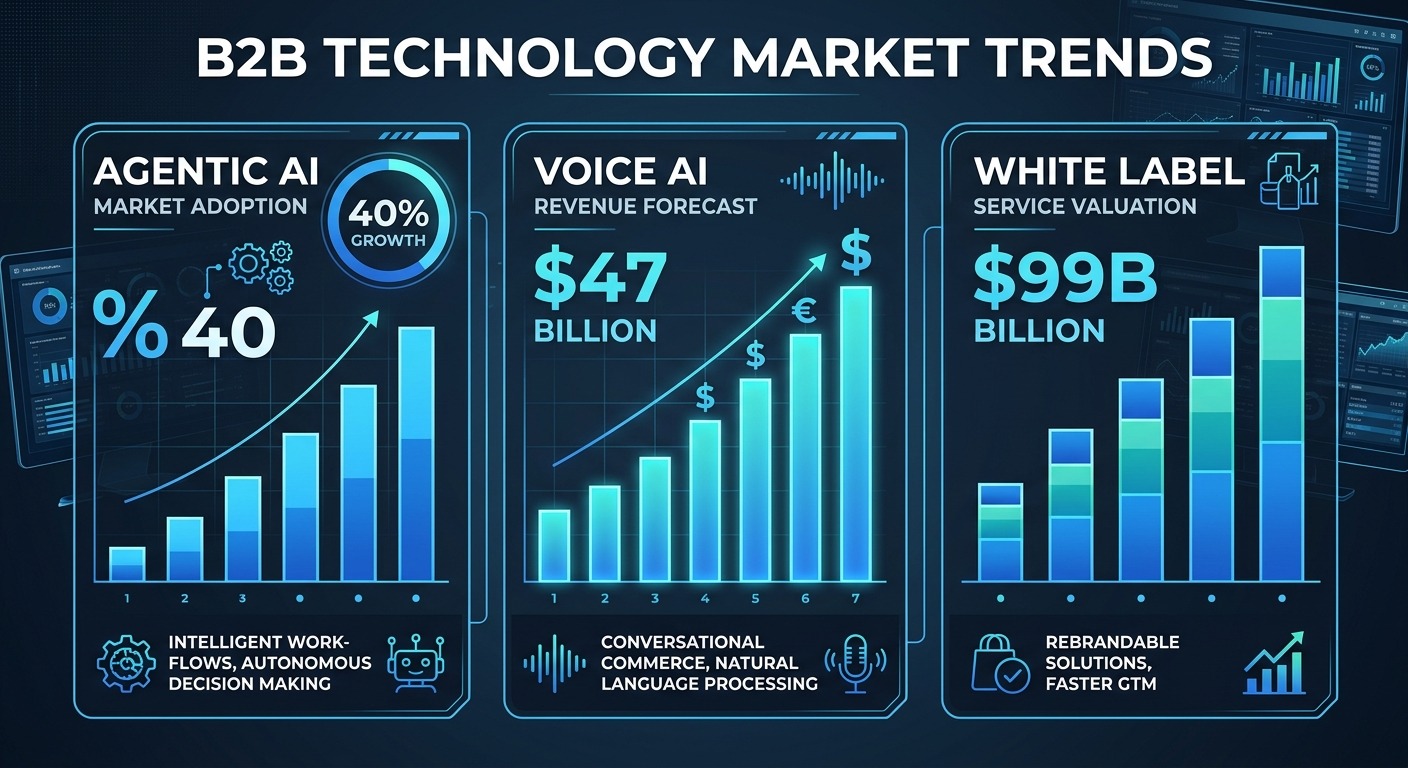
The voice AI market is projected to reach $47.5 billion by 2034. AI voice agents are demonstrably reducing customer service costs by 65-90% for early adopters. Agencies that add voice agent deployment to their service catalog in 2026 are positioning themselves in a high-growth, high-margin segment.
Category 4: SEO
The SEO tool category has evolved substantially in 2026 with the rise of Answer Engine Optimization (AEO) – ensuring client brands appear in AI search results from ChatGPT, Perplexity, and Google AI Overviews. Agencies that only optimize for traditional search are missing a growing share of high-intent traffic.
Semrush remains the most comprehensive SEO platform for agencies. The Guru plan at $249.95/month includes the features most growth-stage agencies need: content marketing tools, branded reports, historical data, and multi-location tracking. Semrush’s AI Visibility Toolkit ($99/month as a standalone) now tracks brand mentions across AI search engines – an essential add-on for agencies selling AEO services. The Agency Growth Kit ($69/month) adds white-label client reporting and a dedicated agency CRM.
Ahrefs Standard at $199-$249/month is the preferred choice for agencies with strong backlink analysis and technical SEO service lines. Its content gap identification and AI content grader features are particularly valuable for agencies doing content audits and competitive analysis at scale.
Surfer SEO at $175-$219/month (Scale plan) integrates directly with Jasper for SEO-optimized content brief creation and has an AI Tracker that monitors brand presence in AI search results. Agencies combining Jasper, Surfer SEO, and Semrush’s AI Visibility Toolkit are well-positioned to sell AEO as a premium service line.
Category 5: Social Media Management
Buffer’s Agency plan at $100/month covers ten social channels with unlimited users and 2,000 posts per channel – the most affordable agency-tier social management option available. The AI Assistant is included on all plans, including the free tier. For agencies managing smaller client rosters (five to ten clients) without deep social analytics requirements, Buffer delivers strong value per dollar.
Hootsuite’s Team plan at $249-$399/month steps up with OwlyWriter AI for content generation, advanced inbox automation, and smarter scheduling optimization. Agencies managing clients with active social customer service operations (retail, hospitality, SaaS) will find Hootsuite’s unified inbox and automation capabilities worth the premium.
Sprout Social is the analytics-first choice for data-driven agencies. Its Professional plan at $299/seat/month provides unlimited social profiles, competitive reporting, AI Assist, and sentiment analysis. The seat-based pricing is expensive at team scale, but agencies billing reporting as a premium deliverable can justify the cost.
Category 6: Analytics and Reporting
Google Analytics 4 and Looker Studio remain the foundational reporting layer for most agencies. Both are free, both integrate natively with Google Ads and Search Console, and Looker Studio’s customizable dashboards make it a strong white-label reporting tool at zero software cost.
AgencyAnalytics at approximately $12-$18/client/month is purpose-built for agency reporting. It auto-generates branded PDF reports and live dashboards across SEO, PPC, social, and email – eliminating manual reporting that typically consumes five to ten hours per client per month.
Category 7: Automation and Integration
Automation is what transforms a collection of tools into a connected stack. Without it, data lives in silos, manual work multiplies, and the productivity gains from individual AI tools never compound.
Zapier with its 8,000+ app connectors remains the most accessible automation layer for agency teams. The Professional plan starting at approximately $49/month handles the core workflows every agency runs: lead from chatbot to CRM, CRM update to project management task, content approval to social scheduling.
Make (formerly Integromat) at $29/month for the Team plan provides greater technical flexibility for complex multi-step automation scenarios. Agencies building sophisticated client automation workflows – multi-path logic, API transformations, data manipulation – find Make’s visual builder more capable than Zapier at a lower price point.
The most effective agencies in 2026 are building connected stack workflows where data moves automatically: a ChatMaxima lead triggers a HubSpot contact, which creates an Asana task, which notifies the account manager in Slack. This reduces manual data entry by 80%, freeing agency teams to focus on strategy rather than administration.
Budget Tier Breakdowns: What a Real Agency Stack Costs
One of the most common mistakes agency principals make is budgeting for individual tools without understanding total stack cost. Here is a realistic breakdown at three agency stages.
Bootstrap Agency: $0-$150/month
Profile: Solo operator or two-to-three person team, one to three clients, proving the model.
The bootstrap stack: ChatMaxima Starter ($19/month), HubSpot Free, Asana Free, Canva Free, Buffer Free (three channels), Looker Studio Free, GA4 Free, Zapier Free, ChatGPT Plus ($20/month), and Ahrefs Starter ($29/month).
Total: approximately $68/month. This enables a solo agency to deploy a working chatbot, produce content, manage social presence, track SEO, and report results – all under $70/month.
Growth Agency: $150-$600/month
Profile: Three-to-ten person team, five to fifteen clients, growing monthly recurring revenue, specializing in defined service lines.
ChatMaxima Pro ($99/month), HubSpot Starter ($25/month), Monday.com Standard for five users ($60/month), Jasper Pro ($59/month), Buffer Agency ($100/month, ten channels), Semrush Pro ($140/month), Zapier Professional ($49/month), Synthesia Creator ($89/month), and Canva Teams ($15/month).
Total: approximately $636/month. This supports fifteen client engagements – chatbots, content, social, SEO, video, and reporting – at roughly $42 per client in monthly software costs. Against typical retainer rates of $2,000-$5,000/month, the margin is substantial.
Scale Agency: $600-$2,500/month
Profile: Ten-to-fifty person team, twenty to one hundred clients, multiple specializations, white-labeling AI services for recurring revenue.
The defining move at this tier is ChatMaxima Ultra ($499/month) for full white-label chatbot reselling. Against twenty clients paying $250/month each for branded chatbot services, the monthly revenue from the chatbot layer alone is $5,000 – making ChatMaxima’s net cost negative from day one.
The rest of the scale stack: HubSpot Professional ($800/month), Monday.com Pro for twenty users ($380/month), Jasper Business (~$300/month), Hootsuite Team ($249/month), Semrush Guru ($250/month), Ahrefs Standard ($249/month), Zapier Team ($103/month), Make Team ($29/month), Synthesia Creator ($89/month), ElevenLabs Pro ($99/month), and AgencyAnalytics for twenty clients ($360/month).
Total: approximately $3,407/month before the white-label revenue offset. Chatbot revenue from twenty clients covers 147% of the total stack cost – the agency’s remaining tools are effectively paid for by one productized AI service.
How the Stack Connects: ChatMaxima as the Conversational Intelligence Layer
Across all three budget tiers, ChatMaxima functions as the conversational intelligence layer – the point where traffic from every other tool converts into qualified leads, conversations, and customers.
Semrush drives organic traffic. Buffer amplifies brand awareness on social. Jasper and the SEO tools attract inbound interest. But none of those investments produce revenue until a visitor engages, a lead is captured, and a conversation begins. That is where ChatMaxima operates.
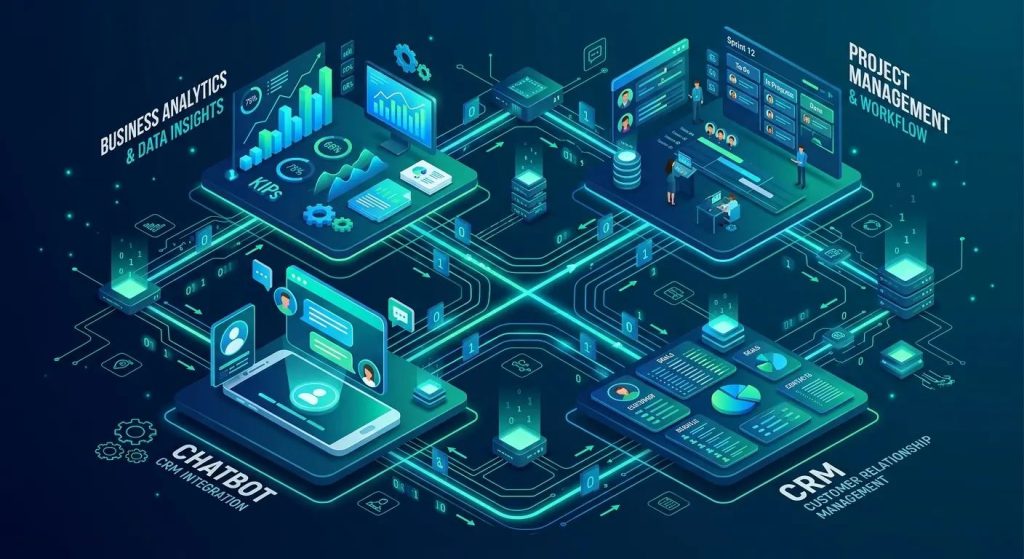
The integration model is straightforward: ChatMaxima deploys on client websites and across messaging channels. Leads captured by the chatbot flow through Zapier to HubSpot, where they become CRM contacts. HubSpot triggers Asana task creation for follow-up. The account team manages delivery in Asana. Looker Studio reports results. The cycle repeats automatically.
Agencies interested in the full agency use case can explore the ChatMaxima platform for agencies and review detailed pricing options for each tier.
How does ChatMaxima compare to other chatbot platforms? The alternatives page provides side-by-side comparisons, including dedicated analyses for Intercom alternatives, Tidio alternatives, and Drift alternatives.
Three Trends Reshaping the Agency Stack in 2026
Agentic AI: From Task Execution to Autonomous Campaigns
The most significant structural shift in agency AI is the move from tools that execute instructions to agents that plan, decide, and act independently. Gartner’s prediction that 40% of enterprise apps will embed task-specific AI agents by year-end reflects a change that is already visible in the tools agencies use daily – Jasper’s agentic campaign orchestration, Make’s AI goal-oriented scenario generation, and emerging chatbot capabilities that can browse the web, update CRMs, and process orders within a single conversation.
For agencies, the practical implication is this: the manual work of coordinating tools across teams is itself becoming automatable. Agencies that invest now in building agentic workflows will deliver client results faster, at lower cost, than agencies still relying on human coordination for every step.
White-Label AI Reselling: From Project Revenue to Recurring Revenue
The white-label AI market is projected to reach $99.19 billion globally by the end of 2026. Agencies using white-label AI platforms report 30-40% higher profit margins compared to custom builds. For agency principals, this represents a structural revenue model shift: from project-based income (lumpy, client-dependent) to subscription recurring revenue (predictable, scalable).
ChatMaxima Ultra’s white-label capability is one of the clearest examples of this opportunity. At $499/month, an agency can brand the entire platform, set its own pricing, and resell to clients at $200-$500/month each. Ten clients generate $2,000-$5,000 in monthly recurring revenue from a single productized service, independent of project work.
Answer Engine Optimization: The New SEO Frontier
Agencies that built their SEO practice around Google rankings face a new challenge: a growing share of informational queries are being answered directly by AI systems – ChatGPT, Perplexity, Google AI Overviews – without a click to the client’s website. AEO is the practice of ensuring client brands appear in these AI-generated answers.
The tools are emerging: Semrush’s AI Visibility Toolkit ($99/month) tracks brand mentions across AI search engines. Surfer SEO’s AI Tracker monitors brand visibility in AI responses. Agencies that add AEO to their service catalog are creating a new high-margin service line in a space where client demand is growing and specialist supply remains limited.
Building the Right Stack: Two Questions Worth Answering
How many tools is too many? The answer depends less on the number of tools than on whether they are connected. A ten-tool stack with Zapier integrations between every layer is more productive than a five-tool stack where data moves manually. Integration should be the first question when evaluating any new tool addition.
When does the white-label model make sense? The white-label chatbot model becomes viable when an agency has five or more clients who would benefit from conversational AI. At that scale, ChatMaxima Ultra’s economics are compelling: $499/month for the platform, $2,000-$5,000 in monthly recurring revenue from client subscriptions. The minimum viable stack for a new agency is ChatMaxima Starter ($19/month) plus free tiers of HubSpot, Asana, Canva, Buffer, GA4, and Looker Studio – a complete operational foundation for under $40/month while the agency builds revenue to invest in premium tiers.
Conclusion: Build the Stack, Own the Outcome
The 2026 agency tech stack is not about having the most tools – it is about having the right tools, connected correctly, operating in service of a clear business model.
The agencies that will outperform in 2026 and beyond are those that treat their tech stack as a strategic asset, not an operational expense. They choose tools that work together, they invest in the automation layer that connects them, and they identify the highest-leverage category – conversational AI – as the foundation on which client engagement is built.
For agencies evaluating their chatbot strategy, the comparison between ChatMaxima and alternatives like Intercom, Botpress, Tidio, and Drift is not close on a cost-per-workspace basis. ChatMaxima Pro at $99/month delivers five client workspaces, all channels, and unlimited conversations – a value proposition that is three to ten times better on a per-client cost basis than the enterprise alternatives.
The path forward is clear: audit your current stack against the ten categories covered here, identify the gaps, build the integrations, and capture the recurring revenue that white-label AI services make available. The agencies that act on this in 2026 will have a structural advantage that compounds for years.
Start with ChatMaxima’s pricing to understand how the conversational layer fits into your agency stack. Review the integrations available to see how ChatMaxima connects to the CRM, SEO, and automation tools already in your workflow. Then read more on the ChatMaxima blog for tactical guidance on deploying AI chatbots across client engagements.
The stack is available. The economics are proven. The only variable is execution.