Meta is pulling the plug on messenger.com. Starting April 2026, the standalone Messenger website will cease to exist, and users will be automatically redirected to facebook.com/messages. If you run a business that relies on Messenger for customer communication, this is not just a minor inconvenience. It is a fundamental shift in how one of the world’s largest messaging platforms operates, and it carries serious implications for any company that built workflows, support processes, or sales pipelines around the standalone Messenger experience. The news, first reported by TechCrunch, confirms what many had suspected after Meta quietly shut down the Messenger desktop apps for Windows and Mac in late 2025: the era of Messenger as an independent product is officially over.
This matters because businesses do not just “use” Messenger casually. Support teams have agents sitting in messenger.com all day, handling customer inquiries through a dedicated web interface. Sales teams route leads from Facebook ads directly into Messenger conversations. E-commerce brands use Messenger as a real-time channel for order updates, returns, and complaints. When the surface those teams depend on disappears, the disruption ripples through every department that touches customer communication. The question every business leader should be asking right now is not “how do I adapt to this change?” but rather “why was I this dependent on a single platform in the first place?”
Messenger’s Journey: From Standalone Product to Facebook Footnote (2008-2026)
Understanding why this shutdown matters requires a brief look at how Messenger evolved, and how Meta repeatedly changed direction on its own product strategy. The timeline tells a story of a platform that could never quite decide what it wanted Messenger to be.
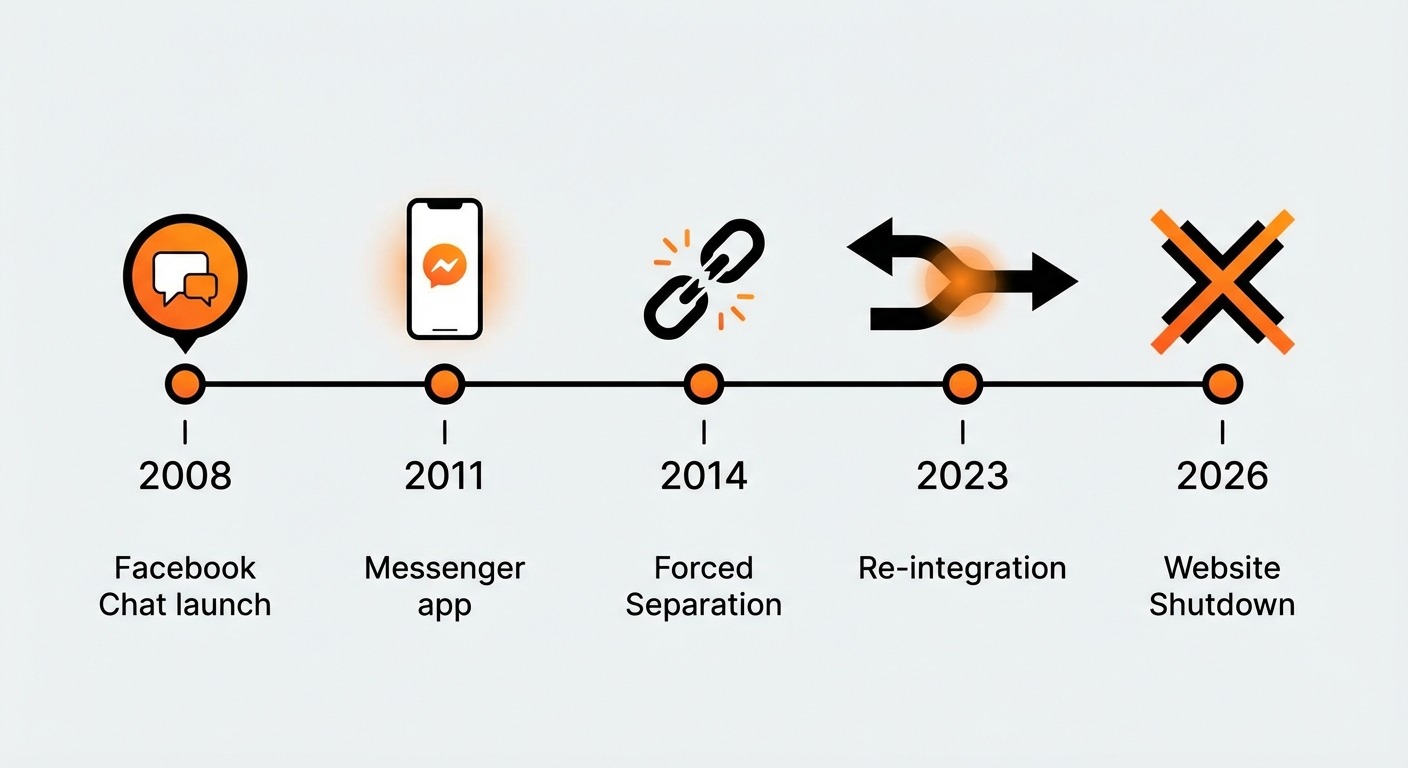
It started in 2008 when Facebook launched “Facebook Chat,” a simple in-app messaging feature that let users send real-time messages to friends. By 2011, Facebook spun this out into a standalone mobile app called Facebook Messenger, recognizing that messaging deserved its own dedicated experience. Then came the controversial 2014 decision that forced users to download the separate Messenger app to send messages on mobile, removing the messaging capability from the main Facebook app entirely. Users were frustrated, but Meta (then Facebook) was committed to making Messenger a standalone powerhouse.
Fast forward to 2023, and Meta reversed course entirely. The company began merging Messenger back into the main Facebook app, undoing the very separation it had forced on users nearly a decade earlier. The desktop apps for Windows and Mac were quietly discontinued in late 2025. And now, with the April 2026 shutdown of messenger.com, the consolidation is complete. Messenger as a standalone product is gone. It exists only as a feature within the Facebook ecosystem. Reverse engineer Alessandro Paluzzi first spotted the changes, and Meta has since confirmed the timeline. Users who access Messenger without a Facebook account will lose web access entirely and be limited to the mobile app only. Those who do have Facebook accounts will find their conversations redirected to facebook.com/messages.
The pattern here is unmistakable. Meta builds a standalone product, pushes millions of users and businesses onto it, then absorbs it back into the mothership when the economics of maintaining separate platforms no longer make sense. The reasons are straightforward: fewer platforms mean lower infrastructure costs, fewer engineering teams to maintain, and fewer security surfaces to protect. For Meta, this is a rational business decision. For the businesses that built their communication strategy around Messenger’s standalone experience, it is a disruption they did not plan for.
Direct Impact on Businesses: What Changes Starting April 2026
The shutdown of messenger.com creates several concrete problems for businesses that relied on the standalone web experience. These are not hypothetical concerns. They are operational disruptions that will affect teams starting in April.
First, support teams that used messenger.com as their primary interface for handling customer conversations will need to transition to facebook.com/messages. This sounds like a simple redirect, but the experience is different. The Facebook messages interface is embedded within the broader Facebook UI, which means more distractions, different navigation patterns, and a workflow that was designed for personal social networking rather than professional customer support. Agents who were efficient in the clean, focused messenger.com interface will need to adjust to a cluttered environment that was not built with high-volume customer support in mind.
Second, businesses that use Messenger without linking it to a Facebook account face a more severe problem. What happens to businesses that used Messenger independently? Starting in April, these users lose web access completely. Their only option is the mobile app, which is far less practical for professional customer support operations. If your business had agents using Messenger on desktop without Facebook accounts, that workflow is simply gone. There is no workaround within Meta’s ecosystem.
Third, there is the question of chat history. Meta has stated that users can restore chat history using their backup PIN, but the transition period creates uncertainty. Businesses need to ensure that conversation records, which may contain important customer data, support tickets, and order information, are preserved through the migration. If your team has not set up backup PINs or does not have a systematic approach to archiving Messenger conversations, now is the time to address that gap before the April deadline.
The practical reality is that Meta is forcing every Messenger-dependent business into the Facebook ecosystem proper. If you want to communicate with customers via Messenger on desktop, you must go through Facebook. There is no opt-out, no alternative web client, and no standalone option. This is the kind of platform risk that businesses often acknowledge in theory but rarely plan for in practice. Companies that built omnichannel support strategies early are far better positioned to absorb this change without major disruption.
The Bigger Picture: Platform Dependency Is the Real Problem
The Messenger shutdown is not an isolated event. It is the latest in a long series of decisions by Meta that have disrupted businesses relying heavily on the Facebook ecosystem. Consider the history: Facebook Pages once had massive organic reach, and businesses invested heavily in building audiences there. Then the algorithm changes came, and organic reach dropped to single-digit percentages, forcing businesses to pay for the visibility they once had for free. API changes have repeatedly broken integrations that businesses spent months building. The 2018 Cambridge Analytica scandal led to sweeping API restrictions that cut off data access many businesses depended on.
Every time Meta changes direction, businesses that over-indexed on the platform absorb the cost. The Messenger website shutdown is simply the latest example. But unlike algorithm tweaks that gradually reduce effectiveness, this is a binary change: one day the platform exists, and then it does not. Businesses that treated messenger.com as a permanent fixture of their customer support infrastructure are now scrambling to adapt with just weeks of notice.
This is the core lesson: any channel you do not own can be changed or eliminated without your consent. Meta controls Messenger. They decided to build it, they decided to make it standalone, and they decided to absorb it back into Facebook. At no point in that process did any business customer get a vote. The same is true for every third-party platform your business communicates through. WhatsApp, Instagram DMs, Telegram, and every other messaging channel operate at the discretion of their parent companies. The risk is not that any single platform will disappear overnight, though that can happen. The risk is that the platform will change in ways that break your specific workflow, and you will have no recourse except to adapt or lose access to those customers.
This is why platform diversification is not a luxury. It is a core business requirement. If your entire customer messaging strategy depends on a single channel controlled by a single company, you are not building on solid ground. You are building on borrowed ground, and the landlord can change the terms at any time.
Why Single-Channel Dependency Is Dangerous for Business Messaging
The Messenger shutdown exposes a vulnerability that many businesses share but few openly discuss: single-channel dependency. When a business routes all of its customer communication through one platform, it creates a single point of failure that can disrupt operations, damage customer relationships, and cost revenue when that platform changes.
Consider a mid-size e-commerce business that handles 80% of its customer support through Messenger. Their agents are trained on the Messenger interface. Their response time metrics are calibrated to Messenger’s notification system. Their chatbot workflows are built on the Messenger API. When messenger.com shuts down, every part of that operation needs to be re-evaluated. Even if the underlying Messenger API continues to function, the agent experience changes, the workflow changes, and the transition period creates gaps in customer service. Multiply this across thousands of businesses, and the scale of disruption becomes clear.
Single-channel dependency is dangerous for three specific reasons. First, it concentrates risk. If your only customer communication channel goes down, changes, or disappears, you have no fallback. Second, it limits your reach. Not every customer prefers the same channel. Some prefer WhatsApp, others prefer Instagram DMs, and many prefer web chat on your own website where they do not need to log into any third-party platform. Third, it gives the platform disproportionate leverage over your business. When you depend entirely on one channel, you have no negotiating power when the terms change. You simply comply, because the alternative is losing access to your customers entirely.
The businesses that will emerge from the Messenger shutdown unscathed are those that already diversified their messaging channels. They use Messenger as one of several touchpoints, not as their entire communication infrastructure. When one channel changes, their agents simply handle more volume on the others while they adjust. That kind of resilience does not happen by accident. It requires deliberate investment in omnichannel communication platforms that unify multiple channels into a single operational workflow.
How Omnichannel Platforms Protect Your Business from Platform Risk
The solution to platform dependency is not to abandon Messenger or any other specific channel. It is to ensure that no single channel becomes your only channel. This is where omnichannel messaging platforms provide their most important value, not as a feature upgrade, but as a form of business continuity insurance.
An omnichannel platform like ChatMaxima aggregates conversations from Messenger, WhatsApp, Instagram DMs, Telegram, web chat, email, and SMS into a single unified inbox. Your agents work from one interface regardless of which channel the customer chose. Your reporting and analytics span all channels. Your chatbot automations deploy across every platform simultaneously. When Meta shuts down messenger.com, your agents do not need to learn a new interface or scramble to redirect workflows. They continue working from the same inbox they have always used, because the Messenger conversations were never tied to messenger.com in the first place. They flow through the API into your unified platform.
This is the key distinction: when you use a platform like messenger.com directly, you are dependent on that specific interface. When you route Messenger conversations through an omnichannel platform, you are dependent only on the Messenger API, which continues to function regardless of what happens to the website. The surface can change, the website can shut down, and the desktop apps can disappear, but your workflow remains intact because it was never built on those surfaces in the first place.
The practical benefits extend beyond risk mitigation. When all your channels feed into one inbox, you gain a complete view of each customer’s communication history across every platform. A customer who started on Messenger, moved to WhatsApp, and then reached out via web chat has one unified conversation thread. Your agents see the full context without switching tools. Your response times improve because agents are not juggling multiple interfaces. And when you need to add or remove a channel, you make one configuration change in your platform rather than overhauling your entire support operation.
Which Channels to Diversify Into Right Now
If the Messenger shutdown has prompted you to rethink your channel strategy, here are the channels that deserve your attention in 2026, along with the strategic rationale for each.
WhatsApp Business API is the most important channel for most businesses to invest in right now. With over three billion active users globally and the highest message open rates of any messaging platform, WhatsApp has become the default communication channel in most markets outside North America. The WhatsApp Business API supports rich media, automated responses, broadcast campaigns, and seamless integration with CRM and support platforms. If you are not on WhatsApp yet, the Messenger shutdown should be the catalyst that gets you there.
Instagram DMs are growing rapidly as a business communication channel, particularly for consumer brands, D2C companies, and service businesses that rely on visual content. Instagram’s audience skews younger and more engaged, and the DM automation capabilities available through platforms like ChatMaxima make it possible to handle high volumes without manual effort.
Web chat on your own website is the one channel you fully control. Unlike every other platform on this list, your website chat widget runs on your infrastructure, under your domain, with your branding. No third party can shut it down, change its interface, or restrict your access. Every business should have a live chat widget on their website as a baseline communication channel, because it is the only channel where you are not a tenant on someone else’s platform.
Telegram offers a developer-friendly, privacy-focused messaging platform with growing adoption in tech-savvy markets. The Telegram integration supports bots, groups, and channels, making it versatile for both support and marketing use cases.
SMS remains relevant for transactional messages, appointment reminders, and reaching customers who are not active on messaging apps. While it lacks the rich media capabilities of modern messaging platforms, its near-universal reach makes it a valuable backup channel.
The goal is not to be on every channel simultaneously. It is to be on enough channels that losing any single one does not cripple your operations. A good starting point for most businesses is WhatsApp plus web chat plus one additional channel relevant to your audience.
Migration Checklist for Affected Businesses
If your business currently relies on messenger.com for customer communication, here is a practical checklist to ensure a smooth transition before the April 2026 deadline.
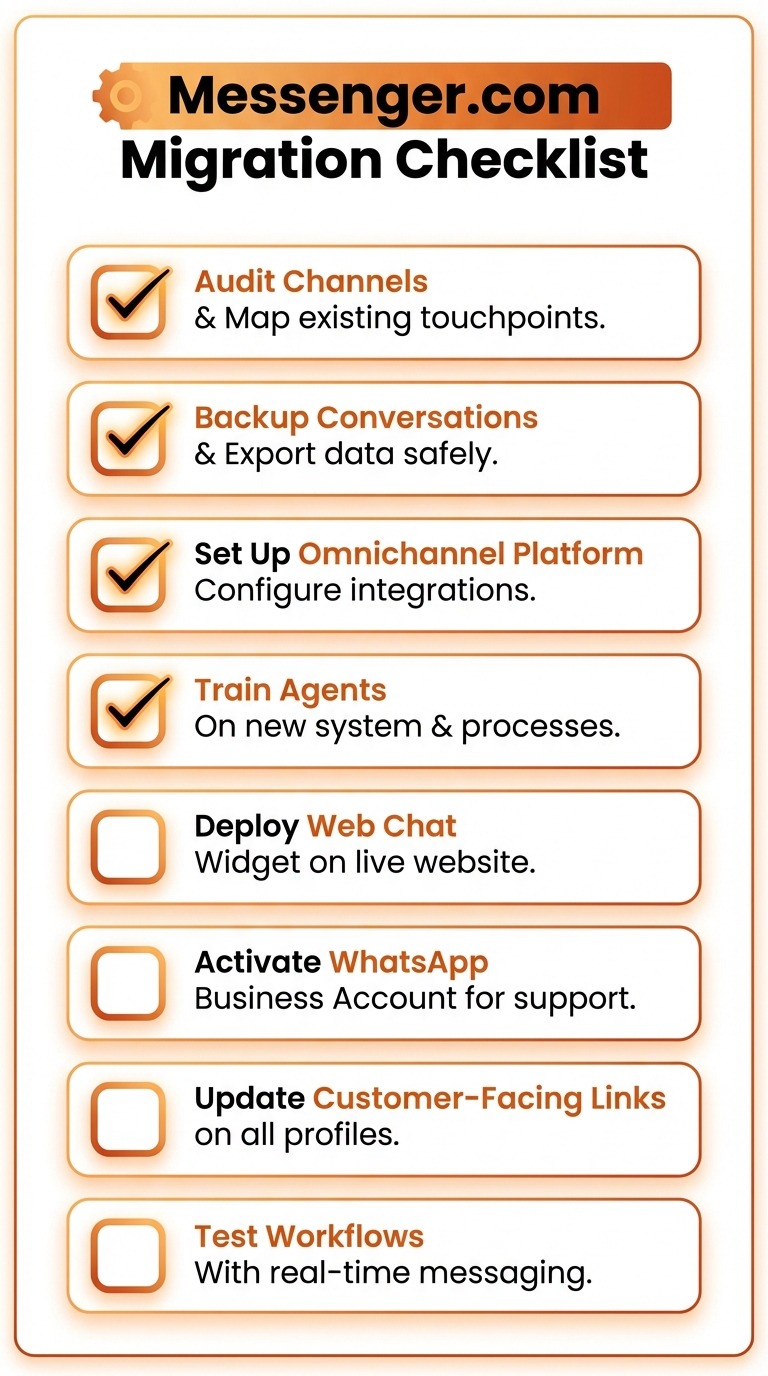
1. Audit your current Messenger usage. Document how many agents use messenger.com, what types of conversations they handle, average daily volume, and any automations or chatbots that depend on the Messenger web interface. You cannot plan a migration without understanding the scope.
2. Back up your conversation history. Ensure all agents have their backup PINs configured and that important conversation data is exported or archived. If you use a third-party platform that already stores Messenger conversations via API, verify that historical data is intact and accessible.
3. Evaluate and deploy an omnichannel platform. If you are not already using a unified inbox, now is the time. Platforms like ChatMaxima connect Messenger, WhatsApp, Instagram, Telegram, web chat, and more into a single interface. This ensures the Messenger shutdown does not disrupt your agent workflow because conversations continue flowing through the API into your platform regardless of what happens to the web interface.
4. Set up WhatsApp Business API. If you are not on WhatsApp yet, begin the verification and onboarding process now. WhatsApp is the natural fallback for businesses losing their Messenger web presence. The setup process takes time, so starting early avoids a last-minute rush.
5. Deploy a web chat widget on your website. Add a live chat or AI chatbot widget to your website to capture customers who previously reached you through messenger.com. This gives you a channel you fully own and control.
6. Redirect customer-facing links. If your website, email signatures, or marketing materials contain links to messenger.com, update them to point to your new preferred channels. Consider using a multi-channel widget like OneTap that gives visitors access to WhatsApp, Messenger, Instagram, Telegram, and web chat from a single button.
7. Train your agents on the new workflow. If agents are transitioning from messenger.com to a unified inbox, schedule training sessions before the April deadline. Familiarity with the new interface before the cutover prevents a drop in response times during the transition.
8. Test everything before the deadline. Run test conversations across all channels, verify that automations fire correctly, confirm that conversation routing works, and ensure that no customer-facing workflows are broken. Do this at least two weeks before the April cutover to leave time for fixes.
What This Means for the Future of Business Messaging
The Messenger shutdown is not the end of a story. It is a preview of how platform consolidation will continue to reshape business messaging in the years ahead. Meta is optimizing for fewer, larger surfaces. Google has repeatedly launched and killed messaging products. Even Apple’s iMessage ecosystem is evolving with RCS support. The one constant in business messaging is change, and the businesses that thrive are those built to absorb change without breaking.
The companies that will navigate this successfully share a common trait: they treat every messaging channel as temporary and their customer relationship as permanent. The channel is just the pipe. The relationship, the conversation history, the context, the trust, that is what matters. When you build your communication infrastructure around a unified platform that owns the customer relationship layer, the underlying channels become interchangeable. One can shut down while another rises, and your business continues without interruption.
If the Messenger shutdown has caught you off guard, use it as the catalyst for building the messaging infrastructure you should have had all along. Audit your channels, deploy an omnichannel platform, diversify your touchpoints, and ensure that no single company’s product decision can disrupt your ability to talk to your customers.
Ready to protect your business from platform dependency? Start a free trial with ChatMaxima and unify your Messenger, WhatsApp, Instagram, Telegram, and web chat conversations into one resilient inbox that keeps working no matter what Meta decides next.