
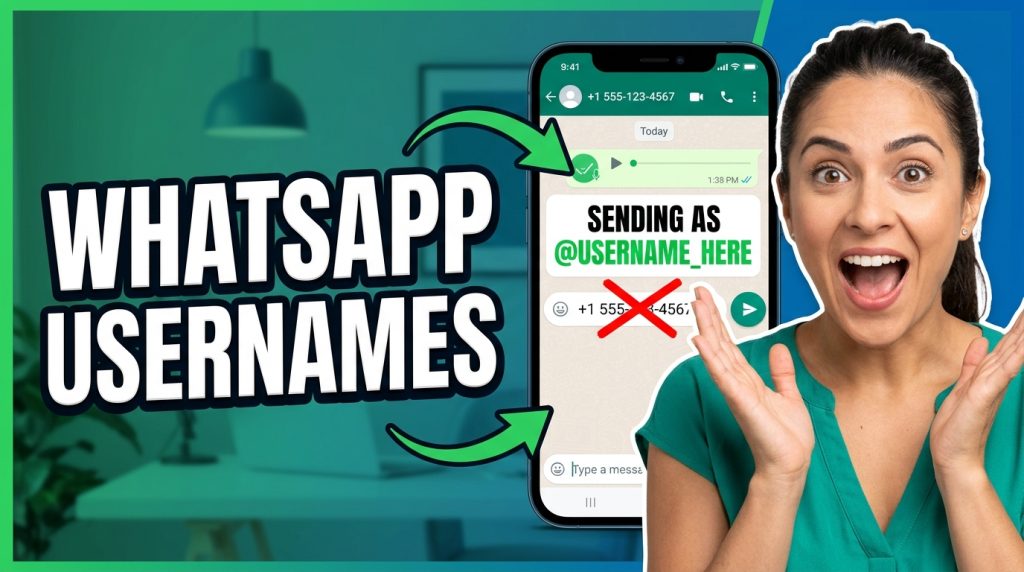
For seventeen years, your identity on WhatsApp was one thing: your phone number. It was your login, your address, your business card, and your privacy liability all rolled into a single string of digits. It was how friends found you, how businesses reached you, and how strangers in a group could quietly copy you into their contacts forever. In June 2026, that began to change. WhatsApp started rolling out WhatsApp usernames, and with them, the most significant rethinking of identity in the app’s history.
This is not a cosmetic tweak or a vanity handle bolted onto a settings page. WhatsApp usernames touch personal privacy, business operations, the WhatsApp Business API, CRM systems, anti-spam design, marketing strategy, and the competitive balance against Telegram and Signal. On June 29, 2026, WhatsApp opened username reservations, with full functionality arriving in geographic waves through the rest of the year. The headline is simple: you will soon be able to talk to people on WhatsApp without ever exposing your phone number.
This guide is the long version. It walks through every angle in depth: what was actually announced, exactly how reservation works, the precise username rules and how to choose a good one, why WhatsApp deliberately refused to build a searchable directory, how the optional username key works, the hard line between privacy and anonymity, the rollout timeline and why it is structured the way it is, and the business-critical change called the Business-Scoped User ID. It then goes further than most coverage, into real-world scenarios, the security and spam implications, common misconceptions, and a practical action plan for teams that run customer conversations on WhatsApp. If you only have two minutes, read the next three sections. If you own a WhatsApp number that matters to your business, read all of it.
What WhatsApp Actually Announced
The single most important thing to understand about the June 29, 2026 announcement is that the action available right now is reservation, not full use. WhatsApp opened the door for users to claim a username ahead of time. The ability to actually receive messages by username, and to have your phone number hidden from new contacts, rolls out country by country over the second half of 2026.
The core promise, in WhatsApp’s own words, is that when someone messages you for the first time, “they will no longer see your phone number, if you enabled your username.” Your number stays in your settings and never has to leave it. That is the whole idea distilled into one sentence. Everything else in this guide is the detail that makes that sentence real.
There are two parallel tracks bundled inside this single announcement, and they are constantly blurred together in news coverage. The first track is usernames for people, a consumer privacy feature that lets any individual swap the phone number for a handle in first contact. The second track is Business-Scoped User IDs, usually shortened to BSUID, an infrastructure change for companies on the WhatsApp Business API that carries a hard June 2026 compliance deadline. The two are related but not identical. Most articles cover only the first. For any business that runs support, sales, or marketing on WhatsApp, the second is the one that can quietly break your systems if nobody plans for it.
WhatsApp has also been candid that this took longer to ship than expected. The company described the work as overhauling the app’s core identification system. That is a fair description. Phone numbers were not just a display field. They were woven through routing, contact matching, account recovery, group membership, and the entire WhatsApp Business API. Decoupling identity from the number, even partially, is the kind of change that ripples into hundreds of places, which is exactly why businesses need a runway to adapt.
The Two Tracks: People and Businesses
Before going deeper, it helps to hold the two tracks side by side, because the rest of this guide moves between them.
For people, a username is an optional alias. You reserve it, you optionally enable it, and from then on new contacts see your handle instead of your number. You can still share your number with whoever you want. Nothing is taken away. A capability is added: the ability to be reachable without leaking your digits. This is purely a privacy upgrade for the individual.
For businesses, the change is structural rather than cosmetic. When a customer who uses a username messages a business, the business cannot rely on receiving that customer’s phone number anymore. Instead, the business receives a Business-Scoped User ID, a stable identifier scoped to that specific business, delivered inside the message webhook. The business now identifies, routes, and remembers that customer by an ID rather than a number. This is not optional and it is not cosmetic. It is a change to the data that every WhatsApp Business API integration receives on every message, and it has a deadline.
Keep this split in mind. When this guide talks about reserving a name, choosing a good handle, or the username key, that is the people track. When it talks about BSUID, webhooks, CRM matching, and June 2026, that is the business track.
Why WhatsApp Relied on Phone Numbers for So Long
To appreciate how big this change is, it helps to understand why WhatsApp tied identity to the phone number in the first place, and why it stuck with that decision for so long.
When WhatsApp launched, the phone number was a brilliant shortcut. Every smartphone already had one, it was globally unique, and it came with a built-in contact graph: your phone’s address book was already full of numbers, so WhatsApp could instantly show you which of your existing contacts were on the app without asking you to build a friend list from scratch. There were no usernames to invent, no profiles to set up, no social graph to seed. You installed the app, verified your number, and your contacts were simply there. That frictionless onboarding was a major reason WhatsApp grew as fast as it did, especially in markets where people were not already on other social platforms.
The number also served as a natural anti-spam mechanism. Acquiring phone numbers in bulk costs money and effort, so tying every account to a verified number raised the price of creating armies of fake accounts. It made identity feel real, because behind every account was a SIM that someone had to obtain. For years, the benefits of this model clearly outweighed the costs.
But the world changed around it. Phone numbers became the linchpin of digital identity far beyond messaging, accumulating links to banking, email, payments, and social accounts. The very thing that made the number a convenient identifier, its uniqueness and permanence, turned it into a high-value target and a privacy liability. The contact graph that once felt magical started to feel invasive, as people realized that every group they joined and every business they messaged was quietly collecting their most sensitive identifier. Usernames are WhatsApp’s answer to that drift: a way to keep the easy onboarding and the verified-number anti-spam floor, while finally letting the number step out of the conversation. Understanding this history makes clear that usernames are not a sudden reversal but a careful correction, preserving what worked about the old model while fixing what had quietly broken.
How to Reserve Your WhatsApp Username
The reservation flow itself is deliberately quick. WhatsApp wants the friction near zero so that as many people as possible claim a name early. Here is the path.
First, update WhatsApp to the latest version from your app store. The username option only appears on current builds, and because the rollout is gradual, an up-to-date app is the precondition for even seeing the menu item. Next, open the app and go to Settings, then Account, then Username. Enter the name you want. The app checks availability and format in real time. When you confirm, the name is reserved to your account. WhatsApp describes the whole process as taking “just a few seconds,” and that is accurate.
If you cannot think of a name, WhatsApp built a username generator to suggest one for you. This is useful for people who are not chasing a specific brand handle and simply want something clean and available. For creators, businesses, and organizations, there is a more strategic option: you can claim your existing Instagram or Facebook username on WhatsApp, so your handle stays consistent across Meta’s apps. If your audience already knows you as a particular name on Instagram, carrying that exact name onto WhatsApp removes confusion and strengthens recognition.
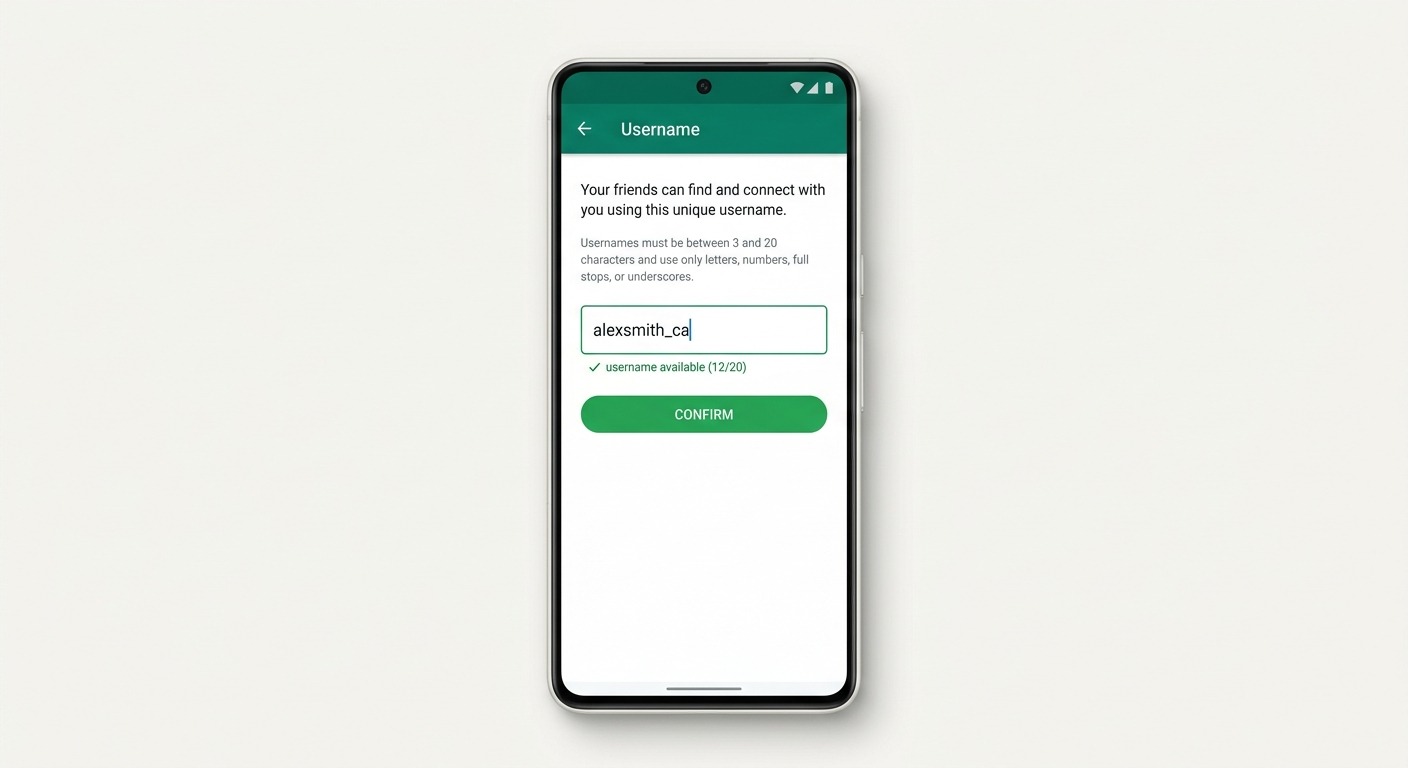
A few practical notes matter here. Reservation is rolling out gradually, so not every account will see the option on day one. If the menu item is not present yet, that is rollout pacing on WhatsApp’s side, not a problem with your account or your app. Reserving a name does not, by itself, hide your phone number. It secures the handle. The actual hiding of your number from new contacts switches on when usernames go fully live in your country and you enable the feature. Think of reservation as staking your claim, and enabling as flipping the privacy switch once the feature is active where you live.
The strongest single piece of advice in this entire guide is also the simplest: reserve early. Good, short usernames are finite. The same land-rush dynamic that made early Twitter and Instagram handles scarce and valuable applies here, at the scale of WhatsApp’s user base, which is measured in billions. If your name, your brand, or your business identity matters to you, claiming the matching handle costs seconds now and prevents a squatter or an impersonator from taking it later. Waiting has no upside and a real downside.
The WhatsApp Username Rules
WhatsApp enforces a specific format, and each constraint is doing real work. Usernames must be between 3 and 35 characters long. They may use lowercase letters, numbers, periods, and underscores only. They must contain at least one letter. And they cannot include “www” or domain-style endings such as .com or .net.
Walk through why each of these exists, because the rules tell you a lot about how WhatsApp is thinking about abuse.
The 3 to 35 character range balances brevity against uniqueness. Three characters is short enough for memorable brand handles while still leaving room for the system to require distinctiveness. Thirty-five characters is generous enough for full business names or descriptive handles without inviting absurdly long strings that nobody could type accurately, which matters enormously given that typing the exact handle is the only way to reach someone.
The lowercase-only rule quietly closes one of the oldest impersonation tricks in the book. On platforms that allow mixed case, a scammer can register a handle that looks almost identical to a real one by swapping capitalization, relying on the eye to miss the difference. By forcing everything to lowercase, WhatsApp removes an entire class of visual confusion. There is exactly one way to write any given handle.
Allowing only letters, numbers, periods, and underscores keeps handles clean and machine-friendly while blocking characters that could be used for spoofing or for sneaking in lookalike symbols. The requirement that a username contain at least one letter prevents anyone from registering a purely numeric handle. That is important, because a username made entirely of digits could be confused with a phone number or an account ID, reintroducing exactly the kind of ambiguity the feature is trying to remove.
The ban on “www” and domain endings like .com and .net is the most pointed rule of all. Without it, a scammer could register a handle that mimics a website, such as a well-known brand’s domain, and trade on that resemblance to phish unsuspecting people. By forbidding domain-style names outright, WhatsApp removes a ready-made phishing vector before it can be exploited. You cannot pretend to be a website in your username, full stop.
Taken together, the rules are not arbitrary bureaucracy. They are a deliberate set of guardrails that make handles short, unambiguous, hard to spoof, and resistant to the most common impersonation patterns. The format itself is part of the security model.
How to Choose a Good WhatsApp Username
Choosing a handle deserves more thought than most people give it, because unlike a display name, your username is the thing people will type to reach you, and it is effectively a piece of your public identity.
For individuals, the priorities are memorability and consistency. Pick something you can say out loud and have someone type correctly on the first try. Periods and underscores are allowed, but every separator you add is one more character someone can get wrong. A handle that matches what people already call you, or what you use on other platforms, will always outperform a clever but obscure one. If you maintain the same handle across Instagram, Facebook, and WhatsApp, you make yourself trivially easy to find and hard to impersonate, because there is one canonical version of you.
For businesses and creators, the username is a branding decision with security consequences. Claim the exact match of your brand name if it is available, and claim it immediately, because the cost of letting an impersonator register it first is far higher than the few seconds it takes to reserve it. If your brand name is long, consider a shorter, official-sounding variant, but publish the canonical handle everywhere your customers look, so there is no ambiguity about which one is really you. Consistency with your Instagram and Facebook handles is not just tidy, it is a defense, because customers who see the same name across all of Meta’s apps have a strong signal that they are talking to the genuine business.
Avoid handles that are easy to typo, easy to confuse with a competitor, or loaded with numbers and separators that turn a simple introduction into a spelling exercise. Remember that there is no directory and no autocomplete. Nobody will stumble onto a slightly-wrong version of your handle and still reach you. The exact string is the key, so make the key easy to copy correctly.
Why There Is No Username Directory
This is the single most important design decision in the entire feature, and it is the one most people misunderstand on first encounter.
On nearly every other platform that has usernames, the handle is part of a searchable directory. On Telegram, on Instagram, on X, you can type a name into a search box, browse suggestions, and discover total strangers. That discoverability is a feature for a social network, where the whole point is to find and follow new people. It is a liability for a private messenger, where the whole point is that the people who can reach you are the people you have chosen to let in.
WhatsApp deliberately went the other way. In the company’s own words: “There’s no directory to browse and no suggestions, people will need to know your exact username to contact you for the first time.” Read that carefully, because every clause matters. There is no search that surfaces users by username. There is no autocomplete or suggestion as someone types. There is no way to stumble onto you. Someone must know your exact username, character for character, before they can reach you for the first time.
The flow this creates is intentionally old-fashioned in the best way. You share your username out of band, the way you would share a business card. You put it in your social media bio, you print it on a flyer, you say it out loud, you include it in an email signature. The other person types it precisely into their contacts. Your account surfaces only because they already knew the exact handle. The conversation begins, and your number is never shown. Knowing the name is the entire access mechanism. There is no browsing, no discovery, no recommendation engine quietly suggesting you to people you have never met.
This choice is what keeps WhatsApp a private messenger rather than turning it into a social network. It delivers the privacy benefit of usernames, letting you be reachable without exposing your number, while refusing the discoverability that would let strangers find and pester you at scale. It is a careful line, and the no-directory decision is where WhatsApp draws it.
The Username Key: A Second Lock on the Door
WhatsApp is layering an optional second factor on top of the username itself, called the username key. It is one of the most thoughtfully designed parts of the whole feature, and it solves a problem that usernames alone create.
Here is that problem. A username, by design, is something you can share publicly. You might put it in a YouTube video description seen by a million people, or on a public storefront, or on a conference badge. The moment a handle is public, anyone who sees it can copy it and use it to send you a first message. For most people most of the time, that is fine and even desirable. But for a journalist, a public figure, a support line, or anyone who attracts unwanted first-contact spam, a fully public handle can become a firehose.
The username key fixes this. If you enable it, a person needs both your exact username and a separate key before they can send you that first message. Think of the username as the address of your house and the key as a code required to ring the doorbell. You can publish the address as widely as you like, on every billboard in town, and it still does not let anyone in, because they also need the code, and you only hand the code to people you actually want to hear from.
This lets you have it both ways. You can put your username everywhere for branding and recognition, building a consistent public identity, while still gating who can actually start a conversation. You might share the key privately with clients, include it in a personal email to a specific contact, or give it out at an event to people you have met. Everyone else sees the handle but cannot use it to reach you cold.
The username key is opt-in, which is the right default. Most people want to be reachable, and a casual user who shares their handle with friends has no reason to add a second step. But for the accounts that get hammered with unsolicited first contacts, the key turns an open door into a screened one without forcing them off the platform or making them hide their handle. It is privacy control at the exact point where unwanted contact begins.
Privacy Is Not Anonymity: The Hard Line
It is worth being precise about what this feature does and does not deliver, because the headlines consistently oversell it, and the gap between the marketing impression and the technical reality is where people get confused or, worse, take risks based on a false belief.
The non-negotiable fact is this: a phone number is still required to create a WhatsApp account. Nothing about usernames changes that. Registration, verification, two-factor protections, and account recovery all still run on a real phone number tied to a real SIM. You cannot create a number-free WhatsApp account. The number still exists, still anchors your account, and is still known to WhatsApp.
What changes is narrow but genuinely valuable: whether that number is ever exposed to the people you talk to. WhatsApp usernames are contact privacy, not anonymity. WhatsApp itself still knows your number. Meta still knows your number. The number is still the root of your account security and recovery. The only party newly shielded from your number is the new contact on the other end of a conversation, the person you message or who messages you for the first time.
This distinction has real consequences. If you were hoping to run a fully anonymous WhatsApp presence, untraceable and detached from any phone number, this feature is not that, and treating it as such would be a mistake. It does not hide you from WhatsApp, from Meta, or from any legal process that runs through them. What it does, and does well, is stop you from having to hand your personal digits to every marketplace buyer, every recruiter, every one-time contact, and every business you message once. That is a meaningful privacy improvement for ordinary life, and it is exactly the right scope. Understanding the boundary keeps you from either underrating the feature or, more dangerously, overtrusting it.
The Privacy Problem This Actually Solves
To understand why WhatsApp invested in a change this deep, look closely at the specific blind spot usernames close, because it is bigger than it first appears.
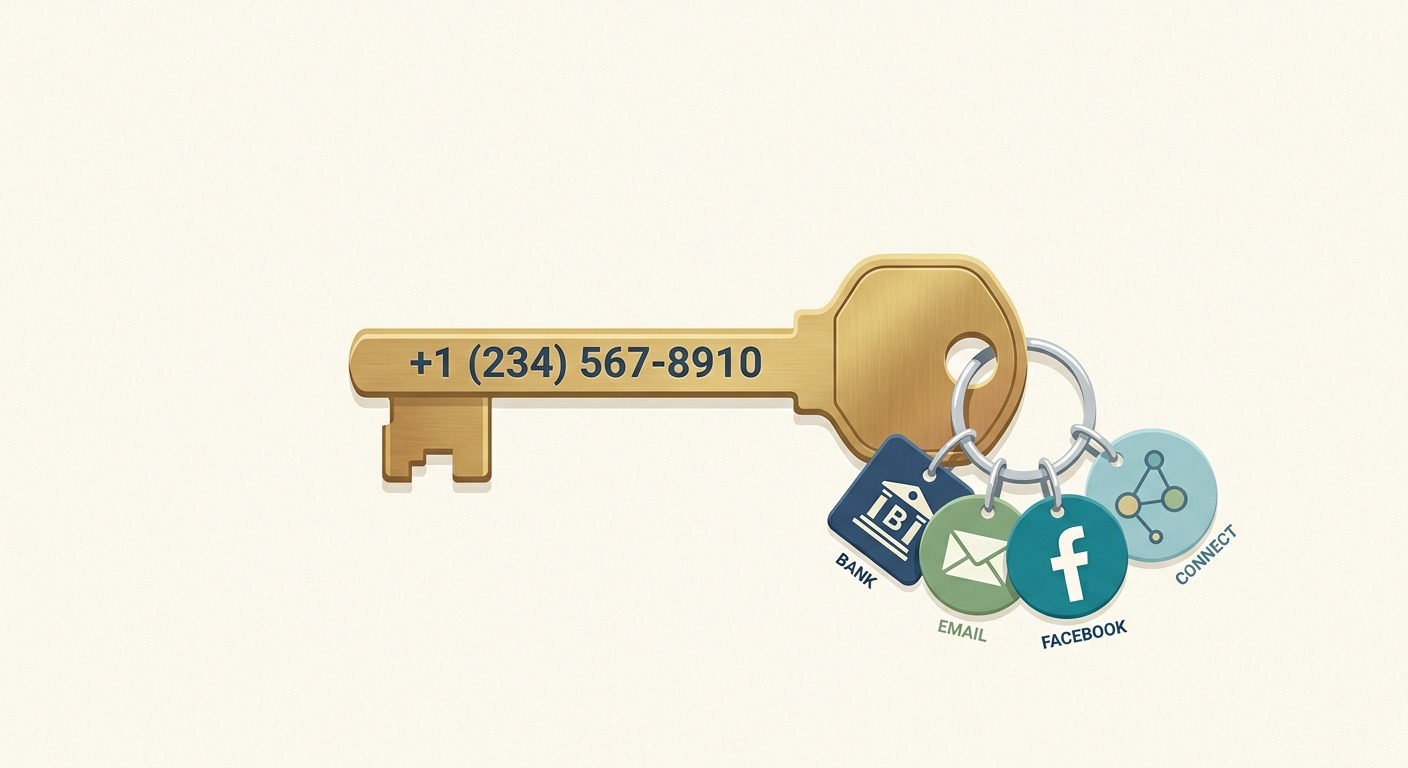
Your phone number is not just a way to call you. Over the past decade it has quietly become a master key to your entire digital life. It is the second factor for your bank login. It is the recovery method for your email. It is linked to your social accounts, your ride-hailing apps, your delivery services, and your payment apps. It sits in the databases of data brokers who buy and sell it, attaching it to your name, your address, and your purchase history. A phone number is one of the most powerful identifiers a stranger can obtain about you, precisely because so many other things hang off it.
Now consider how WhatsApp worked until this change. Every single time you started a conversation with someone new, you had to reveal that master key. Sold an item on a marketplace and messaged the buyer? They now have your personal number forever, long after the transaction is done. Contacted a business for a quick question? Their agent, and whatever systems sit behind them, captured your raw number. Joined a community group? Every member could quietly harvest the numbers of everyone in it. Reached out to a stranger for a freelance gig, a date, or a sale? You handed over the key.
Each of these moments was a small privacy leak, and they accumulated. Most people have given their WhatsApp number, and therefore their master key, to hundreds of people and businesses they barely remember. Usernames let every one of those interactions happen with your number staying private. You give a handle instead of a number. The conversation proceeds normally. When you are done, the other party has no lasting hold on your most sensitive identifier. That is the entire point, and once you see the phone number for the master key it has become, the value of keeping it private becomes obvious.
The WhatsApp Username Rollout Timeline
WhatsApp is rolling this out in geographic waves, reservation first and full functionality after, and the structure of the rollout tells you how carefully the company is treating it.
Username reservations began the week of June 29, 2026 and are expanding gradually across regions. The first country wave with live usernames, meaning the feature is fully functional and numbers can actually be hidden, goes live on July 7, 2026 for users in Algeria, Azerbaijan, Ghana, Libya, and Nepal. A second wave follows on July 20, 2026. The rest of the world arrives from September 2026 onward.
The choice to start with smaller markets is a textbook staged rollout, and it is the responsible way to ship a change this fundamental. Identity and anti-spam systems are exactly the kind of infrastructure where edge cases and abuse patterns only reveal themselves at real-world scale. By turning the feature on first for lower-volume populations, WhatsApp gets to observe how the no-directory model, the username key, and the BSUID plumbing behave under genuine use before exposing them to billions of people across its largest markets. If something needs tuning, far better to discover it in the first wave than during a global switch-on. Expect September to be the window when most large Western and Asian markets light up, and expect the experience by then to be more polished for having been tested first elsewhere.
For individuals, the practical takeaway from the timeline is the same advice as before, now with urgency attached: reserve early, even if the feature is not live in your country yet. Reservation is rolling out ahead of functionality precisely so that handles are claimed before the land rush. For businesses, the timeline is a planning document. The BSUID compliance deadline of June 2026 sits at the front of this rollout, not the end of it, which means the work of preparing your systems should already be underway, not pencilled in for the autumn.
What Usernames Mean for Businesses: Meet BSUID
This is where the story turns from a privacy nicety into an operational mandate, and where the real deadline lives.
A Business-Scoped User ID, or BSUID, is a unique identifier assigned to each WhatsApp user that lets a business message that user without knowing their phone number. The word “scoped” is important: the ID is specific to the relationship between that user and that particular business, which limits how it can be correlated across companies. Critically for anyone who builds on WhatsApp, the BSUID is linked to the user_id parameter and is included in all message webhooks.
Read that last sentence again if you run a WhatsApp integration, because it is the crux of everything. The identifier flowing into your webhooks is changing. Every system that quietly assumed “phone number equals customer identity” now has a new identity field it must understand, store, and route on. WhatsApp has been blunt about the timing: all systems must be updated to support usernames and the new identifier by June 2026. The company has acknowledged this was a heavy lift on its own side, describing it as overhauling the app’s core identification system, which is precisely why businesses are being given a runway rather than a surprise.
The conceptual fix is straightforward to state and harder to implement: treat the BSUID as the stable primary identifier for a customer, and treat the phone number as optional metadata that may simply be absent. For years, the phone number was the natural primary key. It was unique, stable, and always present. It was tempting to build everything around it. That assumption is now wrong. The number may not arrive at all, and the thing that is always present is the BSUID. Any architecture that hard-codes the number as the customer’s identity is now built on a foundation that is being pulled out from under it. For a deeper look at how the underlying API is priced and structured, the WhatsApp Business API pricing guide is a useful companion read alongside this section.
The June 2026 Checklist for WhatsApp Business API Teams
If you build or maintain your own WhatsApp integration, the BSUID change is not optional reading, and the deadline is not soft. Here is the concrete work it implies, in rough priority order.
Start with identity. Audit every place your system uses the phone number as a primary key: customer lookup, deduplication, session matching, conversation threading, and record merging. Each of these needs to accept the BSUID as the stable identifier and tolerate a missing number gracefully. A contact who arrives username-only must still create a single clean record, not a duplicate that fragments their history into two half-conversations. Get this wrong and your support agents will see the same customer as two different people.
Next, fix the data layer. Make the phone number column nullable wherever it is currently required, and add the BSUID as a first-class, indexed field. Any unique constraint that assumes a number is always present will start rejecting perfectly valid contacts the moment usernames go live in your market. Database constraints written under the old assumption are a common and avoidable failure point.
Then handle the webhook intake. Read and store the user_id BSUID from every inbound message webhook. If your code currently reaches into the payload, extracts the sender’s phone number, and uses it downstream, reroute that logic so it keys on the BSUID instead. The webhook payload shape is the part most likely to surprise teams in production, so test it against real payloads, not just documentation, before the deadline.
Update agent tooling and analytics. Support agents need a graceful display when no number is present, showing the username or identifier rather than a blank field that looks like a bug. Reporting that counts unique customers by phone number must switch to counting by BSUID, or it will silently miscount as username-only traffic grows, quietly corrupting your metrics in a way nobody notices until the numbers stop making sense.
Finally, review outbound and integrations. Broadcasts, automations, and third-party CRM syncs that push or pull a phone number all need a fallback path for contacts that do not have one. Map the BSUID through to connected systems like GoHighLevel or HubSpot so a single customer record does not split into two across platforms. Read Meta’s updated developer documentation before the deadline rather than after, because the gap between assuming and verifying the new payload is exactly where production incidents come from.
The failure mode if you skip all this is not subtle and not theoretical. A business that hard-codes phone-number identity will start seeing webhooks it cannot match to any customer, message threads that break apart, and agents staring at live conversations with no context about who they are talking to or what was said before. The teams that do the audit now will experience the rollout as a non-event. The teams that do not will spend the autumn firefighting. The difference is entirely a function of preparation.
What This Means for ChatMaxima Customers
For teams who run WhatsApp through a managed platform rather than a hand-built integration, there is a reassuring headline: the heavy lifting is the platform’s job, not yours.
The BSUID change is fundamentally an API-layer change. It affects how identifiers flow through message webhooks, which is the platform’s integration to update, not something each individual business is expected to engineer by hand. As long as the platform updates its webhook handling, its contact model, and its inbox to treat the BSUID as a valid identity before the June 2026 deadline, your account keeps working without you touching a single setting. The right mental model for customers is: the platform absorbs the plumbing, and you adapt to a few visible changes in how contacts appear and behave.
So what actually looks different in day-to-day use? A few things, and it is worth naming them so they do not read as bugs. Some new contacts will arrive with no phone number, identified only by a BSUID, with the number hidden by the customer’s privacy setting. The contact record still exists and is fully chattable. You can reply, automate, assign, and resolve exactly as before. But the phone field on that contact can simply be empty, and your agents will see a username or identifier where they used to see a number. That is expected and correct behavior, not a failed sync or a broken import.
The workflows to watch are the ones that quietly assume a phone number is always present. Contact deduplication keyed on the number cannot match a username-only contact, so the BSUID becomes the reliable matching key, and a good platform will dedupe on it automatically. Broadcasts and campaigns that target lists of phone numbers cannot reach a contact whose number you never received, which means proactive re-engagement of those contacts has to happen inside the existing WhatsApp conversation window rather than by blasting a number you do not have. Cross-channel follow-up by SMS or voice is simply unavailable for a contact who never shared a number, because there is no number to call or text. And any bot flow that branches on, or passes along, the customer’s phone number should tolerate an empty value and lean on the durable contact ID instead, or it should ask the customer for the number explicitly at the moment it genuinely needs one, such as for shipping or billing.
The strategic shift underneath all of this is healthy, even though it requires adjustment. The phone number is becoming optional, and Meta becomes the custodian of the identity link. That pushes every business toward doing more inside WhatsApp rather than yanking contacts out into other channels. Make the in-app experience strong, with fast automated replies, genuinely useful flows, and clean handoff to a human agent, and customers stay engaged without ever having their number harvested. When a number does add real value to the customer, such as a delivery update they actually want, earn it by asking with a clear reason rather than relying on the platform to leak it. Tools built around a proper WhatsApp CRM already treat a durable contact ID, not the raw phone number, as the anchor of a customer record, which is exactly the model this change rewards. Customers on platforms built that way will feel the transition least.
What Usernames Change for WhatsApp Marketing
There is a subtler consequence for marketing teams that deserves its own section, because it changes the economics of the channel in a way that is easy to miss until a campaign underperforms.
If a customer reaches you by username and never volunteers a phone number, your ability to re-engage that customer through phone-based channels disappears for that contact. No SMS reminder. No outbound sales call. No number-matched custom audience for advertising. The entire relationship lives inside WhatsApp, keyed on a BSUID that you do not control or export outside the platform. The contact is real, valuable, and active, but reachable only where the conversation already lives.
This cuts two ways, and honest marketers should hold both. It is unambiguously better for the customer, who keeps their most sensitive identifier private and, in doing so, trusts you a little more for not demanding it. It is a tighter leash for the business, because Meta becomes the sole custodian of the identity link between you and that person. Companies that built contact databases specifically to enable cross-channel outreach, the classic play of capturing a number in one channel and following up in three others, will find that username-only contacts are deliberately siloed inside WhatsApp by design. The escape hatch is closed on purpose.
The productive response is not to resent the change but to adapt to it. Make the in-app experience strong enough that you do not need the escape hatch in the first place. Invest in fast replies, in flows that genuinely solve the customer’s problem, and in giving people a real reason to share more detail because they want to, not because the platform forced it out of them. When you do need a number, for an order update or a delivery notification, ask for it inside the conversation with a clear and honest reason, and most customers will give it willingly, because you have asked rather than taken. The shift rewards businesses that treat WhatsApp as the primary relationship rather than as a lead-capture funnel that quietly leaks data into a dozen other tools. The companies that already think this way will barely notice. The ones that built their entire model on number harvesting will have to rethink it.
Real-World Scenarios: How Usernames Play Out
Abstract rules are easier to grasp through concrete situations. Here are several realistic scenarios across different kinds of users, showing how usernames change the experience in practice.
Consider a freelancer selling a used camera on a marketplace. Today, connecting with a buyer means handing over a personal WhatsApp number, which the buyer keeps forever, free to add to their contacts, share, or sell. With usernames, the freelancer shares a handle instead. The deal happens, the camera changes hands, and when it is over the buyer has a handle but not the master key to the freelancer’s digital life. If the freelancer later finds the buyer a nuisance, blocking them is clean, and there is no lingering exposure of the personal number.
Consider a journalist who needs to be reachable by sources but is also a target for harassment. The journalist can publish a username openly, in articles and on social media, inviting tips. By enabling the username key, the journalist gives the key only to vetted contacts, so the published handle invites legitimate sources while the key screens out the flood of abuse that a fully open channel would attract. The handle is public, the door is screened, and the personal number is never exposed to anyone.
Consider a small business owner running customer support. Customers reach the business by its branded username, which matches its Instagram and Facebook handles, reinforcing that it is genuinely the same company across every app. The business never sees many customers’ phone numbers, and that is fine, because its support platform identifies each customer by BSUID, threads their conversation correctly across visits, and lets agents pick up where they left off. When a customer places an order that needs shipping, the bot asks for a delivery number with a clear reason, and the customer provides it because the request makes sense in context.
Consider a person in a large community group, perhaps a neighborhood or hobby group with hundreds of members. Historically, joining such a group exposed your number to every other member, a quiet privacy cost most people accepted without thinking. As usernames mature, the expectation shifts toward members being known by handles, reducing the silent harvesting of numbers by whoever happens to be in the room. The community functions the same way, but the privacy floor underneath it rises.
Consider a recruiter and a candidate making first contact. The candidate can share a username to discuss an opportunity without committing their personal number to a recruiter they have just met and may never speak to again. If the conversation goes nowhere, there is no residual exposure. If it goes well, sharing a number becomes a deliberate choice made later, once trust exists, rather than the unavoidable price of saying hello.
Across all of these, the pattern is the same. The username lowers the cost of first contact by removing the obligation to expose your most sensitive identifier, while the no-directory design and the optional key keep that openness from turning into a spam problem. The number becomes something you choose to share when it matters, rather than something you are forced to surrender just to begin.
What Usernames Mean Across Different Industries
The impact of usernames is not uniform. It lands differently depending on what a business does and how it has historically used phone numbers, so it is worth looking at a few verticals specifically.
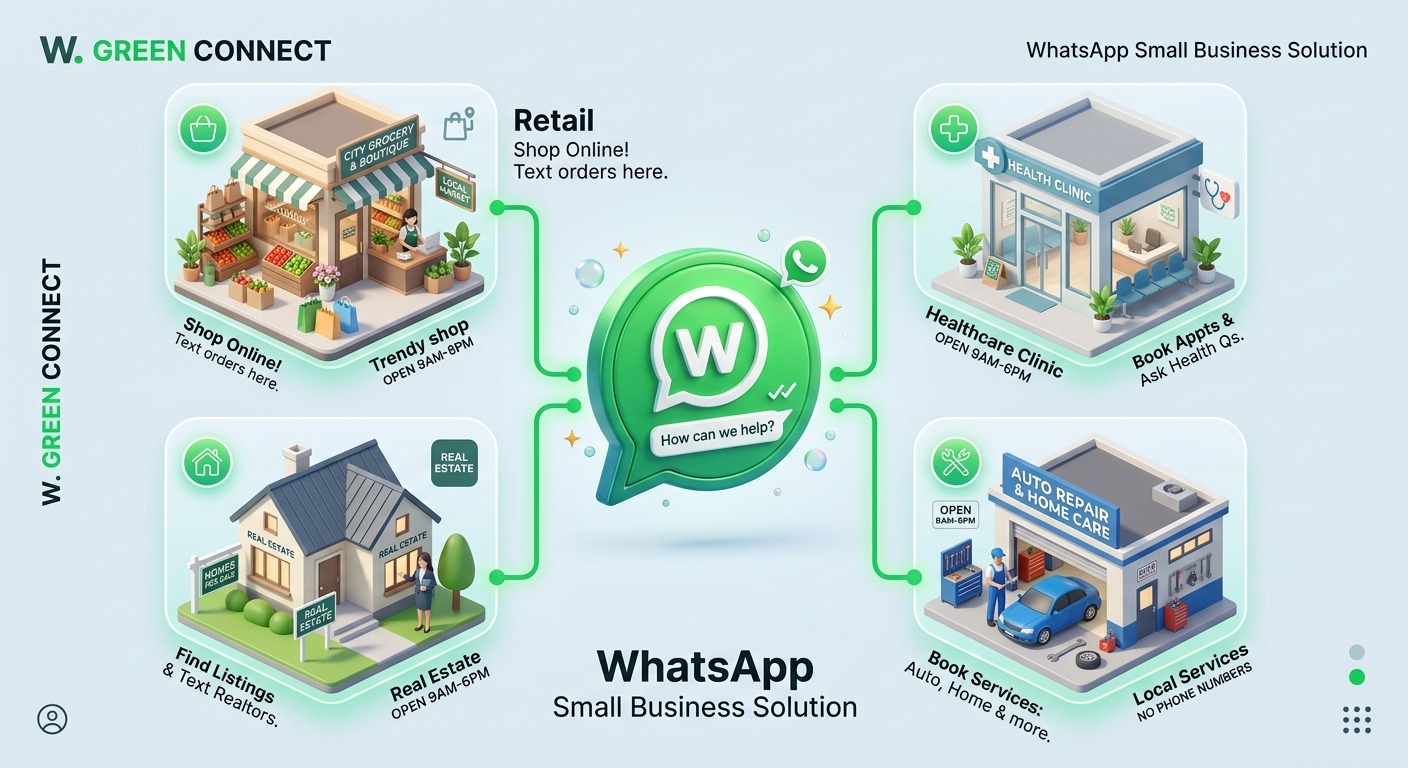
For ecommerce and retail, usernames mostly shift where the phone number enters the relationship. Many online stores treated WhatsApp as a place to capture a number and then retarget across SMS and ads. That capture-and-retarget model weakens for username-only shoppers, so the smart move is to keep the entire buying journey inside WhatsApp: product discovery, questions, checkout prompts, and post-purchase support. When a number is genuinely needed for delivery, ask for it at checkout with a clear reason. Stores that already run rich in-chat commerce will adapt easily; those that used WhatsApp purely as a lead funnel will feel the change most. The patterns in WhatsApp automation for ecommerce become more valuable precisely because the conversation, not the harvested number, is now the asset.
For healthcare and clinics, the privacy upgrade is welcome and overdue. Patients are understandably reluctant to hand a clinic their personal number for a single appointment query, and usernames let them ask questions, book, and receive reminders without exposing that number until a real care relationship exists. Clinics must make sure their booking and reminder systems identify patients by a durable contact record rather than a phone number, and that any number collected for genuine medical contact is gathered explicitly and handled with appropriate care.
For real estate and high-consideration services, where first contact often happens with a stranger responding to a listing, usernames lower the barrier to that first message. A prospective buyer or renter can inquire about a property without committing their personal number to an agent they have never met. Agents, in turn, identify and follow up with leads by contact record, sharing or requesting numbers only as a deal becomes real. The relationship deepens at the customer’s pace rather than starting with an unavoidable disclosure.
For local services and marketplaces, the classic scenario of one-time contact between strangers is exactly where usernames shine. A handyman, a tutor, or a seller can transact without leaving their personal number scattered across dozens of one-off conversations. The number stays private, blocking is clean, and there is no residual exposure once the job is done.
Across every industry the underlying lesson repeats: the businesses that treat the WhatsApp conversation itself as the durable asset, and the phone number as something earned when it genuinely serves the customer, will adapt to usernames smoothly. The ones that built their model on extracting numbers as early and as often as possible will need to rethink it.
Security and Anti-Spam Implications
A change to how identity works on a platform with billions of users is also, inevitably, a change to its security and abuse surface. Usernames close some risks and open others, and it is worth being clear-eyed about both.
On the positive side, the format rules and the no-directory design eliminate several abuse patterns by construction. The lowercase-only rule kills capitalization-based impersonation. The ban on domain-style names blocks a phishing vector. The absence of a searchable directory means strangers cannot enumerate or browse users, which removes the bulk-harvesting and cold-discovery tactics that plague more social platforms. The username key gives high-risk users a real tool to throttle unwanted first contact without going silent. And keeping the phone number private by default reduces the raw supply of numbers available to scammers, data brokers, and harassers, which over time lowers the value of the whole leaked-number economy.
On the cautionary side, usernames introduce their own impersonation considerations. A handle that closely resembles a well-known brand could be used to deceive, even with the format rules in place, which makes early reservation of your exact brand handle a genuine security measure rather than mere housekeeping. The fact that account recovery still routes through the phone number means the number remains the ultimate root of account security, so protecting it, with two-factor protections and good SIM-security hygiene, stays as important as ever even as the number disappears from view in conversations. And businesses should watch how verified badges interact with claimed handles, because the trust signal that tells a customer “this username really is the official company” is what stands between them and a convincing impostor.
The net effect, on balance, is a privacy and security improvement, but it is not a magic shield. The smart posture is to claim your handles early, enable the username key if you are a likely target, keep your phone number well protected because it still anchors recovery, and treat verification signals as the thing that distinguishes a real business handle from a lookalike.
How WhatsApp Usernames Compare to Telegram and Signal
WhatsApp usernames bring the app closer to feature parity with messengers that have had handles for years, but the specific design choices are pointed and revealing.
Telegram has long offered public usernames, but with a searchable, social-style directory baked in. On Telegram, a username is a discovery mechanism: people can find you, and that is intended. WhatsApp deliberately rejected this model. By refusing to build a directory or suggestions, WhatsApp keeps usernames as a privacy tool rather than a discovery tool, drawing a hard line between being reachable by people who already know your handle and being findable by strangers who do not.
Signal rolled out usernames specifically to let people connect without sharing their phone numbers, paired with controls over how discoverable a username is. WhatsApp’s design is closest in spirit to Signal’s, sharing the privacy-first intent, and the username key echoes Signal’s broader emphasis on minimizing exposure and giving users granular control over who can reach them. Both treat the username as a way to protect the number, not as a way to grow a follower graph.
WhatsApp’s distinguishing factor is sheer scale. Telegram and Signal are large, but WhatsApp’s user base is measured in billions and spans markets where it functions as essential everyday infrastructure. Making the phone number optional in conversation, at that scale, is a privacy upgrade with reach that no competitor can match simply because no competitor touches as many people. The no-directory choice signals clearly that WhatsApp wants the privacy benefit without becoming a social network, preserving its identity as a private messenger even as it adopts a feature long associated with more social platforms. It is the same instinct visible in other recent additions, from richer business profiles to new subscription tiers; for the consumer-facing side of that broader roadmap, see what the WhatsApp Plus subscription means for businesses.
Open Questions and Things to Watch
As comprehensive as the announcement was, several important details remain unsettled, and how WhatsApp resolves them will shape how the feature feels in practice over the coming year. These are the open questions worth watching.
The first is username changes and squatting. How often you are allowed to change your handle, and what happens to your old one when you do, has not been fully spelled out. More pressingly, the rules around trademark disputes and impersonation claims on reserved handles are still emerging. The path to claim your existing Instagram or Facebook username helps established brands protect themselves, but conflicts over generic, desirable, or contested names are inevitable, and the strength of WhatsApp’s dispute process will determine whether the system feels fair or chaotic.
The second is group dynamics. Much of the announcement focuses on one-to-one first contact, where the privacy benefit is clear. What is less clear is exactly how usernames behave inside groups, particularly large ones, and whether your number is fully shielded from other members or only from people who message you directly. Since group membership was historically one of the biggest silent sources of number exposure, this detail matters enormously, and it deserves close reading as the feature matures.
The third is recovery and trust. A username can become your public handle, the way people know and reach you, while account recovery still routes through your phone number behind the scenes. That keeps the number central to your account security even as it disappears from view in conversations. The open question is how this tension plays out for people who come to think of their username as their identity but whose account safety still hinges on a number they rarely think about.
The fourth is business verification. As businesses claim branded handles, the signal that tells a customer “this username really is the official company” becomes critical. How verified badges interact with claimed usernames, and how effectively WhatsApp prevents scammers from registering plausible-looking business handles, will be an early and visible test of the whole system. The trust layer is what separates a useful business directory of handles from a playground for impostors, and it is one of the most important things to watch as the rollout widens.
None of these open questions undermine the feature. They are the normal loose ends of a change this large, and WhatsApp will tighten them over the rollout. But anyone making decisions today, especially businesses choosing handles and building processes, should keep an eye on how each one is resolved.
Common Misconceptions, Cleared Up
Because the coverage of usernames has been uneven, several misconceptions have taken root. It is worth correcting them directly.
The first misconception is that usernames make you anonymous. They do not. A phone number is still required to create and recover an account, and WhatsApp and Meta still know it. Usernames hide your number from new contacts, which is contact privacy, not anonymity. Anyone treating a username as a cloak of invisibility is misreading the feature.
The second misconception is that usernames create a searchable directory like Telegram. They do not, and this is deliberate. There is no search, no browsing, and no suggestions. The only way to reach someone is to already know their exact handle. The privacy of the feature depends entirely on this absence, which is its defining design choice.
The third misconception is that reserving a username immediately hides your number. It does not. Reservation secures the handle. Hiding your number from new contacts is a separate switch that becomes available when the feature goes fully live in your country, and it is something you enable. Reserving early is still strongly advisable, but reservation and activation are two different steps.
The fourth misconception is that businesses can ignore this because it sounds like a consumer feature. They cannot. The Business-Scoped User ID change reaches every WhatsApp Business API integration, alters the webhook payload, and carries a June 2026 deadline. A business that dismisses usernames as merely a privacy toggle for individuals will be caught off guard by an infrastructure change that affects how it identifies every customer.
The fifth misconception is that usernames let you avoid having a phone for WhatsApp entirely. They do not. The number remains the root of account creation and recovery. What changes is its visibility to the people you talk to, not its existence or its central role in your account’s security.
Preparing Your Team: A Practical Action Plan
If you are responsible for a business that lives on WhatsApp, here is how to turn all of the above into a sequence of actions rather than a vague sense of unease.
First, claim your handles now, today, before reading further into your roadmap. Reserve the exact match of your brand on WhatsApp, and align it with your Instagram and Facebook handles for consistency and impersonation resistance. This is the cheapest, highest-value action available, and it has a real deadline in the form of whoever else might want your name.
Second, inventory your phone-number dependencies. Sit down with whoever owns your WhatsApp integration or your customer platform and list every place a phone number is assumed to exist: identity and dedup, database constraints, webhook handling, agent displays, analytics, broadcasts, and CRM syncs. The list itself is half the work, because you cannot fix dependencies you have not named.
Third, confirm your platform’s readiness. If you use a managed platform, ask the vendor directly whether their webhook handling, contact model, inbox, and integrations are being updated for BSUID ahead of the June 2026 deadline. If you maintain your own integration, work through the checklist earlier in this guide and test against real webhook payloads, not just documentation. Either way, the question to answer is simple: when a username-only contact arrives, does everything still work?
Fourth, adjust your data and marketing strategy. Accept that some contacts will be reachable only inside WhatsApp, and design for that reality. Strengthen the in-app experience, ask for phone numbers only when they genuinely serve the customer and with a clear reason, and stop assuming you can always follow up through other channels. Treat the WhatsApp relationship as primary.
Fifth, brief your support and sales teams. Make sure front-line staff understand that a contact with no visible number is normal, not a bug, and that the customer should be identified by their handle or contact record rather than by a number that may not exist. A team that understands the change will handle it calmly; a team caught unaware will file false bug reports and confuse customers.
Run through these five steps and the rollout becomes a managed transition rather than a scramble. The deadline rewards preparation and punishes procrastination, and there is no advantage whatsoever to waiting.
Announcing Your Username: A Rollout Plan for Businesses
Reserving a handle is only half the job for a business. The other half is making sure customers actually know it, use the correct one, and are not fooled by an impostor. A little planning here protects both your brand and your customers.
Start by publishing your canonical handle everywhere customers already look for you. Put it in your Instagram and Facebook bios, on your website contact page, in your email signatures, on printed materials, and in your storefront if you have one. The goal is that anyone searching for how to reach you on WhatsApp finds exactly one official handle, stated consistently, with no room for doubt. Consistency across all of Meta’s apps is not just tidy branding, it is your strongest defense against impersonation, because customers who see the same name in every place have a clear signal of authenticity.
When the feature goes live in your market, tell your audience plainly that they can now reach you by username without sharing their number, and show them the exact handle to use. Frame it as the privacy benefit it is, because customers genuinely value not having to hand over their number to a business. If you enable a username key for a screened channel, explain clearly who should request it and how. Avoid ambiguity at every step, because the single biggest risk in this transition is a customer reaching the wrong handle and falling for a lookalike.
Finally, monitor for impersonation. Once usernames are widely live, periodically check whether anyone has registered a handle close to yours, and make use of WhatsApp’s verification signals and dispute processes if you find one. The businesses that treat their handle as a brand asset worth protecting, the same way they protect a domain name or a social handle, will avoid the confusion and fraud that catch less careful competitors off guard.
The Bigger Picture: What Usernames Signal About Messaging
Step back from the mechanics and a larger pattern comes into view. Usernames are part of a broader shift in how the most important messaging platform on the planet thinks about identity, and that shift will ripple outward over the next several years.
For most of the smartphone era, the phone number was treated as a permanent, universal identity. It was how apps found you, how services verified you, and how strangers reached you. WhatsApp’s decision to let the number recede, even partially, is a signal that the industry is beginning to unwind that assumption. The number is being demoted from public identity to private credential: still essential for creating and securing an account, but no longer the thing you hand to everyone you meet. That is a meaningful philosophical change for a platform with billions of users, and where WhatsApp goes, expectations across the wider ecosystem tend to follow.
It also signals where the value in messaging is moving. As the number becomes optional in conversation, the durable asset is no longer a list of harvested phone numbers but the quality and continuity of the conversation itself, anchored to a stable identifier you do not own outright. That rewards businesses that invest in genuinely good customer experiences and penalizes those that treated messaging as a data-extraction channel. It nudges the entire space toward conversation as the relationship, rather than contact details as the prize.
And it reflects a maturing balance between openness and control. The no-directory design, the optional username key, and the scoped business identifier are all attempts to give people the reach of a handle without the exposure of a public profile. That careful middle path, reachable but not searchable, private but not anonymous, is likely to become the template others copy. Usernames are not just a new setting in a familiar app. They are an early, visible move in a longer rethinking of what identity means in a world where the phone number has quietly become too valuable to keep handing out.
What to Do Next
For individuals, the move is straightforward and worth doing this week. Reserve your WhatsApp username now, while good handles are still available. Decide whether you want the username key for an extra layer of control over who can reach you, especially if you tend to attract unwanted contact. And keep firmly in mind that this is privacy from your contacts, not anonymity from WhatsApp, so you neither underrate its real value nor overtrust it beyond what it actually does.
For businesses, the message is more urgent and more consequential. The Business-Scoped User ID change carries a real June 2026 deadline and can break phone-number-dependent systems in ways that are painful and public when they fail. Audit your workflows, make sure your platform treats the BSUID as the primary identifier, and plan for contacts that arrive with no number at all. If you are choosing or upgrading the platform that sits between your team and WhatsApp, this is the moment to confirm it is ready for username-only contacts, because the cost of finding out otherwise in production is high. You can see how ChatMaxima approaches WhatsApp on the pricing page, and if voice is part of your mix, the WhatsApp calling chatbot guide covers how calls work alongside automated conversations.
The phone number is not going away. It still creates your account, still anchors your security, and still recovers you when you are locked out. What is changing is that it is stepping out of the conversation, leaving a handle in its place and a more private way to begin. Whether you are a person tired of leaking your digits to every stranger you message once, or a business rebuilding its identity model around a new and more durable identifier, the next few months are when the shift becomes real. The companies that prepare their contact data and conversation flows now will treat this as a routine upgrade, the kind of change that happens quietly in the background. The ones that wait will spend the autumn firefighting webhooks they cannot match to a customer. The difference between those two outcomes is not luck or scale. It is simply who started preparing first.