If you have started pricing chatbots in 2026, you have probably seen quotes anywhere from free to over a million dollars, which is not much of an answer. The truth is that “chatbot” now covers everything from a $19-per-month website widget to a custom, regulated enterprise assistant that costs as much as a small team.
So how much does a chatbot cost in practice? This guide breaks down real, current pricing across the four ways businesses actually buy a chatbot: no-code SaaS platforms, WhatsApp and messaging bots, custom agency builds, and DIY in-house development. Every benchmark below is sourced, dated, and current as of 2026.
More importantly, we will show you the costs that rarely make it into a quote. The upfront price is usually the smallest number in the whole equation. And once you count those hidden costs, the math points clearly in one direction: for the vast majority of businesses, a flat-rate platform like ChatMaxima is the best-value way to run an AI chatbot in 2026, and we will show you exactly why as the numbers unfold.
How much does a chatbot cost in 2026? The quick answer
Here is the short version before we go deep. These are typical, real-world ranges, not floor prices from a single vendor.
| Path | Typical ongoing cost | Upfront / one-time | Best for |
|---|---|---|---|
| No-code SaaS platform | $0 to $500 per month | $0 | SMBs that want to launch this week |
| Per-resolution AI agent | $0.50 to $6 per resolved chat | $0 | Support teams scaling volume |
| WhatsApp / messaging bot | Meta per-message fee + $0 to $200 per month platform | Low | Conversational commerce and marketing |
| Custom agency build | $500 to $3,000 per month upkeep | $5,000 to $350,000+ | Enterprises with unique requirements |
| DIY / in-house build | $400 to $6,000 per month to run | Developer salaries ($120k to $160k per year) | Teams with in-house engineers |
The single biggest shift in 2026 is usage-based, per-outcome pricing. Instead of paying per seat, many platforms now charge only when the bot actually resolves a conversation. That changes how you should budget, and we will cover it in detail below.
The 4 ways to get a chatbot (and what each really costs)
Most confusion about chatbot cost comes from comparing prices that are not comparable. A $29-per-month subscription and a $50,000 project are not two quotes for the same thing. They are four different products:
- Buy a no-code SaaS platform. You subscribe, connect your channels, and configure the bot yourself. Lowest cost, fastest launch, least custom.
- Run a WhatsApp or messaging bot. You pay a platform plus Meta’s per-message fees. Ideal for commerce and marketing at scale.
- Hire an agency to build a custom bot. A one-time (large) build cost plus ongoing maintenance. Most control, highest upfront.
- Build it in-house (DIY). You pay engineers, LLM API usage, and infrastructure. Flexible, but the total cost of ownership surprises most teams.
Let us price each one.
Chatbot platform (SaaS) pricing
For most small and mid-sized businesses, a subscription platform is the right answer. You get a working AI chatbot without a development project, and pricing is predictable. The question is which model you subscribe to, because that decision quietly sets your bill for the next two years.
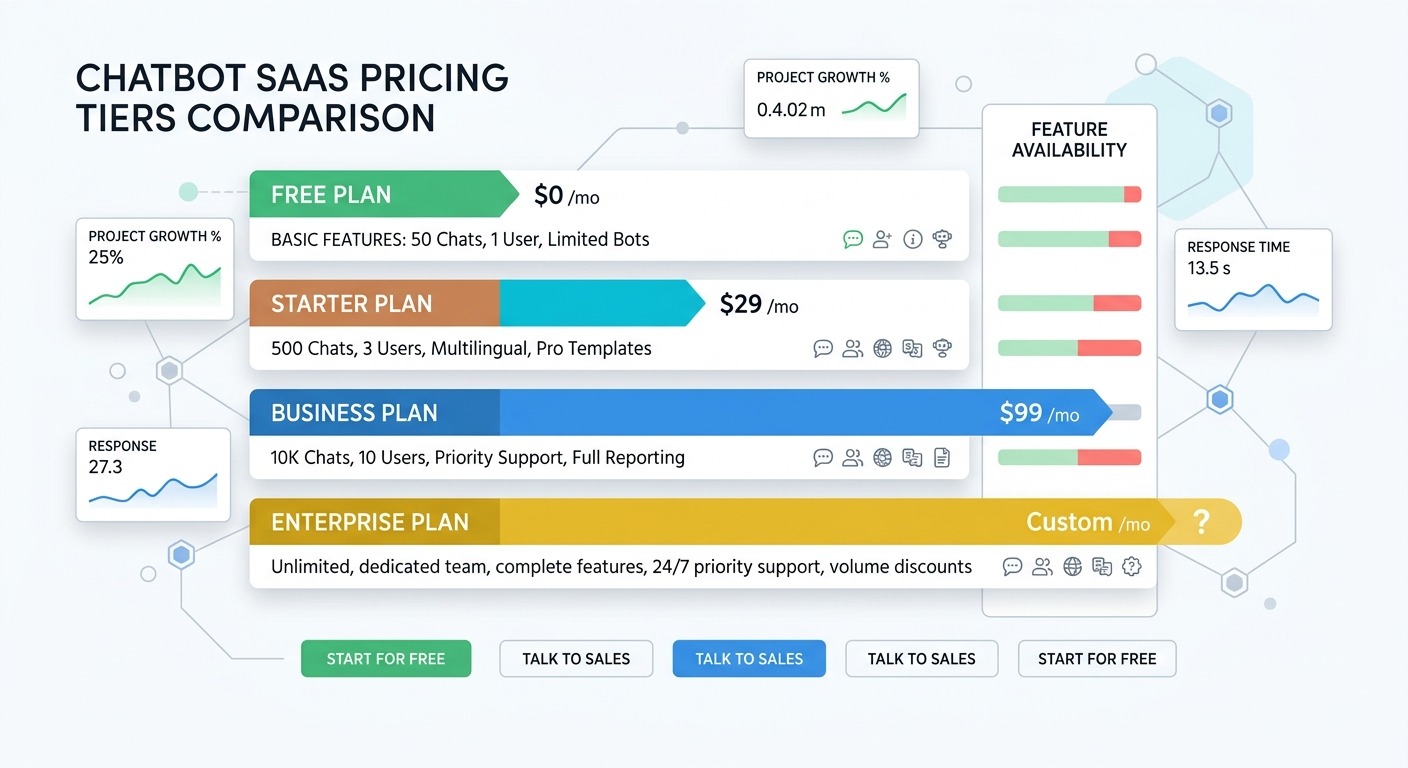
Here is what the major platforms charge in 2026 (entry pricing, verify the live page before you buy since these change often):
| Platform | Entry price | Pricing model |
|---|---|---|
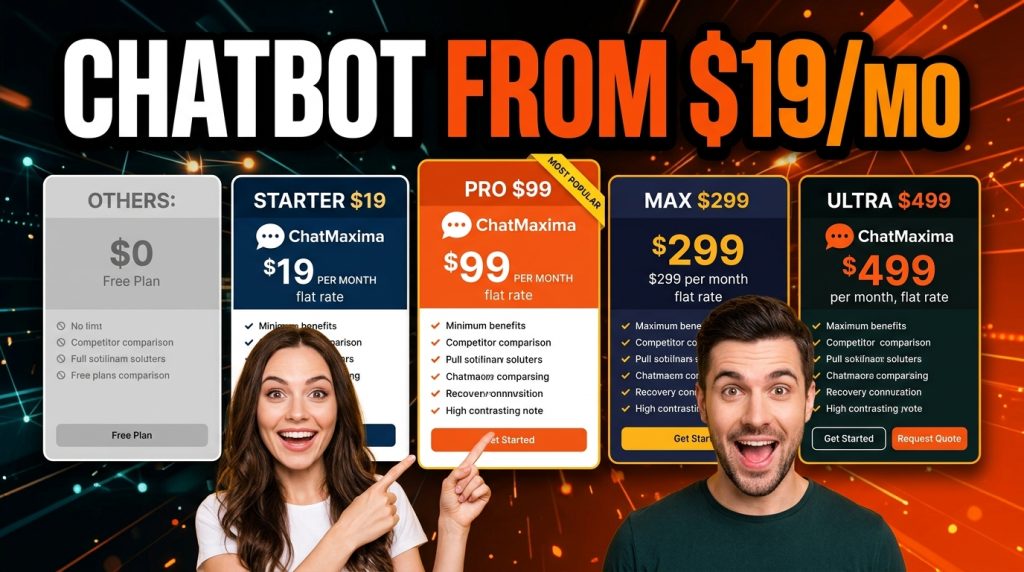
| ChatMaxima | $19 / $99 / $299 / $499 per month (4 flat tiers, 7-day free trial, no free plan) | Flat rate per workspace |
| Tidio | Free, then $24.17/mo | Usage-based (billable + Lyro AI conversations) |
| Chatfuel | Free, AI PRO $49/mo | Flat subscription |
| Landbot | Free, $45/mo | Chats + seats |
| Botpress | Free, then $150/mo | Per-conversation |
| Freshchat | Free, $19/agent/mo | Per seat + AI sessions |
| Intercom (Fin) | ~$39/seat/mo + $0.99 per resolution | Seat + per-outcome |
| Zendesk | $19 to $115/agent/mo + per resolution | Seat + outcome |
| HubSpot (Breeze) | Free builder, $0.50 per resolved conversation | Credits / per-outcome |
| Ada | Custom quote | Per-resolution, enterprise only |
Sources: vendor pricing pages (ChatMaxima, Tidio, Botpress, Freshworks, Landbot, Fin AI, Zendesk, HubSpot), 2026.
One structural difference decides who wins this table. Most of these platforms charge you more as you add seats or as the bot resolves more conversations, so your bill climbs exactly as your chatbot succeeds. ChatMaxima takes the opposite approach: a flat rate per workspace, from $19 to $499 per month, that does not move no matter how many chats the bot handles or how many channels you connect. At 5,000 conversations a month, a $0.99-per-resolution agent can run close to $5,000 while ChatMaxima’s Pro plan stays at $99. That is the single clearest reason it comes out ahead on value for growing teams: you are billed for the tool, not taxed for using it.
By business size, the pattern holds across almost every roundup: small businesses spend $0 to $500 per month (most land on a $29 to $99 plan), mid-market companies pay roughly $800 to $1,500 per month, and enterprise teams pay $1,000 to $10,000 or more per month, often above $3,000 once add-ons and AI usage are included (Tidio, 2026).
Is a free chatbot worth it?
Almost every platform above has a free tier, and for a simple website FAQ bot or a first pilot, it is genuinely enough to prove value. The catch is the limits: free plans cap the number of conversations, contacts, or AI resolutions, and the AI features are usually the first thing gated behind a paid plan. Tidio’s free plan, for example, covers 50 conversations a month and 50 lifetime Lyro AI chats before you pay. Free is the right place to start; just expect to graduate to a paid tier the moment the bot is doing real work, because that is exactly when the volume limits bite.
The 2026 shift: paying per resolution, not per seat
The defining change this year is outcome-based pricing. Rather than charging for every agent seat, leading platforms now bill only when the AI resolves a conversation:
- Intercom’s Fin AI Agent charges $0.99 per resolution, with a 50-resolution monthly minimum and at most one charge per conversation (Fin AI, 2026).
- HubSpot’s Breeze Customer Agent moved to $0.50 per resolved conversation as of April 2026 (CMSWire, 2026).
- Premium enterprise agents like Ada reportedly run $1 to $3.50 per resolution, with published pricing gated behind sales.
The takeaway: per-resolution pricing is really a success penalty. The better your bot gets and the more it deflects, the more you pay, so your reward for good automation is a bigger invoice. At $0.99 per resolution, 2,000 resolved chats a month is roughly $1,980, and 10,000 is nearly $10,000. This is precisely where a flat-rate platform like ChatMaxima pulls ahead: the same 10,000 resolutions cost the same $99 to $299 as the first hundred. If you expect your chatbot to actually work, uncapped volume pricing is the model to avoid. For a deeper platform-by-platform view, our ChatMaxima vs Intercom vs Tidio comparison breaks down where each model wins.
WhatsApp and messaging chatbot costs
If your customers live on WhatsApp, your chatbot cost has two parts: a platform fee and Meta’s per-message charges. This trips people up because the platform subscription is often the smaller number.
Since July 1, 2025, Meta bills per message rather than per conversation, and charges apply only when a template message is delivered (Meta for Developers, 2025). Messages your customer sends first, answered inside the 24-hour customer service window, are free.
Per-message rates vary widely by country and category. As a benchmark:
- United States: marketing about $0.025, utility and authentication about $0.004 per message.
- United Kingdom: marketing about $0.0485, utility and authentication about $0.0202.
- India: marketing about $0.0094, utility and authentication about $0.0014 (India moved to localized billing in January 2026).
On top of Meta’s pass-through cost, your Business Solution Provider adds a markup, typically $0.003 to $0.010 per message, or a flat platform license. Twilio, for example, adds about $0.005 per message, while some providers charge a flat monthly fee instead (Telnyx, 2026). For an exact, current breakdown by country, see the ChatMaxima WhatsApp API pricing guide.
The practical rule: for a WhatsApp bot, your monthly cost scales with message volume, not features. A low-traffic support bot might cost $20 to $50 a month all in; a marketing bot blasting templates to 100,000 contacts is a different budget entirely.
This is another place ChatMaxima keeps costs down. Instead of paying a separate platform for WhatsApp, another for your website widget, and another for AI, you run all of them from one flat-rate workspace and only add Meta’s raw per-message pass-through on top. You avoid stacking three subscriptions and three markups to cover the channels your customers actually use, which is how most businesses quietly overspend on messaging.
Custom-built chatbot development costs
If a subscription platform cannot do what you need, you hire an agency to build a custom bot. This is where the big numbers come from, and where the range is widest.
| Chatbot type | One-time build cost |
|---|---|
| Simple rule-based bot | $5,000 to $15,000 |
| Mid-complexity NLU bot | $8,000 to $20,000 |
| Advanced AI / LLM-powered bot | $20,000 to $60,000 |
| Enterprise (NLP, CRM/ERP, multi-language, compliance) | $80,000 to $350,000 |
| Regulated / agentic (banking, healthcare) | $200,000 to $1,000,000+ |
Sources: Groovy Web, Debut Infotech, CustomGPT, 2025 to 2026.
Two things push these numbers around. First, integrations: each CRM, ERP, or helpdesk connection typically adds 15 to 30 percent to the project cost (Debut Infotech, 2026). Second, location: offshore development can cut the build cost by 40 to 60 percent versus an in-house or onshore team.
A custom build gives you total control. It also gives you a maintenance bill, which we will get to shortly. Before you sign a five-figure statement of work, it is worth asking what you actually need that a configurable platform cannot already do. Modern tools like ChatMaxima ship the parts most teams pay agencies to rebuild from scratch, AI answers trained on your content, CRM and helpdesk integrations, WhatsApp and web channels, and human handoff, for a monthly fee that is a rounding error next to an $80,000 project. Custom is the right call for genuinely unusual or regulated requirements; for everything else, it is the expensive way to get what a platform already offers.
DIY / in-house build costs
The “just build it ourselves on the OpenAI or Claude API” plan looks cheap on a whiteboard. The API calls really are cheap. Everything around them is not.
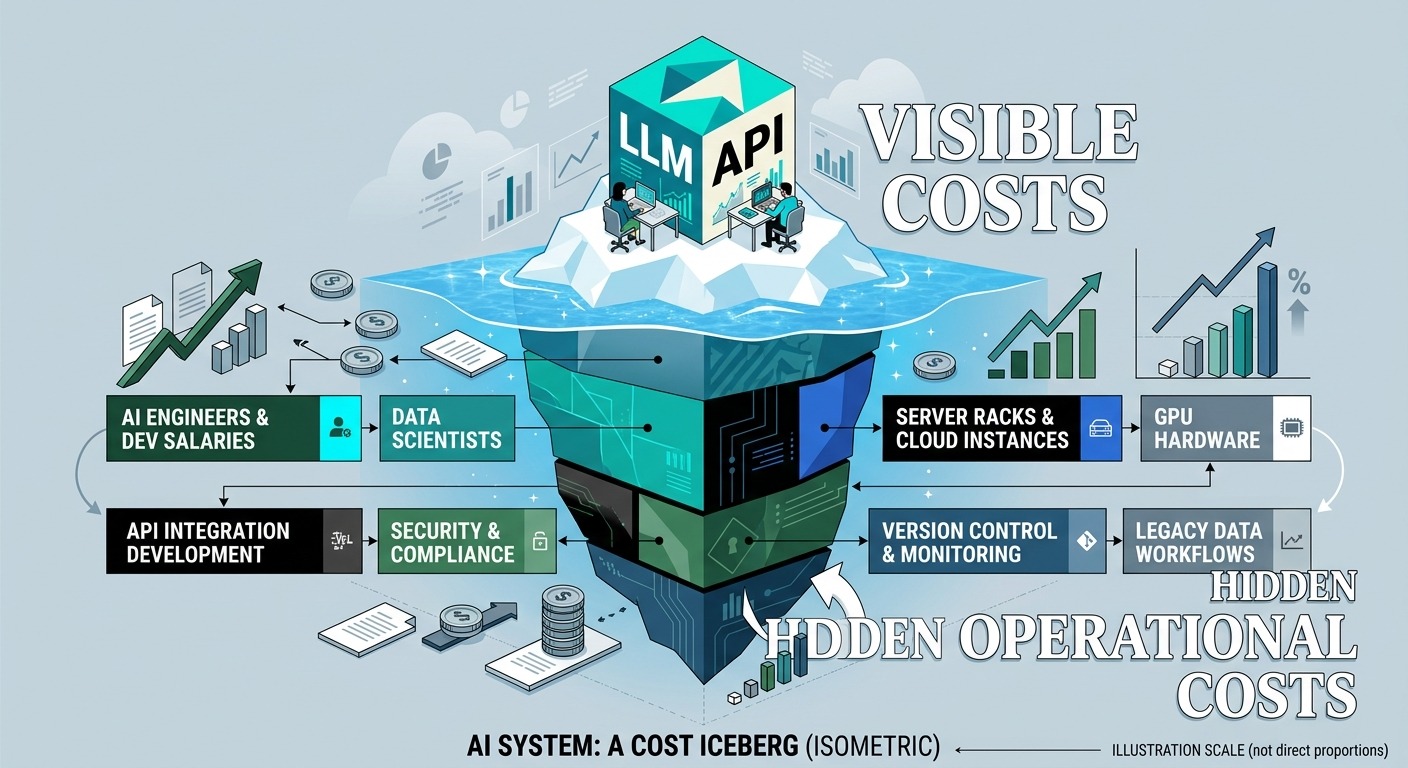
The people are the real cost. A conversational AI engineer averages about $123,000 per year, and a machine learning engineer about $163,000 per year in the US (Glassdoor, 2025 to 2026). One or two engineers is your single largest line item, before a single message is sent.
The LLM API is now the cheap layer. As of 2026, Claude Haiku 4.5 costs $1 per million input tokens and $5 per million output tokens, and Anthropic’s own worked example puts 10,000 support conversations at roughly $37 in total API spend (Anthropic, 2026). Prompt caching can cut repeated-context input by up to 90 percent. OpenAI’s GPT-4o sits around $2.50 in and $10 out per million tokens (verify on the official page, since it changes).
Infrastructure adds up quietly. A vector database like Pinecone starts around $50 a month and climbs to $700 or more at 100 million vectors, and a production AI chatbot’s total operating cost typically runs $400 to $6,000 per month (Groovy Web, 2026). One real-world RAG support bot saw its vector-database bill climb from $50 to $2,847 in three months as data and traffic grew.
The uncomfortable truth of DIY is that you rebuild, and then forever maintain, the exact infrastructure a platform already runs for you: the channel connectors, the retrieval layer, the dashboard, the analytics, the handoff. A single engineer’s salary alone dwarfs years of a ChatMaxima subscription, before you have paid for a single token or shipped a single feature. DIY makes sense when a chatbot is your core product; if it is a tool to support your business, buying beats building on cost almost every time. Our breakdown of ChatMaxima vs building your own chatbot on the OpenAI API walks through the full trade-off with numbers.
The hidden costs nobody quotes
This is the section that changes budgets. The build or subscription price is only the first of several recurring layers.
Maintenance. Plan on 15 to 20 percent of the build cost every year just to keep a custom bot working. A $50,000 chatbot needs $7,500 to $10,000 annually for patches, retraining, and integration upkeep (Metageeks, 2026).
Integrations and rework. Connecting the bot to your existing stack adds 20 to 50 percent to the overall budget, not a one-time flat fee.
Human handoff. No bot resolves everything. Typically 10 to 25 percent of conversations escalate to a human, and each of those live-agent conversations costs $4 to $12, versus $0.10 to $1.50 for an AI-handled one (Layer3Labs, 2026). Staffing is where support budgets actually go: about 94 percent of live-chat cost is people, not software.
Add it up and a “cheap” $5,000 to $15,000 custom bot rarely stays cheap. A custom build’s 24-month total cost of ownership commonly exceeds $80,000 (Groovy Web, 2026). It is no surprise that a majority of companies that abandoned a chatbot cited unexpected costs as the main reason.
The lesson is not “do not build a chatbot.” It is “price the whole iceberg, not just the tip.” And a flat-rate platform is how you shrink the iceberg to a single, known number. On ChatMaxima, maintenance, hosting, model costs, integrations, and updates are already inside the subscription, so the recurring layers that sink custom and DIY budgets simply are not separate line items. Predictability is not a nice-to-have here; it is the difference between a chatbot that pays for itself and one your finance team quietly kills.
Chatbot ROI: what you actually save
Cost only matters against return, and this is where chatbots earn their keep. The economics are simple: a machine handling a routine question is far cheaper than a person doing it.
- A chatbot interaction costs roughly $0.50 versus about $6 for a human agent (a figure originally from IBM, circa 2017, still widely cited as an order-of-magnitude benchmark).
- Juniper Research found chatbots save just over $0.50 to $0.70 per interaction and around four minutes per enquiry in banking and healthcare (Juniper Research, 2017 to 2018).
- Gartner projects conversational AI will cut contact-center agent labor costs by $80 billion in 2026, noting that labor is up to 95 percent of contact-center costs (Gartner, 2022).
The market reflects this. The global chatbot market is projected to grow from about $9.6 billion in 2025 at a 19.6 percent CAGR (Grand View Research, 2025), and 85 percent of customer service leaders were set to explore or pilot customer-facing conversational AI in 2025 (Gartner, 2024). For the full picture on returns, see our roundup of AI customer support statistics for 2026.
Which option is right for you?
Match the path to your situation rather than chasing the lowest sticker price:
- You are an SMB and want a bot live this week: a flat-rate platform like ChatMaxima at $19 to $99 a month. Predictable, fast, and it will not surprise you as you grow.
- Your customers are on WhatsApp: run WhatsApp, web, and AI from one flat-rate workspace so you pay Meta’s per-message fees once, not three stacked platform markups. This is ChatMaxima’s core strength.
- You run high support volume: avoid per-resolution pricing, which taxes your success. A flat plan means 10,000 resolutions cost the same as 100.
- You have genuinely unique, regulated needs: a custom build, with eyes open to the 24-month total cost of ownership, but confirm a platform truly cannot do it first.
- You have engineers and a chatbot is your product: DIY, but budget for salaries and maintenance, not just the API bill.
Notice how many of those rows land in the same place. For the vast majority of businesses, a flat-rate managed platform is the sensible answer because it converts the unpredictable costs that sink every other path (development, maintenance, spiky LLM and infrastructure bills, per-resolution taxes, and handoff staffing) into one predictable subscription. That is exactly what ChatMaxima is built for: WhatsApp, website, and AI chatbots across every channel, with a flat rate that does not punish you for growing and a 7-day free trial with no credit card. You can compare plans on the ChatMaxima pricing page.
The bottom line
So, how much does a chatbot cost in 2026? For most businesses, $0 to $500 a month on a SaaS platform, scaling to per-resolution fees of $0.50 to $6 as volume grows. Custom builds start around $5,000 and reach $350,000 or more, with a real 24-month total cost of ownership that regularly passes $80,000. WhatsApp bots are priced by message volume, and DIY costs are dominated by salaries, not tokens.
The mistake is budgeting only for the upfront number. Price the maintenance, the integrations, and the human handoff too, then weigh it against a return that is measured in dollars saved per interaction. Do that honestly, and most roads lead to the same place: a flat-rate platform that folds every one of those costs into one predictable line and does not bill you more for succeeding.
That is the case for ChatMaxima. Starting at $19 a month with a 7-day free trial, it gives you AI chatbots across WhatsApp, your website, and every major channel, without per-resolution taxes, an $80,000 build, or a DIY maintenance treadmill. For most businesses in 2026, it is simply the best value on the board. The question stops being “how much does a chatbot cost” and becomes “how quickly does it pay for itself,” and on a flat plan, the answer is usually within the first month.