In nine days, three labs shipped frontier models. OpenAI’s GPT-5.6 family reached general availability on July 9, 2026. Moonshot AI released Kimi K3 on July 16. Anthropic shipped Claude Opus 5 on July 24. If you are building an AI agent or a customer-facing chatbot, your model shortlist was rewritten twice while you were reading the last comparison post.
The Kimi K3 vs Claude Opus 5 vs GPT-5.6 question is being answered badly almost everywhere, because almost every comparison ranks these models on benchmark scores and price per million tokens. Neither number tells you what an agent will cost you or whether it will work.
This post does it differently. We will go through the benchmarks, then show you why they contradict each other, then do the arithmetic that actually decides the question: cost per resolved conversation. By the end you will have a decision framework that survives the next release, which is probably about six weeks away.
Three frontier models in nine days
Here is what actually landed, and what each lab is optimising for.
Kimi K3 is a 2.8-trillion-parameter mixture-of-experts model from Moonshot AI, the largest open-weight model ever released. It has a 1.05-million-token context window, native visual understanding, and an always-on reasoning mode Moonshot calls thinking mode. The weights land on July 27, 2026. It debuted at number 2 on the Vals AI index and number 1 on Frontend Code Arena.
Claude Opus 5 is Anthropic’s new cost-efficient flagship, released a day before this post went up. It matches or beats Claude Fable 5 on 8 of 13 benchmarks at half the token price, which makes it the relevant Claude for agent work rather than Fable 5.
GPT-5.6 is not one model, and this is the single most important fact in this comparison. OpenAI ships it in three tiers: Sol (flagship), Terra (balanced), and Luna (fast and cheap), plus a Sol Ultra high-effort mode. Every comparison that pits “GPT-5.6” against K3 as if it were one product is comparing the wrong thing.
The numbers that actually matter for agents
Benchmark tables age fast, but they are the right starting point. Here is the flagship-tier comparison.
| Kimi K3 | Claude Opus 5 | GPT-5.6 Sol | |
|---|---|---|---|
| Released | Jul 16, 2026 | Jul 24, 2026 | GA Jul 9, 2026 |
| Price in / out per 1M | $3 / $15 | $5 / $25 | $5 / $30 |
| AA Intelligence Index | 57 | ~60 | 59 |
| AA Coding Agent Index | 76.2 | not published | 80 |
| AA Agentic Index | 50.1 | leads | 2nd on AA-Briefcase |
| SWE-bench Pro | not published | 79.2% | 64.6% |
| Terminal-Bench 2.1 | 88.3% | not published | 88.8% (Ultra 91.9%) |
| Output speed | 33 tok/s | 56 tok/s | 64 tok/s |
| Time to first token | 161s | 65s | 155s |
| Context window | 1.05M | 200K (1M beta) | 400K |
| Open weights | Yes, Jul 27 | No | No |
And here is the part most comparisons omit entirely, the GPT-5.6 tier structure.
| Price in / out | AA Intelligence | Coding Agent Index | |
|---|---|---|---|
| Sol | $5 / $30 | 59 | 80 |
| Terra | $2.50 / $15 | 55 | 77 |
| Luna | $1 / $6 | 51 | 75 |
Look at Luna. It costs $1 in and $6 out, scores 75 on the Coding Agent Index against K3’s 76.2, and is built for exactly the high-volume, latency-sensitive traffic a customer chatbot generates. That single row undoes most of the “Kimi K3 is the budget option” analysis published in the last week.
Why the benchmarks contradict each other
If you read the table carefully you found the problem. SWE-bench Pro says Claude Opus 5 wins 79.2% to 64.6%, a 14-point rout. The Coding Agent Index says GPT-5.6 Sol leads the field at 80. Both are real measurements. They disagree because they measure different things.
SWE-bench Pro measures whether the answer is correct. It is closer to single-shot patch accuracy. The Coding Agent Index rewards efficient completion of an agentic loop. It cares about getting to done.
The timing data makes the split obvious. In a July 24 audit, Opus 5 had a median time to first token of 65 seconds against Sol’s 155 seconds, but mean total task time reversed the order: 398 seconds for Opus against 230 for Sol. Opus 5 deliberates and is more likely to be right. Sol moves and is more likely to be finished.
That distinction should drive your choice, and it points different directions for different jobs. For a coding agent grinding through a backlog, finishing faster is worth real money. For a customer-facing chatbot, a wrong tool call is a wrong answer to a paying customer, and there is no test suite to catch it before it ships. Correctness wins.
So when someone asks which of these models is best, the honest answer is that the question is underspecified. Best at what, on whose traffic, measured how?
Token price is not your real cost
Here is where nearly every comparison goes wrong. It ranks models by price per million tokens and stops. That number is a component of your cost, not your cost.
Consider a customer support agent handling 10,000 conversations a month. A realistic conversation runs about 8 turns. Each turn sends roughly 2,000 input tokens, because you are re-sending the system prompt, the conversation history, and your tool schemas, and returns about 250 output tokens. That is 16,000 input and 2,000 output tokens per conversation, so 160M input and 20M output per month.
At list prices, here is the monthly bill:
| Model | Input cost | Output cost | Monthly total |
|---|---|---|---|
| GPT-5.6 Luna | $160 | $120 | $280 |
| GPT-5.6 Terra | $400 | $300 | $700 |
| Kimi K3 | $480 | $300 | $780 |
| Claude Opus 5 | $800 | $500 | $1,300 |
| GPT-5.6 Sol | $800 | $600 | $1,400 |
| Claude Fable 5 | $1,600 | $1,000 | $2,600 |
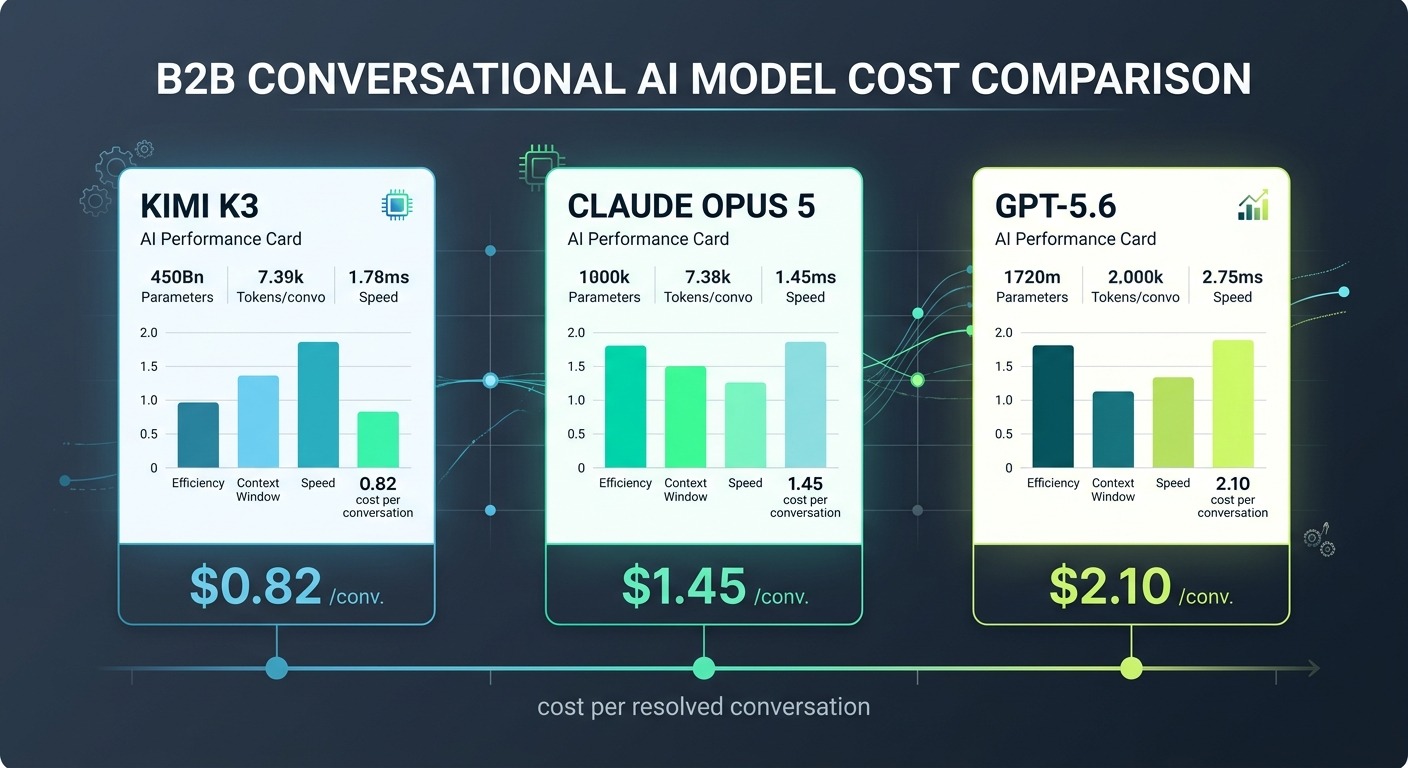
Luna comes in 2.8 times cheaper than Kimi K3 and 9 times cheaper than Fable 5. If token price were the deciding factor, the post would end here and the answer would be Luna.
It is not the deciding factor.
Cost per resolved conversation: the math
The number that decides this is what it costs you to close a conversation without a human touching it. Every conversation your agent fails to resolve gets escalated, and an escalation is not free.
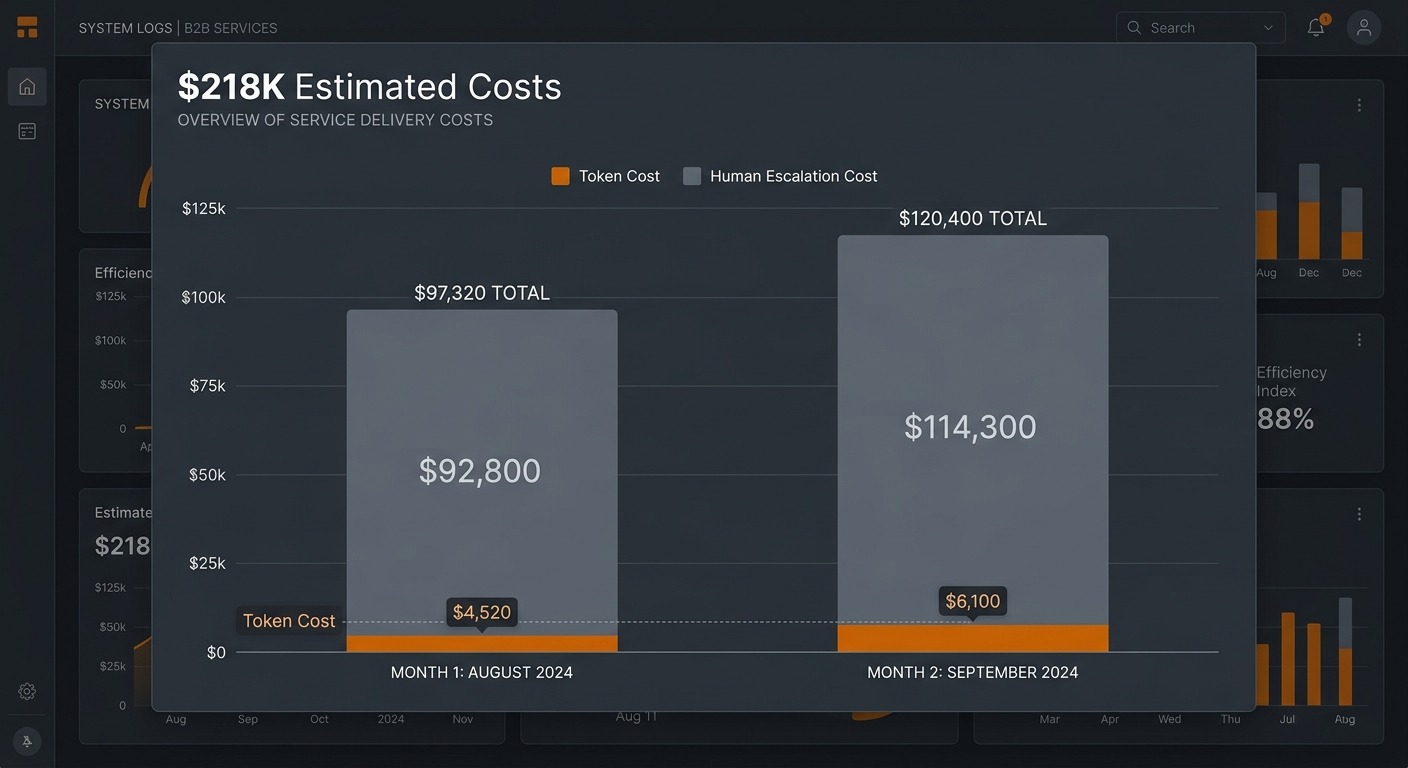
Say a human agent spends about 8 minutes on an escalated conversation at a fully loaded cost of $15 per hour. That is $2.00 per escalation. Now assume Luna resolves 70% of conversations unaided and Opus 5 resolves 85%. Those resolution rates are illustrative, not measured, and yours will differ. Run your own. But watch what the arithmetic does.
GPT-5.6 Luna at 70% resolution: Token cost $280, plus 3,000 escalations at $2.00 = $6,000. Total $6,280.
Claude Opus 5 at 85% resolution: Token cost $1,300, plus 1,500 escalations at $2.00 = $3,000. Total $4,300.
Opus 5 costs 4.6 times more per token and still comes out roughly 32% cheaper overall. A 15-point difference in resolution rate is worth far more than the entire token bill, because human time is one to two orders of magnitude more expensive than inference.
This is the whole argument. Your token bill is a rounding error next to your escalation bill. Any model comparison that optimises the rounding error and ignores the escalation rate is optimising the wrong variable.
Two things follow. First, a 5-point resolution improvement justifies a large token price increase, so you should be biased toward capability at your current volume. Second, the moment your volume gets large enough that inference rivals labour cost, the calculation flips and the cheap tiers become genuinely correct. Know which regime you are in before you pick.
Tool calling is the real differentiator
Resolution rate is mostly determined by whether the model calls your tools correctly. A support agent that cannot reliably look up an order, check a booking, or write to your CRM is a very expensive FAQ page.
This is where the gap between the three is widest, and it is not a benchmark gap. It is an architecture gap.
OpenAI ships Programmatic Tool Calling. GPT-5.6 writes and runs small programs that coordinate tools, process intermediate results, and choose the next action as work unfolds. Tool-heavy tasks advance with fewer model round trips. OpenAI reports it matched quality while using 24% fewer output tokens and completing tasks 28% faster. For an agent chaining five or more tools per turn, that attacks your dominant cost directly.
Anthropic ships a Tool Search Tool, a memory tool, and an effort parameter. Marking tools with deferred loading lets Claude discover them on demand instead of loading every definition upfront, preserving 191,300 tokens of context against 122,800 with the traditional approach, an 85% reduction. The memory tool gives you cross-session state without hand-rolling it. The effort parameter, which runs from low to max, means a cheap chat turn and a deep reasoning run can use the same model with different budgets.
Moonshot ships standard function calling and always-on thinking mode. There is no equivalent to either of the above. You will build that scaffolding yourself, and you will pay reasoning tokens on turns that did not need reasoning.
Both frontier labs have now shipped a real answer to “my agent has 40 tools.” That is a genuine capability difference, it directly affects resolution rate, and it does not appear in any index score.
What Kimi K3’s open weights are actually for
None of the above means K3 is a bad model. It is a legitimately frontier-class system. Terminal-Bench 2.1 at 88.3% is within half a point of Sol’s 88.8%, from a model you can download. It has the largest context window in the comparison at 1.05M tokens. And its cache-hit input rate of $0.30 per million tokens is the cheapest cached context on this list, which matters a lot if you run a heavy system prompt against short user messages.
But the open weights are not primarily a cost story, and this is widely misread. Moonshot recommends production deployment on supernode configurations of 64 or more accelerators. The previous-generation 1-trillion-parameter K2.7 already needed roughly 577GB of VRAM at INT4. At 2.8 trillion parameters you are not self-hosting this on hardware you happen to own. For almost everyone, self-hosting only pays off at volumes where fixed hardware cost beats a metered API bill.
The real value of open weights is sovereignty, not savings. If a customer contract or a regulator requires that inference never touches a third party, K3 is the only model in this comparison that can satisfy it. That is a serious unlock for regulated industries and for data-residency requirements in the EU, India, and the Gulf. It is a compliance capability with a price tag, not a discount.
There is also a latency cost to weigh. At 33 tokens per second, K3 is roughly half the throughput of Opus 5 and Sol. For a live WhatsApp or web chat, that is the difference between a reply that feels instant and one the customer abandons. Its 161-second time to first token, measured in a max-effort reasoning configuration, is not what you would run in production, but the throughput ratio holds across configurations.
How to choose: a decision framework
Skip the leaderboards. Answer these five questions about your own workload.
1. Is a wrong answer expensive or cheap? If a bad tool call books the wrong appointment, charges the wrong card, or gives a customer wrong medical or financial information, buy capability. Claude Opus 5, with SWE-bench Pro at 79.2% and the strongest agentic averages, is the conservative pick. If the worst case is a slightly unhelpful reply, a cheap tier is fine.
2. How many tools does a single turn touch? One or two, and any of these models will cope. Five or more, and Programmatic Tool Calling or the Tool Search Tool stop being nice-to-haves. This is the question that most often overrides price.
3. Does a human see the latency? For a live chat, throughput and time to first token are product features. Opus 5’s 65-second median time to first token is 2.4 times faster than either alternative in the same audit. For a batch job or an overnight agent, latency is free and you should buy on price.
4. What regime is your volume in? Under roughly 50,000 conversations a month, human escalation cost dominates and you should buy capability. Well past that, inference cost becomes material and the Terra and Luna tiers get seriously attractive. Do the two-line calculation above with your own numbers rather than trusting either instinct.
5. Does anyone require that inference stay in-house? If yes, Kimi K3 is your answer and the rest of this framework is secondary. If no, open weights are a feature you are not using.
Notice that none of these questions is “which model scored highest.” That is deliberate.
The winner changes every six weeks, so stop picking one
The uncomfortable truth about this entire comparison is its shelf life. In the nine days covered by this post, the correct answer changed twice. GPT-5.6’s arrival made Fable 5 hard to justify. Opus 5’s arrival, one day before publication, made Fable 5 hard to justify a second time and reset the price-performance frontier again.
Anyone who hardcoded a single model name into their chatbot in June has already rewritten that decision, or is about to.
And capability churn is not the only reason. Availability is a real risk too. Claude Fable 5 was suspended for three weeks under export controls before being redeployed on July 1, 2026. A model can become unavailable for reasons that have nothing to do with how well it performs on your traffic.
The architectural conclusion is the one we argued in model independence: the model is a dependency, not a foundation. Build so you can route per use case and swap in a day. That means your prompts, your tool definitions, your conversation history, and your evaluation set live in your platform, not inside one vendor’s API shape.
Practically, this looks like using a reasoning-heavy model for the small number of high-stakes turns, a fast cheap tier for the bulk of routine traffic, and keeping an open-weight option qualified for the customers who demand it. That is three models in one product, chosen per job, and it is strictly better than any single pick in this post.
This is why ChatMaxima connects to all of these providers rather than betting on one. Anthropic, OpenAI, Moonshot, Gemini, xAI, Groq, Amazon Bedrock, Azure AI, and OpenRouter sit behind the same bot builder, alongside an OpenAI-compatible endpoint option for anything self-hosted. When a release like this week’s reshuffles the price-performance frontier, changing which model answers a given conversation is a configuration change, not a migration.
What to do this week
The Kimi K3 vs Claude Opus 5 vs GPT-5.6 decision is not settled by a leaderboard, and it is not settled by a price list. It is settled by running your own flows and measuring what matters.
Take your ten most common conversation flows. Run them against Claude Opus 5, GPT-5.6 Terra, and GPT-5.6 Luna with identical prompts, identical tool definitions, and identical retry policy. Add Kimi K3 if data residency is on your requirements list. Then measure five things: tool-call accuracy, resolution rate, escalation rate, time to first token, and cost per resolved conversation.
That last number is the only ranking that matters, and it will not match any published index. It never does, because no index knows what your escalations cost you.
Our own read for most teams building customer-facing agents right now: use a capable model for the reasoning-heavy work where errors are expensive, run a cheap fast tier for routine volume, and treat Kimi K3 as the answer to a compliance question rather than a cost question. Then re-run the comparison in six weeks, because there will be something new to add to the table.
If you would rather run that comparison inside a platform that already handles multi-channel delivery, tool connections, and conversation data, ChatMaxima lets you point a bot at any of these providers and switch without rebuilding the flow. See ChatMaxima pricing and start with the flows you run most.
Sources for the benchmark and pricing figures in this post: Artificial Analysis for index scores, throughput, and latency measurements, and OpenAI’s GPT-5.6 announcement for Programmatic Tool Calling figures. Prices are list API rates as of July 25, 2026 and change frequently.