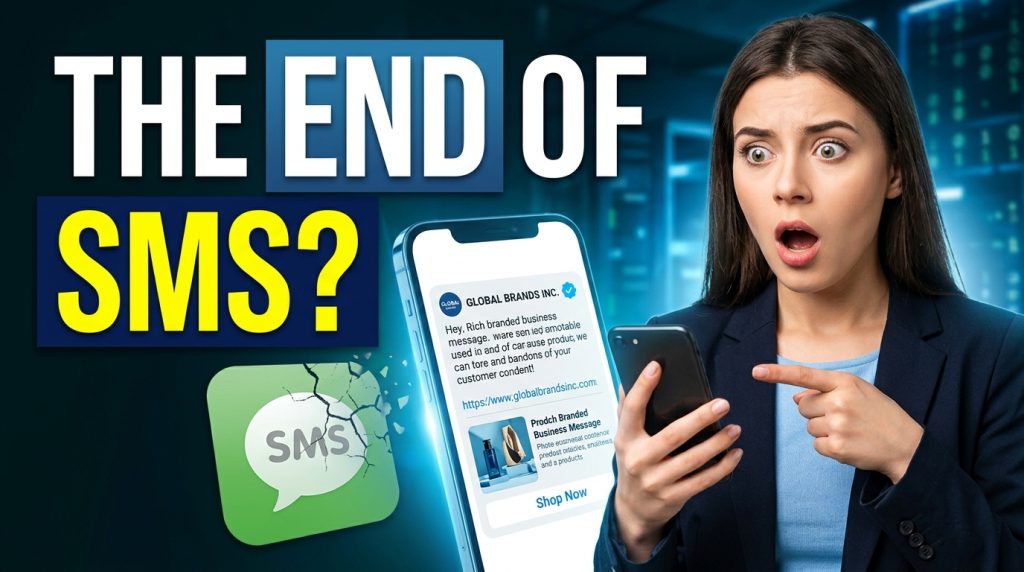
For twenty years, the text message your business sent looked the same: 160 characters of plain text from a random short code, no logo, no images, no reply buttons, and no way for the customer to know the message was really from you. SMS survived because it was universal, not because anyone liked it.
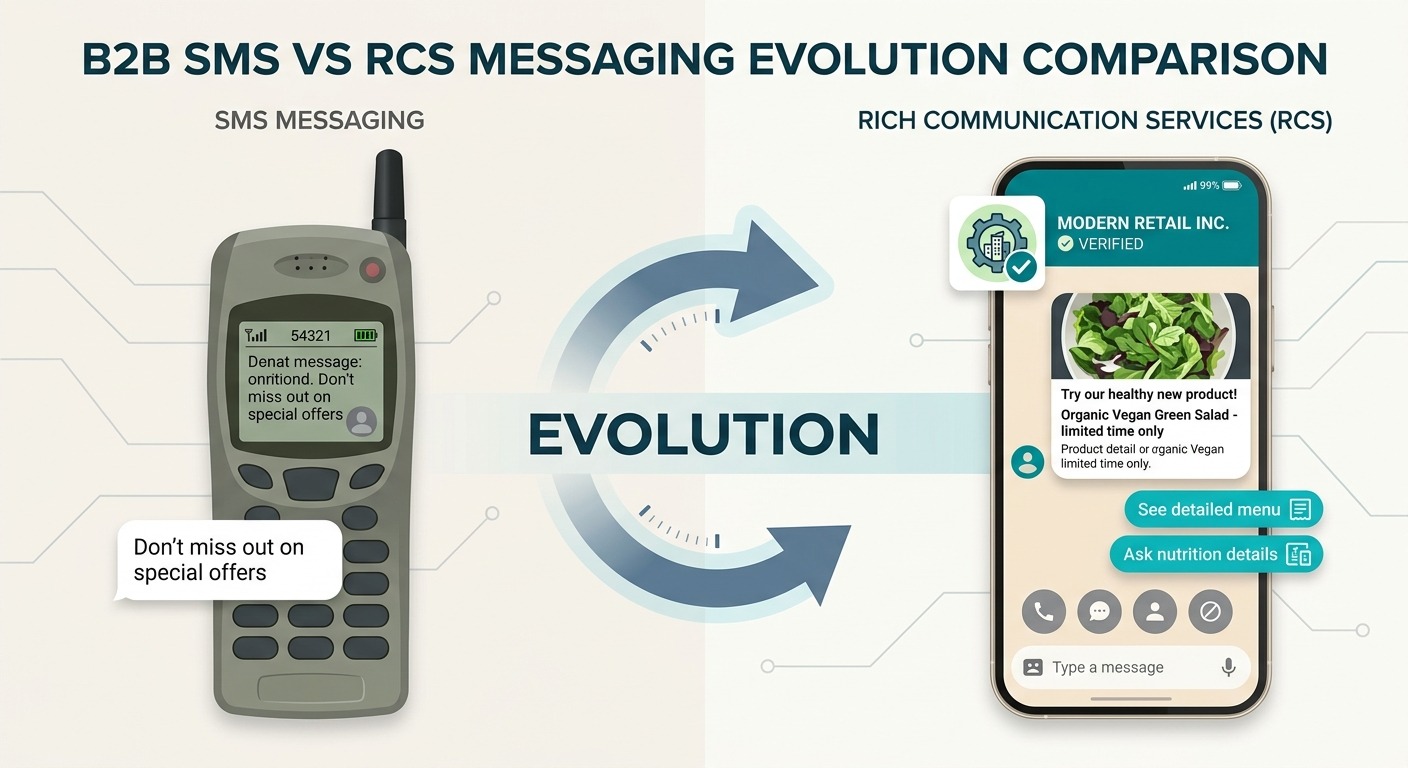
RCS business messaging is what replaces it. RCS (Rich Communication Services) upgrades the default messaging inbox on a smartphone into something that looks and behaves like a modern chat app: branded sender profiles with a verified badge, images and carousels, suggested reply buttons, read receipts, and real two-way conversation. No app install, no opt-in to a new platform, because it arrives in the same inbox where text messages already live.
For small and mid-sized businesses the practical questions are simple: what exactly is RCS, how is it different from the SMS you already send and the WhatsApp channel you may already run, what does it cost, and when is the right time to adopt it? This guide answers all four.
What RCS Business Messaging Actually Is
RCS is a carrier-backed messaging standard, coordinated largely through Google’s Jibe infrastructure, that replaces SMS as the default messaging protocol on modern smartphones. Person-to-person RCS is what makes chats between Android users feel like iMessage: typing indicators, high-resolution media, reactions.
RCS for Business (sometimes called RBM, RCS Business Messaging) is the application-to-person layer on top: businesses register a verified “agent” through an RCS provider or aggregator, and can then send rich, branded, interactive messages to customers at scale. The pieces that matter:
- Verified sender identity. Your business name, logo, and brand color appear on the message, with a verification badge issued through the registration process. Customers see who is messaging them, not a five-digit short code
- Rich content. Product images, media cards, carousels of items, PDFs, and location pins, all rendered natively in the default inbox
- Interactivity. Suggested replies and action buttons (visit a link, call, share location) that turn a notification into a conversation
- Delivery intelligence. Read receipts and delivery events, so you finally know whether that appointment reminder was seen, something SMS never told you
The reason 2026 is the year this stopped being a niche Android story: Apple now supports RCS, including RCS for Business on iPhone. With both platforms on board, industry analysts at Juniper project the active RCS user base to reach roughly 3.8 billion users by the end of 2026, about 40 percent of smartphone users worldwide, and Google reports over a billion RCS messages sent daily in the US alone. The channel has crossed from experiment to infrastructure.
RCS vs SMS: An Upgrade, Not a Choice
Comparing RCS to SMS is the easy part, because RCS was designed to replace it in place.
| Capability | SMS | RCS |
|---|---|---|
| Sender identity | Short code or random number | Verified brand name, logo, badge |
| Content | 160-character text | Images, carousels, cards, files |
| Interaction | None (reply STOP) | Suggested replies, action buttons |
| Read receipts | No | Yes |
| Conversation | One-way blast, mostly | True two-way chat |
| Reach | Every phone on earth | Most modern smartphones, SMS fallback for the rest |
| Trust | Spoofable, phishing-prone | Verified sender, dramatically harder to spoof |
The trust line deserves emphasis. SMS phishing works because any sender can claim to be your bank or your courier. RCS verification closes that door, and it shows: industry surveys consistently find a large majority of consumers say they trust a message more when it carries a verified sender badge.
The practical migration model for an SMB is not “switch off SMS.” RCS providers send RCS where the handset supports it and fall back to SMS automatically where it does not. Your appointment reminders get richer for most customers and stay deliverable for all of them. If your business sends any meaningful SMS volume today, RCS is less a new channel than a quality upgrade to one you already pay for.
RCS vs WhatsApp: Different Animals in the Same Zoo
The harder comparison is WhatsApp, because on paper the two look similar: rich media, verified businesses, interactive buttons, two-way conversations. The differences that matter to an SMB are structural.
Reach depends on geography. WhatsApp is the default communication layer in India, Brazil, much of Southeast Asia, Latin America, and the Middle East, with more than two billion users who open it daily. RCS reach is strongest where WhatsApp is weakest, notably the United States, where iMessage and SMS habits kept WhatsApp adoption low and where a billion RCS messages now flow daily. The first question is never “which channel is better,” it is “where do my customers live.”
The inbox is different. WhatsApp is an app people chose, with an identity (your number) and social context. RCS lives in the default messaging inbox alongside delivery notifications and one-time passwords. Marketing sent over RCS inherits the utilitarian feel of that inbox; marketing on WhatsApp arrives where customers talk to family. Depending on your brand and market, either can be an advantage.
Governance differs. WhatsApp is one company’s platform with one global rulebook: template approvals, 24-hour service windows, per-message pricing categories set by Meta. RCS is a standard operated across carriers and Google, accessed through aggregators, with pricing and capabilities that vary by country and carrier. WhatsApp gives you predictability; RCS gives you a channel no single platform owns.
Conversation mechanics differ. WhatsApp’s model is built around customer-service windows and pre-approved templates, which we covered in detail in our WhatsApp Business API pricing guide. RCS models vary: in some markets you pay per message (basic text vs rich message tiers), in others conversational pricing covers a 24-hour session. Neither is universally cheaper; the math depends on your mix of notifications versus conversations.
For most SMBs outside North America, the honest 2026 answer is: WhatsApp remains the primary conversational channel, and RCS is the upgrade path for everything you still send as SMS. For US-focused businesses, RCS is closer to the main event, because it reaches the customers WhatsApp never captured there.
What RCS Costs in 2026
RCS pricing is set by carriers and varies by market and provider, so there is no single global rate card the way Meta publishes one for WhatsApp. The structure, however, is consistent:
- Basic messages (text-only, SMS-equivalent) price in the low single-digit cents in most markets, typically at or slightly above SMS rates
- Rich messages (cards, images, carousels) carry a premium over basic messages
- Conversational pricing, available in many markets outside the US, bills a single session fee for all messages exchanged in a 24-hour window, similar in spirit to WhatsApp’s conversation model
- In the United States, agents currently operate per-message rather than per-conversation
As a concrete reference point, RCS marketing messages in European markets like the DACH region have settled around the mid-single-digit cents per message as carrier billing went live in early 2026. Verification and agent registration typically involve a one-time setup process through your provider rather than a large recurring fee.
Budgeting advice for an SMB: price RCS against what the same message costs you on SMS and WhatsApp today, per use case. Utility notifications often cost similar money at higher quality; rich marketing messages cost more than SMS but earn it back in engagement, with several early studies reporting multiples of SMS click-through rates for well-designed RCS campaigns. Our roundup of business messaging statistics covers why rich, conversational formats consistently outperform plain broadcasts.
Where RCS Fits an SMB Playbook Right Now
Cut through the hype with three questions:
1. Do you send SMS today? If yes, RCS is the obvious first move: same use cases (reminders, OTPs, order updates, delivery notifications), same fallback safety net, better identity and engagement. This is the lowest-risk adoption path and the one to take in 2026.
2. Are your customers in a WhatsApp-first market? Then WhatsApp stays your conversational core: support, sales, and campaigns where the customer talks back. RCS complements it on the notification layer rather than replacing it. Running both from one inbox, with the conversation history in one place, matters more than either channel alone; channel sprawl is how SMBs end up missing messages.
3. Are you US-focused with a marketing use case? RCS is the first real chance to run branded, interactive campaigns in the American default inbox. Verified sender identity alone is worth the migration for any business whose SMS gets mistaken for spam.
And one warning that mirrors every messaging channel before it: trust is the asset. RCS engagement rates are high right now partly because inboxes are not yet flooded. The businesses that win on RCS long-term will be the ones that treat it like a conversation channel with consent and value, not a louder blast cannon. The same discipline that keeps a WhatsApp number healthy, respecting opt-ins, frequency, and relevance, applies from day one.
The Omnichannel Bottom Line
RCS in 2026 is where WhatsApp Business was a few years ago: past the experiment phase, growing fast, and rewarding early movers while the channel is still uncrowded. It will not replace WhatsApp where WhatsApp is the daily habit, and it has already begun replacing SMS everywhere.
For an SMB the strategy is not picking a winner. Customers move between channels, and the businesses that convert them are the ones whose conversations follow: the ad click that becomes a WhatsApp chat, the delivery update that arrives over RCS, the voice call that picks up where the messages left off, which is exactly the stack we described in our WhatsApp Business Calling pricing guide.
ChatMaxima’s platform is built for that multi-channel reality: WhatsApp, Instagram, Facebook Messenger, Telegram, SMS, email, and web chat in one shared inbox with AI agents working across all of them. If you are planning your 2026 channel mix, take a look at our plans and start from the channels your customers already use today.