
On June 16, 2026, the Government of India ordered a temporary, nationwide restriction on Telegram. The Telegram channel ban in India runs until June 22 and is tied directly to the NEET (UG) 2026 re-examination scheduled for June 21. This is one of the most significant platform-level actions a major messaging app has faced in the country, and it carries real lessons for any business that depends on third-party channels to reach customers.
The order was issued by the Ministry of Electronics and Information Technology (MeitY) under Section 69A of the Information Technology Act, 2000, acting on recommendations from the National Testing Agency (NTA). It does two things at once: it blocks access to the platform for a defined window, and it forces Telegram to switch off a specific product feature in India.
If your brand runs a Telegram channel, a support bot, or any marketing presence on the platform, the Telegram channel ban in India is a reminder of a hard truth. You do not own the channels you rent. Here is exactly what happened today, why it happened, and what it means for how you communicate with customers.
What the June 16 order actually covers
The action is narrow and time-boxed on purpose. According to the NTA statement and reporting from outlets including Business Today and Prokerala, the order has two distinct parts.
Part one: an access restriction under Section 69A. Telegram access is restricted across India for a defined and limited period ending June 22, 2026. This window covers the day of the NEET (UG) 2026 re-examination and its immediate aftermath. The official wording describes it as “calibrated and bounded in time,” meaning regulators deliberately scoped it to the exam window rather than an indefinite block.
Part two: a feature-specific direction on message editing. Telegram has been directed to disable, inside India, its message-editing feature for messages that have already been posted. This direction runs longer, through June 30, 2026, and addresses a specific abuse pattern we will cover below.
The distinction matters. Part one is a blunt instrument, full access restriction. Part two is a surgical one, killing a single feature without taking the platform down. Both are framed as the “minimum restriction necessary” to protect public order during a sensitive period.
Why Telegram, and why now
The trigger is exam fraud at scale. In the weeks leading up to the re-exam, channels operating openly on the platform under names that advertised their own purpose, “Paper Leaked NEET,” “Re-NEET 2026,” “Private Mafia,” “REE NEET MAFIAA” and similar formulations, were demanding sums ranging from a few thousand to several lakh rupees from candidates and their families in exchange for purported access to the re-examination paper.
The NTA has placed on record that no such paper exists outside the secured examination chain. Every one of these offers was a fraud. But the scams worked because of the channel format. A Telegram channel can broadcast to an unlimited audience, spin up under a new name the moment one is taken down, and operate from anywhere with near-total anonymity.
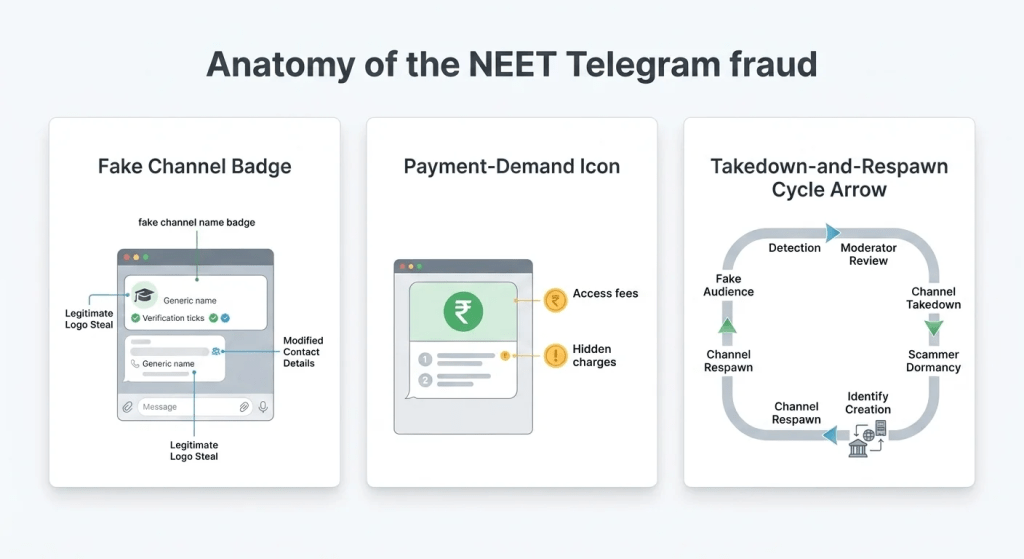
The Indian Cyber Crime Coordination Centre (I4C), under the Ministry of Home Affairs, has acted as the lead nodal agency, securing the takedown of a large number of Telegram channels, groups, and bots. State police forces have moved too. The Bihar Police Economic Offences Unit issued a public advisory on June 9, 2026, and the Ahmedabad City Cyber Crime Branch arrested members of an inter-state gang running eight Telegram channels, with documented transactions of roughly 1.5 crore rupees routed through fraudulent bank accounts and about a thousand mobile numbers contacted in a single month.
The platform-level order came only after channel-by-channel takedowns proved insufficient. When you can delete a channel and watch three more appear before lunch, individual enforcement loses the race. That is the official justification for escalating to a Section 69A access restriction.
The message-editing angle is the interesting part
Most coverage leads with the ban. The more revealing detail is the editing restriction, because it exposes a structural weakness in how broadcast channels can be weaponized.
Telegram lets a channel administrator edit the content of a message that was already posted, including swapping out an attached file such as a PDF, while keeping the original send-time stamp. Read that twice. You can post an innocent message today, and next week replace its attachment with something else, and the timestamp still says today.
Fraud rings used this to manufacture fake “proof.” After an exam was conducted, an administrator would edit an older, innocuous message to insert the actual question paper, then circulate screenshots of that chat as “evidence” that the paper had leaked before the exam. The retained timestamp made the fabrication look credible.
Disabling edit-after-post for the window through June 30 closes that specific avenue. For businesses, this is a useful illustration of a principle: features built for convenience (fixing a typo in a broadcast) become liabilities when the platform hosts bad actors at scale and regulators decide the feature itself is the problem.
What this means for businesses using Telegram
A temporary, exam-driven restriction is not the same as a Telegram exit from India. The platform remains widely used for legitimate personal, educational, and professional purposes, and the NTA explicitly acknowledged that the access restriction affects lakhs of ordinary users and apologized for the inconvenience. Ordinary sending and receiving of new messages is unaffected by the editing direction.
But if your customer communication strategy leans on Telegram, today is a planning prompt, not a panic button. Three things are worth internalizing.
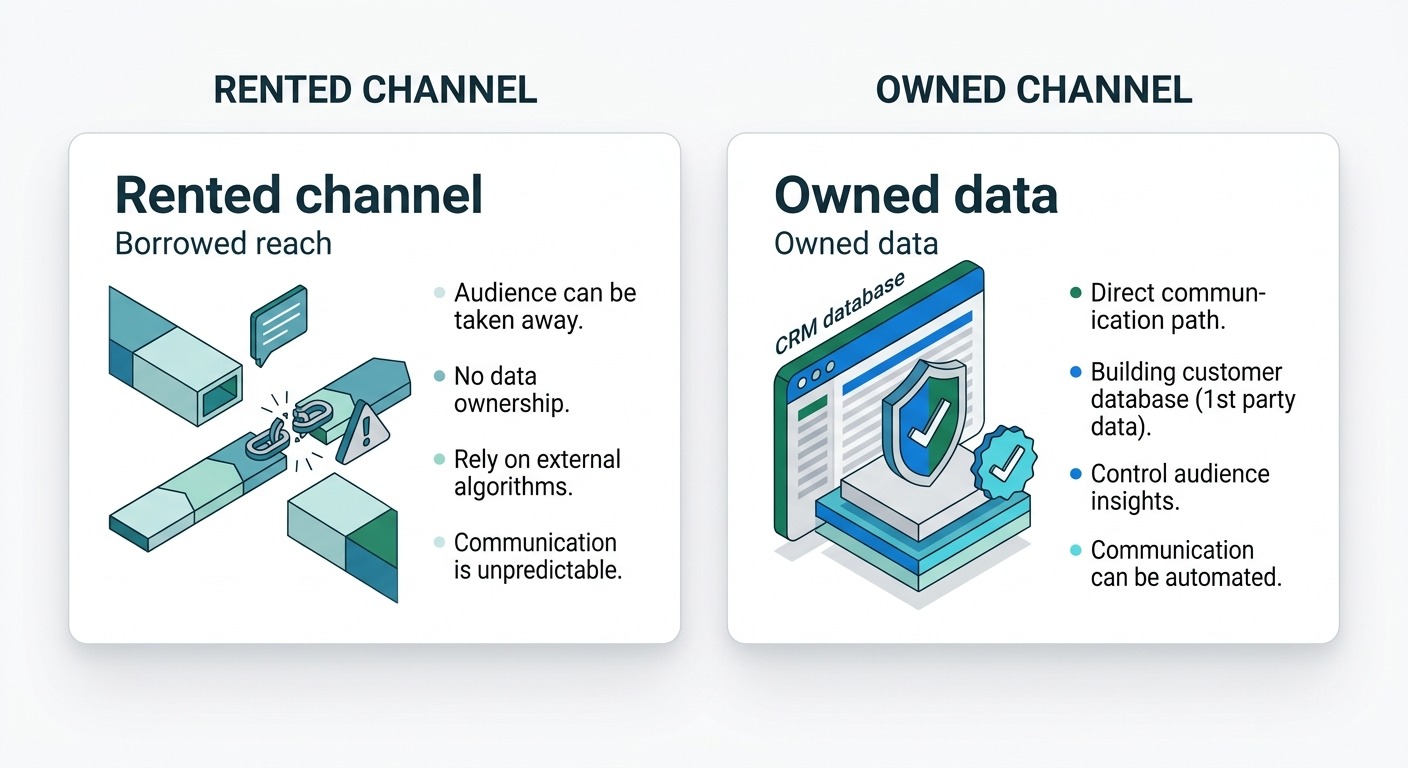
You operate on rented land. When a regulator issues a Section 69A order, your perfectly compliant brand channel goes dark alongside the fraud channels. You have no recourse and no warning. This is the same lesson behind every platform outage and policy shift, including the WhatsApp and Instagram API outage in June 2026 that knocked business messaging offline for hours. Platform risk is real and it is not yours to control.
Owned data beats borrowed reach. Followers on a Telegram channel are a list you cannot export, contact directly, or move. The moment access is cut, that audience is unreachable. Phone numbers and opted-in contacts in your own CRM, by contrast, travel with you across channels. Building on owned customer data is the single best hedge against any one platform going dark.
Compliance and verification are becoming the baseline. The direction of travel for messaging regulation in India is toward traceability and accountability, not away from it. Channels that verify business identity and enforce opt-in are increasingly the safe harbor. That is precisely the design of the WhatsApp Business API, where every sender is a verified business and every conversation is permissioned.
Why verified business messaging is the safer foundation
The NEET-Telegram episode is a stress test of trust. Candidates could not tell a fraud channel from a real one because Telegram channels carry no inherent identity guarantee. Anyone can name a channel anything and broadcast to a crowd.
Compare that to a verified business presence. On WhatsApp, a business goes through Meta’s verification, displays a confirmed name, and can only message users who opted in. The format that made the NEET scams possible, anonymous broadcast to a non-consenting audience, is exactly the format verified business messaging is built to prevent.
This is why we keep pushing customers toward owned, verified channels rather than open broadcast platforms. The numbers back it up too. Our own roundup of business messaging statistics for 2026 shows that customers consistently engage more, and trust more, when they know who is on the other end of the conversation. Trust is not a nice-to-have in messaging. It is the entire product.
There is also a platform-consolidation story here. As Meta winds down standalone Messenger features in favor of unified business messaging, the channels that survive and grow are the ones with verified identity and clear compliance rails. Open, unverified broadcast channels are moving in the opposite direction, toward more scrutiny, not less.
How to build a platform-resilient messaging stack
If today’s order made you nervous about channel dependence, here is the practical playbook. None of it requires abandoning Telegram if it works for your community. It requires not betting the business on any single platform.
Centralize contacts in a CRM you own. Every lead, every opt-in, every conversation should land in a system you control, not scattered across channels you rent. When a platform goes dark, you can still reach people through another channel because the contact record is yours.
Run a multi-channel presence, not a single-channel bet. Meet customers on WhatsApp, Instagram, web chat, and email, with one inbox behind them. If any one channel is restricted, the conversation continues elsewhere without your team scrambling. A unified platform like ChatMaxima exists precisely so a Telegram restriction, a WhatsApp outage, or an Instagram policy change does not become a business outage.
Prioritize verified, permissioned channels for anything transactional. Use verified business messaging for orders, confirmations, OTPs, and support, where identity and trust are non-negotiable. Reserve open broadcast channels for community and content where the stakes are lower.
Automate identity and consent, not just replies. Good automation is not only fast answers. It is opt-in capture, verification, and a clean audit trail, so that when regulations tighten, you are already on the right side of them. AI agents that handle qualification and routing also handle the compliance scaffolding that keeps you safe.
The brands that came through today’s news unbothered are the ones that never treated a Telegram channel as their primary customer relationship. They used it as one surface among many, with the real relationship anchored in owned data and verified channels.
What happens after June 22
By its own terms, the access restriction lifts on June 22, 2026, the day after the NEET (UG) 2026 re-exam. The editing direction stays in force through June 30. The NTA has stressed that the re-exam itself proceeds as scheduled on June 21, and that the security of the exam is the entire point of the action. Candidates have been urged to ignore unverified content and rely only on official NTA channels at neet.nta.nic.in, and to report fraudulent solicitations to the National Cyber-Crime Helpline at 1930 or cybercrime.gov.in.
For everyone else watching from a business lens, the takeaway outlasts the June 22 deadline. Platform-level restrictions are now a normal tool of Indian regulators, and they do not distinguish between fraud channels and your brand channel when the order comes down. The only durable protection is to own your customer data and to communicate through verified, permissioned channels you are not at risk of losing overnight.
If you want to move customer conversations onto owned, verified, multi-channel rails, that is exactly what ChatMaxima is built for. Start with our pricing page to see how a unified inbox and AI agents across WhatsApp, Instagram, and web chat keep you talking to customers no matter which platform makes headlines next.