
For a law firm, the phone is still where most new matters begin. Someone has just been injured, served with papers, arrested or told their landlord wants them out, and they call the first few firms they find. The firm that answers, takes the details properly and books a consultation usually gets the case.
Many firms miss that moment. In Clio’s 2024 Legal Trends Report, a secret-shopper study found that only 40% of law firms answered the phone, and 48% could not be reached by phone at all, neither answering nor calling back (Clio, 2024).
A legal answering service closes that gap. This guide explains what a legal answering service does, how an AI receptionist handles intake calls, what to collect for conflict checks, the ethics and confidentiality questions to settle first, the costs, and an eight-step setup.
What is a legal answering service?
A legal answering service answers a law firm’s calls when the firm cannot: during busy hours, at lunch, after hours and at weekends. Unlike a general answering service, it follows a legal intake script, understands that new clients and existing clients need different handling, and knows what it must never say.
There are two kinds today:
| Human legal answering service | AI receptionist for law firms | |
|---|---|---|
| Who answers | Remote receptionists trained in legal intake | Software holding a spoken conversation |
| Live transfer to an attorney | Usually yes | Not available on ChatMaxima; the attorney calls back |
| Intake questions | Scripted by the provider and the firm | Scripted by the firm, asked the same way every time |
| Consultation booking | Often by message, sometimes direct | Directly into the calendar during the call |
| Calls at once | Depends on staffing | Many at the same time |
| Pricing | Per minute or per call, often with legal premiums | Monthly plan plus usage |
Many firms combine them, or use AI for new-client intake and keep people for existing clients. Our comparison of virtual and AI receptionists covers the general pricing picture.
Why intake calls are different
A plumber’s caller wants a time slot. A law firm’s caller often wants something harder:
- They are stressed. Many callers are in the middle of a crisis, and tone matters.
- They want advice. “Do I have a case?” is the most common question, and the one the receptionist must not answer.
- Timing can be critical. Court dates, filing deadlines and limitation periods mean some calls cannot wait for Monday.
- Confidentiality starts on the first call. Even a prospective client is owed care with what they share.
- Conflicts must be cleared before the firm takes on anything, which means collecting names correctly.
A good legal answering service, human or AI, is built around these five facts.
What an AI receptionist handles on intake calls
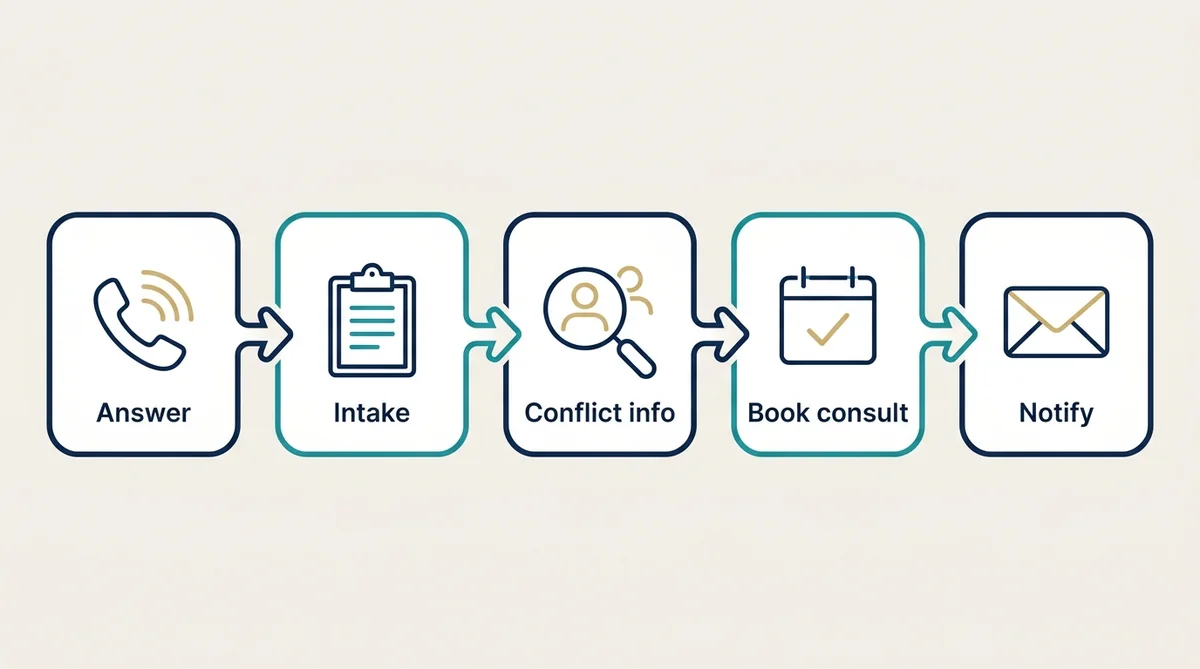
- Answers immediately in the firm’s name, and says it is the firm’s virtual assistant.
- Separates new and existing clients. Existing clients get a message taken for their attorney; new callers go through intake.
- Asks the intake questions your firm defines: practice area, a short description, location, how they found you and any deadline.
- Collects conflict-check details: the caller’s full name and the names of any other parties involved.
- Screens out what you don’t handle. Practice areas or locations you do not serve get a polite referral message.
- Books a consultation in the right attorney’s calendar, or captures a callback request.
- Sends everything to the team: the intake answers by email or into your CRM, with the full call transcript in the inbox.
It does all of this without giving legal advice, which brings us to the script.
A sample intake script
AI: Thank you for calling Harper & Lane. I’m the firm’s virtual assistant. Are you a current client, or calling about a new matter?
Caller: New. I was in a car accident last week and the other driver’s insurance keeps calling me.
AI: I’m sorry that happened. I can take some details so one of our attorneys can review your situation. What’s your full name?
Caller: Daniel Ortiz.
AI: Thank you, Daniel. Do you know the name of the other driver or their insurance company? We ask so the firm can check for conflicts before you speak with an attorney.
Caller: The driver was Mark Ellis. Insurance is Coastline.
AI: Got it. Is there any deadline you’re aware of, such as a court date or a letter asking you to respond by a certain day?
Caller: The insurer wants a recorded statement by Friday.
AI: Thank you. I can’t give legal advice, but I’ll flag that date for the team. I have a free 30-minute consultation available Wednesday at 10am or Thursday at 2pm. Which would you prefer?
The AI acknowledged the caller, collected conflict details, flagged the deadline, declined to advise and booked a consultation, all in under two minutes.
Conflict-check details: what to collect
Conflicts are checked by people, but they can only check what was collected. Ask for:
- The caller’s full legal name, and any other names they use.
- The other parties: the opposing person or company, their insurer, an employer, a landlord, a spouse in a family matter.
- Related people, such as co-defendants or business partners, where relevant.
- The matter type and location, to confirm jurisdiction.
Tell the AI to say why it is asking (“so the firm can check for conflicts”), and never to confirm or deny whether the firm represents anyone else.
What the AI must never do
Write these rules into its instructions, word for word, and test them:
- No legal advice, including “you probably have a case” or “you should not sign that”.
- No promises about outcomes, fees beyond your published consultation terms, or whether the firm will take the case.
- No statement that an attorney-client relationship exists. A short line such as “speaking with me does not make you a client of the firm” helps.
- No discussion of other clients or matters.
- Urgent situations go to people fast. If a caller says they are in custody, facing a hearing tomorrow or in danger, the AI gives the firm’s urgent number or emergency services and emails the on-call attorney immediately.
- Collect only what intake needs. Short descriptions, not the full story. The detailed facts belong in the consultation.
Ethics, confidentiality and AI
Lawyers are responsible for the tools their firm uses. The American Bar Association’s Formal Opinion 512 (July 2024) sets out how the Model Rules apply to generative AI, including competence, confidentiality and supervision of the tools and staff that use it. It asks lawyers to understand how a tool handles information before client information goes into it.
For an AI receptionist, that means asking every vendor, including us:
- Is call content used to train AI models?
- Where are transcripts and recordings stored, and for how long?
- Who can access call data, inside the vendor and inside your firm?
- Which third-party AI and voice services handle the audio and text?
Then design the call to collect the minimum, keep detailed facts for the consultation, and limit transcript access to the people who handle intake. State bar rules and opinions vary, so have the attorney responsible for ethics in your firm sign off on the setup. This article is not legal advice.
Existing clients and urgent calls
Existing clients call about their own matters, and they expect their attorney or paralegal. Because a ChatMaxima voice agent has no way to put a caller through to a colleague mid-call, plan the existing-client path like this:
- Take a precise message: who is calling, which matter it concerns, what they need and when they can talk.
- Email the responsible attorney or team straight away, and say when they can expect a reply.
- Use the firm’s urgent line for anything time-critical, and read it out clearly.
- Follow up by text. Through Missed Call Text Back, the firm’s urgent number and office hours can land in the caller’s WhatsApp or SMS seconds after they ring.
If live transfer to an attorney is essential, keep a human answering service or a staffed line for existing clients and let the AI take new-client intake.
After hours and weekends
Legal emergencies do not keep office hours. Arrests happen at night, eviction notices arrive on Fridays, and accident victims call the evening it happened. Forward your line to the AI outside office hours in your phone system, so every caller is taken through intake and offered a consultation, and urgent calls reach the on-call attorney by email. The forwarding options are set out in the after-hours answering service guide.
Beyond the phone: chat and WhatsApp intake
Many prospective clients would rather write than call, especially about something sensitive. The same assistant can run intake on your website chat and on WhatsApp:
- Structured intake forms inside WhatsApp, using WhatsApp Flows, for matters with many questions.
- Practice-area routing: conversations assigned to the right department or attorney with Talk to Agent.
- Document uploads in the chat for letters, notices or photos, when your process allows.
- Paid consultations: a Stripe or Razorpay payment link sent in the chat before the booking is confirmed.
- One inbox for calls, chat and WhatsApp, so intake staff see every new enquiry in one place.
Getting intake into your systems
Intake is only useful if it reaches the people and systems that act on it:
- Email each intake summary to the intake team or the right practice group.
- Save the contact in MaxCRM, with practice area, status and source.
- Send it to your practice management system with the API Request block, where that system accepts incoming data.
- Book consultations on booking pages that check each attorney’s Google Calendar, with email and WhatsApp reminders and links to reschedule.
Legal answering service by practice area
Personal injury. High call volume, high value per case, and callers who phone several firms. Speed and a booked consultation win. Collect accident date, location, injuries in brief and insurer names.
Family law. Sensitive, emotional calls. Keep the tone gentle, collect the other party’s name for conflicts, and route safety concerns to people immediately.
Criminal defense. Calls come at night and from jails. Take the person’s name, the charge in brief, the court date and who is calling on their behalf, and alert the on-call attorney.
Immigration. Many callers prefer another language. A multilingual AI can take intake in the caller’s language, with deadlines such as hearing dates flagged.
Estate planning and business law. Calmer, planned enquiries. Booking a consultation and sending a document checklist covers most calls.
Landlord and tenant, employment. Deadline-driven. Always ask for notice dates and response deadlines.
What it costs
Human legal answering services usually charge by the minute or the call, and legal intake often costs more than general answering; published plans in this market start at around $160 a month for small call allowances. Vendor prices at several call volumes are compared in AI answering service vs live answering service.
On ChatMaxima, the cost is a plan from $19 a month, the Voice Calls add-on (2,000 minutes for $50 a month), a Twilio number with its call minutes, and the speech-to-text and voice costs billed to your own provider account. A firm taking 200 intake calls a month at four minutes each would pay about $93 a month in total. The AI model is part of the plan.
Compare that with the value of one signed matter that would otherwise have gone to the next firm on the caller’s list.
Signs your firm needs a legal answering service
- Calls go to voicemail while attorneys are in court or with clients.
- New enquiries are returned the next day, or not at all.
- Paralegals spend hours on the phone instead of on case work.
- Intake details arrive incomplete, so conflicts and follow-ups are slow.
- Your ads or referral partners send calls you never hear about.
- Evening and weekend callers are lost to firms that answer.
Questions to ask any legal answering service
- Do you follow our intake script exactly, by practice area?
- How do you collect conflict-check details, and in what format do we receive them?
- Can you book consultations directly into each attorney’s calendar?
- How are urgent calls identified and escalated after hours?
- Where is call data stored, who can see it, and is it used to train AI models?
- What does it cost at our current call volume, and at double it?
How to set up an AI legal answering service in 8 steps
- List your practice areas and locations, and the matters you decline.
- Write the intake questions for each practice area, with a short version for the phone.
- Define conflict-check fields and the exact wording the AI uses to ask for them.
- Write the rules: no advice, no promises, the client-relationship disclaimer, urgent triggers and the urgent number.
- Create consultation booking pages for each attorney or practice group, with buffers and working hours.
- Decide where intake goes: email to the intake team, MaxCRM, and your practice management system.
- Settle confidentiality: data retention, access, vendor answers, and sign-off from the attorney responsible for ethics.
- Test with realistic calls: a new personal injury lead, an existing client, a caller asking “do I have a case?”, someone in custody and a practice area you decline. Then route after-hours calls first, and widen once the transcripts look right.
What to measure
- Answered calls versus calls that went unanswered before.
- Intake completion rate: callers who finished the intake questions.
- Consultations booked and how many took place.
- Signed matters from those consultations, by practice area and source.
- Time to first contact from an attorney after intake.
What’s next
Most firms do not have a marketing problem; they have an answering problem. A legal answering service makes sure every caller reaches someone, every new matter goes through proper intake, and every qualified caller leaves with a consultation booked, while the attorneys keep the advice, the judgment and the relationships.
Start with after-hours and overflow calls, read the transcripts for two weeks, then decide how much of the day the AI should cover. The AI receptionist for small business guide covers the general setup, and ChatMaxima pricing lists plans and voice minutes.

