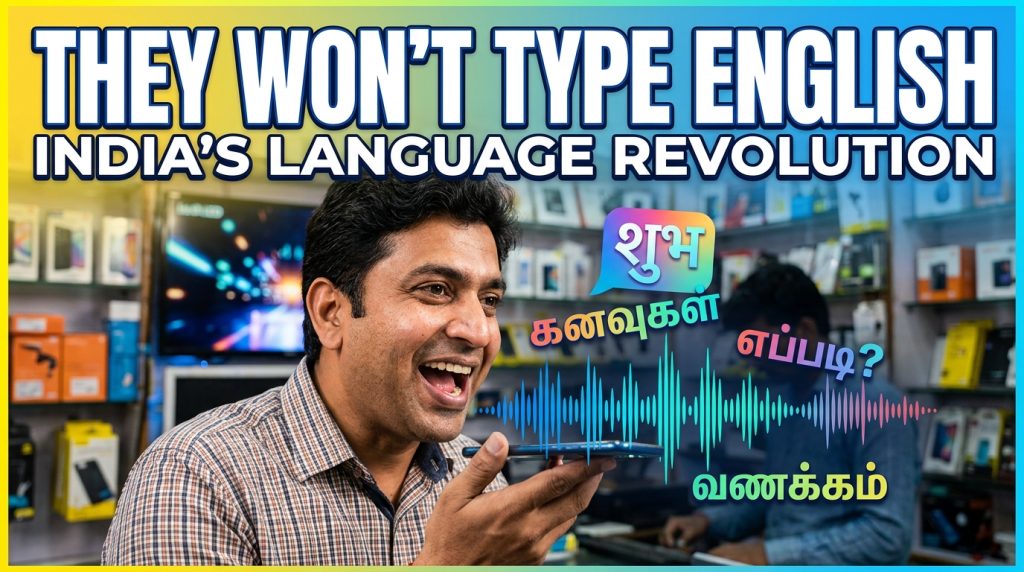
Every business in India says it wants to reach the next hundred million customers. Very few are willing to admit what that actually requires: those customers will not fill in your English web form, they will not type to your English chatbot, and many of them will not type at all. They will call you, or they will send a voice note, and they will do it in Hindi, Tamil, Telugu, Marathi, Bengali, or a fluid mix of their language and English that no dropdown menu ever planned for.
Vernacular voice AI – AI agents that can hold a spoken conversation in a customer’s own language – is how businesses close that gap without hiring a multilingual call center. It is the point where two of the strongest trends in Indian customer engagement collide: the shift to regional languages and the shift from typing to talking. Handled together, they are a growth lever. Handled separately, each one is only half a solution.
This post looks at why voice and vernacular belong in the same strategy, what makes spoken regional-language AI genuinely hard, where businesses are already using it, and how to roll it out without burning customer trust.
The Next 100 Million Customers Are Already Online. They Just Are Not Typing
India’s internet population crossed 900 million users, and the growth is no longer coming from English speakers in metros. Industry studies have pointed the same direction for years: the landmark Google-KPMG study on Indian languages projected that 9 out of every 10 new internet users in India would prefer to use the internet in an Indian language, and reports from IAMAI have consistently found that a majority of Indian internet users access the internet in a regional language, not English.
For customer-facing teams, the second-order effect matters more than the headline number. Language preference is not evenly distributed across your funnel. The customers you already serve well tend to be English-comfortable, urban, and used to typing. The customers you are trying to acquire next – tier 2 and tier 3 cities, first-generation internet users, older buyers with real purchasing power – skew heavily toward regional languages and voice.
These users have money to spend and problems your product solves. What they do not have is patience for an English-only support experience. When the chat widget greets them in English, most will not push through the friction. They simply leave, and your analytics record it as an unexplained drop-off rather than what it really is: a language gap.
A language gap is a revenue gap. It hides inside your abandoned carts, your unanswered ad clicks, and your one-star reviews that say “no support” when what happened was “no support in my language.”
Why Text-Only Multilingual Support Is Half a Solution
The standard response to this problem is a multilingual chatbot: translate the bot flows, add a language picker, ship it. That is genuine progress, and if your widget only speaks English today, fixing that is still step one. We have written before about making a chat widget speak your customer’s language, and everything there still applies.
But text-only multilingual support quietly assumes something that is not true for a large share of Indian users: that reading a language and comfortably typing it are the same skill.
They are not. Many Indians who speak Hindi, Tamil, or Kannada fluently every day rarely type in those scripts. Native-script keyboards are unfamiliar to a lot of users, and transliteration is inconsistent – the same Hindi sentence can be typed in Roman script a dozen different ways. The result is a customer who fully understands your Tamil chatbot but still finds replying to it slow and awkward.
Watch how these same users behave on WhatsApp and the pattern is obvious. Voice notes dominate. Speaking is effortless in a way typing never became. India has also seen years of explosive growth in voice search, with Google repeatedly noting that Indian users adopt voice queries at among the highest rates in the world, precisely because speaking skips the keyboard problem entirely.
So a text-only regional chatbot solves the reading half of the problem and leaves the speaking half on the table. The customer can understand you. They still cannot comfortably talk to you.
Voice Plus Vernacular Is the Actual Unlock
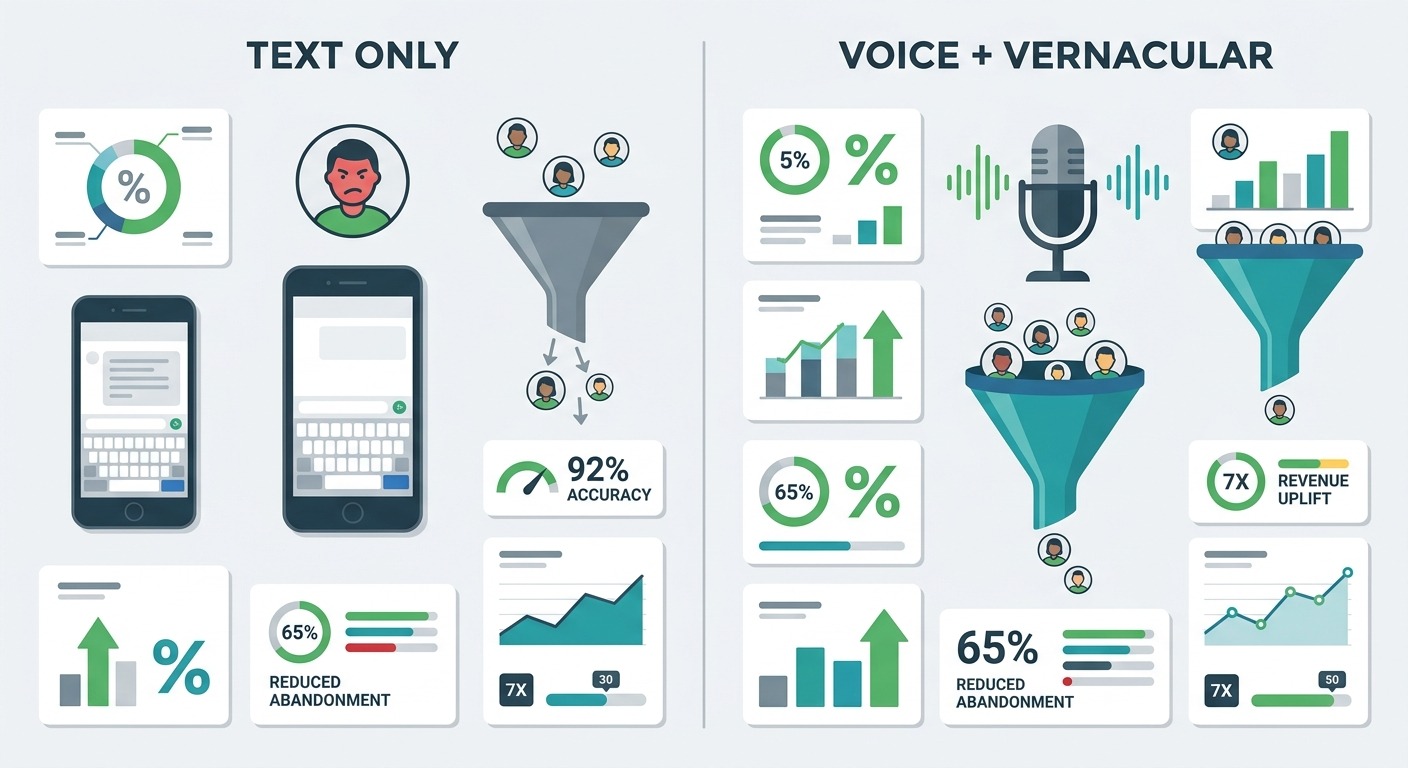
Put the two shifts together and the strategic picture changes. The customers who prefer regional languages are disproportionately the same customers who prefer speaking over typing. Serving them properly means handling spoken conversations in their language, not just translated text.
That is what vernacular voice AI does. A customer calls your business number, or taps a call button on WhatsApp, or speaks to your app instead of typing. An AI agent answers in their language, understands what they said, does something useful – books the appointment, checks the order, qualifies the lead – and hands off to a human when the conversation needs one.
Three things make this a growth lever rather than a nice-to-have:
It expands your addressable market without expanding headcount. An English support team plus a vernacular voice agent serves a dramatically larger slice of India than an English support team plus an English chatbot. You are not improving an experience at the margin, you are becoming reachable to customers who previously had no workable way to contact you.
It converts high-intent moments that text lets die. A buyer who clicks your ad at 9 pm and wants to ask one question in Marathi will not type it into an English form. They will ask it out loud to a voice agent that answers in Marathi. Speed and language together decide whether that intent becomes a sale; we covered the speed half in our piece on AI agents qualifying ad leads 24/7, and vernacular voice completes it.
It compounds trust. Customers consistently rate support in their own language as a reason to buy again. Hearing your business speak their language, literally, signals respect in a way a translated FAQ never will.
What Makes Vernacular Voice AI Hard (and Why an IVR in Hindi Does Not Count)
If this were easy, everyone would have shipped it years ago. Businesses did try: the result was the Hindi IVR menu, and customers hate it for good reasons. Press 1 for orders, press 2 for refunds, in any language, is not a conversation. It is a phone tree wearing a translation.
Real vernacular voice AI has to clear several bars that an IVR never attempts:
Accent and dialect coverage. Tamil spoken in Chennai, Coimbatore, and Jaffna are not identical. Hindi across UP, Bihar, and Mumbai varies in vocabulary and rhythm. A voice agent tuned on one accent and brittle on others will work in demos and fail in production.
Code-switching. Real Indian speech mixes languages mid-sentence. “Mera order kal deliver hona tha, but tracking abhi bhi pending dikha raha hai” is one sentence in two languages, and it is completely ordinary. Hinglish, Tanglish, and their cousins are the default register of Indian customers, not an edge case. If your agent forces customers to pick one pure language and stay in it, it has already failed the most common input.
Names, addresses, and numbers. The hardest entities in Indian voice AI are the practical ones: person names from every linguistic tradition, addresses with landmarks instead of street numbers, order IDs read out in mixed English. Getting these wrong does not just lose accuracy points, it breaks the task the customer called about.
Latency and interruption. Spoken conversation has rhythm. An agent that takes three seconds to respond, or cannot handle being interrupted, feels broken even when its answers are correct. Customers hang up on awkward, not just on wrong.
The good news is that 2026-era speech models have moved all four of these bars dramatically compared to even two years ago. Major Indian languages now have strong speech recognition and natural-sounding synthesis, and modern conversational agents handle code-switching far more gracefully. The technology is no longer the bottleneck for mainstream use cases. Design and rollout discipline are.
Where Vernacular Voice AI Is Being Deployed
The use cases producing results are the ones where the task is clear, the vocabulary is bounded, and the customer’s language preference is strong:
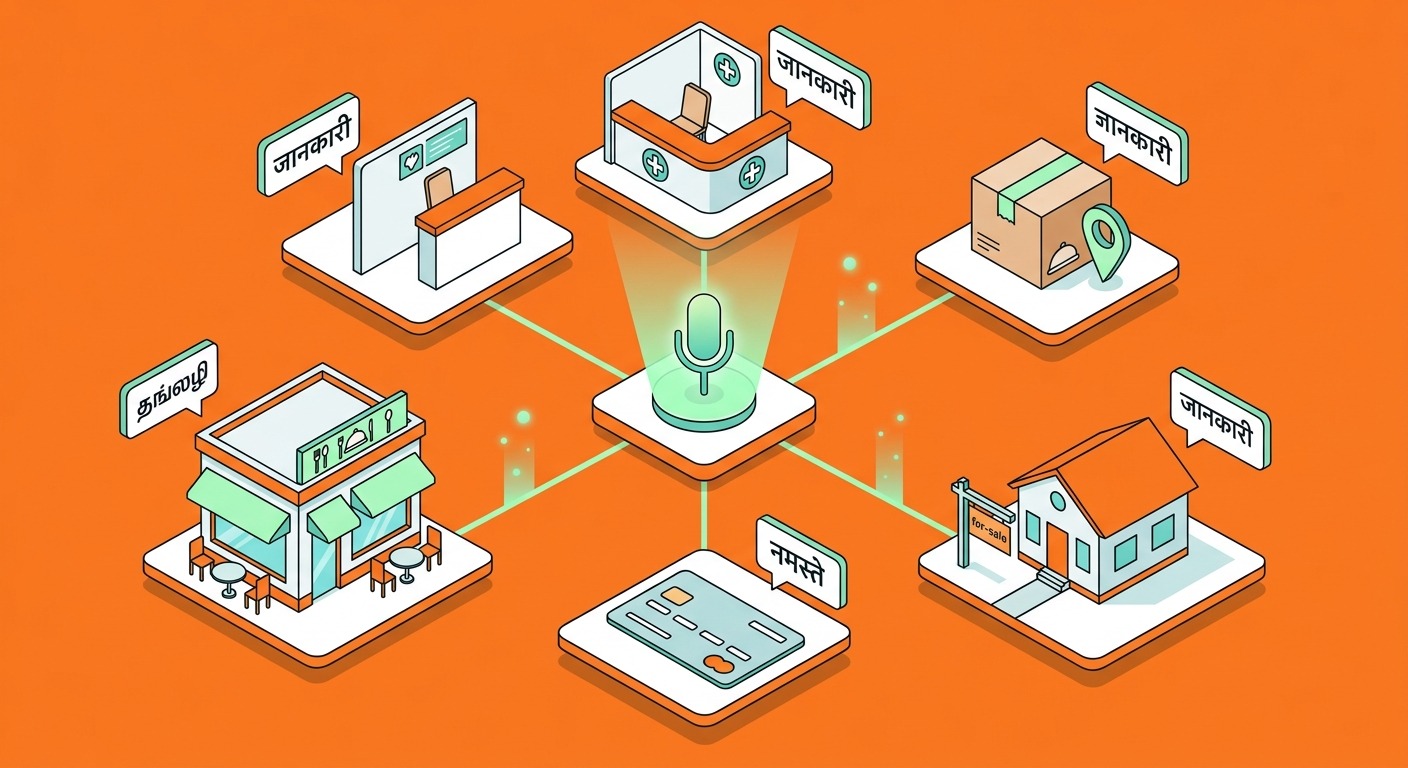
Appointment booking for clinics and hospitals. Patients, especially older ones, call. A voice agent that books, reschedules, and reminds in the patient’s language reduces no-shows and frees front-desk staff. Healthcare is consistently one of the strongest fits because the callers skew vernacular and the task is structured.
Order status and returns for D2C and e-commerce. “Where is my order” is the highest-volume query in commerce, it is fully automatable, and it is exactly what tier 2 and tier 3 customers want to ask in their own language. Deflecting it by voice cuts support load while improving the experience for customers who would never have typed the question.
Lead qualification for real estate, education, and financial services. These industries run on phone follow-up. A vernacular voice agent that calls back within a minute of an inquiry, speaks the prospect’s language, and asks the qualifying questions turns dead leads into pipeline. It also works the other direction, answering inbound calls at hours when your sales team is asleep.
EMI, balance, and account queries in fintech. Routine, sensitive enough that customers want to ask directly, and heavily vernacular. Voice agents handle the routine layer and escalate anything ambiguous to humans.
Local services and hospitality. Restaurants, salons, repair services, hotels. Businesses whose customers simply call, and whose owners lose revenue every time the phone rings unanswered.
For a broader tour of what voice agents do across support and sales, see our guide to voice agents with 10 business examples.
The Economics: Voice Agent vs Multilingual Support Team
The traditional way to offer support in five languages is to hire for five languages, across shifts, with quality supervision in each. For an SMB this is simply out of reach, and even for mid-market teams it means language coverage gets rationed: Hindi and English get staffed, everything else gets “please hold for an English agent.”
A vernacular voice agent changes the cost structure rather than trimming it:
- Coverage is 24/7 by default. The 9 pm Marathi caller and the 6 am Tamil caller get the same experience as the 11 am English one.
- Languages are configuration, not headcount. Adding a sixth language does not mean recruiting in a new city.
- Cost scales with conversations, not shifts. Seasonal spikes, ad-campaign surges, and festival-sale weekends stop being staffing crises.
- Humans move up the stack. Your actual team handles the complex, high-emotion, high-value conversations, with the routine 70 percent already resolved.
The honest comparison is not “AI agent vs great multilingual human team.” It is “AI agent vs the multilingual coverage you can actually afford,” which for most businesses today is none. Against that baseline, the ROI question answers itself.
How to Roll Out Vernacular Voice AI Without Burning Trust
The failure mode in voice AI is overreach: launching a do-everything agent in eight languages and letting customers discover its limits live. Trust burns fast on the phone. A calmer sequence works better:
Start with one task in two languages. Pick your highest-volume structured query – order status, appointment booking – and launch in your strongest regional language plus English. Nail accent coverage and code-switching for that pair before expanding.
Disclose, then deliver. Let the agent say it is an AI assistant, in the customer’s language, and get to useful work within the first ten seconds. Customers forgive an upfront AI that solves their problem. They do not forgive a fake human.
Make escalation instant and obvious. “Baat kariye” or “talk to a person” should work at any point, hand the conversation to a human with full context, and never loop the customer back to the menu. The agent’s job is to resolve what it can and route what it cannot.
Measure containment and callback, not just call volume. The numbers that matter: what share of calls the agent fully resolves, how many customers call back within 24 hours about the same issue, and how CSAT differs by language. A high-containment, high-callback agent is failing quietly.
Let real calls expand the scope. Your transcripts will tell you the next task and the next language. Customers vote with their questions.
Whether voice or text converts better for a given flow is worth testing rather than assuming; we compared the two modes in AI voice agents vs text chatbots. The consistent finding is that voice wins where typing friction is highest, which is exactly the vernacular customer’s situation.
Where ChatMaxima Fits
ChatMaxima approaches vernacular voice as part of one conversation stack rather than a separate phone product. AI voice agents handle spoken conversations and hand off to your team in the same shared inbox where your WhatsApp, Instagram, and web chat conversations already live, so a call that escalates does not lose its history. WhatsApp Business Calling support means the voice conversation can start from the app your Indian customers already use daily, tap to call, no separate number to remember. And the same multilingual foundation that powers the widget and inbox carries through, so language coverage is a setting you configure, not a project you staff.
The practical path most teams take: automate one vernacular voice use case, watch the containment numbers for a month, then expand languages and tasks from evidence rather than optimism.
The Language Gap Is a Revenue Gap
India’s next hundred million customers are not waiting for your English chatbot to improve. They are already calling businesses, sending voice notes, and buying from whoever answers them in their own language. Text-only multilingual support was the 2024 answer. In 2026, vernacular voice AI is the difference between being technically multilingual and being actually reachable.
The technology has crossed the usefulness line. The businesses that win this segment will be the ones that start narrow, measure honestly, and expand as the transcripts justify it – while their competitors keep translating FAQ pages.
If you want to see what a vernacular voice agent would look like for your business, ChatMaxima’s plans start at SMB-friendly pricing and the voice, WhatsApp, and multilingual pieces come as one platform rather than three vendors.