Wholesale is a repeat-order business. The average wholesaler makes most of its revenue not from winning new accounts but from keeping existing accounts ordering, on time, at healthy volumes. Which means the most expensive event in wholesale is silent: a regular customer whose orders quietly shrink, then stop, while nobody on your team notices until the quarter closes.
A generic CRM will not catch that. Generic CRMs were built for one-and-done deal pipelines, not for businesses where the same 200 accounts reorder every two to six weeks, where pricing is negotiated per customer, and where a quote is worthless if the stock is not actually in the warehouse.
That is why choosing a CRM for wholesalers is a different exercise from choosing a CRM for a SaaS sales team. In this guide we compare the 10 best CRMs for wholesale businesses in 2026, from stock-aware platforms built exclusively for distribution, to AI-driven rep guidance tools, to conversational CRMs that live where your buyers actually place orders: WhatsApp and chat.
Our evaluation criteria: repeat-order and reorder management, inventory and ERP awareness, customer-specific pricing support, team-wide visibility into every account conversation, automation, and total cost of ownership.
What Makes a CRM Good for Wholesale?
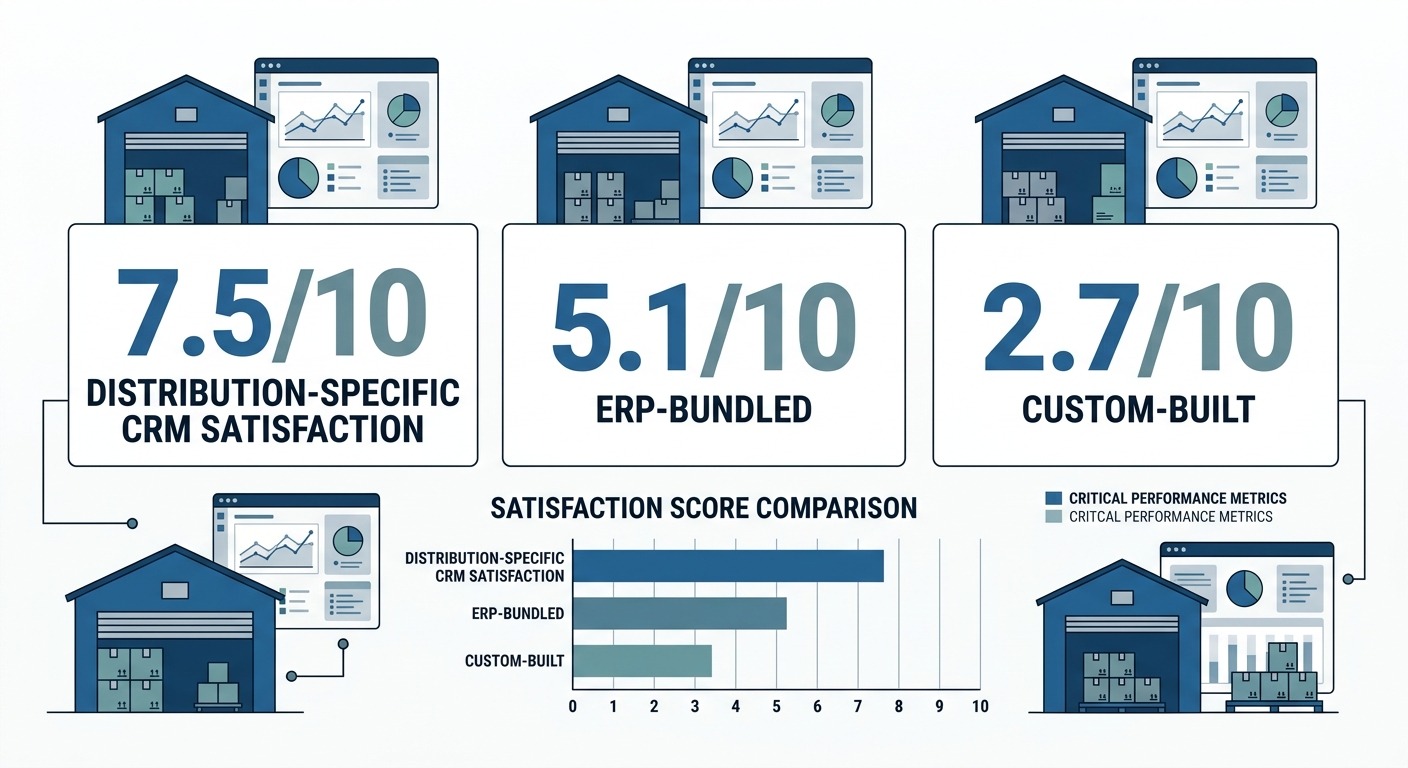
Before the list, it is worth being precise about what wholesale actually demands from a CRM, because the gap between “marketed to distributors” and “built for distributors” is wide. Industry data backs this up: distribution-specific CRMs score 7.5 out of 10 on user satisfaction versus 5.1 for ERP-bundled CRMs and 2.7 for custom-built tools, according to Proton’s 2026 distribution CRM research.
Reorder visibility. The single most valuable report in wholesale is “which accounts are overdue to reorder.” Your CRM should surface declining or lapsed buying patterns automatically, not wait for a rep to notice.
Stock and ERP awareness. Reps quoting products they cannot see inventory for is how you sell stock you do not have. The best wholesale CRMs sync with your inventory system or ERP so availability, product data, and customer-specific pricing appear inside the sales workflow.
Customer-specific pricing and quoting. Wholesale pricing is tiered, negotiated, and volume-based. A CRM that only stores one price per product will fight you daily.
Conversation capture across channels. B2B buyers now behave like consumers. They message on WhatsApp, email, and chat, and they expect fast answers. If those conversations live on individual reps’ phones, the business owns nothing when a rep leaves. This is the blind spot most traditional wholesale CRMs still have in 2026, and it is where conversational platforms have changed the game.
Fast rep adoption. Field and phone reps do not tolerate heavy data entry. If updating the CRM takes longer than the call did, your data quality dies within a month.
The 10 Best CRMs for Wholesalers in 2026
1. ChatMaxima – Best Conversational CRM for Wholesalers (Most Affordable)
Overview
ChatMaxima approaches wholesale CRM from the direction most platforms ignore: the conversation. In most wholesale businesses today, the real order flow happens in messages. A retailer WhatsApps a photo of an empty shelf, a purchasing manager texts “same as last time plus two cases,” a new stockist fills a form on your website. ChatMaxima captures all of that into a shared team inbox with a built-in CRM, so every account’s conversation history, contact record, tags, and order context live in one place the whole team can see.
On top of the inbox sits a no-code AI chatbot builder. Wholesalers use it to automate the repetitive half of the job: answering price-list and availability questions instantly, qualifying new stockist enquiries, collecting reorders through structured WhatsApp flows, and sending broadcast campaigns for new stock arrivals, seasonal pre-orders, and reorder reminders to segmented account lists. Because ChatMaxima is an official WhatsApp Business API partner and also covers Instagram, Facebook Messenger, Telegram, SMS, and website live chat, the entire buyer communication stack consolidates into one dashboard.
Key Features
- Shared team inbox with assignment, internal notes, and full account conversation history
- Native CRM with contacts, tags, custom fields, and pipeline tracking
- No-code AI chatbot builder for order-taking, FAQs, and lead qualification
- WhatsApp broadcast campaigns with segmentation and analytics, ideal for reorder reminders
- Multi-channel: WhatsApp, Instagram, Messenger, Telegram, SMS, live chat
- Integrations with popular business and ecommerce tools
Pricing
- Starter – $19/mo
- Pro – $99/mo
- Max – $299/mo
- Ultra – $499/mo
All plans include unlimited chatbots. View full pricing details.
Pros
- 3 to 10 times cheaper than most platforms on this list
- Captures the WhatsApp order flow that traditional CRMs miss entirely
- AI automation handles availability and pricing questions around the clock
- Fast setup, no implementation project required
- No markup on Meta’s per-conversation charges
Cons
- Not a stock-aware CRM, inventory sync requires connecting your existing system
- Lighter on deep ERP integration than distribution-specialist platforms
Best For: Wholesalers whose buyers order and communicate over WhatsApp and chat, and any wholesale business that wants CRM plus automation without enterprise pricing.
2. Prospect CRM – Best Stock-Aware CRM for Wholesale
Overview
Prospect CRM markets itself as the “stock-aware CRM,” and the label is accurate. It was built specifically for B2B wholesalers, distributors, and manufacturers, and its defining feature is live inventory data inside the sales workflow. Reps see stock levels, product specs, and customer-specific pricing while quoting, which eliminates the classic wholesale failure of quoting stock that is not there. It integrates with inventory and accounting systems like Unleashed, Cin7, Xero, and Sage, and its Missed Order and RFM (recency, frequency, monetary) alerts are purpose-built for spotting lapsing repeat buyers.
Pricing
Plans start around $210-243 per month for 4 users on annual contracts, rising through Professional (around $421/mo for 4 users) to Advanced tiers for larger teams. A 14-day free trial is available.
Pros
- Genuinely built for wholesale, not adapted to it
- Quote-to-order workflow with real-time stock and pricing
- Excellent repeat-business analytics (RFM, missed orders)
Cons
- Annual contracts with a 90-day cancellation notice
- Per-user cost climbs quickly for bigger teams
- No native conversational or WhatsApp channel
Best For: Product-led wholesalers on inventory platforms like Unleashed or Cin7 who want stock data inside every quote.
3. Proton.ai – Best AI-Driven CRM for Mid-Market Distributors
Overview
Proton is built exclusively for wholesale distribution and leans hard into AI. It ingests order history and buying patterns from your ERP (it connects to Epicor, Infor, SAP, Prophet 21, NetSuite, and others) and tells reps who to contact, what to recommend, and when to follow up. For distributors with tens of thousands of SKUs and long reorder cycles, that guidance converts directly into recovered revenue from accounts that would otherwise quietly churn.
Pricing
Custom, quote-based. Positioned for mid-market and enterprise distributors, expect a meaningful annual commitment.
Pros
- AI recommendations grounded in your actual order data
- Deep ERP integrations out of the box
- Strong ROI reporting for sales leadership
Cons
- Priced beyond small wholesalers
- Requires clean ERP data to shine
- Implementation is a project, not an afternoon
Best For: Established distributors with an ERP and a multi-rep sales team who want AI to direct daily sales activity.
4. Zoho CRM – Best Value General-Purpose CRM
Overview
Zoho CRM is not wholesale-specific, but it is the strongest value play among the big general CRMs, and its customization goes deep enough to model wholesale realities: custom modules for price lists, workflow rules for reorder follow-ups, and integrations with Zoho Inventory and Zoho Books to bring stock and invoicing into view. For a small wholesaler that wants a traditional CRM without enterprise cost, Zoho is the sensible default.
Pricing
Free for up to 3 users. Paid tiers run Standard $14, Professional $23, Enterprise $40, and Ultimate $52 per user per month billed annually.
Pros
- Excellent price-to-capability ratio at every tier
- Zoho Inventory pairing covers stock awareness cheaply
- Mature automation and reporting
Cons
- Wholesale workflows require configuration effort
- UI feels dense to new users
- Support quality varies by plan
Best For: Budget-conscious wholesalers who want a conventional CRM and are willing to configure it, especially if already inside the Zoho ecosystem.
5. NetSuite CRM – Best ERP-Native Option
Overview
For wholesalers already running NetSuite ERP, NetSuite CRM is the path of least resistance: customers, orders, inventory, invoicing, and CRM live in a single data model, so there is no sync layer to break. Quote-to-cash is genuinely seamless, and customer-specific pricing flows from the ERP automatically. As a standalone CRM for a non-NetSuite business, it is hard to justify; as an add-on for a NetSuite house, it is often the right call.
Pricing
Custom, module-based pricing on top of a NetSuite license. Realistically an enterprise-level investment.
Pros
- One system of record for finance, inventory, and sales
- Customer-specific pricing natively enforced
- Scales to complex multi-entity operations
Cons
- Expensive, with implementation partners usually required
- CRM UX trails dedicated CRM products
- Overkill for small wholesalers
Best For: Mid-size and large wholesalers already committed to NetSuite ERP.
6. HubSpot CRM – Best for Marketing-Heavy Wholesalers
Overview
HubSpot’s free CRM tier remains the easiest zero-cost starting point in the industry, and its marketing tooling is the best in this list. Wholesalers that actively generate inbound demand, content, trade-show follow-up, email nurture for stockist recruitment, get a lot from HubSpot’s combined CRM and Marketing Hub. Inventory awareness is absent natively, so wholesale-specific workflows depend on integrations from the app marketplace.
Pricing
Free CRM core. Sales Hub Starter begins around $15-20 per seat per month; Professional tiers run roughly $90-100 per seat per month, and costs stack quickly once Marketing Hub is added.
Pros
- Genuinely useful free tier
- Best-in-class marketing automation and email tools
- Huge integration marketplace
Cons
- Costs escalate sharply as contact counts and hubs grow
- No native stock or ERP awareness
- Wholesale quoting needs third-party add-ons
Best For: Wholesalers recruiting new stockists at volume, where marketing capability matters as much as account management.
7. Pipedrive – Best Simple Visual Pipeline
Overview
Pipedrive is the CRM reps actually use, because it demands so little of them. Its visual pipeline, activity reminders, and clean mobile app make it ideal for small wholesale teams that mainly need disciplined follow-up on new accounts and a tidy view of open deals. It has no inventory concept and thin B2B pricing features, so it fits wholesalers whose complexity lives elsewhere (in their ERP or accounting tool) and who just need the sales motion organized.
Pricing
Lite $14, Growth $39, Premium $59, Ultimate $79 per seat per month billed annually. 14-day free trial.
Pros
- Fastest rep adoption of any CRM here
- Clean automations for follow-up cadences
- Fair pricing at the low end
Cons
- No stock awareness or wholesale pricing logic
- Reporting is basic compared to Zoho or Salesforce
- Repeat-order management requires workarounds
Best For: Small wholesale teams (2-10 reps) focused on new-account acquisition who want a CRM nobody has to be forced to use.
8. Salesforce – Best for Enterprise Customization
Overview
Salesforce can be shaped into an excellent wholesale CRM, with Experience Cloud B2B portals, CPQ for complex quoting, and Manufacturing Cloud constructs for run-rate business. The operative word is “shaped”: everything is possible, little is prebuilt for you, and the budget must cover licenses plus admins or partners. For large distributors with dedicated RevOps resources, it remains the most powerful platform available.
Pricing
Starter Suite $25 per user per month (capped at 10 users), Professional $75, Enterprise $150, Unlimited $300 per user per month. CPQ and portals cost extra.
Pros
- Unmatched customization and ecosystem
- CPQ handles genuinely complex wholesale quoting
- Scales past anything else on this list
Cons
- Highest total cost of ownership here
- Needs admin resources permanently
- Slow time-to-value for small teams
Best For: Large wholesale and distribution enterprises with the team to exploit it.
9. Monday CRM – Best for Ops-Flexible Teams
Overview
Monday CRM sits on the monday.com work platform, which makes it unusually good at the messy operational edges of wholesale: sample tracking, trade-show planning, onboarding checklists for new stockists, and custom boards for anything the business invents next. As a pure CRM it is lighter than Zoho or Salesforce, but as a flexible operating layer for a small wholesale team that wants CRM plus project tracking in one tool, it earns its spot.
Pricing
CRM plans run roughly $12 to $28 per seat per month billed annually, with a 3-seat minimum and an Enterprise tier by quote.
Pros
- Extremely flexible boards adapt to wholesale ops beyond sales
- Pleasant, modern UI teams enjoy using
- Solid automation recipes without code
Cons
- Not stock-aware; inventory needs integrations
- Deep sales reporting is limited
- Per-seat costs add up with the whole ops team on it
Best For: Small wholesalers who want one flexible tool for sales pipeline plus operational workflows.
10. Method:CRM – Best for QuickBooks-Centric Wholesalers
Overview
Method:CRM’s reason to exist is its two-way, real-time sync with QuickBooks (and Xero). For the large population of small wholesalers whose single source of truth is QuickBooks, Method puts customers, estimates, invoices, and payment history into a CRM without double entry. Reps can generate estimates that flow straight into QuickBooks, and customer purchase history is visible while they sell.
Pricing
Roughly $25 to $74 per user per month depending on tier, with a free trial.
Pros
- The deepest QuickBooks sync in the CRM market
- Estimates and invoices without re-keying data
- Customizable without code
Cons
- Value collapses if you are not on QuickBooks or Xero
- Interface feels dated next to modern CRMs
- Limited marketing and conversational features
Best For: Small wholesalers running their business out of QuickBooks who want CRM visibility without changing accounting systems.
Quick Comparison: 10 Best CRMs for Wholesalers in 2026
| CRM | Best For | Starting Price | Stock-Aware | Conversational Channels |
|---|---|---|---|---|
| ChatMaxima | WhatsApp-driven wholesale, affordability | $19/mo | Via integrations | WhatsApp, IG, FB, Telegram, SMS, chat |
| Prospect CRM | Stock-aware quoting | ~$210/mo (4 users) | Native | No |
| Proton.ai | AI rep guidance for distributors | Custom | Via ERP | No |
| Zoho CRM | Best-value general CRM | $14/user/mo | Via Zoho Inventory | Add-ons |
| NetSuite CRM | ERP-native operations | Custom | Native (ERP) | No |
| HubSpot | Marketing-heavy wholesalers | Free / ~$15 seat | No | Limited |
| Pipedrive | Simple visual pipeline | $14/seat/mo | No | Add-ons |
| Salesforce | Enterprise customization | $25/user/mo | Via add-ons | Via add-ons |
| Monday CRM | Flexible sales + ops boards | ~$12/seat/mo | No | Limited |
| Method:CRM | QuickBooks-centric wholesale | ~$25/user/mo | Via QuickBooks | No |
How to Choose: Match the CRM to Your Order Flow
The fastest way to shortlist is to ask where your orders actually come from and where your complexity actually lives.
Orders arrive by message. If your buyers WhatsApp their reorders, send shelf photos, or expect chat-speed answers on pricing and availability, a conversational platform is not optional, it is your order channel. Start with ChatMaxima, and if you also need deep stock logic, pair it with your inventory system. Our guide to running a WhatsApp AI agent across the sales pipeline shows what that looks like in practice, and the same automation patterns from WhatsApp automation for ecommerce apply directly to wholesale reordering.
Complexity lives in inventory and quoting. Thousands of SKUs, per-customer price lists, stock that must be accurate at quote time: go stock-aware. Prospect CRM for small and mid-size teams, NetSuite if you are already on the ERP, Proton if you want AI on top of ERP data.
Complexity lives in the sales team. Many reps, long acquisition cycles, management wanting forecasts: Zoho, Pipedrive, or Salesforce depending on budget and scale.
Complexity lives in the books. If QuickBooks is your operational brain, Method:CRM extends it with the least disruption.
Many wholesalers in 2026 land on a two-tool stack: a system of record for inventory and finance, plus a conversational CRM for the front line where buyers actually talk. That combination costs less than one enterprise suite and covers both halves of the job properly. If you are comparing conversational options specifically, our breakdown of the 10 best WhatsApp CRM systems in 2026 goes deeper on that category.
Conclusion: The Best Wholesale CRM Is the One Your Buyers Already Use
Wholesale CRM selection in 2026 comes down to a simple truth: the platform only creates value if it sits in the path of real orders. Stock-aware CRMs like Prospect and ERP-native suites like NetSuite win when quoting complexity is the bottleneck. General CRMs like Zoho and Pipedrive win when the sales motion needs discipline at a fair price.
But for a growing share of wholesalers, the path of real orders is a WhatsApp thread. Buyers reorder in messages, ask for price lists in messages, and judge you on how fast those messages get answered. ChatMaxima puts a full CRM, shared team inbox, and AI automation directly on that channel for $19 a month, which is why it leads this list. Start free, connect your WhatsApp number, and see your actual order flow inside a CRM this week: chatmaxima.com/pricing/.