
Click to WhatsApp Ads have quietly become the highest-converting paid channel in Meta’s lineup. While most advertisers still push traffic to landing pages and pray for a form fill, the smartest teams now route that same ad spend straight into a WhatsApp conversation. The result is a funnel with two steps instead of five, and a cost per lead that drops sharply once the friction disappears.
This is the part most guides skip: a Click to WhatsApp Ad only wins if everything after the click is wired correctly. The ad gets the conversation started. What closes the deal is a fast first reply, AI that qualifies the lead in real time, and a 72-hour window where your follow-up messages cost you nothing. Get those three things right and CTWA outperforms almost any other acquisition channel you are running in 2026.
This playbook walks the entire journey, from the Meta click to the closed deal. We will cover campaign setup, the first-message window, AI qualification, the free messaging window, and the attribution mistakes that quietly drain your return on ad spend.
Why CTWA Is the Fastest-Growing Channel in 2026
A Click to WhatsApp Ad (CTWA) is a standard Facebook or Instagram ad with one difference: instead of sending the click to a website, it opens a WhatsApp chat with your business. The customer taps “Send Message” and lands directly in a conversation, with no form, no redirect, and no cookie consent banner in the way.
That structural difference is why CTWA is growing so fast. A typical web conversion campaign has roughly five steps between the click and the lead: load the landing page, read it, find the form, fill it in, submit, and wait for a callback. A CTWA campaign has two: click, then send the first message. Every step you remove is a step where people drop off.
The numbers reflect this. Well-implemented CTWA campaigns consistently report lower cost per lead and higher conversion than equivalent landing-page campaigns, with cost per acquisition running materially lower in markets where WhatsApp is the default messaging app. CTWA is now the fastest-growing format within Meta Ads across India, Latin America, Southeast Asia, Southern Europe, and the MENA region.
The catch is volume. A successful CTWA campaign generates conversations faster than a human team can answer them, and an unanswered WhatsApp message is a lost lead. This is exactly why AI handling has moved from a nice-to-have to the backbone of the playbook.
The CTWA Funnel: Two Steps for the Customer, Five Stages for You
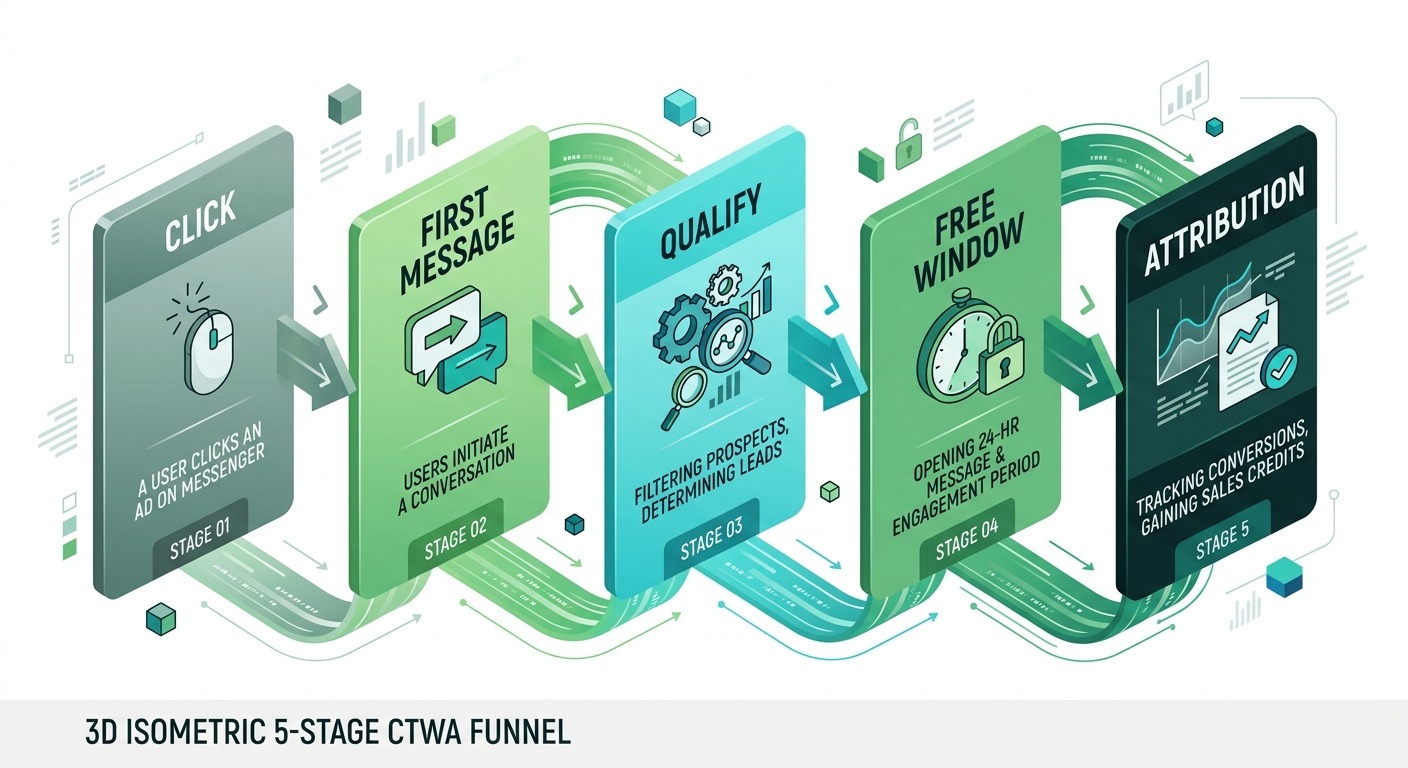
The customer sees a simple path. Behind the scenes, your job is to engineer five stages so that simplicity actually converts:
- The click – the campaign, targeting, and creative that earn the tap
- The first message – the welcome that replies in seconds, not hours
- Qualification – the AI conversation that separates buyers from browsers
- The free window – the 72 hours where follow-up costs nothing
- Attribution – the tracking that proves which ad produced the sale
Skip any one of these and the whole funnel leaks. Let us build each stage properly.
Stage 1: The Click (Campaign Setup That Actually Converts)
Everything downstream depends on attracting the right click. Three settings decide whether your CTWA campaign brings buyers or tire-kickers.
Choose the Leads objective, not Engagement or Traffic. In 2026, the Leads objective with a messaging destination consistently beats Engagement for lead quality. Avoid the “Traffic to Messages” setup. It optimizes for clicks rather than conversations, which means Meta will happily spend your budget on people who tap the ad and never send a single message.
Go broad with your targeting. Meta’s delivery algorithm in 2026 is genuinely good at finding buyers inside a large pool. A broad audience of two to ten million, paired with a strong creative, lets the system learn quickly. Once you have a base of converted leads, build a 1 to 3 percent Lookalike Audience from your best customers. That remains the strongest scaling lever for CTWA.
Optimize for a qualified lead event, not just a started conversation. “Conversations started” is a vanity metric if half of them go nowhere. Where your sales cycle allows, optimize for a downstream event such as LeadQualified or Contacted. This tells Meta to find people who actually talk, not people who just tap.
Your creative should set the right expectation. Tell people they will be messaging you on WhatsApp and give them a reason to start the conversation: a quote, an availability check, a discount code, a quick question answered. The more specific the promise, the higher the quality of the conversation that follows.
Stage 2: The First Message (Your 30-Second Window)
Here is where most CTWA budgets are quietly wasted. A person clicked your ad because they were interested at that exact moment. If your first reply arrives an hour later, that moment is gone.
The standard to hold is a welcome reply within 30 seconds, automatically. A human team cannot promise this at 11pm or during a spike, which is why the welcome message must be automated. A good welcome does three things: it confirms the customer reached the right business, it acknowledges what they clicked on, and it asks the first qualifying question to keep momentum going.
This matters even more because of how the WhatsApp pricing window works. When a customer messages you through a CTWA ad, a free entry point window opens. Replying instantly is not only better for conversion, it also starts the clock on a 72-hour period where your messages cost nothing. We will come back to that in Stage 4.
The teams that win CTWA treat the welcome message as the most important asset in the funnel. It is the one message every single lead receives, so it deserves more attention than the ad creative itself.
Stage 3: Qualification (Where AI Earns Its Keep)
A welcome message that replies fast is table stakes. The real leverage is what happens in the next three minutes.
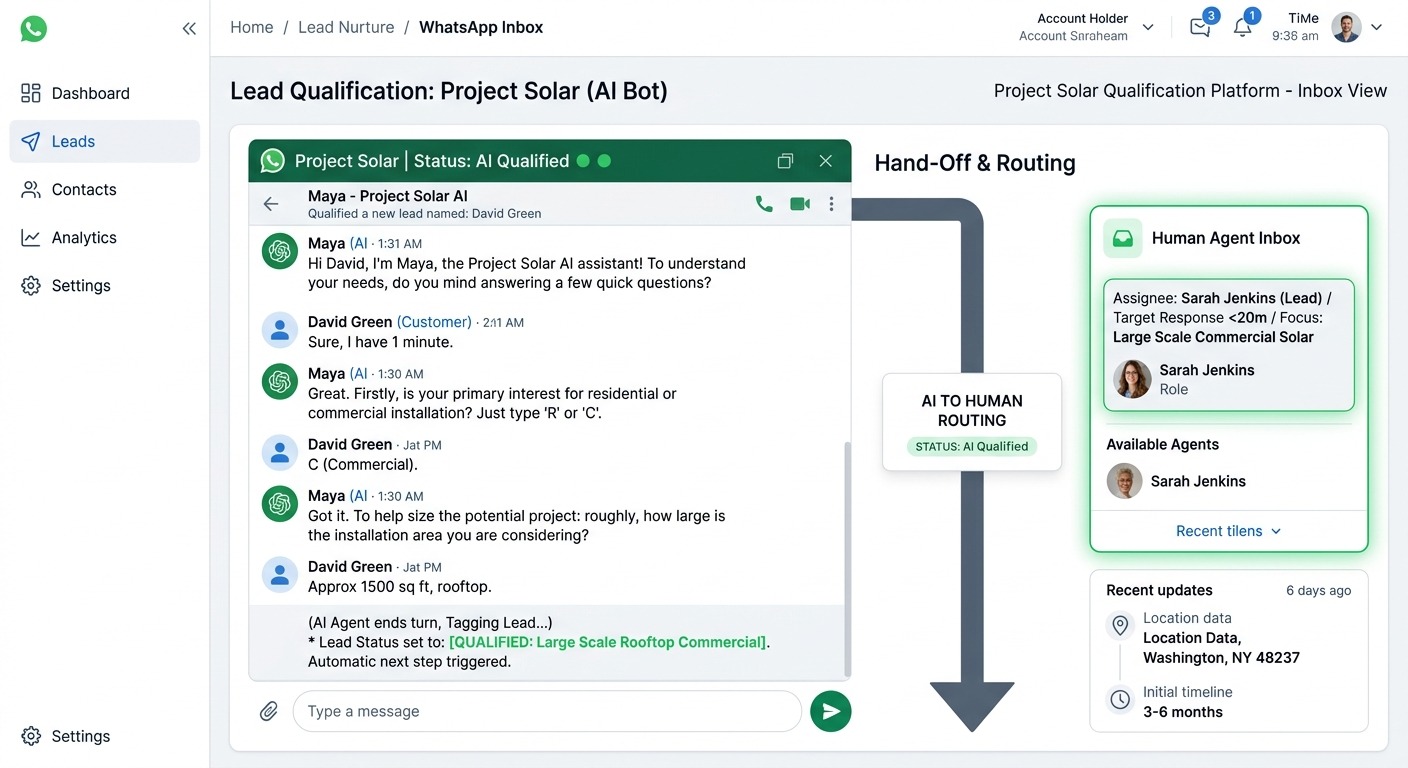
This is the difference between a chatbot that simply replies and an AI agent that understands why each person came. A generic bot sends the same script to everyone. An AI agent reads the incoming message, adapts its tone and questions to the originating ad, asks one to three qualifying questions, and routes the conversation based on the answers.
For lead-heavy businesses such as real estate, financial services, healthcare, and B2B SaaS, the WhatsApp conversation itself is the qualifier. The AI can confirm budget, timeline, location, or intent, then hand a warm, qualified lead to a human rep with the full context already captured. The rep spends their time closing, not asking “how can I help you?” for the hundredth time.
The volume math is what makes this non-negotiable. Without AI, manual response capacity effectively caps your daily ad spend, because every extra dollar buys conversations no one can answer. With AI handling the majority of conversations autonomously, you can scale spend several times higher while keeping reply times low and quality consistent. The AI absorbs the volume; humans handle the deals worth their time.
We covered the full lead-to-close journey in depth in our guide on how WhatsApp AI agents manage your entire sales pipeline, which pairs naturally with this playbook.
Stage 4: The 72-Hour Free Window (Close Without Extra Cost)
This is the most underused advantage in the entire CTWA playbook.
When a customer starts a chat with you through a Click to WhatsApp Ad on the WhatsApp mobile app, Meta opens a Free Entry Point window of 72 hours. Inside that window, the marketing, utility, and authentication template messages you send to that customer are free. No per-message charge.
Think about what that means for your funnel. You have three full days to nurture, quote, follow up, send a catalog, answer objections, and close, all without paying for a single template message to that engaged lead. For a business running CTWA at scale, this can dramatically cut messaging costs while the conversation is at its hottest.
The mistake most teams make is letting the window expire unused. They reply once, the lead goes quiet, and three days later the free window closes with no follow-up sent. Build your sequence to do real work inside those 72 hours: a value-add message on day one, a gentle nudge or offer on day two, and a final call to action before the window closes.
If you want to understand how this window fits into the broader cost structure, our complete guide to WhatsApp Business API pricing in 2026 breaks down per-message costs and the entry point window in detail. Pairing CTWA with Meta’s newer bidding controls, covered in our WhatsApp Max-Price bidding guide, can lower your costs even further.
Stage 5: Attribution (Stop Losing Credit for Your Sales)
You can run a flawless CTWA funnel and still fail at the one thing that decides budget: proving it worked.
The common failure is stark. Roughly nine out of ten advertisers lose CTWA attribution. Their Meta dashboard shows “conversations started,” but they cannot connect those conversations to actual sales. So when it is time to scale spend, they hesitate, because the data does not show revenue.
Two technical pieces fix this:
Capture the ctwa_clid. When a customer arrives from a CTWA ad, Meta injects a click identifier called ctwa_clid into the webhook payload. This is the thread that ties a specific conversation back to a specific ad, ad set, and campaign. If you do not capture and store it, you have permanently lost the link between spend and outcome.
Fire the right Conversions API events. Sending qualified-lead and purchase events back to Meta through the Conversions API closes the loop. Meta learns which conversations turned into revenue and optimizes delivery toward more of the same. This is also what lets you optimize for that LeadQualified event from Stage 1 instead of guessing.
Done together, capturing ctwa_clid and firing Conversions API events turn your CTWA program from “we started some chats” into “this campaign produced this revenue at this cost.” That is the report that unlocks bigger budgets. Meta documents the click identifier and the entry point window in its WhatsApp Business Platform documentation, which is worth reviewing before you build your tracking.
Building the Full Playbook in ChatMaxima
Here is how the five stages come together on a single platform, step by step.
Step 1: Connect your WhatsApp Business API number. Your CTWA ads need a verified WhatsApp Business number as the destination. Connecting through the official API gives you automation, AI, and the free entry point window, none of which the basic WhatsApp Business app supports at scale.
Step 2: Build the welcome flow. Create the automated welcome message that fires the instant a CTWA lead messages you. Keep it short, confirm the context, and ask the first qualifying question. This is your 30-second reply from Stage 2.
Step 3: Add the AI qualification agent. Configure an AI agent with your product knowledge, your qualifying questions, and your routing rules. Let it handle the conversation, tag the lead, and escalate qualified prospects to a human with full context. This is Stage 3 working for you around the clock.
Step 4: Design the 72-hour nurture sequence. Map out the template messages that go out across the free window, so no engaged lead sits untouched while the clock runs. This captures the free messaging value from Stage 4.
Step 5: Wire up attribution. Capture the ctwa_clid from the incoming conversation and send qualified-lead and purchase events back through the Conversions API. Now every closed deal traces back to the exact ad that produced it.
Because ChatMaxima connects your Meta ads, WhatsApp, AI agents, and team inbox in one place, the handoffs between stages happen automatically rather than through brittle integrations. You can see the available connections on the integrations page.
Common Mistakes That Quietly Kill CTWA ROI
A few patterns show up again and again when CTWA underperforms. Avoid these and you are ahead of most advertisers.
Optimizing for clicks instead of conversations. If you choose Traffic over Leads, Meta finds people who tap and leave. Always optimize toward a messaging or qualified-lead event.
Slow or human-only first replies. A welcome message that depends on a person being awake will lose leads every night and every weekend. Automate the first reply, always.
Treating the AI like a phone tree. A rigid, menu-driven bot frustrates buyers. A conversational AI agent that adapts to the lead is what actually qualifies and converts. The gap between the two is the gap between wasted and profitable spend.
Ignoring the free window. Letting the 72-hour entry point window expire without a follow-up sequence is leaving free, high-intent contact on the table.
Flying blind on attribution. Without ctwa_clid capture and Conversions API events, you cannot prove revenue, so you never confidently scale the campaigns that work.
Notice that none of these are about the ad itself. The ad is the easy part. The playbook is everything that happens after the click, which is precisely where most teams stop paying attention.
What’s Next
Click to WhatsApp Ads reward the businesses that treat the conversation, not the click, as the real product. The ad opens the door. A fast welcome, an AI agent that qualifies in real time, a fully used 72-hour free window, and airtight attribution are what carry a lead from a Meta click to a closed deal.
The teams winning with CTWA in 2026 are not the ones with the cleverest creative. They are the ones who wired the back end so that every conversation gets answered, qualified, nurtured, and tracked, automatically and at scale. That is the difference between a channel that looks busy and a channel that prints revenue.
If you are ready to build this funnel end to end, see what it costs to run CTWA on autopilot on the ChatMaxima pricing page, and start turning your next Meta click into a closed deal.