
Most WhatsApp statistics posts copy each other. The same “98% open rate” and the same inflated user counts get passed from one listicle to the next until nobody remembers where they came from. Some of those numbers are years out of date. A few were never sourced at all.
This roundup is different. Every one of the 52 WhatsApp business statistics below is attributed to a named source with a year, Meta earnings calls, official announcements, DataReportal, Statista, Sensor Tower, Kantar, Juniper, and named vendor studies. Where a popular figure could not be traced to a credible source, we left it out and, at the end, listed the WhatsApp stats you should stop citing.
The short version: WhatsApp crossed 3 billion monthly active users, 73.3% of consumers now say they prefer messaging a business, and click-to-WhatsApp ads grew 60% year over year for Meta. Here is the full, sourced picture for 2026.
WhatsApp global scale in 2026
The reach numbers explain why every other statistic in this post matters.
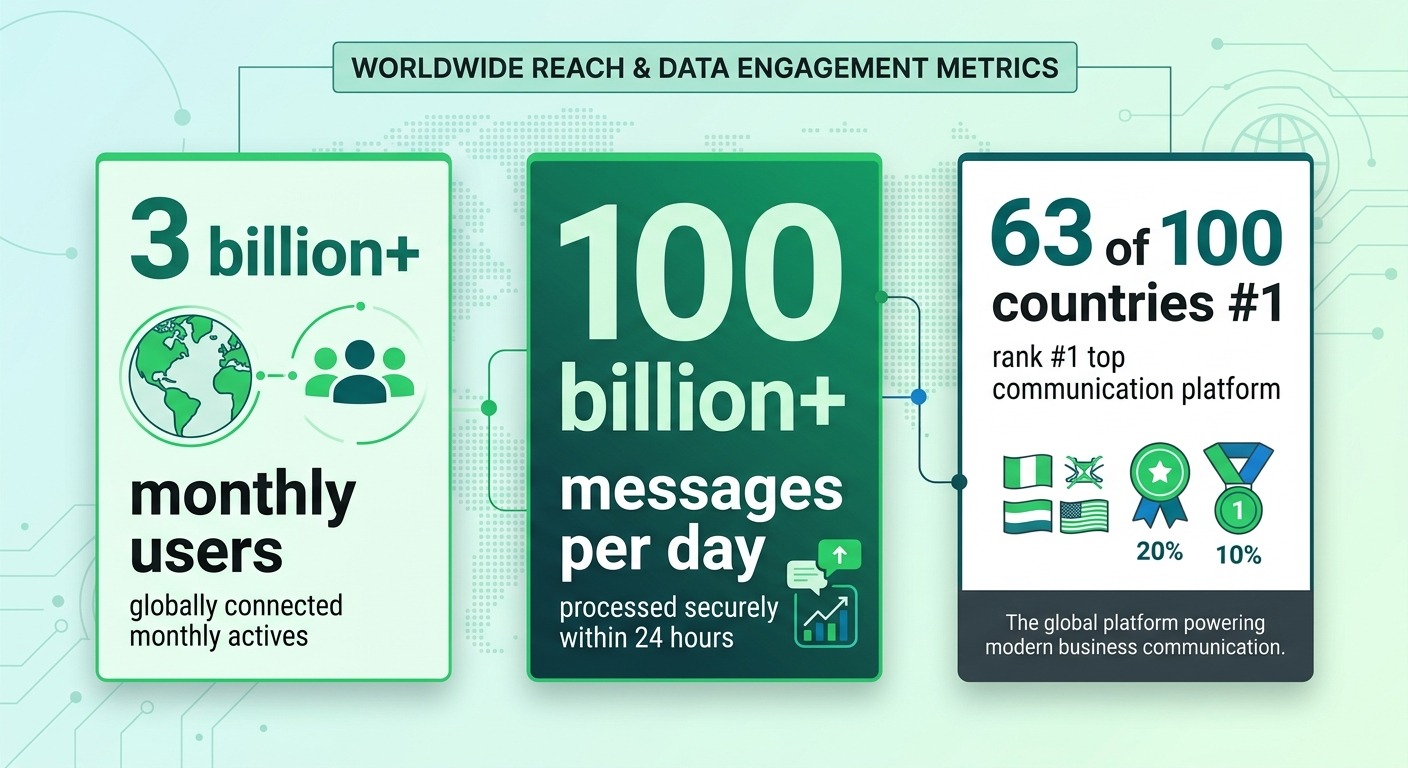
1. WhatsApp passed 3 billion monthly active users in 2025. Mark Zuckerberg announced the milestone on Meta’s Q1 2025 earnings call. Monthly active users is a floor, so 3 billion is the conservative read for 2026. (Source: Meta Q1 2025, via TechCrunch)
2. WhatsApp is used in more than 180 countries. It is the default messaging layer across most of the world. (Source: Meta)
3. More than 100 billion messages are sent on WhatsApp every day. The figure traces to Meta directly and, because the base number dates to 2020, “100 billion+” is deliberately conservative. (Source: Meta, via TechCrunch, 2020)
4. Around 7 billion voice messages are sent on WhatsApp every day. Voice notes have become a core behavior, not a novelty. (Source: WhatsApp, via Backlinko, 2024)
5. WhatsApp saw roughly 6.3 billion app downloads in 2024, taking cumulative downloads past 7.4 billion. (Source: Business of Apps / Udonis, via Demandsage, 2024)
6. WhatsApp is the largest over-the-top messaging app in the world, and dominates business messaging even more than consumer messaging. (Source: Juniper Research, 2025)
7. WhatsApp is the most popular messaging app in 63 of 100 countries studied, dominant across Europe, Latin America, Africa, and much of Asia. (Source: Infobip research, 2024)
8. WhatsApp users spend around 59 minutes per day in the app on average (Android). Time-spent estimates vary by measurement method, so attribute carefully. (Source: DataReportal, via Backlinko, 2025)
9. WhatsApp holds a 4.6 out of 5 rating on the Apple App Store and 4.2 out of 5 on Google Play. (Source: app stores, via Backlinko, 2025)
10. WhatsApp generated approximately $1.785 billion in revenue in 2024, up from $1.279 billion in 2023. (Source: Business of Apps, via Demandsage, 2024)
Who uses WhatsApp: demographics
WhatsApp skews broad, not niche, which is what makes it a business channel rather than a generational one.
11. WhatsApp’s global gender split is roughly 51.3% male and 48.6% female. (Source: DataReportal, via Backlinko, Q2 2025)
12. By generation, WhatsApp users are 36.4% Millennials, 23.6% Gen Z, 22.7% Gen X, and 12.8% Baby Boomers. No single age group dominates. (Source: eMarketer, via Backlinko, 2024-2025)
13. Among US WhatsApp users, 31% are aged 18-34, 27% are 35-44, 20% are 45-64, and 11% are 65 or older. (Source: Statista, via Backlinko, 2024)
14. About 32% of US adults use WhatsApp. Adoption is lower in the US than in most markets, which is exactly why US brands underrate it. (Source: Pew Research Center, via Demandsage, 2024)
WhatsApp by country and region
The platform’s weight sits outside the US, and the numbers are lopsided.
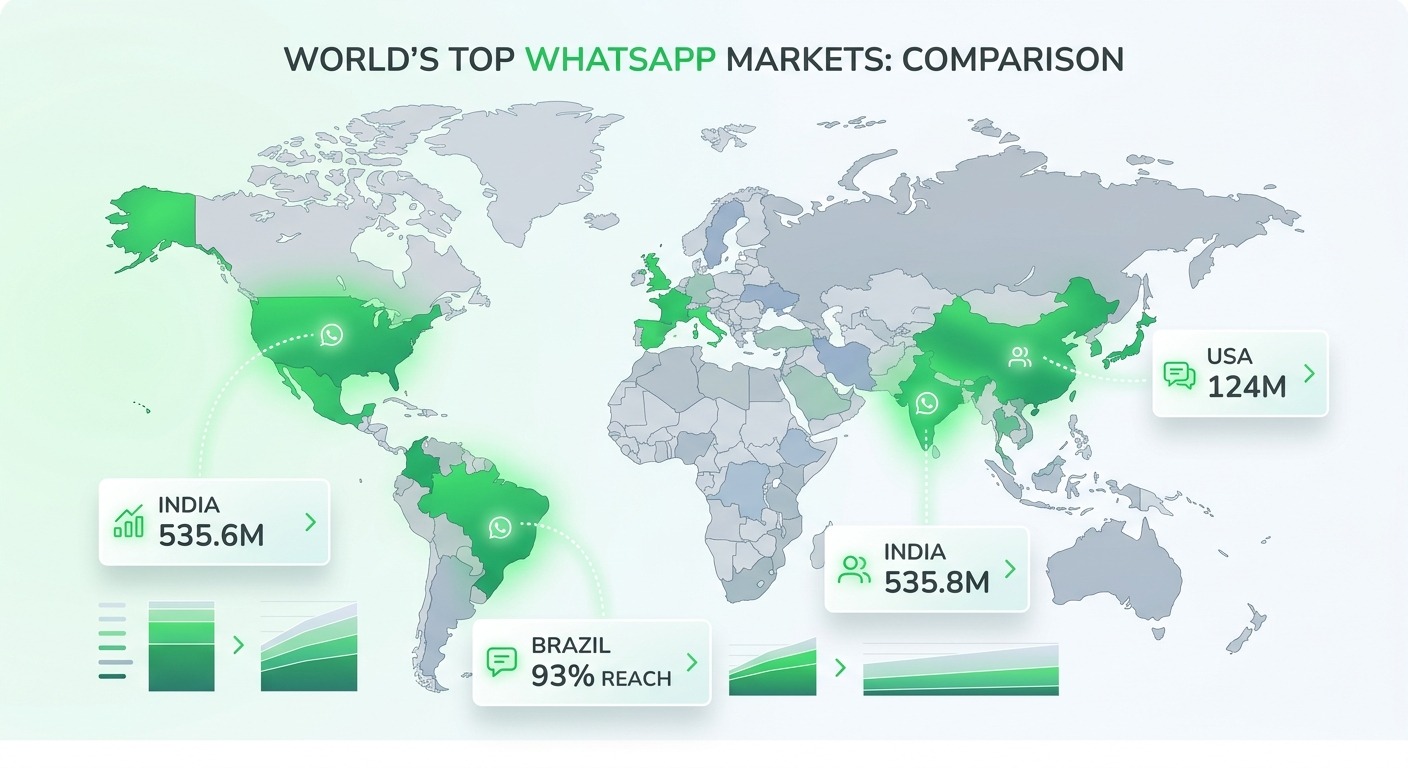
15. India is WhatsApp’s largest market with roughly 535.8 million users. (Source: DataReportal Digital 2025, via Statista) Note: higher figures circulate from less rigorous trackers; DataReportal is the defensible number.
16. The United States has around 124 million WhatsApp monthly active users. (Source: Sensor Tower, via Demandsage, Q2 2025)
17. In Brazil, WhatsApp reaches about 93% of the population and is the country’s most-used social platform. (Source: Statista / DataReportal, 2024)
18. Indonesia has approximately 112 million WhatsApp users, its third-largest market. (Source: World Population Review, 2024)
19. Nigeria is WhatsApp’s largest African market, with messaging penetration around 95%. (Source: DataReportal / World Population Review, 2024)
20. In Mexico, WhatsApp reaches about 92.2% of the online audience. (Source: Statista, 2023)
WhatsApp Business adoption
This is where most statistics posts go wrong, so read the caveats.
21. The WhatsApp Business app has more than 200 million monthly active users, as of June 2023. This remains the most recent official figure Meta has published for the standalone Business app; always year-stamp it. (Source: Meta, 2023)
22. People hold more than 1 billion active conversation threads with businesses every day across Meta’s messaging apps. This is WhatsApp, Messenger, and Instagram combined, not WhatsApp alone. (Source: Meta Q3 2025 earnings call)
23. Around 600 million conversations happen every day between people and businesses across Meta’s messaging apps. (Source: Meta, Conversations 2025, via TechCrunch, 2025)
24. More than 175 million people message a WhatsApp Business account every day. This is a genuine Meta figure but it dates to 2020 and has not been refreshed, so treat it as a floor. (Source: Meta, 2020)
25. Meta now describes business messaging as a multi-billion-dollar annual run-rate business growing at double-digit rates. (Source: Meta Q2 2025, via Mobile Ecosystem Forum)
26. Business-messaging adoption surged 53% year over year in 2025, with WhatsApp the number-one channel. EMEA accounted for 41% of global adoption. (Source: respond.io Business Messaging Trends Report 2025)
27. WhatsApp Business app worldwide downloads declined roughly 1% year over year in 2025. Growth is now in usage and the API, not fresh app installs. (Source: Sensor Tower, State of Mobile 2026)
For the mechanics of how businesses actually get billed for these conversations, our WhatsApp Business API pricing guide breaks down the per-message model that took effect in 2025.
How consumers want to message businesses
These figures come from Meta and WhatsApp’s 2025 State of Business Messaging report, a Kantar survey of 11,056 adults across 22 markets (April to September 2025). It is a Meta-commissioned study, attribute it as such, but the sample is large and the direction is consistent across the market.
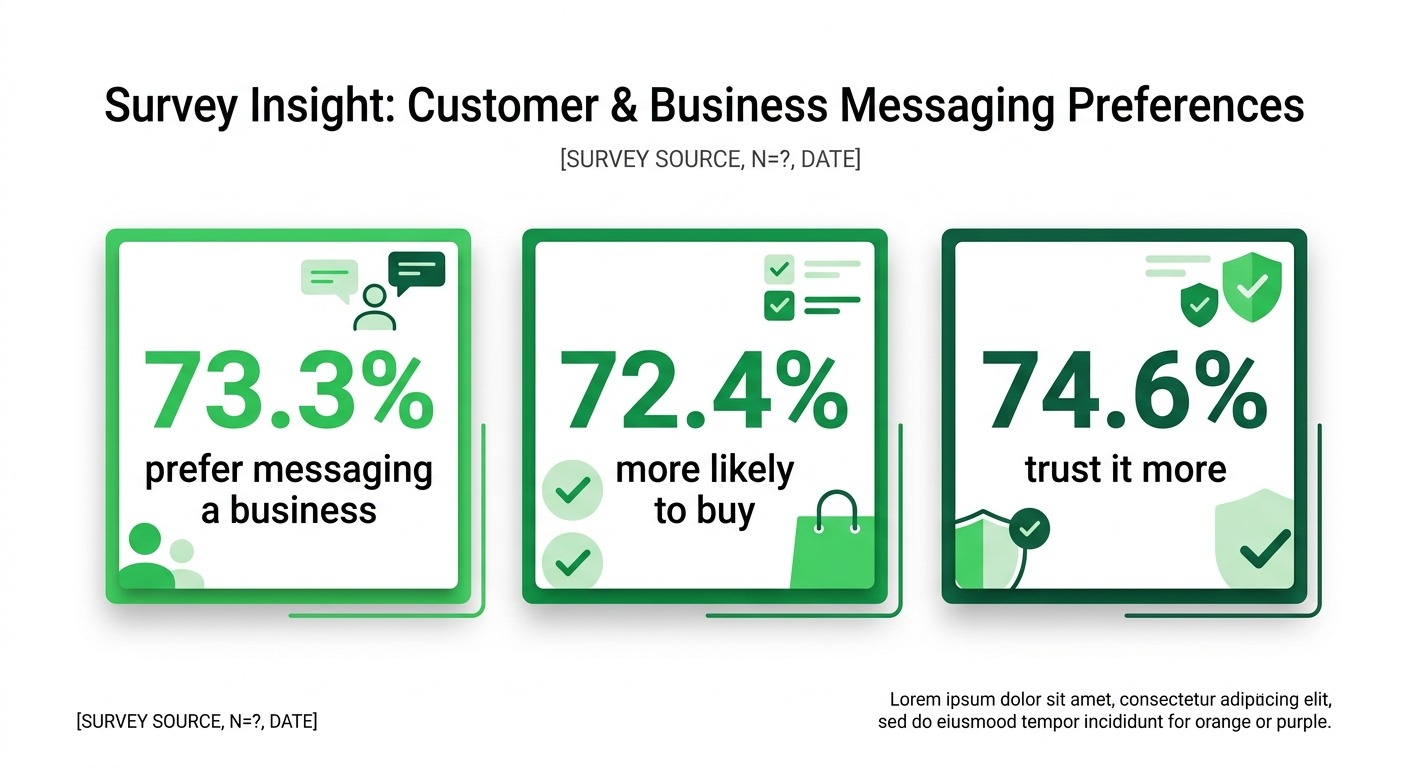
28. 73.3% of consumers prefer messaging when communicating with a business. (Source: Kantar / Meta State of Business Messaging, 2025)
29. 72.4% of consumers are more likely to purchase from a brand that offers messaging. (Source: Kantar / Meta, 2025)
30. 75.1% of consumers want to message businesses the same way they message friends and family. (Source: Kantar / Meta, 2025)
31. 74.6% of consumers trust a business more when they can exchange messages with it. (Source: Kantar / Meta, 2025)
32. 66.8% of consumers feel frustrated when messaging is not offered as a contact option. (Source: Kantar / Meta, 2025)
33. 79.3% of consumers require proof of legitimacy, such as verification, before engaging with a business via messaging. Trust and a verified profile are prerequisites, not nice-to-haves. (Source: Kantar / Meta, 2025)
34. 67.7% of consumers find AI chatbot responses helpful, and 42.9% believe AI would improve their business-messaging experience. (Source: Kantar / Meta, 2025)
For the cross-channel picture, our business messaging statistics for 2026 roundup places these WhatsApp figures next to SMS, email, and live chat.
WhatsApp marketing and engagement benchmarks
Here is the section that usually gets faked. Instead of the unsourced “98% open rate,” these are click and conversion benchmarks from a named study with disclosed methodology (30+ brands, 100,000+ conversations each). Note the study measures clicks and conversions, not open rates, because WhatsApp read receipts are not reliably trackable.
35. WhatsApp broadcast campaigns see click rates of 5% to 12% and conversion rates of 3% to 7%. (Source: Chatarmin / charles WhatsApp E-Commerce KPI Study, 2025)
36. WhatsApp automated flows perform even better: 8% to 15% click rates and 8% to 15%+ conversion rates. Triggered, behavior-based messages beat broadcasts. (Source: Chatarmin / charles KPI Study, 2025)
37. WhatsApp e-commerce unsubscribe rates run about 0.1% to 0.2%, and return on WhatsApp ad spend reaches 15x to 40x for broadcasts and 30x to 100x+ for flows. (Source: Chatarmin / charles KPI Study, 2025)
WhatsApp commerce and payments
Commerce is where messaging turns into revenue, and the payments rails are finally maturing.
38. Around 40 million people view a WhatsApp Business catalog every month, browsing products without leaving the app. Attribute as a Meta figure carried via industry reporting. (Source: Meta, via industry reports, 2026)
39. WhatsApp Pay processed 61 million UPI transactions in India in January 2025, more than double the 26 million a year earlier. (Source: NPCI data, via TechCrunch, 2025)
40. India’s NPCI lifted the 100-million-user cap on WhatsApp Pay, opening UPI payments to WhatsApp’s full 500 million+ Indian user base. (Source: MediaNama, 2025)
41. In Brazil, WhatsApp charges merchants a 3.99% transaction fee on in-app payments and added Pix and Boleto payment links in early 2026. Brazil has roughly 120 million active WhatsApp users. (Source: Infobip, 2026)
WhatsApp advertising and Meta revenue
The growth rates are the story, and they come straight from Meta’s books.
42. Click-to-WhatsApp ads grew revenue 60% year over year in Q3 2025. These are the ad units that open a WhatsApp chat instead of a landing page. (Source: Meta Q3 2025 earnings call)
43. Click-to-message ad revenue grew more than 40% year over year in Q2 2025, showing the acceleration through the year. (Source: Meta Q2 2025 earnings call)
44. Meta’s Family of Apps “Other” revenue reached $690 million in Q3 2025, up 59% year over year. This line blends WhatsApp paid messaging with Meta Verified, so it is not WhatsApp-only. (Source: Meta Q3 2025)
45. In Q2 2025, that same “Other” revenue line was $583 million, up 50% year over year, driven largely by WhatsApp paid messaging. (Source: Meta Q2 2025)
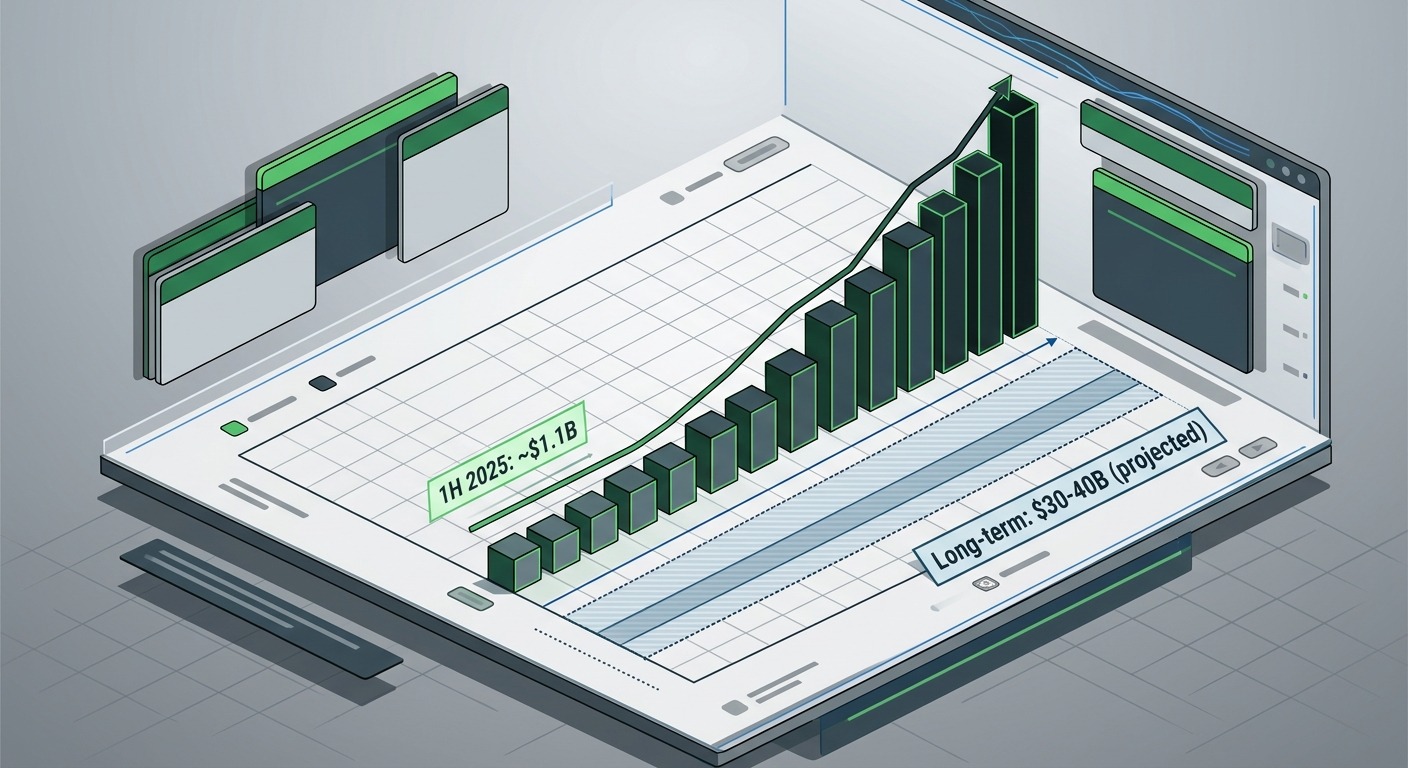
46. The Meta segment containing WhatsApp paid messaging generated roughly $1.1 billion in the first half of 2025. (Source: Meta Q2 2025, via Mobile Ecosystem Forum)
If paid acquisition is on your roadmap, our click-to-WhatsApp ads playbook covers how to structure those campaigns.
Market size and growth projections
Treat these as projections from named research firms, not facts, but the direction is unanimous.
47. The conversational commerce market is projected at $12.64 billion in 2026, growing at a 12.28% CAGR to $22.56 billion by 2031. (Source: Mordor Intelligence, 2026)
48. The global A2P (application-to-person) messaging market is projected to reach $96.73 billion by 2030, a 5.4% CAGR from 2025. (Source: Grand View Research, 2024)
49. Global business-messaging traffic is set to grow from about 2 trillion messages in 2025 to nearly 3 trillion by 2030. (Source: Juniper Research, 2025)
50. OTT business-messaging traffic (led by WhatsApp) will grow 45%, from 390 billion messages in 2025 to more than 560 billion by 2027. (Source: Juniper Research, 2025)
51. WhatsApp authentication (one-time-passcode) messaging is priced 50% to 90% lower than traditional A2P SMS, a major reason businesses are shifting OTP traffic to WhatsApp. (Source: Juniper Research, 2025)
52. Estimates of WhatsApp paid-messaging revenue for 2025 range from $2.5-2.8 billion (conservative) to $6-7 billion, with long-term projections of $30-40 billion. Cite the range, and label it as estimates. (Source: Mobile Ecosystem Forum, and Wolfe Research via Yahoo Finance, 2025)
The WhatsApp statistics you should stop citing
This section is the reason to bookmark this post. Every figure below appears constantly in WhatsApp statistics roundups and could not be traced to a credible primary source. Using them makes your content less trustworthy, not more.
- “WhatsApp business messages have a 98% open rate.” The single most-copied WhatsApp marketing statistic, with no verifiable primary source. Use the real, methodology-backed click and conversion benchmarks in stats 35 to 37 instead.
- “2.78 billion” or “2.7 billion monthly active users.” Stale and inconsistent with Meta’s own 3 billion milestone. Use the 3 billion figure with its Meta source.
- “2 billion+ daily active users.” Meta has not published an official WhatsApp daily-active-user figure at this level; it is asserted, not sourced.
- “200 million businesses use WhatsApp Business monthly” or “50 million+ active business accounts.” These conflate different metrics. The only official Business-app figure is 200 million monthly active users, as of June 2023.
- “Brazil and Mexico have 50%+ of mid-to-large brands on WhatsApp.” A specific claim with no supporting data.
The pattern is clear: the flashiest WhatsApp statistics are usually the least sourced. A smaller set of verified numbers serves your credibility far better than a big number nobody can stand behind.
What these numbers mean for your business
Strip away the noise and 2026 tells a simple story. WhatsApp has the reach (3 billion+ users, number one in 63 countries), the consumer intent (73.3% prefer messaging a business, 72.4% more likely to buy), the performance (broadcast conversions of 3-7%, flow conversions up to 15%), and the commercial momentum (click-to-WhatsApp ads up 60%, a multi-billion-dollar run-rate for Meta). The channel is not emerging. It is where your customers already are.
The gap for most businesses is not awareness, it is execution: answering fast, at scale, without a bigger team. That is what a WhatsApp-native AI chatbot and shared inbox are built for, turning those 3 billion users and rising expectations into conversations your team can actually keep up with. Our 55+ AI customer support statistics roundup shows how automation is reshaping the support side of that equation.
If WhatsApp is on your 2026 roadmap, see how ChatMaxima is priced to run automated WhatsApp conversations, campaigns, and support from one place.
A note on sourcing
Every statistic in this post is attributed to a named source with a year, and figures that could not be sourced were excluded rather than repeated. Several of the strongest numbers come from Meta’s quarterly earnings calls and will be updated as Meta reports Q4 2025 and 2026 results. We refresh this roundup as new official figures land, so it stays a citable reference rather than a snapshot. If you cite these statistics, please link to the primary sources named above.