
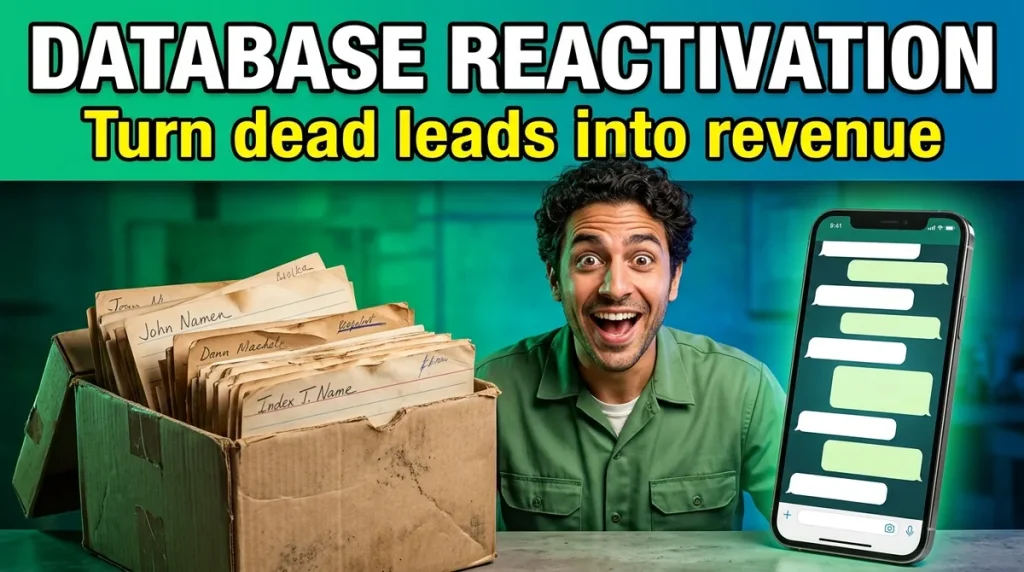
Every business you pitch has a list it has stopped talking to. Old enquiries that never booked, customers who bought once and drifted, members who cancelled a year ago. Database reactivation is the service of turning that dormant list back into conversations, bookings and orders, and it is one of the easiest AI agent services to sell because the client already paid to acquire every name on it.
Most database reactivation guides you will find are written for SMS and email in the United States. This one is built around WhatsApp and an AI agent that answers the replies, which is where the format works best for clients outside the US. It also covers the part most guides skip: how to do it without getting a client’s number restricted or breaking consent rules.
This is idea 10 from our list of 25 AI agent business ideas with pricing math, the win-back agent, expanded into a full playbook: who buys it, how to run it step by step, what to measure, and how to price it.
What Database Reactivation Is (and Why Clients Pay for It)
A database reactivation campaign re-engages contacts who are already in a business’s CRM or spreadsheet but have gone quiet. It is close to what email marketers call a win back campaign, with one difference that matters: the goal is a two-way conversation that ends in a booking or a sale, not a click.
The economics are the pitch. Acquiring a new customer is often quoted as 5 to 25 times more expensive than keeping an existing one (Harvard Business Review, 2014). Treat that as a widely cited range rather than a law; HBR itself notes it depends on the study and the industry. The better-known figure comes from Frederick Reichheld’s work at Bain: a 5% increase in customer retention increased profits by 25% to 95% in the service businesses he studied (Reichheld, Loyalty Rules!, 2001). It is old research from specific industries, but the direction has held up.
Then there are the leads that never got a proper follow-up. A Journal of Marketing study framed the problem as the “sales lead black hole”: the 70% of marketing-generated leads that sales reps never pursue (Sabnis et al., 2013). An HBR audit of 2,241 companies found that 23% never responded to a web lead at all (HBR, 2011). Those old leads and dead leads are still sitting in the database.
Why WhatsApp plus an AI agent beats a plain broadcast
You could send a one-off promotional blast. The problem is what happens next: replies arrive at all hours, most of them questions (“is the offer still on?”, “do you have a slot on Saturday?”), and the client’s team is not staffed to answer them. Replies that go unanswered for a day go cold again.
A re-engagement agent fixes that. The broadcast opens the door, and the AI agent handles the conversation that comes back: it answers questions, books the appointment, sends the offer code and hands over to a human when needed. Data from Braze across 26 brands found two-way conversational messaging drove a 17% higher session start rate than one-way messaging (Braze, 2024). That gap is the reason this is an agent service and not a broadcast service.
Who Buys a Database Reactivation Service
The best clients have three things: a list of at least a few thousand contacts with phone numbers, a product people buy more than once, and a team too busy to work the list themselves.
- Clinics and dental practices: patients overdue for a checkup or a follow-up treatment.
- Gyms and studios: lapsed members and trial users who never converted.
- Salons and spas: clients who have not booked in three months or more.
- Real estate agencies: old buyer and tenant enquiries that went quiet.
- Education and coaching: enquiries for past course intakes.
- Ecommerce and D2C brands: one-time buyers and customers who have not ordered in 90 days.
- Auto service and home services: customers due for a service, renewal or seasonal job.
The US exception you must know before you pitch
WhatsApp is the wrong channel for a list of US phone numbers. Meta’s documentation is explicit: “WhatsApp does not currently deliver marketing template messages to WhatsApp users with United States phone numbers” (Meta for Developers). A reactivation campaign is marketing by definition, so for a US-heavy list, use SMS or email instead. For clients across Europe, Latin America, the Middle East, Africa and Asia, WhatsApp is usually the channel customers actually read.
Check a client’s country mix in the discovery call, before you quote.
What the Re-Engagement Agent Actually Does
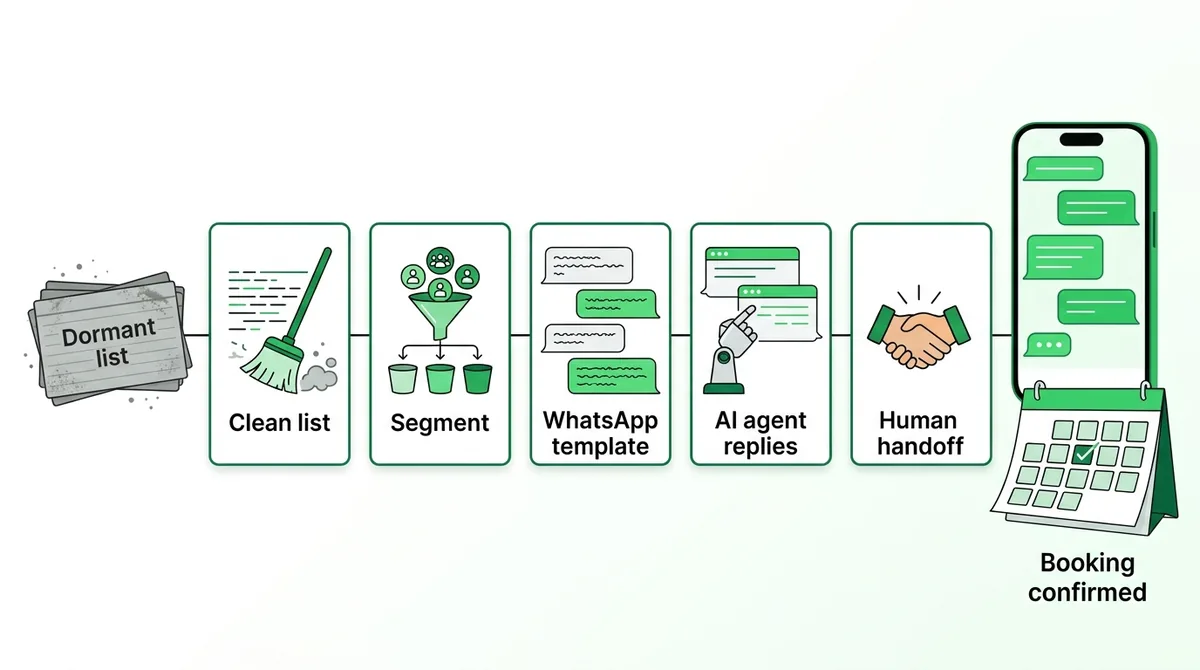
The service has five moving parts. Each one maps to something you configure once per client:
- Clean and segment the dormant list into groups that deserve different messages.
- Send an approved WhatsApp marketing template to one segment at a time, with personalized fields and, where it fits, a unique offer code.
- Answer every reply with an AI agent trained on the client’s services, prices and booking rules.
- Hand over to a human for anything the agent should not decide, such as a complaint, a refund or a custom quote.
- Report sends, reads, replies, opt-outs and the bookings or orders the client confirms.
Step 1: Audit and Clean the List Before You Send Anything
This step decides whether the campaign makes money or gets the client’s number restricted. Do not skip it to save time.
Check consent first
WhatsApp’s Business Messaging Policy only allows you to contact people who gave the business their number and opted in to receive messages, and the business is “solely responsible for determining the method of opt-in” (WhatsApp Business Messaging Policy). An old list scraped from invoices or bought from a vendor does not qualify.
Privacy law points the same way. The UK regulator, the ICO, notes that “consent is likely to degrade over time” and recommends considering a refresh every two years, with an audit trail of how and when consent was given (ICO guidance on consent). Rules differ by country (GDPR, PECR, TCPA, India’s DPDP Act and others), but the common thread is the same: provable, specific, recent consent, plus an easy opt-out in every message.
In practice, ask the client where each segment came from and when. Contacts with no record of opt-in stay out of the WhatsApp campaign.
Remove the numbers that will hurt you
- People who already opted out or complained. Exclude them before the first send, not after.
- Duplicates. The same person in three lists should get one message.
- Very old numbers. Phone numbers get reassigned. In the US alone, about 35 million numbers are disconnected and made available for reassignment every year (FCC, 2018), so a message to a ten-year-old number may reach a stranger.
- Obviously invalid entries. Missing country codes, landlines, placeholder numbers.
Data quality is a known problem: in a 2025 survey of CRM users, 76% said less than half of their organization’s CRM data is accurate and complete (Validity, 2025). Budget time for cleanup and say so in your proposal.
Step 2: Segment the Dead List
Blasting everyone with the same message is the fastest way to collect blocks. Split the list by how recently and why each contact went quiet:
- Lapsed customers who bought before, split by recency: 3 to 6 months, 6 to 12 months, over 12 months.
- High-value lapsed customers, the ones who spent the most, who deserve a more personal message.
- Never-converted leads: enquiries that never booked or bought.
- One-time buyers who never came back for a second purchase.
- Cancelled members or subscribers, who need a different reason to return.
Start with the warmest segment: recent lapsed customers who bought more than once. Their reply rate tells you whether the message works before you spend the client’s budget on the coldest names.
How to build these segments in ChatMaxima
ChatMaxima does not track “last active” automatically for imported contacts, so you bring the date with the data. When you import the client’s list from CSV or Excel, any extra column becomes a contact attribute named after its header. Include columns such as last_purchase_date, total_spend and segment.
Then create a Dynamic list in the Contact Hub with rules on those attributes, for example last_purchase_date before a chosen date, matched with all of your rules. Add the rule Subscribed = Y to every campaign list so contacts who opted out of marketing never receive the broadcast. Dynamic lists update as attributes change, so the same list keeps working for the next wave.
Step 3: Write the Message Sequence
Re-engagement messages are marketing templates in WhatsApp’s categories. Meta classifies any template that promotes or recommends offers, products or services as marketing, even when the customer asked for it, and mixing a promotion into a utility message also makes it marketing (Meta template categorization). Do not try to slip a win-back offer into an order-update template; it will be recategorized or rejected.
The first message: value, then a reason to reply
The first touch should feel like a person remembering a customer, not a coupon blast. A pattern that works:
Hi {first_name}, it’s Maya from Riverside Dental. It’s been a while since your last checkup, and our new evening slots fill up fast. Would you like us to find you a time this month?
[Book a checkup] [Not now] [Stop messages]
Three details matter here:
- Name the business clearly so the contact knows who is writing.
- Use quick-reply buttons. A tap is easier than typing, and the button text can start the right flow in the AI agent.
- Always include an opt-out. A “Stop messages” button gives unhappy contacts a better option than the block button.
The second message: the offer, spaced out
If a contact reads and does not reply, a second template a few days later can carry the offer. Space messages out: WhatsApp also limits how many marketing templates a person can receive from businesses, and when a message fails with error 131049 Meta advises waiting at least 24 hours before trying again (Meta per-user marketing limits). Our WhatsApp campaign frequency guide covers how often is too often.
Two messages per segment is a sensible ceiling for a dormant list. After that, contacts who never read either message should be retired from WhatsApp campaigns.
Step 4: Let the AI Agent Handle the Replies
This is the part clients cannot do themselves at scale, and the reason the service commands a monthly fee.
When a contact replies to a broadcast in ChatMaxima, the message lands in the shared inbox and is passed to the bot connected to that WhatsApp number. A quick-reply tap arrives as the button text, so you can use it as a keyword trigger: “Book a checkup” starts the booking flow, “Not now” sends a polite close, and free-text questions go to the MaxIA AI Agent block trained on the client’s knowledge base.
A good re-engagement agent should:
- Answer the obvious questions (price, availability, what changed since they last visited) from the client’s own content.
- Move to a booking or order in the same chat, instead of sending people to a website.
- Send the offer code when a contact asks for it, or when the client’s rules allow it.
- Hand over to a person with the “Talk to Agent” block for complaints, refunds, medical questions or anything outside the agent’s brief.
- Say it is AI. In Salesforce’s State of the AI Connected Customer report, 72% of customers said it is important to know when they are communicating with an AI agent (Salesforce, 2025). Disclose it and offer a human, and people engage more, not less.
Because there is one bot per WhatsApp number rather than one per broadcast, design the agent to recognize campaign replies by their button text, and keep the general support flows working for everyone else.
What the replies cost
Since 1 October 2026, Meta charges per message for service messages beyond a free tier of 1,000 delivered service messages per month per business number (WhatsApp pricing). A busy reactivation campaign can pass that tier, so the agent’s replies have a cost too. We explain the change in detail in WhatsApp service message pricing from October 2026. Build it into your price.
Step 5: Use Offers Without Training Customers to Wait for Discounts
Incentives work, but a discount on every message teaches customers to ignore full-price messages. Research on win-back offers at a telecom company found that an offer combining a discount with a service upgrade was the most effective at bringing customers back, and that customers who had left over price tended to stay longer once won back (Kumar, Bhagwat and Zhang, Journal of Marketing, 2015).
A practical approach:
- Lead with value (a new service, a convenient slot, a reminder of what they liked).
- Save the discount for the second message or for contacts who ask.
- Pair it with something extra rather than a deeper discount: a free add-on, priority booking, free delivery.
- Keep a no-offer control group in each segment so you can tell whether the discount actually earned its cost.
Unique offer codes per contact
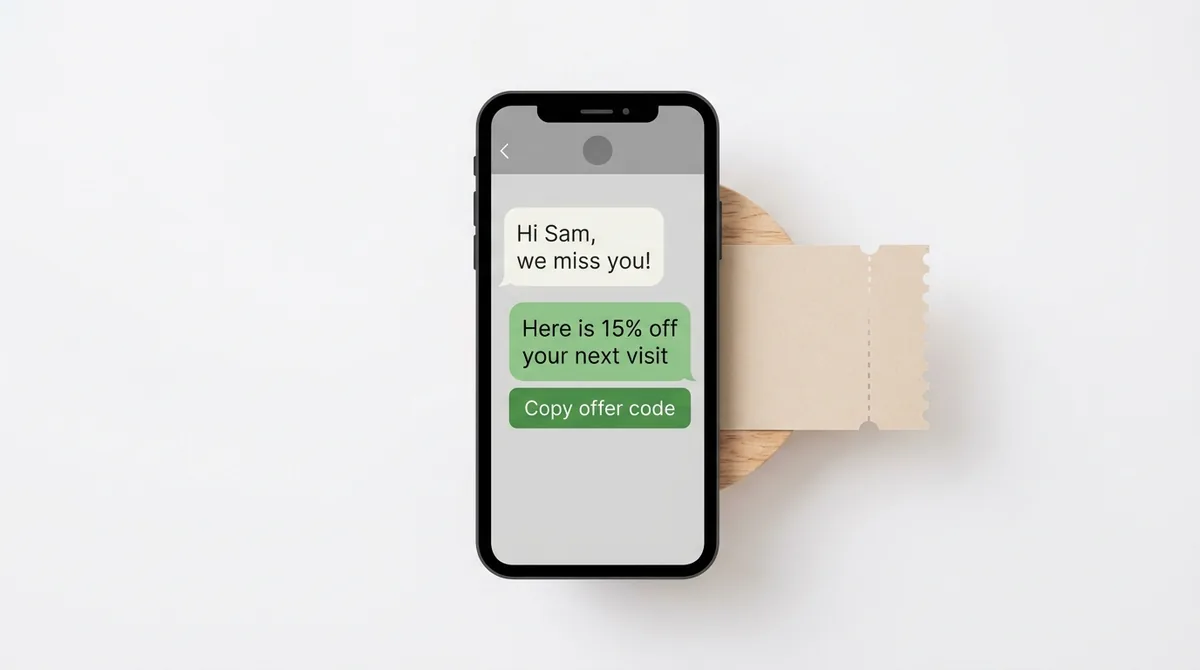
If the client wants a unique code per person (so codes cannot be shared and redemptions can be counted), generate the codes in their store or booking system and import them as a CSV column. The column becomes a contact attribute, and you map it into the template’s Copy Offer Code Value field, or into the body, in the broadcast’s Templates Messages Variable Mapping step. ChatMaxima fills in each contact’s own code at send time. Run a test send first: a contact with no code in that column receives an empty value.
Step 6: Protect the Client’s Number
A dormant list contains more people who might block or report the business than an active one. Meta rates every template and every phone number on how customers react, and it acts on those ratings.
- Template quality is based on usage, customer feedback and engagement. A template that gets negative feedback from multiple users, or low read rates, can be paused for 3 hours, then 6 hours, and then disabled on repeat offences (Meta template pausing).
- Template pacing means Meta may send a new template to a small group first and hold the rest while it gathers early feedback.
- Phone number quality reflects blocks and reports over the last seven days. A number that stays flagged can have its messaging limit lowered a tier.
- Messaging limits start at 250 unique customers per rolling 24 hours for new numbers and rise to 2,000, 10,000, 100,000 and unlimited as the number earns trust (Meta messaging limits).
So start small. Send the warmest segment first, watch the read rate, replies and opt-outs, and only then widen the audience. ChatMaxima lets you Pause, Resume or Stop a broadcast while it is sending, and it stops a run automatically if Meta returns account-level errors such as the 131048 spam rate limit, or if most recent sends are failing. Contacts who hit a per-person limit do not stop the campaign; they can be retried later.
How to Measure a Database Reactivation Campaign
Clients will ask one question: how much revenue came back? Set up the answer before the first send.
The numbers to track
In ChatMaxima’s broadcast report you get Sent, Delivered, Read, Replied, Error and Unsubscribed counts, with a drill-down list and export for each one, plus monthly read, reply and failure rates in Campaign Reports. That covers the messaging side. ChatMaxima does not track clicks or revenue for WhatsApp broadcasts, so revenue comes from the client’s own system:
- Replied contacts: export the list and match it against bookings or orders.
- Redeemed offer codes: unique codes make attribution simple.
- Revenue per contacted person: total attributed revenue divided by contacts sent.
- Holdout group: keep 5 to 10% of each segment unsent and compare their purchases over the same period. This is the honest way to show lift instead of claiming every sale.
What realistic results look like
Be careful with the numbers you promise. The often-repeated “98% WhatsApp open rate” has no traceable primary source. Measured figures are lower and still strong:
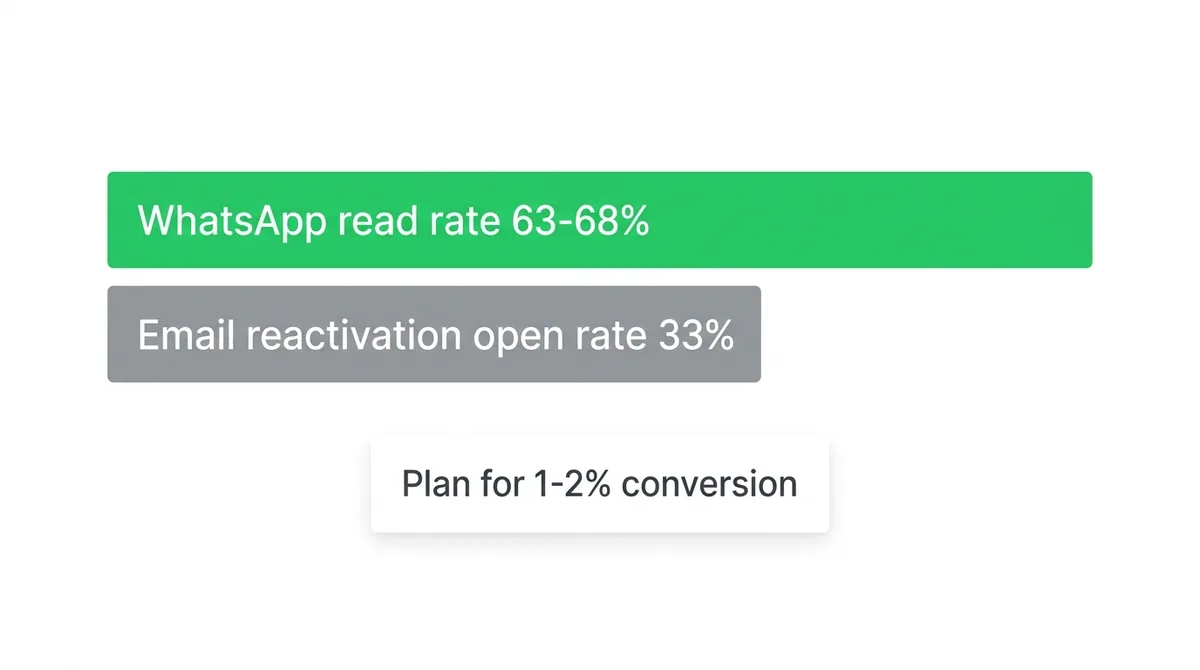
- Opted-in WhatsApp marketing messages averaged a 68% read rate across 26 brands in 2023 (Braze, 2024).
- A 2026 benchmark of 355 smaller WhatsApp accounts found a 63% median read rate, while the median account’s click rate was just 0.6% (SendPulse, 2026).
- In one Braze customer case, lapsed users still read 67% of messages, against 71% for active users (Braze).
- For comparison, email reactivation campaigns average a 33% open rate and a 0.54% conversion rate (Omnisend, 2026).
Plan around a conversion rate of 1 to 2% of contacted people for a well-segmented list with a good offer, and treat anything higher as upside. It is much easier to beat a modest forecast than to explain a missed one.
How to Price a Database Reactivation Service
Price on the value the client can see, and keep the math conservative.
Worked example for one client
Take a clinic with 6,000 contacts who have not visited in over six months.
- After cleaning (no consent record, opted out, invalid, duplicates): 3,500 eligible contacts.
- Converting at 1.5% of contacted people: about 52 returning patients.
- At an average visit value of $120: about $6,300 in recovered revenue from one campaign wave.
Meta’s per-message charges come out of that, and they vary by the recipient’s country, so price them from Meta’s current rate card rather than a fixed figure.
Three pricing models that work
- Setup fee plus monthly retainer. For example, a one-time setup fee to clean the data, build the segments and train the agent, then a monthly fee for new waves, agent upkeep and reporting. In our business ideas list we priced the win-back agent at $750 per month, which takes 14 clients to reach about $10,500 in monthly recurring revenue.
- Base fee plus a share of recovered revenue. Lower monthly fee, plus a percentage of revenue from redeemed codes or confirmed bookings. This needs clean attribution, so agree on the rules in writing.
- Per-campaign project. A fixed fee per wave. Good as a first engagement to prove results before moving the client to a retainer.
Whichever model you choose, Meta’s message charges are passed through or included explicitly, never absorbed silently.
The reactivated contacts are also a natural bridge to a second service. People who reply but do not book are warm leads again, and our guide to speed to lead covers how an AI agent keeps new enquiries from going cold in the first place.
Common Database Reactivation Mistakes
- Sending without consent. The single biggest risk to the client and to you.
- Blasting the whole list on day one. Start with the warmest segment and grow.
- Using WhatsApp for US numbers. Marketing templates are not delivered to them; use SMS or email.
- Retrying 131049 failures immediately. Wait at least 24 hours, and stop after a second attempt.
- Hiding the promotion in a utility template. It will be recategorized as marketing or rejected.
- No opt-out path. People who cannot easily say no will block the number instead.
- Promising inflated open rates. Sell on realistic read rates and replies.
- No holdout group. Without one, you cannot prove the revenue was yours.
Build Your Re-Engagement Agent on ChatMaxima
Database reactivation is one of the most straightforward AI agent services to sell: the client’s list already exists, the results are measurable, and the work repeats every quarter as more contacts go quiet. The craft is in the parts clients cannot do alone: cleaning the list, writing messages people want to answer, an AI agent that handles every reply, and protecting the number while you scale.
In ChatMaxima you have everything needed to run it:
- WhatsApp broadcasts with scheduling and Pause, Resume and Stop controls.
- Dynamic lists built on imported attributes.
- Per-contact variables and offer codes.
- The MaxIA AI Agent answering replies, with handoff to a human.
- Broadcast reports you can export for the client.
See the plans on our pricing page, and browse the rest of the AI agent business ideas for the next service to add once your first database reactivation client is live.