
A new lead fills in your form at 9:47 PM. They also filled in two of your competitors’ forms. Whoever replies first, while the customer is still holding their phone, usually wins the conversation. That is speed to lead, and for most businesses it is the cheapest growth lever they are not using.
This guide explains what speed to lead is, what the research actually says, why most teams are slow, and a practical model for replying to every lead in under a minute: an AI agent that answers instantly on WhatsApp and qualifies the lead, and a human who calls back the best ones fast.
What is speed to lead?
Speed to lead is the time between a lead raising their hand and your business making meaningful contact. The hand-raise can be a web form, a Click to WhatsApp ad, a phone call, a chat on your website or a direct message. Meaningful contact means a real, relevant reply, not an automatic “thanks, we’ll be in touch.”
It is usually measured as lead response time: minutes from lead creation to first reply, tracked as an average and, more usefully, as the share of leads answered within five minutes, an hour and a day.
Speed to lead statistics: what the research really says
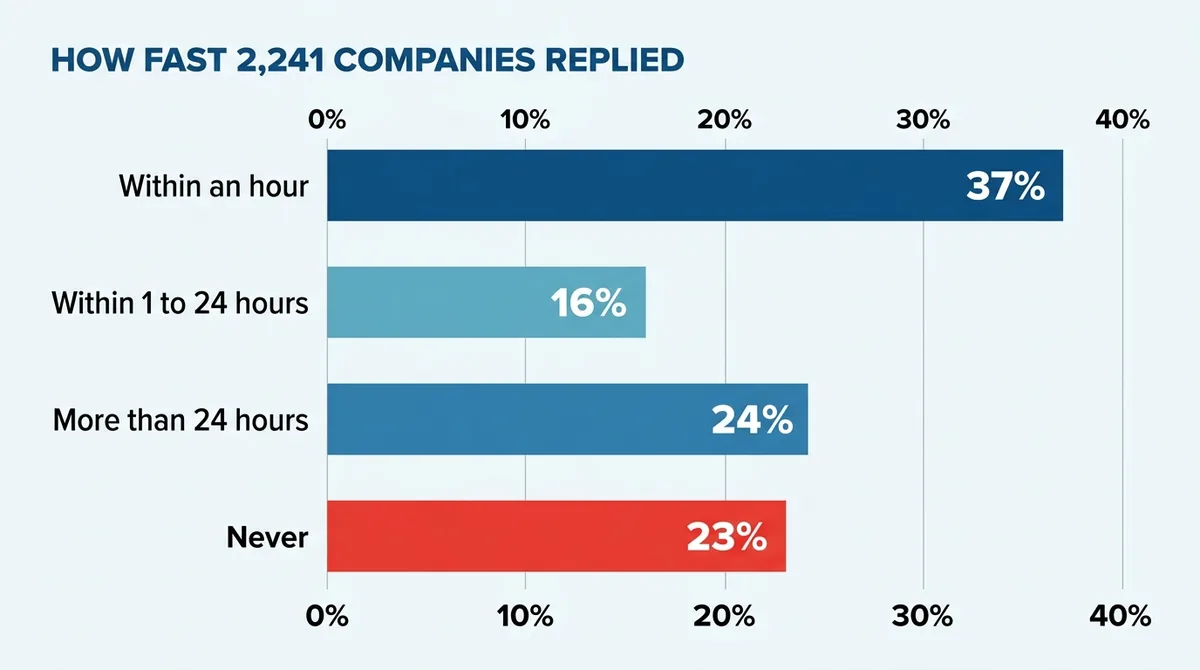
The most cited research comes from a Harvard Business Review study, “The Short Life of Online Sales Leads,” by James Oldroyd, Kristina McElheran and David Elkington (Harvard Business Review, 2011). The researchers sent test leads to 2,241 US companies and measured how long each took to respond:
| Response time | Share of companies |
|---|---|
| Within an hour | 37% |
| Within 1 to 24 hours | 16% |
| More than 24 hours | 24% |
| Never responded | 23% |
Among companies that did respond within 30 days, the average response time was 42 hours. The same article reported that firms contacting a lead within an hour were nearly seven times more likely to qualify it than those that waited even an hour longer.
A note on accuracy, because these numbers get mixed up. Claims such as “100 times more likely if you respond within five minutes” come from a different study, a 2007 lead response study by the same lead author with InsideSales, and are often wrongly credited to Harvard. The consistent finding across both is simple: minutes matter, and most businesses take hours or days.
The research is more than a decade old, and channels have changed. But customer patience has only shortened since then. On messaging apps, customers expect a reply in minutes, not the next business day.
Why most businesses are slow to respond
Very few teams are slow on purpose. The delay comes from how leads flow:
- Leads land in the wrong place. Form submissions go to a shared email inbox that someone checks twice a day.
- Leads arrive after hours. Evenings and weekends are when many customers research, and when nobody is working.
- Routing is manual. Someone has to decide who owns the lead before anyone contacts it.
- Phone tag. The first call goes to voicemail, the callback comes the next day, and the lead has moved on.
- No follow-up rhythm. One attempt is made, it fails, and the lead is never contacted again.
None of these is solved by telling the team to “be faster.” They are solved by changing what happens in the first minute automatically.
The two-speed model: AI replies instantly, people call back the best leads
The most practical way to fix speed to lead combines two speeds:
- Instant (seconds): an AI agent replies on WhatsApp. The moment a lead arrives, the customer gets a personal, relevant message on the app they actually check. The agent answers questions, asks a few qualifying questions and, where it fits, books a slot.
- Fast (minutes): a person calls back the best leads. Leads that qualify are routed to the right salesperson, who gets a mobile alert and calls back with the conversation history in front of them.

This gets you the best of both. Every lead hears back in seconds, including at 9:47 PM. Your team spends its time on conversations with people who are ready, instead of chasing cold leads. And when the salesperson calls, the customer is expecting the call and has already shared what they need.
How to set up speed to lead step by step
1. Capture every lead source in one place
List every way leads arrive: website forms, Click to WhatsApp ads, website chat, Instagram and Facebook messages, and phone calls. Connect each one so that a new lead starts an automated flow, instead of landing in an inbox. Website forms can post straight to a webhook that starts the flow, and tools like Zapier, Make or n8n can connect most other sources.
2. Reply in seconds on WhatsApp
For leads that arrive outside WhatsApp, such as a web form, the first message must be an approved WhatsApp template, because the business is starting the conversation. Write it to sound human: use the lead’s name, mention what they asked about, and ask one easy question.
For leads that arrive inside WhatsApp, such as a Click to WhatsApp ad, the agent can reply immediately with a normal message. We cover that case in depth in our guide to AI agents that qualify Click to WhatsApp leads 24/7.
Get consent first. WhatsApp requires that people opt in before a business messages them (WhatsApp Business Policy). Add a clear opt-in line to your forms, such as “Reply to me on WhatsApp,” so your instant message is welcome rather than a surprise.
3. Qualify with three to five questions
Let the AI agent ask what your best salesperson would ask first: what they need, when, the budget range and how they prefer to be contacted. Keep it to three to five questions; every extra question loses people. Save the answers to the contact record so nobody asks twice.
4. Book directly when you can
If the next step is a meeting, viewing or consultation, let the agent offer real times from your calendar and book the slot in the chat. A booked lead is worth far more than a lead marked “contacted.”
5. Route hot leads to the right person
Assign qualified leads automatically, by team, territory or round robin, so no lead waits for someone to claim it. Send the salesperson a mobile notification the moment a lead is assigned.
6. Call back fast, with context
The salesperson calls back with the conversation in front of them: what the lead asked, how they answered the qualifying questions and what they booked. The call becomes a continuation, not a cold start. On WhatsApp, businesses must ask the customer’s permission before calling them, so have the agent or salesperson request it in the chat first.
7. Follow up when there is no reply
Many leads read your message and do not answer straight away. Set a follow-up sequence: a short nudge after a few hours, another the next day, then a final message. Stop as soon as the lead replies.
8. Measure response time every week
Track first response time, the share of leads answered within five minutes, and the share that book a next step. If response time creeps up, find which source or shift is slipping.
Writing the first WhatsApp message
The first message decides whether the lead replies. It should be short, personal and easy to answer. Three examples you can adapt:
After a web form for a service: “Hi Emma, thanks for asking about kitchen renovation. I’m the assistant for Brightline Interiors. To get you an accurate estimate, is this for a full remodel or an update to cabinets and worktops?”
After a consultation request: “Hi Daniel, you asked about a free consultation with Harbor Legal. I can book you in today. Is your question about a business contract, employment, or something else?”
After a property enquiry: “Hi Sofia, thanks for your interest in the two-bedroom apartment on Park Lane. Would you like to see it this week? I have viewings on Thursday and Saturday.”
Each one uses the lead’s name, refers to exactly what they asked about, says who is writing and ends with one easy question. Avoid long introductions, links in the first message and anything that reads like a newsletter.
How fast is fast enough?
Aim for these targets, then improve from there:
- Under one minute for the first automated reply to every lead, at any hour.
- Under five minutes for a human callback to qualified leads during working hours.
- First thing next working morning for qualified leads that arrive after hours, with the AI agent having already replied, qualified and ideally booked a time.
Most businesses will find that the first target is the hard one without automation, and the easy one with it. The second target is where sales discipline matters: an alert is only useful if someone acts on it.
Missed call text back and call-triggered follow-up
Phone leads deserve the same speed. With missed call text back, a business automatically sends a text or WhatsApp message to a caller it could not answer, so the lead gets a response instead of silence. It is one of the simplest speed-to-lead wins for trades, clinics and local services.
Two better options exist if you can use them:
- Answer every call. An AI receptionist picks up every call, answers questions and books appointments, so there is no missed call to text back. See our guide to the AI receptionist for small business.
- Follow up every call on WhatsApp. A WhatsApp follow-up after the call gives the caller a written summary, a booking link or the next step, in a channel they can reply to later.
Speed to lead by channel
| Lead source | What “fast” looks like | First message |
|---|---|---|
| Web form | Under 1 minute | Approved WhatsApp template |
| Click to WhatsApp ad | Instant | Normal WhatsApp reply |
| Website chat | Instant | AI agent reply |
| Phone call | Answered, or followed up in minutes | AI receptionist or WhatsApp follow-up |
| Instagram or Facebook DM | Instant | AI agent reply |
Speed to lead by industry
Real estate. Buyers and renters enquire about several properties at once. The first agent to offer a viewing time usually gets the viewing. An instant reply that offers two viewing slots wins far more often than a callback the next day.
Home services. People with a leaking pipe or a broken boiler call or message several companies and book the first one that confirms a visit. Speed is the whole game here, so answer every call and follow up every enquiry within minutes.
Clinics and wellness. Patients often enquire in the evening, after work. An agent that answers questions about the treatment and offers appointment times turns those evening enquiries into next-day bookings.
Education and coaching. Prospective students compare programmes for days or weeks. Fast first contact still matters, but the follow-up sequence matters more: send useful information over several days, and invite them to a call when they are ready.
B2B services. Inbound demo requests are expensive to generate. Reply instantly, qualify on company size and use case, and route the best ones to a salesperson who calls the same hour.
Common speed-to-lead mistakes
Replying fast with nothing useful. “Thanks for your enquiry, we’ll be in touch” is fast, but it is not contact. Reply with something that moves the conversation forward.
Messaging without consent. Unexpected WhatsApp messages get reported, and reports hurt your quality rating. Collect opt-in on every form.
Asking too many questions. Qualification should feel like a helpful conversation, not a form in disguise.
Never handing over to a person. Some leads want to talk to someone straight away. Make that path obvious.
Treating every lead the same. Hot leads deserve a call in minutes; cold leads can stay in an automated sequence.
Not measuring. If you do not track response time, it will drift back to hours.
Your speed-to-lead checklist
- Every lead source starts an automated flow, none land only in an email inbox.
- Every form includes a clear WhatsApp opt-in.
- An approved first-message template is ready for each source.
- The AI agent asks no more than five qualifying questions.
- Qualified leads are assigned automatically, with a mobile alert.
- Salespeople call back within five minutes during working hours.
- Non-responders get a short follow-up sequence that stops when they reply.
- First response time is reviewed every week, by source and by person.
If you can tick every box, you are faster than most of your competitors.
Speed to lead as a service
For agencies, speed to lead is one of the easiest AI services to sell, because the result is so easy to show: response time drops from hours to seconds. It is idea 2 in our list of AI agent business ideas, with pricing math for building a recurring service around it.
Speed to lead with ChatMaxima
ChatMaxima gives you the instant layer and the human layer in one platform:
- Instant replies from any source. Start a flow from a website form or any tool that can call a webhook, or through the API, and send an approved WhatsApp template within seconds. Click to WhatsApp ad leads get an instant reply, with the ad source captured for reporting.
- AI qualification. A MaxIA AI agent asks your qualifying questions in natural language and saves the answers as contact data.
- Booking in the chat. Check availability and book into Google Calendar, or share your ChatMaxima booking page.
- Routing and alerts. Assign leads by team or round robin, with mobile push notifications to the assigned agent.
- Callbacks. Agents call back from the browser dialer, or with WhatsApp calling after requesting the customer’s permission in the chat.
- Call-triggered follow-up. An inbound call to your Twilio line can trigger an automatic WhatsApp follow-up flow.
- No-reply follow-ups. Send a nudge when a lead does not reply within minutes, hours or days.
- Response-time reporting. Track first response time per day and per agent.
What’s next
Speed to lead is not about working harder. It is about making sure the first minute after a lead arrives is handled automatically, every time, at any hour, and that your team’s time goes to the leads most likely to buy.
Start with your biggest lead source. Connect it, write one instant WhatsApp reply and three qualifying questions, and route the qualified leads to a person with an alert. Then measure your response time next week and compare.
Ready to answer every lead in under a minute? Compare ChatMaxima plans and start a 7-day free trial.