
Something fundamental just shifted in how businesses will talk to customers on WhatsApp. On July 1, 2026, the Meta Business Agent Platform went live for partners, opening the door for any business to deploy an AI agent that can answer questions specific to that business, recommend products, book appointments, and close sales, all inside a WhatsApp conversation. This follows the global unveiling of the Meta Business Agent at Meta’s Conversations conference in London on June 3, 2026, where the company positioned conversational AI agents as the next major layer of its messaging business.
For years, business messaging on WhatsApp meant templates, buttons, flows, and human agents typing replies in an inbox. The Meta Business Agent changes the default. Instead of a scripted tree or a person, a business can now put an AI agent at the front of the conversation, one that understands the business, reasons about the customer’s request, pulls in live data, and drives toward an outcome. Meta is also introducing a new pricing model to match, charging for the agent by the token, the same consumption-based approach that OpenAI, Microsoft, and other AI providers use.
This is a long, complete explainer written for businesses and the partners who serve them. It covers what the Meta Business Agent Platform actually is, what an agent can do, how the new token pricing works, the two billing changes arriving in August and October 2026 that affect every business on WhatsApp, and how all of this fits alongside the third-party AI agents and human teams that businesses already run. If you want the underlying per-message economics that this sits on top of, our WhatsApp Business API pricing guide is the companion read. Here, the focus is the agent layer and what it changes.
What the Meta Business Agent Platform Actually Is
It helps to separate two things that share a name, because the announcement bundles them together and the distinction matters.
The Meta Business Agent is the AI agent itself, a conversational assistant that a business can deploy to handle customer conversations end to end. It is Meta’s own agent, running on Meta’s models and infrastructure, tuned for business messaging. A business configures it with knowledge about itself, connects it to the systems that hold its data, and the agent then converses with customers on the business’s behalf.
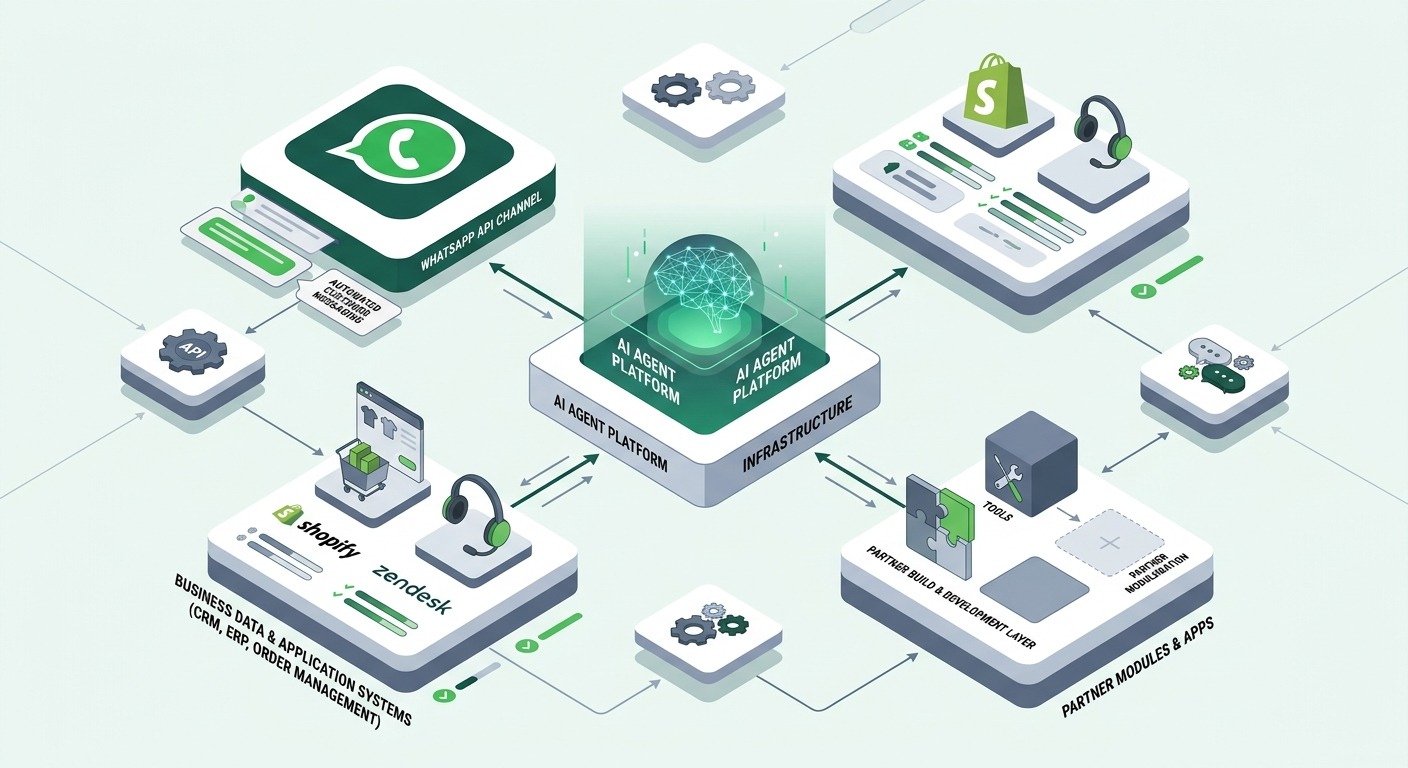
The Meta Business Agent Platform is the enterprise-grade infrastructure layer around that agent. It is what lets larger organizations and their partners build, customize, and deploy agents at scale, connect them to third-party systems such as Shopify for commerce or Zendesk for support, and manage the whole thing as a production service rather than a toy. Think of the Business Agent as the engine and the Platform as the factory, the tooling, the connectors, and the operational surface that turn one agent into a fleet of them tailored to individual brands.
The reason this framing matters is that the Platform is explicitly built for partners. Meta is not only shipping an agent for businesses to switch on. It is shipping the scaffolding for systems integrators, agencies, and technology partners to build agent solutions on top, customize them per client, and run them as an ongoing service. That is a deliberate ecosystem move, and it is why the July 1 milestone was framed as a partner rollout rather than a simple feature toggle.
What a Meta Business Agent Can Do
The promise is concrete, and it is worth being specific because the capabilities define the business case. A Meta Business Agent can do four headline things inside a conversation.
It can answer questions specific to a business. Not generic chatbot answers, but responses grounded in that company’s catalog, policies, hours, inventory, and knowledge. A customer asking whether a product ships to their pincode, what the return window is, or whether a particular size is in stock gets an answer drawn from the business’s own information rather than a canned deflection.
It can make product recommendations. Given what a customer is looking for, the agent can suggest relevant items, compare options, and guide the shopper toward a fit. This turns the conversation from a support channel into a sales channel, which is exactly the shift Meta is selling.
It can book appointments. For service businesses, clinics, salons, consultants, the agent can check availability and schedule directly in the chat, removing the back-and-forth that usually leaks bookings.
It can close sales. The agent can carry a customer from interest to purchase, processing orders and completing transactions without a human stepping in. This is the capability that reframes messaging from a cost center into a revenue line, and it is why the pricing model is built around usage and value rather than a flat fee.
Because the Business Agent spans WhatsApp, Instagram, and Messenger, these capabilities are not limited to a single app. A brand can run the same agent across all three surfaces, meeting customers wherever they already are. For businesses that already treat messaging as a sales pipeline, the pattern echoes what we described in our guide to building a WhatsApp AI agent sales pipeline, now with Meta offering a first-party option for the agent brain.
Why Meta Built This Now
Understanding the motivation clarifies where this is heading. Meta’s messaging apps carry an enormous volume of business-to-customer conversation, and for years the monetization was indirect, through click-to-message ads and per-conversation or per-message fees on the Business Platform. The Business Agent is a direct move to monetize the conversation itself, by providing the intelligence that runs it and charging for that intelligence.
There is a strategic logic beyond revenue. The entire software industry is shifting from apps you operate to agents that operate on your behalf. Customers increasingly expect to type a natural request and have it handled, not to navigate a menu. If Meta did not provide a first-party agent, businesses would bolt third-party AI onto WhatsApp anyway, and Meta would capture none of that value while bearing all of the infrastructure cost. By shipping its own agent and a platform for partners to extend it, Meta positions itself at the center of the agentic shift on its own surfaces, and gives itself a consumption-based revenue stream that scales with usage rather than with ad load.
This is also why the pricing is token-based rather than a subscription. Meta is signaling that it intends to compete as an AI provider, charging for compute the way AI providers do, and betting that its rate will look compelling next to comparable high-complexity models. It is a bet that businesses will find it simpler and cheaper to use Meta’s agent, running natively where the conversation already lives, than to wire an external model into the same channel.
A Brief History: From Templates to Agents
To see how big this shift is, it helps to trace how business messaging on WhatsApp evolved to this point.
In the early years of the WhatsApp Business Platform, the interaction model was rigid by design. Businesses reached customers through pre-approved message templates, and customers navigated menus, quick-reply buttons, and list options. Automation meant a decision tree: if the customer taps this, send that. It was reliable and cheap, but it was not intelligent. A customer who phrased a question in an unexpected way, or wanted something the tree did not anticipate, hit a dead end or a human.
The next step was richer flows and knowledge-based bots, where automation could pull from a knowledge base and handle more varied questions, and where businesses layered in early AI to interpret intent. This was a meaningful improvement, but the intelligence was bolted on, often through third-party tools, and the experience still leaned on structure. The conversation was a series of steps more than a genuine dialogue.
The Meta Business Agent represents the third era: agent-first messaging. Here, the default front line is an AI that understands the business, reasons about the request, retrieves what it needs, and acts, booking, recommending, selling, without requiring the customer to fit their need into a predefined structure. The template and the human do not disappear, they become part of a mix orchestrated around the agent. That progression, from templates to flows to agents, is why this launch is not just a new feature. It is a change in the default mode of business conversation on the platform, and it is why the pricing model changed with it, from paying to send structured messages to paying for the intelligence that runs an open dialogue.
What Is Available Right Now
As of July 1, 2026, the Meta Business Agent Platform is live and the agent APIs are rolling out to eligible partners. Crucially for anyone evaluating it, the platform is free to use until billing begins on August 1, 2026. That gives businesses and partners a window of roughly a month to build, test, and deploy agents at no cost before the meter starts.
This free window is not incidental. It is designed to drive adoption before the pricing kicks in, letting teams prove value on real conversations and get comfortable with the tooling before there is a bill attached. For any business considering an agent, the practical implication is clear: the cheapest time to experiment is now, during the free period, so that when charging starts you already understand your usage patterns and your numbers.
Alongside the platform, Meta has published updated sales, technical, and go-to-market resources for partners, and opened a new Services Partner track so that systems integrators and agencies can build enterprise-scale agent solutions with dedicated implementation and managed-services offerings. Localized versions of the partner resources in Spanish, Portuguese, French, and Simplified Chinese are noted as coming soon, which signals that the global partner push is staged rather than simultaneous.
The Business Agent Versus the Platform Layer
A question businesses will immediately ask is whether they must use Meta’s agent, or whether they can bring their own. The answer is the heart of the design, and it is more open than a first read suggests.
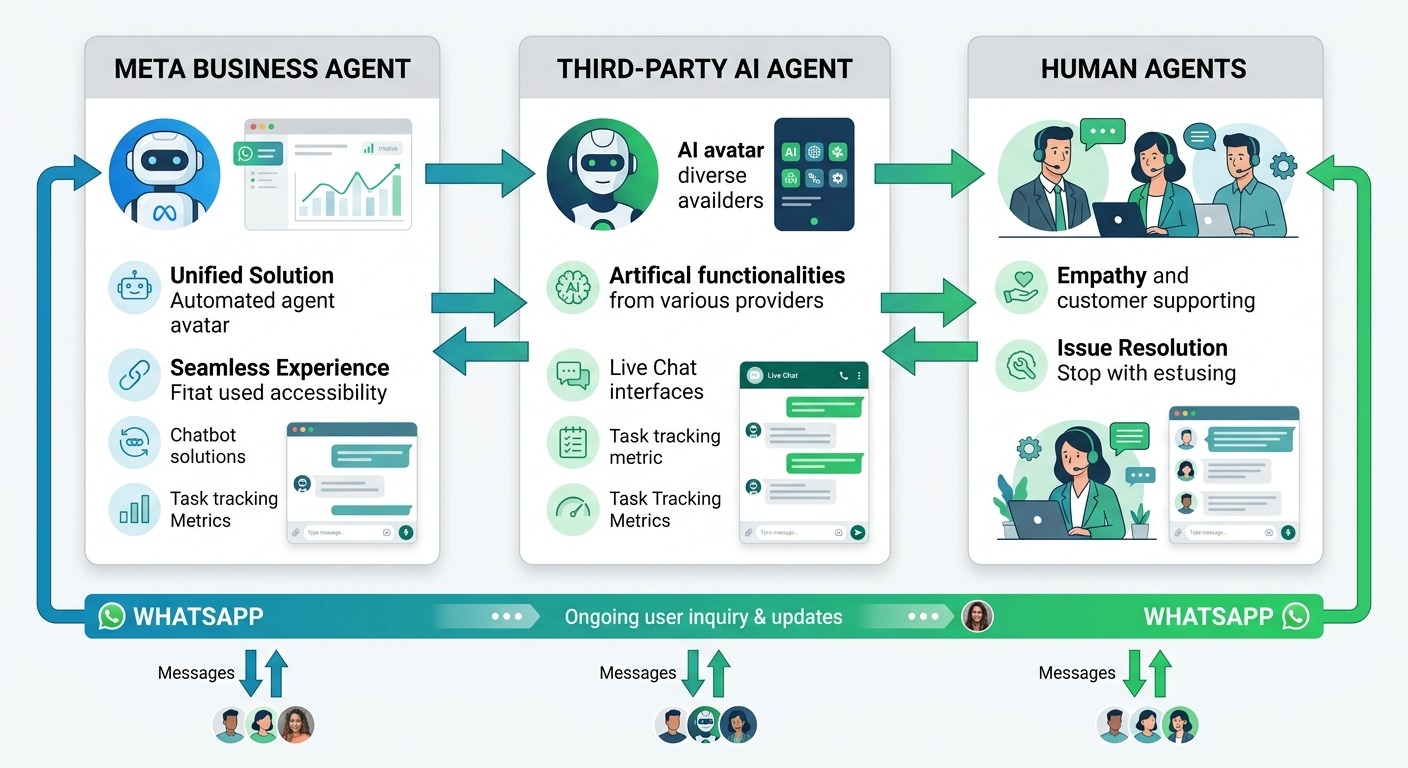
Meta’s framing is that businesses can respond to customers at scale using the Meta Business Agent, a third-party AI agent, human agents, or a combination of all three, with seamless handoffs between them. In other words, Meta’s agent is one option in a mixed environment, not a mandatory replacement for everything else. The Platform layer is what makes that mix possible, connecting agents, whether Meta’s or a partner’s, to the business’s data systems and to the WhatsApp conversation, and orchestrating the handoffs between automated and human responders.
This matters enormously for businesses that have already invested in their own automation, their own knowledge bases, and their own AI. It means the Meta Business Agent does not force a rip-and-replace. It can sit alongside a third-party agent that a business already trusts, handle the parts it is best at, and pass control to a human when the conversation needs one. The connectors to systems like Shopify and Zendesk reinforce this: the agent is meant to plug into the tools a business already runs, not to become a walled garden that replaces them.
Across WhatsApp, Instagram, and Messenger
Although WhatsApp is the headline surface, the Meta Business Agent is a cross-app capability spanning WhatsApp, Instagram, and Messenger. This omnichannel reach changes the calculus for brands, because it means a single agent investment can serve customers across all of Meta’s messaging surfaces rather than being siloed to one.
For a business, the practical benefit is consistency. The same agent, configured once with the brand’s knowledge and connected once to the brand’s systems, can answer a customer who reaches out on Instagram after seeing a post, on Messenger from a Facebook page, or on WhatsApp from a click-to-message ad. The customer gets the same quality of answer and the same ability to buy or book, regardless of which app they happened to open. For brands that run acquisition across Meta’s family of apps, that unified agent layer removes the fragmentation that used to force separate automation per channel.
It also compounds the reach argument. WhatsApp alone counts its users in the billions, and adding Instagram and Messenger extends the agent’s potential audience to nearly the entire Meta messaging footprint. For a business, deploying an agent is not a bet on one app, it is a bet on the dominant messaging infrastructure of much of the world.
How a Meta Business Agent Is Configured
Businesses evaluating the agent will want to understand, at least in outline, what it takes to make one work well, because a capable agent is configured, not conjured.
The foundation is knowledge. An agent is only as good as what it knows about the business. That means grounding it in the catalog, the policies, the hours, the shipping rules, the FAQs, and whatever else customers ask about. This is the difference between an agent that answers confidently and correctly and one that guesses or deflects. Getting the knowledge right, keeping it current, and structuring it so the agent retrieves the right piece at the right moment is the single biggest determinant of quality.
The second element is connections to systems. An agent that can only talk is a brochure. An agent that can act needs to reach the systems that hold live data and perform real operations: the commerce platform to check stock and place orders, the booking system to see availability and schedule, the support system to look up a ticket or a customer. The Platform’s connectors to systems such as Shopify and Zendesk exist for exactly this, turning the agent from a talker into a doer that can check, recommend, book, and sell against real business state.
The third element is behavior and guardrails. A brand needs the agent to speak in its voice, follow its rules, escalate when it should, and never do things it must not. Shaping that behavior, and setting the boundaries where the agent hands off to a human rather than improvising, is part of making an agent safe to put in front of customers.
None of this is a weekend project for a serious deployment, which is exactly why Meta built a partner ecosystem around it. But the outline matters for any business: the agent’s value comes from good knowledge, real system connections, and well-set behavior, and a business should plan for all three rather than expecting an agent to be great out of the box.
Understanding Tokens: A Primer for Business Owners
Because the new pricing is measured in tokens, and most business owners have never had to think in tokens, a short primer pays for itself.
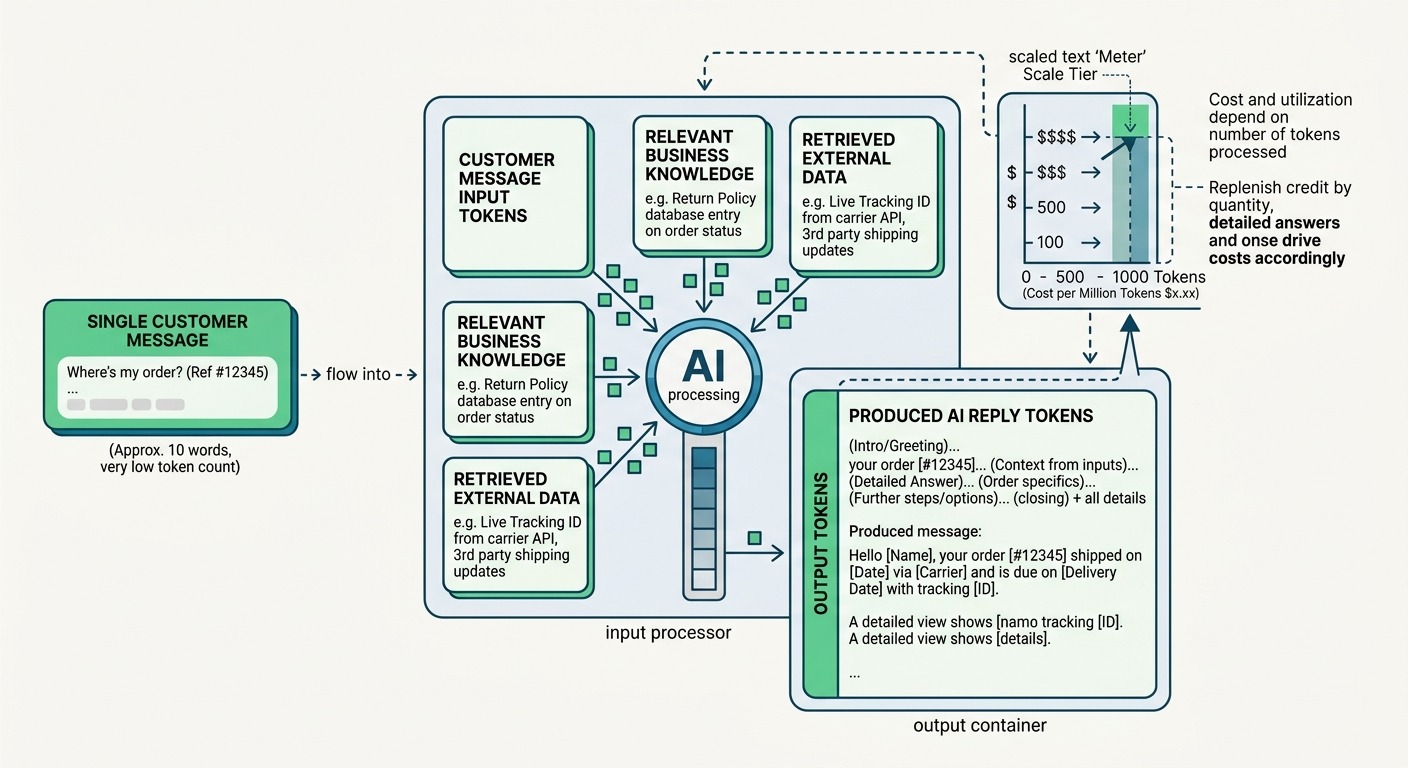
A token is a chunk of text that a language model processes, roughly a word or a piece of a word. When an agent handles a message, it processes tokens in two directions. The input tokens are everything the agent reads to understand and answer: the customer’s message, the relevant slice of the business’s knowledge, any data retrieved from connected systems, and the running context of the conversation. The output tokens are everything the agent writes back: its reply to the customer. Meta’s per-token charge covers this processing, blended together with the message delivery into one figure.
The practical consequence is that cost tracks complexity. A short factual question with a short answer consumes few tokens. A conversation where the agent digests a large catalog, reasons across several turns, retrieves order and inventory data, and composes a detailed, personalized response consumes many more. This is why Meta gives a range, roughly 4 to 5 cents per message, rather than a single fixed price. The number for any given business depends on how much reading and writing its conversations require.
There is a useful lever hidden in this. Businesses that keep their agent’s knowledge well-structured, so the agent retrieves only the relevant piece rather than wading through everything, and that design conversations to reach outcomes efficiently rather than meandering, will consume fewer tokens per outcome and pay less. Token pricing quietly rewards good design. A tidy, well-grounded agent is not just a better experience, it is a cheaper one, and that alignment between quality and cost is one of the healthier features of the model.
The Three Partner Tracks
Meta is expanding its partner programs to support agent deployment across three tracks, and understanding them clarifies who does what in this ecosystem.
Solution Partners are the established messaging partners who help businesses connect to and operate on the WhatsApp Business Platform. Under the new model, their role expands from wiring up messaging to helping businesses build and run agents.
Tech Partners are the technology providers who build products and integrations on top of the platform. For them, the Business Agent Platform is a new capability to build with, extending their own products to orchestrate, customize, or complement Meta’s agent.
The Services Partner track is new. It is aimed at systems integrators, agencies, and other partners who deliver implementation and managed services, and it lets them build and deploy enterprise-scale agent solutions with dedicated offerings. This track recognizes that large agent deployments are not self-serve. They require design, integration, tuning, and ongoing management, and Meta is formalizing a partner category to deliver exactly that.
The common thread is that Meta is not trying to sell agents purely self-serve. It is building a partner economy around agent deployment, because real-world agents need people who can design them for a brand’s specific needs, integrate them with the brand’s systems, and keep them performing over time.
The Partner’s Expanded Role
For partners and agencies, the Business Agent Platform is a genuine expansion of what they can offer, and it reshapes the services opportunity around WhatsApp.
The first new role is to build and customize AI agents on behalf of businesses. This is design and implementation work: understanding a brand’s needs, shaping the agent’s behavior, grounding it in the brand’s knowledge, and connecting it to the brand’s systems. It is the difference between a generic agent and one that actually represents a specific business well.
The second is to offer ongoing managed services. Agents are not set-and-forget. They need their performance optimized, their integrations maintained, and their results interpreted so the business understands what is working. This is recurring work, and it is where partners build durable relationships rather than one-time projects.
The third is to unlock new revenue streams through implementation services, workflow orchestration, and the incentives Meta offers partners for driving deployment and growth. The shape of those partner incentives is detailed in Meta’s own partner materials and is beyond the scope of this public explainer, but the direction is clear: Meta wants partners economically motivated to deploy and grow agent usage, because partner-led deployments are how enterprise adoption scales.
For agencies and integrators, the takeaway is that agent work is a new services line with real recurring revenue, sitting on top of the messaging services many already provide. The businesses that win here are the ones who can translate a brand’s goals into an agent that reliably hits them, and then keep it sharp.
Partner Enablement and Documentation
To support all of this, Meta has published a set of resources for partners and developers alongside the launch: developer documentation for building and testing against the APIs during the free window, pricing documentation with an explainer guide, and partner guidance on where to add value across the agent lifecycle and which engagement model fits.
The investment in enablement is itself a signal of intent. Meta is treating the Business Agent as a major platform motion, not a minor product update, and is putting real technical and go-to-market scaffolding behind it to help partners build, sell, and ship agents. For a partner, the practical first step is to work through the developer documentation and the pricing guide during the free period, identify where they add value in the agent lifecycle, and pick the engagement model that fits their business before billing starts.
Pricing 1: Meta Business Agent Token Billing
This is the change with the widest reach, so it deserves careful explanation. Effective August 1, 2026, Meta will charge for the Meta Business Agent on a per-token basis, aligned to how AI providers price their models.
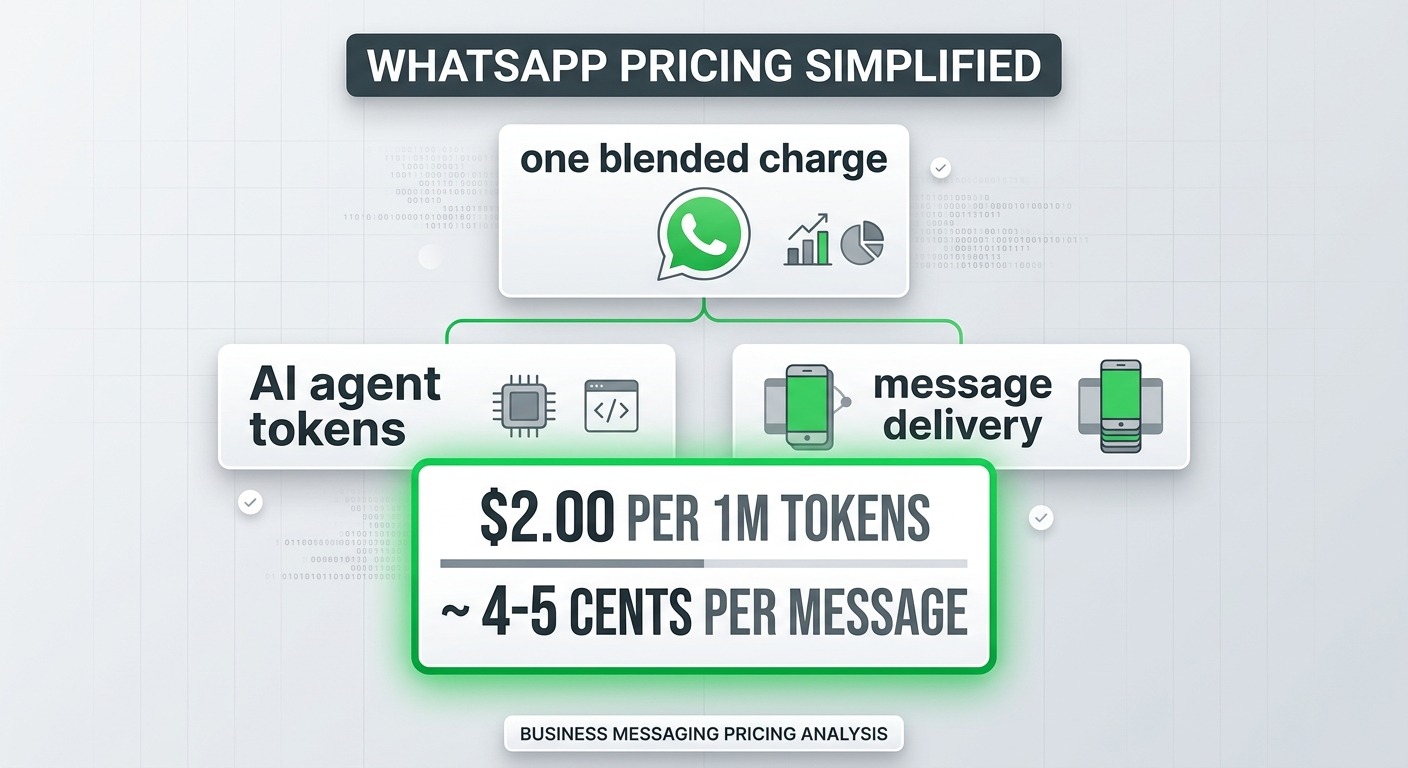
Here are the specifics Meta has shared. The rate is $2.00 USD per 1 million tokens, which Meta translates to roughly 4 to 5 cents (USD) per message. Critically, Meta applies one single charge across both the AI agent usage and the message delivery. That is a meaningful simplification: instead of paying separately for the model’s thinking and for sending the WhatsApp message, a business pays one blended token-based charge that covers both. Meta bills all clients directly for the Business Agent and issues monthly invoices at the end of each billing period.
Tokens are the fundamental units of text that large language models process, covering both the input the agent reads, such as the customer’s message, the business’s knowledge, and any retrieved data, and the output the agent generates, its reply. Because the charge is per token, cost scales with how much the agent has to read and write to handle a conversation. A simple, short exchange consumes fewer tokens than a complex one where the agent digests a large catalog, reasons across several turns, and composes detailed responses. The roughly 4 to 5 cents per message figure is Meta’s estimate of a typical blended cost, and it implies that a single agent-handled message bundles a substantial amount of model processing plus the delivery, all in one charge.
Meta’s positioning is that this rate should be more compelling to businesses than those of comparable high-complexity models, precisely because it blends the AI and the delivery and runs natively where the conversation lives. Whether that holds for a given business depends on conversation complexity and volume, which is exactly why the free window until August 1 is valuable: it lets a business measure its own real token consumption before the rate applies.
Pricing 2: Service Messages Resume Charging
The second pricing change affects every business on WhatsApp, whether or not it uses an agent. Effective October 1, 2026, Meta will resume charging for service messages on a per-message basis.
A service message, as a reminder, is any non-template message a business sends to a customer that is not enabled by the Meta Business Agent. In practice, these are the free-form replies a business or its human agents send inside the customer service window. That window is the open 24-hour period that begins and resets each time the customer sends a message, and service messages can still only be sent while it is open.
For a stretch of 2026, service messages were free, which made human and non-template responses inside the service window effectively costless. That is ending. From October 1, per-message rates for service messages will match the rates for utility and authentication messages in each market, so the cost depends on the country. The effect is that the free-form conversation a business has with a customer inside the service window, once a zero-cost activity, becomes a metered one, priced like the other message categories the business already pays for. Businesses that lean heavily on human agents sending many free-form messages will feel this most, and should model the impact before it lands.
Pricing 3: Utility Templates in the Service Window
The third change closes what would otherwise be a loophole and completes the picture. Also effective October 1, 2026, Meta will resume charging for utility templates sent inside an open customer service window, on a per-message basis.
The logic is consistency. Once service messages inside the window are charged, it would be inconsistent to leave utility templates sent in that same window free, so Meta is charging those too. The net result, stated plainly by Meta, is that any response to a user sent inside the customer service window incurs a charge, whether it is a utility template, a service message, or a Meta Business Agent message. The era of free responses inside the service window is over across the board.
For businesses, this removes the optimization games that used to revolve around which message type to send inside the window to avoid a charge. From October 1, the question is no longer how to respond for free, because there is no free response. The question becomes which response type delivers the most value for its cost, which is a healthier way to think about the channel even if it raises the floor on spend.
The Bigger Pricing Picture
Step back and the three changes tell one story: Meta is moving WhatsApp business messaging toward a model where the intelligence and the interaction are both priced, and where responding to a customer always has a cost attached.
Put the pieces together. From August 1, agent responses are billed per token as a single blended charge. From October 1, human and non-template responses inside the service window are billed per message at utility and authentication rates, and utility templates inside the window are billed too. Whichever way a business chooses to answer a customer inside an open conversation, an AI agent, a human, or a template, there is now a charge. The channel is fully metered.
This reshapes the economics in a way businesses should plan for rather than be surprised by. The strategic questions change. It is no longer about avoiding message costs, it is about maximizing the value of each paid interaction. An agent that closes a sale for a few cents of tokens is cheap. A human sending twenty free-form messages to resolve something an agent could have handled in three is now visibly expensive. The pricing nudges businesses toward efficient, outcome-driven conversations and toward using automation for volume while reserving humans for the interactions that genuinely need them. Our WhatsApp Business API pricing guide walks through the per-message categories and market rates that these changes now extend into the service window.
Token Math: Worked Cost Examples
Because token pricing is unfamiliar to many businesses, a few illustrative calculations make it concrete. These are simplified examples using Meta’s stated figures, not quotes, and real costs vary with conversation complexity.
Start from the rate: $2.00 per 1 million tokens, which Meta estimates at roughly 4 to 5 cents per message. Take the higher end, 5 cents per agent-handled message, for a conservative view.
Consider a small business whose agent handles 5,000 customer messages in a month. At about 5 cents per message, that is roughly $250 for the month, covering both the AI processing and the delivery in the single blended charge. For a business using the agent to answer questions, recommend products, and close some of those conversations into sales, the question is simply whether the revenue and saved labor from 5,000 automated interactions exceed a few hundred dollars, which for most businesses with real sales intent it comfortably does.
Now scale up. A mid-sized business whose agent handles 100,000 messages a month would see roughly $5,000 at 5 cents per message. That is a real number, but it is being spent on automation that would otherwise require a substantial human team to match, and it is directly tied to conversation volume, which usually correlates with demand. The token model means the cost flexes with usage: a slow month costs less, a busy month costs more, and the business is never paying for idle capacity.
The nuance is conversation complexity. Because the charge is per token, an agent that has to reason over a large catalog, retrieve lots of data, and hold long multi-turn conversations will consume more tokens per message than a simple FAQ bot, pushing the effective per-message cost toward or beyond the 5-cent estimate. This is why the free window matters: measuring your own token consumption on your own conversations, before August 1, is the only way to turn these illustrative numbers into a real budget. A business selling complex products with long advisory conversations should expect higher per-message costs than one answering short factual questions, and should size its budget accordingly.
Meta’s Cost Argument Versus Comparable Models
Meta has been explicit that it expects its rate to be more compelling to businesses than those of comparable, high-complexity models. It is worth unpacking that claim, because it explains the strategy and helps businesses judge it.
The comparison Meta is inviting is against running a strong third-party model yourself for the same work. If a business wired an external high-complexity model into WhatsApp, it would typically pay that model provider for input and output tokens, and separately pay Meta to deliver the WhatsApp messages. Meta’s pitch is that its blended charge, one figure of $2.00 per million tokens covering both the intelligence and the delivery, comes out simpler and, for comparable performance, cheaper than assembling those pieces separately from a top-tier external model plus delivery.
Whether that holds depends on two things a business can only know by testing. The first is performance: the argument assumes Meta’s agent performs comparably to the high-complexity models it is being measured against, and each business should judge that on its own conversations rather than on the claim. The second is total cost of ownership: a self-run third-party agent carries build and management effort that the first-party agent does not, but it also carries control and portability that the first-party agent does not offer. The honest reading is that Meta’s rate is designed to be attractive on a simple cost-per-message basis, and often will be, while the choice still comes down to how a business weighs simplicity and blended cost against control and differentiation. The cost argument is real, but it is one input to the decision, not the whole of it.
Key Dates to Put on the Calendar
The rollout and pricing changes land on a clear schedule, and every business on WhatsApp should mark these dates.
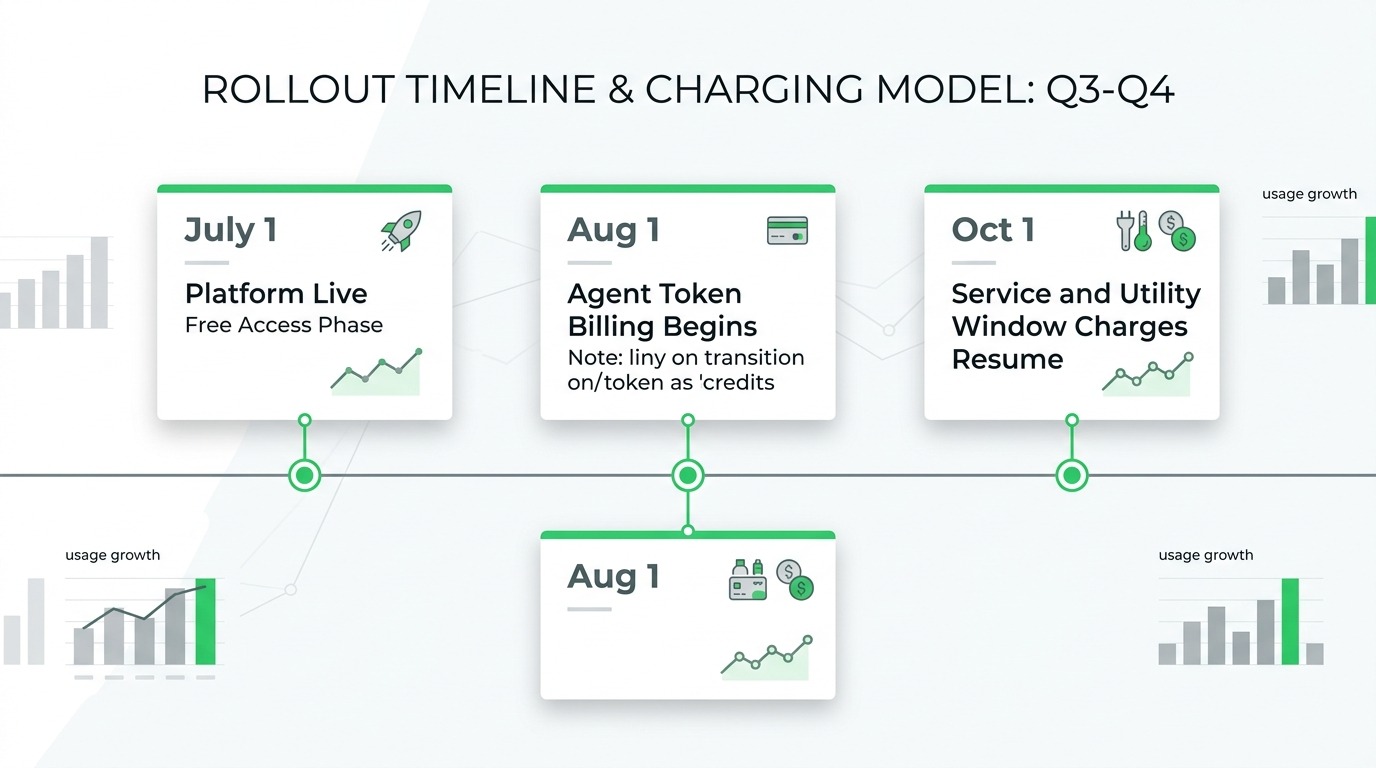
July 1, 2026: the Meta Business Agent Platform and its APIs roll out to eligible partners, and the platform is free to use. This is the build-and-test window.
August 1, 2026: Meta begins charging for the Meta Business Agent on a per-token basis, at $2.00 per million tokens, roughly 4 to 5 cents per message, billed directly by Meta with monthly invoices. The free period ends.
October 1, 2026: Meta resumes charging for service messages and for utility templates sent inside an open customer service window, both on a per-message basis at utility and authentication rates by market. From this date, every response inside the service window carries a charge.
The sequencing is worth noting. The agent becomes billable two months before the broader service-window charges resume, so businesses get a period where the agent is metered but human and template responses inside the window are still free. That interim window is a natural time to shift volume onto the agent and measure the trade-offs before the October changes make every response type billable.
Meta Business Agent Versus Third-Party Agents Versus Humans
The most important strategic question is not whether to use an agent, but which agent, and how to combine automation with people. Meta’s own framing gives businesses explicit permission to mix, and getting the mix right is where the real advantage lies.
The Meta Business Agent is the first-party option: native to the platform, blended into a single token charge, and quick to switch on. Its strengths are simplicity and integration, it lives where the conversation already is, and Meta handles the model. Its constraint is that it is Meta’s agent, behaving as Meta designs, which may or may not match a brand’s specific voice, logic, and control requirements.
A third-party AI agent is the bring-your-own option: a business or its partner runs its own agent, built on the model and logic it chooses, and connects it to the WhatsApp conversation. Its strengths are control, portability, and differentiation. The business owns the agent’s behavior, its data flows, and its evolution, and it is not locked to a single provider’s model or pricing. Its constraint is that the business or partner is responsible for building and running it, which is where a capable platform and partner matter.
Human agents remain essential for the conversations that need judgment, empathy, or authority that automation should not assume. The point of the new model is not to eliminate humans, it is to reserve them for where they are worth their higher cost, while automation handles volume.
The winning pattern for most businesses is orchestration, not exclusivity. An agent, whether Meta’s or a third party’s, handles the bulk of conversations, qualifies and progresses them, and hands off to a human the moment the situation calls for one, with the human able to hand back when the routine resumes. Meta has built the seamless handoff between these responders into the platform precisely because the future is mixed. The businesses that do best will not pick one responder type, they will design the handoffs so each conversation is handled by the cheapest responder capable of handling it well.
The Handoff Architecture in Detail
The seamless handoff between agents and humans is easy to state and harder to appreciate, so it is worth looking at how it actually behaves, because it is the mechanism that makes a mixed setup work rather than fracture.
A good handoff preserves context. When an agent has been talking to a customer and reaches a point where a human should take over, the handoff must carry the full conversation across so the human does not ask the customer to repeat themselves. Nothing frustrates a customer faster than explaining their problem to a bot and then explaining it all over again to a person. The value of the platform’s handoff is that the human inherits the thread, the customer’s history, and whatever the agent has already gathered, and picks up mid-stream.
A good handoff also works in both directions. The interesting cases are not just agent-to-human, but human-back-to-agent. A human resolves the judgment-heavy part of a conversation, then hands control back to automation for the routine follow-up, the order confirmation, the scheduling, the status updates. The conversation flows between responders according to what each turn needs, rather than being locked to whoever answered first.
And a good handoff is invisible to the customer. From the customer’s side, it is one continuous conversation in one thread. They are not bounced between channels or told to start over. Whether an AI or a person is answering at any given moment is a backstage detail, not a front-stage disruption. This is the architecture that lets a business handle volume with automation and reserve people for the moments that need them, without the seams showing. Designing those handoff points well, knowing when the agent should escalate and when it can safely resume, is one of the higher-value pieces of building a real deployment.
Industry Scenarios: Where Agents Deliver
The value of an agent is easiest to see through specific businesses, because the four headline capabilities, answer, recommend, book, sell, land differently across industries.
For ecommerce and retail, the agent is a salesperson that never sleeps. It answers product questions grounded in the live catalog, recommends items based on what the shopper wants, checks stock, and closes the order in the chat. The conversation that used to end at a support answer now continues to a sale. For a store already running conversational commerce, the agent deepens exactly the automation described in our guide to WhatsApp automation for ecommerce, adding first-party AI as one more responder in the mix.
For appointment-based services, clinics, salons, consultants, repair shops, the agent is a booking engine that lives in the conversation. It answers questions about services and availability, then schedules directly, checking the booking system for open slots and confirming in the chat. The bookings that used to leak during business hours because no one answered fast enough get captured around the clock.
For travel and hospitality, the agent handles the high volume of pre-purchase questions, availability, policies, options, that used to overwhelm human teams, recommends the right package or room, and moves toward a booking, escalating to a human for the complex or high-value cases where a person adds real value.
For financial and high-consideration services, the agent handles the informational front end, answering questions and qualifying interest, while handing off to a human at the point where regulation, judgment, or trust require one. The agent does the volume, the human does the moments that matter, and the handoff keeps it seamless.
Across all of these, the pattern repeats: the agent absorbs the routine and the repetitive, drives conversations toward outcomes, and hands off the exceptions. The businesses that map their own customer conversations to this pattern, deciding which parts an agent should own and where a human should step in, are the ones that turn the capability into results.
What It Means for Businesses
For a business weighing all of this, the implications are practical and immediate.
First, the cost of doing nothing is rising. From October 1, responses inside the service window are billable regardless of how they are sent, so the old habit of relying on many free human replies is now a visible line item. That makes efficient automation not just a nice-to-have but a cost-control measure.
Second, the free window until August 1 is a genuine opportunity. Building and testing an agent now, at no cost, lets a business learn its own token economics and prove value before any billing starts. The businesses that experiment during the free period will enter the paid era with data, not guesses.
Third, the choice of agent is a strategic one. A business that wants the simplest path may switch on Meta’s agent. A business that wants control over its agent’s behavior, portability across channels, and freedom from single-provider lock-in will prefer a third-party agent, orchestrated alongside Meta’s where it helps. Neither is wrong, and the platform is designed to let them coexist. The decision should follow from how much a business values control and differentiation versus turnkey simplicity.
Fourth, measurement becomes central. In a metered, token-priced world, the businesses that thrive are the ones that track cost per conversation and value per conversation, and steer toward automation that closes sales and away from expensive human effort on routine tasks. The channel rewards efficiency now in a way it did not when responses were free.
What It Means for Partners and Agencies
For partners, agencies, and systems integrators, the Business Agent Platform is one of the clearer service opportunities to emerge on WhatsApp in years.
The demand is real because agents are not self-serve at quality. Businesses need help designing an agent that represents their brand, grounding it in their knowledge, connecting it to their commerce and support systems, and keeping it performing as products, policies, and catalogs change. That is design work, integration work, and ongoing managed-services work, all of it recurring.
The new Services Partner track exists precisely to formalize this. Partners who can deliver enterprise-scale implementations and manage them over time have a defined lane, and the broader partner motion is built to reward driving deployment and growth. For an agency that already provides messaging services, agent work is a natural expansion that deepens client relationships and adds recurring revenue on top of one-time setup. The partners who invest early, learn the platform during the free window, and build repeatable delivery for agent projects will be positioned as the ecosystem scales through the second half of 2026.
What It Means for ChatMaxima Customers
For businesses running WhatsApp through ChatMaxima, the arrival of the Meta Business Agent is an expansion of options, not a disruption, and the orchestration model is exactly the point.
ChatMaxima customers already build AI agents on WhatsApp today, agents grounded in their own knowledge, wired into their own flows, and connected to their own systems, with human handoff to a live inbox when a conversation needs a person. That third-party agent approach is one of the three responder types Meta explicitly supports, and it is the one that keeps a business in control of its agent’s behavior, its data, and its portability across channels. Nothing about Meta’s first-party agent forces a business to abandon an agent it already trusts.
What changes is that businesses now have a first-party option to weigh alongside their existing setup, and the platform is designed for the two to coexist with seamless handoffs. A ChatMaxima customer can continue to run its own AI agent and human team, and, where it makes sense, incorporate Meta’s agent for specific tasks, orchestrating across all of them. The value of a platform that anchors the customer relationship, manages the conversation, and routes each message to the right responder only grows as the responder options multiply. The same orchestration principle behind a strong WhatsApp AI agent sales pipeline and behind good WhatsApp automation for ecommerce is what makes a mixed agent-and-human setup work in practice.
The October pricing changes matter here too, and preparing for them is the practical near-term task. Because every response inside the service window becomes billable, ChatMaxima customers should be steering routine, high-volume conversations onto automation and reserving human effort for the interactions that justify the cost. That is a natural fit for a platform built to automate the routine and escalate the exceptional.
How to Prepare: An Action Plan
Turning all of this into action is straightforward if it is sequenced.
For businesses, the near-term plan is: use the free window before August 1 to build and test an agent and measure your real token consumption on your own conversations; decide your agent strategy, first-party, third-party, or a mix, based on how much control and differentiation you need; model the October service-window charges against your current human and template volume so the cost is a plan and not a surprise; and shift routine, high-volume conversations toward automation while reserving humans for the interactions that need them.
For partners and agencies, the plan is: review Meta’s partner guidance and identify where you add value across the agent lifecycle; learn the platform and APIs during the free window so you can deliver quickly once billing starts; build a repeatable delivery model for agent design, integration, and managed services; and position agent work as a recurring services line on top of the messaging services you already provide.
For everyone, the unifying advice is to treat the free window as the cheapest time to learn, and to enter the paid era with data about your own usage rather than assumptions.
Getting Started in the Free Window: A Practical Sequence
The window between July 1 and August 1 is the cheapest month a business will ever have to learn this, and a simple sequence makes the most of it.
Begin by picking a narrow, high-volume use case rather than trying to automate everything at once. The best first agent handles one well-defined job that happens often: answering the top product questions, capturing bookings, qualifying inbound leads. A focused first deployment is faster to build, easier to judge, and gives you clean data on token consumption for that use case.
Next, ground the agent in real knowledge for that use case. Feed it the actual catalog, policies, and answers customers really ask about, not a sanitized subset. The point of the free window is to test on representative conversations, and that only works if the agent has representative knowledge to work from.
Then connect one real system if the use case needs it, the commerce platform for stock and orders, the booking system for availability, so you learn what integration actually involves rather than testing a talker in isolation.
Now run real or realistic conversations through it and watch the numbers. Measure tokens per conversation, watch where the agent is strong and where it stumbles, and note where it should hand off to a human. This is the data that turns the abstract 4-to-5-cents-per-message figure into your number.
Finally, decide and plan before August 1. With real usage data, decide whether to expand the agent, how to budget for the token charges, and how the agent fits alongside your humans and any third-party automation you already run. Enter the paid era with a plan built on your own measurements, not on estimates.
Pitfalls to Avoid
A few predictable mistakes trip up first-time agent deployments, and naming them helps you skip them.
The biggest is thin knowledge. An agent grounded in a shallow or outdated knowledge base gives shallow or wrong answers, and no amount of clever configuration fixes a weak foundation. Invest in the knowledge first, and keep it current, because a stale catalog or an outdated policy turns a helpful agent into a liability.
The second is no clear handoff plan. An agent with no well-defined escalation points either over-escalates, dumping everything on humans and defeating the purpose, or under-escalates, pushing forward on conversations it should have handed off, which erodes trust. Decide deliberately where the agent stops and a person starts.
The third is ignoring the numbers. Deploying an agent and never measuring token cost per outcome or value per outcome means flying blind in a metered channel. The businesses that win instrument from day one.
The fourth is treating the free window as the whole story. Building an agent that works beautifully in July but budgeting nothing for August is a planning failure. The free period is for learning, and the learning should include your future cost.
The fifth is all-or-nothing thinking. Deciding you must either go fully first-party on Meta’s agent or fully avoid it misses the design Meta actually shipped, which is a mix. The strongest deployments combine responders, and the businesses that insist on a single answer usually pick a worse one.
Measuring Agent ROI
In a metered channel, the businesses that win are the ones that measure well, so it is worth being concrete about what to track.
The two numbers that matter most are cost per conversation and value per conversation. Cost per conversation, in the agent era, is largely token consumption plus any human time the conversation required. Value per conversation is whatever outcome the business cares about: a completed sale, a booked appointment, a resolved issue that would otherwise have escalated, a qualified lead passed to sales. The agent is working when value per conversation comfortably exceeds cost per conversation, and the job of optimization is to widen that gap.
There are levers on both sides. On the cost side, well-structured knowledge and efficient conversation design reduce tokens per outcome, and good handoff points keep expensive human time reserved for where it earns its keep. On the value side, an agent that recommends well and closes confidently turns more conversations into sales, and one that captures bookings around the clock recovers demand that used to leak. The businesses that instrument these numbers, watch cost per outcome and value per outcome, and tune toward the gap, will run a channel that pays for itself many times over. The ones that deploy an agent and never look at the numbers will not know whether they are winning.
The broader point is that token pricing makes ROI legible in a way flat pricing never did. When every conversation has a measurable cost and a measurable outcome, the return on the channel stops being a matter of faith and becomes a matter of arithmetic. That is uncomfortable for lazy automation and excellent for good automation.
Common Misconceptions
Because this is new, several misreadings are already circulating. A few are worth correcting directly.
The first is that the agent is free. It is free only until August 1, 2026. After that it is billed per token. The free period is a window to learn, not a permanent state, and planning as though it were free past August is a mistake.
The second is that the agent replaces all human agents. It does not, and Meta’s own model assumes a mix. The agent handles volume and routine, humans handle judgment and the moments that need them, and the platform is built for handoffs between them. Treating the agent as a total replacement for people misreads both the technology and Meta’s framing.
The third is that a business must use Meta’s agent. It need not. A business can run a third-party AI agent, or humans, or any combination, with Meta’s agent as one option among them. The first-party agent is a choice, not a mandate, and the choice turns on how much control and differentiation a business wants.
The fourth is that the October changes only affect agent users. They do not. The resumption of charging for service messages and utility templates inside the service window applies to every business responding to customers in that window, agent or not. A business that never touches an agent still needs to plan for the October pricing.
The fifth is that token pricing is unpredictable chaos. It flexes with complexity, but it is measurable and controllable. A business that tests during the free window knows its own numbers, and good agent design keeps token consumption in check. The variability is real but manageable, not mysterious.
Risks and Open Questions
No honest explainer skips the caveats, and there are several worth holding in view.
The first is cost predictability. Token-based pricing flexes with conversation complexity, which means a business with long, data-heavy conversations could see effective per-message costs above the 4-to-5-cent estimate. Until a business measures its own usage, its budget is an estimate. The free window is the tool to resolve this, but it requires actually testing on representative conversations.
The second is lock-in versus control. Meta’s first-party agent is simple, but it is Meta’s agent, and a business that builds its entire customer conversation on it accepts Meta’s behavior, roadmap, and pricing. A third-party agent preserves control and portability at the cost of more responsibility to build and run. This is a genuine trade-off, not a solved question, and each business should decide it deliberately.
The third is the rising floor on spend. The October changes make every service-window response billable. For businesses with heavy human-agent usage, this is a real cost increase, and the mitigation, shifting volume to automation, takes planning and tooling that should start now rather than in October.
The fourth is staged availability. Localized partner resources are still coming, and the rollout is to eligible partners first, so not every business or market is on the same timeline. Businesses should confirm their own eligibility and timing rather than assume uniform availability.
Setting Realistic Expectations on Quality
An honest explainer has to address quality directly, because an agent put in front of customers is representing the brand, and the gap between a good deployment and a poor one is wide.
The single biggest determinant of quality is what the business feeds the agent. An agent grounded in accurate, current, well-structured knowledge answers reliably. An agent grounded in thin or stale information invents, deflects, or misleads, and it does so confidently, which is worse than a bot that simply says it does not know. The uncomfortable truth is that most agent quality problems are not model problems, they are input problems. The model is capable, the knowledge behind it often is not, and the fix is in the business’s own hands.
This is why grounding and retrieval matter so much. A well-built agent answers from the business’s real data rather than from general guesswork, which both improves accuracy and reduces the risk of confident errors. The connections to live systems reinforce this, letting the agent check reality, is this in stock, is this slot open, rather than guess at it. A business evaluating the agent should test exactly these edges: the questions where a wrong answer is costly, the moments where the agent should check a system rather than assume, and the situations where it should hand off rather than press forward.
Human oversight remains part of the picture, not because the agent cannot handle volume, but because judgment, exceptions, and high-stakes moments deserve a person. The right expectation is not a flawless autonomous agent that never needs anyone, it is a strong agent that handles the bulk well, knows its limits, and escalates cleanly. A business that expects perfection out of the box will be disappointed, and a business that treats the agent as a capable front line backed by human judgment and good inputs will be well served.
Finally, expectations should account for staged availability. The rollout reaches eligible partners first, and localized resources in Spanish, Portuguese, French, and Simplified Chinese are still coming, so a business’s exact timing depends on its market and its partner. The realistic posture is to confirm your own availability, test on your own conversations, and judge quality on your own results rather than on the headline capability. The agent is powerful, and its power is only as good as the knowledge, connections, and oversight a business puts around it.
How This Fits the Wider 2026 WhatsApp Shift
The Business Agent does not arrive in isolation. It is one piece of a larger transformation of WhatsApp into a serious, metered, agent-driven business channel, and seeing the whole picture makes each piece easier to plan for.
Three shifts are happening at once. The first is identity, where WhatsApp is decoupling the customer’s phone number from the conversation through usernames and the business-scoped identifier, changing how businesses recognize and remember customers. We covered that in depth in our WhatsApp username and BSUID guide. The second is pricing, where the platform is moving to fully metered per-message and now per-token economics, the subject of our WhatsApp Business API pricing guide. The third is intelligence, the Business Agent itself, putting AI at the front of the conversation.
These are not three unrelated updates, they are three faces of the same maturation. WhatsApp is becoming a channel where customers are identified by durable identifiers rather than raw numbers, where every interaction is priced according to the value it carries, and where AI agents do the heavy lifting of the conversation. A business that understands all three, and prepares for them together, is preparing for the WhatsApp of the next several years rather than reacting to one announcement at a time. The identity changes shape how you recognize a customer, the pricing changes shape what each conversation costs, and the agent shapes how the conversation is handled. Planning for them in isolation misses how tightly they interlock.
The Bottom Line and What to Do Next
The Meta Business Agent Platform marks the moment WhatsApp business messaging becomes an agent-first channel with AI priced like AI. The agent can answer, recommend, book, and sell, across WhatsApp, Instagram, and Messenger. The pricing is token-based, a single blended charge of $2.00 per million tokens or roughly 4 to 5 cents per message, starting August 1. And from October 1, every response inside the service window, agent, human, or template, carries a cost, ending the era of free replies.
The practical response is calm and concrete. Use the free window now to learn your own numbers. Decide your agent strategy with eyes open, first-party for simplicity, third-party for control, and a mix orchestrated with human handoff for most real businesses. Model the October changes before they land. And treat the channel as what it now is: a fully metered, outcome-driven surface where the winning move is to handle each conversation with the cheapest responder capable of handling it well.
For businesses that already run AI and human teams on WhatsApp, none of this requires abandoning what works. It requires deciding, deliberately, how Meta’s new agent fits alongside it, and preparing for a pricing world where efficiency is rewarded. If you want to see how ChatMaxima approaches building and orchestrating agents on WhatsApp, the pricing page is a good place to start, and the broader shifts in WhatsApp identity and cost, from the BSUID and username changes to the per-message pricing model, are all part of the same story: WhatsApp is maturing into a serious, metered, agent-driven business channel, and the businesses that prepare now will lead in it.
Sources: TechCrunch, Meta’s AI agent for WhatsApp Business is now available globally; WhatsApp Business Platform pricing documentation.
Frequently Asked Questions
What is the Meta Business Agent Platform?
Meta Business Agent is Meta’s platform for AI agents that automatically reply to customers across WhatsApp and Messenger. It introduces a new, separately billed message category for AI-generated replies on the WhatsApp Business Platform.
When does Meta Business Agent pricing take effect?
August 1, 2026. From that date, AI replies sent through the Meta Business Agent are billed as their own message category and are no longer free inside the 24-hour customer service window.
How much does the Meta Business Agent cost?
It is billed per token at $2.00 USD per 1 million tokens, roughly 4 to 5 cents per message, as a single charge that covers both AI processing and delivery.
Is Meta Business Agent free inside the 24-hour customer service window?
No. Unlike standard service messages, Meta Business Agent replies are chargeable from August 1, 2026 and are not covered by the customer service window or the free entry point window.
What else changes on October 1, 2026?
From October 1, 2026, utility templates and service messages sent inside the customer service window also become chargeable, and several markets move to standalone rate cards. See our WhatsApp API pricing guide for the current per-message rates by country.
How is Meta Business Agent different from a custom AI agent?
Meta Business Agent runs inside Meta’s platform with per-token billing, while a custom AI agent gives you full control over the flow, data, CRM, and human handoff across every channel. See Meta Business Agent vs Custom AI Agent.