A buyer sends the same enquiry to three agencies at 10:30 PM: “Is the two-bedroom on Maple Street still available? Can I see it this weekend?” The agency that answers first, with real availability and a viewing time, usually gets the viewing. The other two reply the next morning to someone who has already booked.
A real estate chatbot makes sure you are the first. It answers every enquiry instantly, asks the questions a good inside sales agent (ISA) would ask, matches the buyer to listings, books the viewing and hands hot leads to an agent. This guide explains what a real estate chatbot should do, the qualifying questions to use, how to connect it to your listings and calendar, and how to set one up in a week.
What is a real estate chatbot?
A real estate chatbot is an AI agent that talks to buyers, renters, sellers and landlords on your website, WhatsApp, Instagram and other channels. Modern ones are not menu-driven bots. They understand questions in plain language, answer from your own listings and policies, and take actions such as booking a viewing.
The best way to think about it is as an always-on real estate ISA. An inside sales agent’s job is to respond to new leads fast, qualify them, book appointments and pass qualified prospects to agents. A real estate AI agent does the first parts of that job at any hour, for every lead at once, so your human ISAs and agents spend their time on the conversations that need judgement.
Why speed and qualification matter in real estate
The data from the National Association of Realtors shows how much is decided early:
- 88% of buyers purchased their home through an agent or broker (NAR 2025 Profile of Home Buyers and Sellers).
- 43% of buyers said their first step was looking at properties online, while 21% first contacted an agent (NAR 2024 Profile of Home Buyers and Sellers).
- 81% of sellers contacted only one agent before choosing (NAR 2024 Profile of Home Buyers and Sellers).
Most buyers start online, and most sellers never look past the first agent they reach. The first agent who replies helpfully has a large advantage, which is the whole idea behind speed to lead.
What a real estate chatbot should do
A useful AI real estate assistant handles six jobs:
- Answer instantly, on every channel, at any hour.
- Qualify the lead with a few natural questions.
- Match listings to what the person wants, from your own inventory.
- Book viewings or valuation appointments into a real calendar.
- Route qualified leads to the right agent, with an alert.
- Follow up with leads who go quiet, and hand over to a person whenever needed.
If a tool cannot do the last three, it is a contact form with better manners, not an ISA.
The qualifying questions to use
Keep qualification short: three to five questions, asked conversationally, never as a form. The agent should save every answer to the contact record so no human has to ask again.
For buyers:
- What type of property and how many bedrooms?
- Which areas are you considering?
- What is your budget range?
- Are you pre-approved for a mortgage, or paying cash?
- When are you hoping to move?
For renters:
- Which area and how many bedrooms?
- What is your monthly budget?
- When do you want to move in?
- How many people will live there, and any pets?
For sellers and landlords:
- What is the property address and type?
- When are you thinking of selling or letting?
- Have you had a valuation recently?
- Would you like to book a free valuation?
Seller leads are the most valuable, and the NAR data shows most sellers stop at the first agent they contact. A fast, professional reply to a seller enquiry is worth more than almost anything else your chatbot does.
Answering from your listings
The question buyers ask most is “what do you have that fits?” A real estate chatbot should answer from your actual inventory, not from a generic AI model’s guesses.
Three common ways to connect listings:
- A spreadsheet of listings. Keep a Google Sheet with price, area, bedrooms, type, status and a link per property. The agent filters it by the buyer’s answers, for example a budget between two values in a specific area, and replies with the matches.
- Your website. If every listing has a page, the agent can be trained on those pages and answer questions about them.
- Your CRM or property system’s API. Larger agencies can let the agent query their system directly.
Keep the data current. The fastest way to lose a buyer’s trust is to offer a property that sold last week. Make updating the listings sheet or website part of the daily routine, mark properties as under offer or let as soon as it happens, and tell the agent to check status before offering anything. If a buyer asks about a property that is no longer available, the agent should say so and suggest similar ones straight away.
Send photos and a link to the full listing with each match, and always end with a next step: “Would you like to see it on Thursday or Saturday?”
Booking viewings
Booking is where a chatbot pays for itself. The agent checks real availability in the agent’s calendar, offers two or three times, and creates the appointment when the buyer picks one. Give each agent their own booking calendar, so viewings land with the right person, and send the buyer a confirmation with an easy way to reschedule or cancel.
For valuations, the same flow works with the seller: capture the address, offer valuation slots and book the visit.
Routing hot leads and handing over
Not every lead needs a human straight away, but some need one in minutes: a pre-approved buyer ready to view this week, or a seller who wants a valuation. Route those automatically.
- Assign by rule. Use round robin across the team, or rules based on the lead’s answers, such as area or property type.
- Alert the agent. A mobile notification the moment a qualified lead is assigned.
- Hand over with context. The agent sees the whole conversation and every answer, and takes over in the same chat thread.
- Track the pipeline. Move leads through stages, such as new, qualified, viewing booked and offer, so nothing is lost.
Following up with leads who go quiet
Property decisions take time. Many leads read your reply and disappear for days. Set up gentle follow-ups: a nudge if they do not answer within a few hours, a check-in a few days later, and a message from your team when you list a property that matches what they asked for.
For new listings, send a WhatsApp message to the segment of contacts whose saved preferences match, such as buyers looking for three bedrooms in a particular area. Keep it relevant: a message about a property that fits their budget and area is welcome; a weekly blast of everything is not.
The channels buyers use
A real estate chatbot should be wherever enquiries arrive:
- Your website, on listing pages and the contact page.
- WhatsApp, which many buyers and renters prefer for quick questions and sharing photos.
- Instagram and Facebook, where property posts and reels drive messages.
- Click to WhatsApp ads, which start a conversation instead of a page visit. We cover this in our guide to AI agents that qualify Click to WhatsApp leads 24/7.
- Portal and form leads, sent into the same flow by webhook so they get the same instant reply.
- Phone calls, answered by an AI voice agent when your team is busy. See our guide to the AI receptionist for small business.
An example conversation
Here is how a good real estate chatbot handles a late-night enquiry on WhatsApp:
Buyer: Hi, is the two-bed on Maple Street still available?
Agent: Hi Sofia, yes, it’s available. It’s a two-bedroom, two-bathroom apartment with a balcony. To check it suits you, what’s your budget range, and are you buying with a mortgage?
Buyer: Around 400 to 450k, and I have a mortgage approval in principle.
Agent: That fits well. I also have a similar two-bed on Elm Avenue at 435k. Would you like to view Maple Street, or both? I have Thursday at 6 PM or Saturday at 11 AM.
Buyer: Both on Saturday please.
Agent: Done. You’re booked for Maple Street at 11 AM and Elm Avenue at 11:45 AM on Saturday with Daniel. Daniel will see your answers before the viewing. Anything else I can help with?
In under two minutes, at night, the lead is qualified, matched to a second property and booked with an agent, who now has a full brief before Saturday.
Real estate chatbot use cases by business type
Residential agencies. Instant answers to listing enquiries, buyer and renter qualification, viewing bookings and seller valuation requests. The biggest wins come from evenings and weekends, when most portal and website enquiries arrive.
Property developers and new projects. Launches create floods of enquiries in a few days. A chatbot answers questions about floor plans, payment plans and completion dates, qualifies buyers by budget and timeline, and books site visits or sales-office appointments.
Rental and property management. Renters ask the same questions about availability, deposits, pets and move-in dates. A chatbot answers them, collects application details and books viewings. For existing tenants, it can log maintenance requests and route them to the right person.
Commercial real estate. Fewer leads, larger deals. The chatbot’s job is to capture the requirement precisely, such as size, location, budget and lease term, and get a broker on a call quickly.
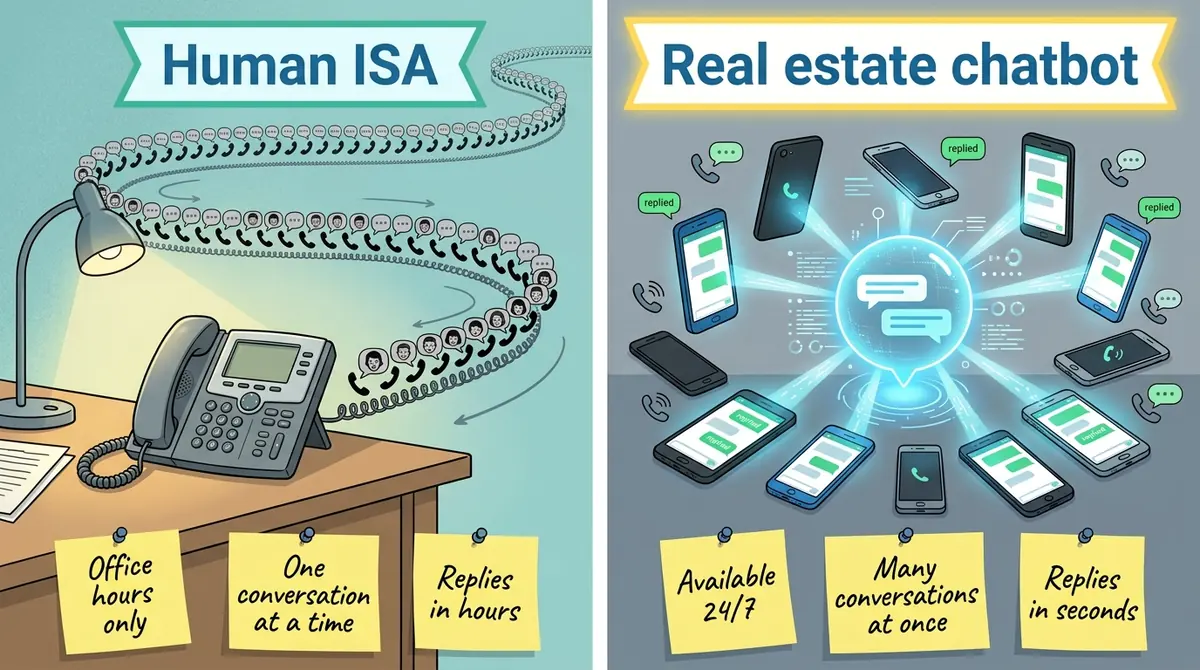
Real estate chatbot vs human ISA
| Human ISA | Real estate chatbot | |
|---|---|---|
| Response time | Minutes to hours, in office hours | Seconds, 24/7 |
| Leads handled at once | One conversation at a time | Many at once |
| Qualification | Deep, adaptive | Consistent, on your script |
| Complex objections | Strong | Should hand over |
| Cost | A full-time salary | A platform subscription |
The strongest setup uses both. The chatbot answers, qualifies and books every lead instantly; human ISAs and agents call the hottest leads, handle negotiation and build the relationship.
Metrics to track
Measure your AI for real estate leads with a handful of numbers each month:
- First response time across all channels, ideally under a minute.
- Qualification rate: the share of conversations where the agent collected budget, area and timeline.
- Viewings booked by the chatbot, and the share that actually happened.
- Hot leads routed to agents, and how fast agents followed up.
- Leads by source, such as website, portal, WhatsApp ads and Instagram, so you know where to spend.
The single most useful number is viewings booked per hundred enquiries. It tells you whether the chatbot is turning attention into appointments.
Mistakes to avoid
Ignoring fair housing rules. In the US and many other markets, housing law forbids steering buyers or renters based on protected characteristics. Keep your chatbot’s questions about the property and the purchase, never about the person’s background, and review its instructions with compliance in mind.
Inventing answers. An AI that guesses prices or availability creates legal and trust problems. Answer only from your listings and policies, and say “let me check with an agent” otherwise.
Asking too much too soon. Five questions in a row feels like an interrogation. Answer the buyer’s question first, then qualify.
No human path. Some buyers want to speak to a person straight away. Make that one tap away.
Letting bookings go unconfirmed. Every viewing needs a confirmation and an easy way to reschedule, or no-shows rise.
How to set up a real estate chatbot in a week
Day 1: Map your lead sources and the questions agents ask first.
Day 2: Prepare your listings in one source of truth, such as a spreadsheet or your website.
Day 3: Write the agent’s instructions: tone, qualifying questions, what it must never say, and when to hand over.
Day 4: Connect calendars for each agent and set viewing lengths and buffers.
Day 5: Set up routing, alerts and the pipeline stages.
Day 6: Test with your team playing buyers, renters and sellers, including tricky questions.
Day 7: Launch on your website and WhatsApp first, then add Instagram, ads and portal leads.
Selling real estate chatbots as a service
Brokerages and developers often want this but have no one to build it. For agencies, a real estate AI agent is a high-value niche, idea 13 in our list of AI agent business ideas, priced at around $1,000 a month per client. The pitch is simple to prove: count the viewings the chatbot books in its first month, especially those booked outside office hours, and compare them with the cost of the service. Most brokerages see the value within weeks.
Real estate chatbots with ChatMaxima
ChatMaxima gives agencies and brokerages the full ISA workflow in one platform:
- AI qualification. A MaxIA agent asks your qualifying questions naturally and saves budget, area, timeline and financing to the contact in MaxCRM.
- Answers from your listings. Filter a Google Sheet of listings by price range, area or type, call your property system’s API, or train the agent on your website’s listing pages.
- Property media. Send listing photos and videos, and image carousels on your website chat.
- Viewings. Check Google Calendar availability and book viewings in the chat, or send each agent’s own booking page, with confirmations and self-service reschedule and cancel links.
- Routing and handoff. Round robin or rule-based assignment, mobile push alerts to agents, pipeline stages in MaxCRM, and human takeover in the shared inbox.
- Every channel. Website chat, WhatsApp, Instagram, Messenger and Telegram, Click to WhatsApp ad attribution, and portal or form leads by webhook.
- Follow-ups. No-reply nudges, delays and WhatsApp messages to segmented contact lists.
- Calls. An AI voice agent answers inbound property calls on your Twilio number or on WhatsApp calling.
What’s next
A real estate chatbot will not replace good agents, but it will stop good leads from going to whoever answers first. Start with your busiest channel, connect your listings and one agent’s calendar, and let the chatbot answer, qualify and book every enquiry. Then measure how many viewings it books in the first month.
Ready to book more viewings? Compare ChatMaxima plans and start a 7-day free trial.