Your next customer may not visit your website at all. They may ask an AI agent to find a dentist with a Saturday slot, reorder their usual coffee beans, or book a table for six, and the agent will do the visiting for them. That shift is called agentic commerce, and it is arriving faster than most businesses are ready for.
The awkward part is that many websites are turning these agents away, sometimes on purpose and often by accident. When an agent cannot get in, the customer behind it does not get served, and the sale goes to a business the agent can reach.
This guide explains what agentic commerce is, why AI shopping agents are being blocked, which standards are emerging to fix it, and a practical checklist to keep your business reachable.
What is agentic commerce?
Agentic commerce is buying and selling where an AI agent acts on the customer’s behalf. Instead of a person searching, comparing, filling in forms and paying, a personal AI agent does some or all of those steps, within limits the customer sets.
It helps to separate two kinds of agent:
- Personal agents work for the consumer. They search, compare, book and buy across many businesses.
- Business agents work for a company. They answer questions, qualify leads, take orders and handle support for that one business.
Agentic commerce happens where the two meet. A personal agent asks, and a business either answers well, answers badly or does not answer at all.
The money at stake is large. McKinsey estimates that agentic commerce could orchestrate $900 billion to $1 trillion of US retail revenue by 2030, and $3 trillion to $5 trillion globally, counting goods only (McKinsey, 2025). Services such as bookings and appointments come on top of that.
How agentic commerce changes the customer journey
Every stage of the buying journey changes when an agent is involved:
- Discovery. Instead of scrolling search results and ads, the customer states a need, and the agent builds a shortlist. Businesses that are easy for the agent to read and query make the list. The rest do not exist for that customer.
- Comparison. The agent compares facts side by side: price, availability, delivery time, cancellation terms and reviews. Vague or inconsistent information counts against you, because the agent cannot ask a salesperson to explain it.
- Transaction. The agent books, orders or pays within limits the customer has approved. A checkout flow that needs five screens and a CAPTCHA is where agent purchases fail.
- Service. After the sale, the agent may also handle “where is my order”, rescheduling and returns. A business that can answer those requests in a conversation keeps the customer; one that can only offer an email form loses them.
The common thread is that agents reward businesses that are clear, consistent and reachable. Brand awareness and clever page design matter less when a machine is doing the reading.
Why AI shopping agents are getting blocked
The first wave of consumer AI shopping agents has run straight into websites built for humans. Three things are getting in the way.
Deliberate blocks
Some large platforms do not want third-party agents shopping on their sites. In September 2026, Amazon began blocking Meta’s Muse agent from its retail site, after Meta declined a request to stop it (Bloomberg, 2026). Many airline, marketplace and review-site terms of use also ban automated tools without written permission.
For a platform that earns money from people browsing its pages, an agent that skips straight to checkout is a threat to its advertising. Expect more of these blocks from large marketplaces.
Accidental blocks
Most businesses have not decided to block agents. Their defences decided for them. Bot protection, CAPTCHAs and “verify you are human” steps were built to stop scrapers and fraud, and they cannot always tell a harmful bot from a legitimate agent acting for a real customer. The result is an agent that gets halfway through a booking or checkout and then stops.
New default settings
Infrastructure providers are also changing their defaults. Cloudflare now sorts AI traffic into three categories: Search, Agent and Training. For new domains, its defaults block the Agent category on pages that display ads, so an agent reading an ad-supported page on a person’s behalf can be turned away (Cloudflare, 2026). Site owners can change these settings, but many do not know they exist.
The three doors an AI agent can use
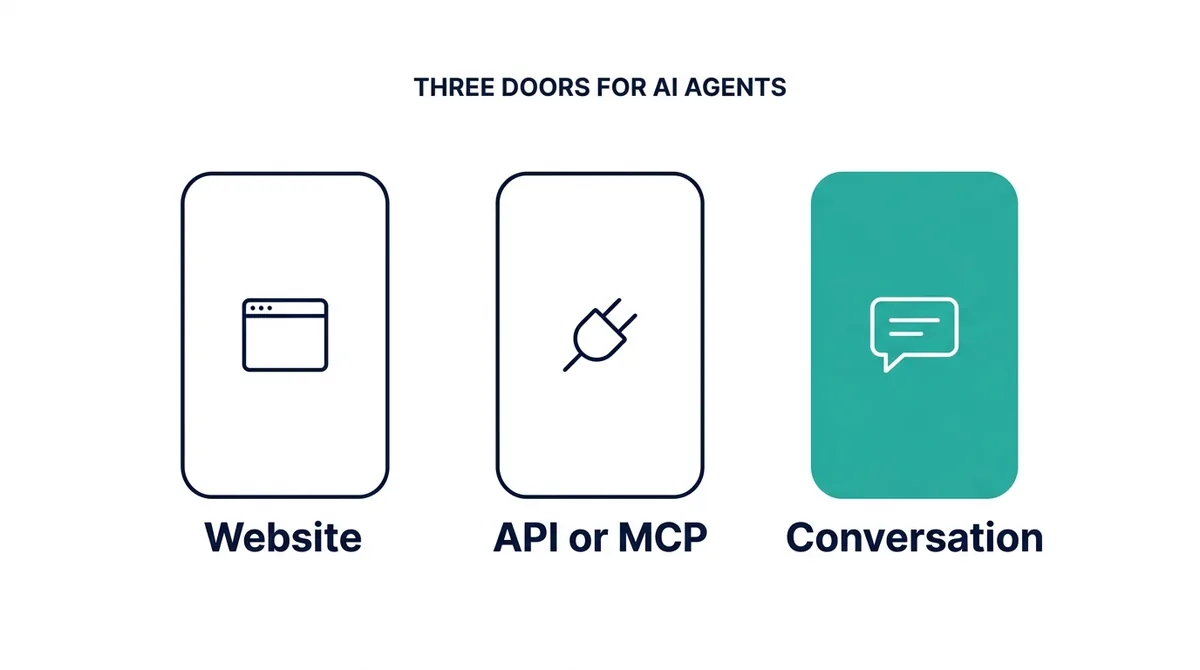
A personal agent can reach your business in three ways. Knowing which ones you have open is the first step.
- The website. The agent browses your pages like a person would. This is the door most likely to be blocked by bot checks, and the most fragile, because a page redesign can break the agent’s path.
- An API or MCP server. The agent calls your booking, ordering or account functions directly through an API, or through the Model Context Protocol (MCP), a standard way for AI agents to use tools. This is the most reliable door, but it needs developer work.
- A conversation. The agent talks to your business in natural language, through your chat, your WhatsApp number or your phone line, and your own business agent handles the request. This is the door most small businesses can open quickly.
The emerging standards treat all three as valid. A personal agent might use the regular website, connect through APIs built on standards such as MCP and OpenAPI, or hand off to a company’s own agent when the task needs a conversation.
The agentic commerce protocols taking shape
Several open standards are competing and overlapping to make agentic commerce safer and more predictable.
Personal Agent Protocol
On October 6, 2026, Sierra and Meta introduced the Personal Agent Protocol, an open standard for how personal agents interact with businesses. It focuses on authentication, consumer control over what an agent may do, and visibility for the business into what agents are doing on its website, through its APIs or with its own agents (Sierra, 2026).
The first partners include Genesys, Instinct, Rocket, Shopify, Stripe and Walmart. A draft specification followed, with dozens more design partners across banking, retail, travel and payments (Sierra, 2026). The basic idea is simple: consumers decide what access to give their agents, and businesses set what those agents are allowed to do.
Other protocols you will hear about
- Model Context Protocol (MCP): a standard way for AI agents to discover and use tools and data from a business system.
- Agentic commerce protocols for payments: several schemes from AI and payments companies aim to let an agent complete a purchase securely, with the customer’s approval and without handing the agent a raw card number.
- Agent-to-agent protocols: standards for one company’s agent to talk directly to another’s.
You do not need to implement any of these this year. You do need to know they exist, because the businesses that adopt them first will be the ones agents can reach most reliably. For a deeper look at how agents can go wrong when access is not controlled, see our piece on why AI agents need guardrails.
Should you block AI agents at all?
It depends on how you make money. Blocking agents can make sense if your revenue depends on people seeing ads on your pages, if your data is the product you sell, or if automated purchases create real fraud or resale risk, as with limited-edition products or event tickets.
For most businesses that sell a product, a booking or a service, the calculation runs the other way. The agent is not taking anything from you; it is bringing you a customer who has already decided to buy. Turning it away means turning away that customer, and they will simply ask the agent to try the next business on the list.
A sensible middle path for most businesses:
- Allow agents on booking, ordering and support paths, where they bring revenue.
- Limit high-volume automated access to pages where scraping hurts you, such as price lists a competitor could harvest.
- Require approval for anything that touches a customer’s account or money, and keep a human handoff for disputes.
Write that down as your policy, then make your technical settings match it.
An agentic commerce checklist for small and mid-sized businesses
You do not need a protocol team to prepare. These eight steps cover most of the ground.
1. Decide your agent policy
Write down, in one paragraph, which agents you want to serve and what they may do: browse, book, buy or only ask questions. Without a policy, your bot protection makes the decision for you, usually by blocking everything.
2. Check your bot and CDN settings
If you use Cloudflare or a similar service, look at how AI Agent traffic is handled, especially on pages with ads. Make sure booking and checkout pages are not blocking legitimate agents by accident, and test with an agent yourself.
3. Make sure verification does not lock out real people
Tighter bot checks can block human customers too. Review every CAPTCHA and “verify you are human” step on booking, login and checkout pages, and keep only the ones that protect against real abuse.
4. Keep your facts consistent and machine-readable
Agents compare businesses on facts: prices, opening hours, stock, delivery times and policies. If your website, your product catalog and your chatbot disagree, the agent will either give up or pick the answer that loses you the sale. Use structured data on your website and keep one source of truth for prices and availability.
5. Open a conversational front door
The simplest way to serve an agent is to give it something to talk to. A business AI agent on your website chat and WhatsApp can answer questions, check availability, take an order and send a payment link, whether the person on the other side is a customer or an agent working for one. On WhatsApp, a product catalog plus payment links lets the whole purchase happen inside the conversation.
6. Answer the phone with an AI receptionist
Personal agents do not only browse. Meta’s Muse, for example, can phone businesses on a user’s behalf, as we covered in our analysis of what Meta Muse changes for businesses. An AI receptionist that answers every call, checks the calendar and books the slot serves both human callers and agent callers, even when your website is closed to bots.
7. Expose your key actions through an API
If you have developers, publish an API, or an MCP server, for your most common actions: check availability, book, order and track. This is the most reliable door for agents, and it is where the new protocols will plug in.
8. Measure agent traffic
Track how many visits, chats and calls come from agents, and where they fail. A rising share of agent-driven bookings is a signal to invest more in the API and conversational doors.
What agentic commerce looks like in four industries
The same principles play out differently by industry.
Restaurants. A customer asks their agent for a table for six on Friday at 8 PM, near the office, with vegetarian options. The agent needs current availability, the menu and a way to book. A restaurant that takes reservations through a WhatsApp or website chat agent can confirm the booking in seconds. One that only takes phone calls during opening hours misses every request that arrives at night, unless an AI receptionist answers.
Clinics and salons. The request is “book my usual appointment with the same stylist next week.” The agent needs the provider’s calendar, the service list and the rescheduling policy. Appointment businesses are well placed, because booking is already a structured task: expose the calendar through a booking agent and the agent can complete it end to end.
Online stores. The request is “reorder the same running shoes in the next size up.” The agent needs product data, stock levels and a checkout it can use with the customer’s approval. Stores with a clean product catalog and a chat or WhatsApp channel that can send a payment link give the agent a path that does not depend on getting past website bot checks.
Travel and hotels. The request is “find a quiet hotel near the conference venue under $200 a night with free cancellation.” Here the agent compares many options at once, so clear policies and real-time rates decide who gets booked. Large travel brands will likely build APIs; smaller hotels can compete by answering agent questions quickly through a conversational channel.
In every case, the business that can answer a precise question and complete the task in one exchange wins the booking.
What this means for the bot traffic on your site
Agent traffic is part of a bigger shift in who visits your website. We covered the wider trend in bot traffic exceeding human traffic. The practical lesson is the same: you cannot treat every bot as an attacker any more. Some are scrapers, some are training crawlers, and some are your customers’ assistants trying to give you their money.
Blocking everything keeps out the bad bots and the good agents together. The goal now is to tell them apart, and to give the good ones a reliable way in.
How ChatMaxima helps you stay reachable
ChatMaxima gives businesses the conversational door from step 5 and the phone door from step 6 in one platform:
- AI agents across channels: one agent trained on your own website, documents and FAQs, answering on website chat, WhatsApp, Instagram, Messenger and in-app chat.
- Commerce inside the conversation: WhatsApp catalogs, payment links, invoices and order updates, so a purchase can be completed in the chat.
- Bookings: calendar booking and reminders from any conversation.
- Voice: an AI voice agent that answers calls, books appointments and hands complex calls to your team.
- Human handoff: a shared inbox, so anything the agent cannot handle reaches a person with the full conversation history.
See how the MaxAgent autonomous AI agent works, or start with a free trial.
What’s next
Agentic commerce will not replace your website overnight. But the share of customers who send an agent instead of visiting themselves is growing, and every blocked agent is a customer you never hear from.
The businesses that win the next few years will make three moves early: decide which agents they welcome, stop blocking good ones by accident, and give agents a reliable way to talk, book and buy. A conversation channel with an AI agent behind it is the fastest of those moves to make.
Ready to open your conversational front door? Compare ChatMaxima plans and start a 7-day free trial.