
Updated October 13, 2026: added the Personal Agent Protocol, the open standard Meta and partners announced on October 6 for how personal agents deal with businesses.
Meta Muse is Meta’s personal AI agent for consumers. It launched in the US on September 8, 2026, and within two weeks it was the most downloaded free app on the US App Store. Unlike a chatbot, which answers questions, Muse acts: it books, buys, calls, fills out forms, and negotiates on behalf of the person who owns it. And it is available directly inside WhatsApp.
Until now, the AI story on WhatsApp and Messenger has been about the business side. Meta’s own Business Agent, third-party AI agents, and chatbots all sit on the company’s end of the chat and answer customers. Meta Muse sits on the other end. It works for the customer.
This guide introduces Meta Muse: what it is, what it can do, how it works, what it costs, and how fast it is growing. Then it turns to the question that matters for a business: what happens when your customer brings their own agent? If you want the business-side half of the picture, our Meta Business Agent Platform explainer covers it.
What Is Meta Muse?
Meta Muse is a personal AI agent: software that takes a goal from a person and carries it out across the apps and websites they use. You connect Muse to your email, calendar, and payments, plus the apps you use for health and fitness, the smart home, dining, shopping, music, and events. Then you hand it errands.
Meta describes it this way: once a person shares a goal, Muse helps build a plan, organizes their time and resources, and then carries on the work by itself. In Meta’s words, “it can open a browser, fill out forms, and negotiate on their behalf.” Meta’s own examples include selling a car for more, lowering a bill, and adjusting a training plan.
The key facts at launch:
- Launched: September 8, 2026, in the US only
- Where it runs: iOS and Android apps, the web at muse.ai, and inside WhatsApp chats. A Mac app followed on September 18, and Meta’s smart glasses are next
- Model: Meta’s own Muse Spark foundation model
- Pricing: free for most everyday use, with two paid plans listed in Meta’s Help Center: Power at $20 a month (500 million Muse tokens per week) and Max at $100 a month (3 billion Muse tokens per week). The plans buy more usage, not extra features, and renew monthly. Subscribers must be 18 or older, and Meta says subscriptions are still in limited testing
- Checkout: purchases go through single-use cards from Link by Stripe, with Shop Pay and PayPal support
Muse is part of a wider Meta product family that already includes Muse Image, an image generator launched in July, and Muse Code, a coding agent launched in August. At Meta’s Connect event on September 23, Mark Zuckerberg called Muse “the centerpiece of our vision for what we’re building.”
What Meta Muse Can Do
The best way to understand Muse is by its verbs. According to Meta’s launch announcement, Muse can:
- Send emails and manage threads, with its own email address coming soon so users can CC or forward messages to it
- Book travel, restaurants, and appointments
- Make purchases from connected retailers
- Lower bills and negotiate prices on the user’s behalf
- Fill out web forms
- Plan and organize, such as turning a recipe reel into a grocery list or sending party invitations
- Place phone calls to US businesses, added on September 17, after Meta said phone calling was one of the top user requests
- Work on a Mac across files, messages, calendar, notes, and mail, continuing in the background
More is on the way. Meta announced a real-time video avatar you can talk to face to face, voice control through its smart glasses, and a keychain wearable called Muse Charm that ships in December 2026. With the Charm you tap a fingerprint sensor and speak, “without having to unlock a phone or open an app,” as Zuckerberg put it.
On the commerce side, Meta lists Stripe, Shopify, Best Buy, Gap, Sephora, Walmart, and Wayfair as partners, with Expedia and Instacart to follow. It also opened a developer program for connectors, and received more than 1,500 applications in under a week.
How Meta Muse Works
Each Muse user gets their own cloud computer, which Meta calls Muse Secure VM. Inside it, Muse has a file system, a terminal for writing small tools, and a full web browser for searching, navigating, filling forms, and completing transactions.
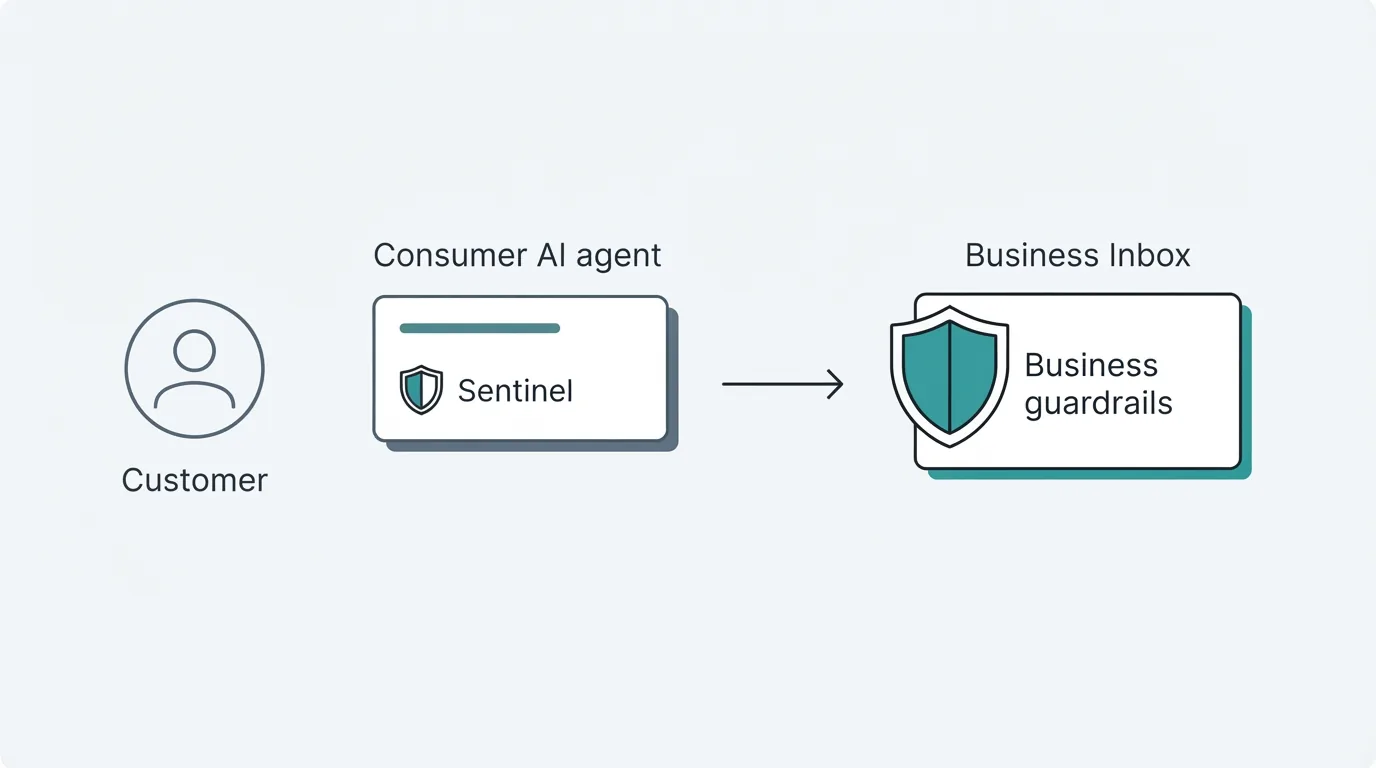
Everything Muse sends out passes through a separate program called Sentinel. Per Meta, “nothing Muse does reaches the internet unless Sentinel approves it.” Sentinel asks the user for permission when it judges it necessary, with a structured approval step before anything irreversible, such as spending money. Meta deliberately avoided asking for approval at every step, because constant prompts train people to approve everything without reading.
Two more design points matter:
- Credentials and payments. Meta says Muse “has no visibility into people’s passwords or payment methods.” Shared logins go into secure storage, and purchases use single-use Link by Stripe cards.
- Ads and privacy. Meta says conversations and data inside a user’s VM are not shared with its ad systems. Later in 2026 it plans a Muse Confidential VM, encrypted with a key only the user holds, so not even Meta can read it.
The overall design will look familiar to anyone who followed AI agents this year. Nat Friedman, head of product at Meta Superintelligence Labs, said openly on X that Muse was “built from scratch, but it is definitely heavily inspired as a product by OpenClaw,” the open-source agent that went viral earlier in 2026. That lineage cuts both ways. OpenClaw showed how capable a computer-using agent can be, and also how it can go wrong, as we covered in why AI agents need guardrails after the OpenClaw Gmail incident.
Notice who Sentinel protects, though. It protects the Muse user from their own agent. Nothing in it protects the business on the other end from an agent that misreads a policy, pushes for a discount it saw somewhere else, or books a slot that does not exist. That protection has to come from the business side.
Meta Muse by the Numbers
Muse’s early growth is the reason businesses should pay attention now rather than later. Download figures differ by tracker, platform, region, and time window, so each number carries its source.
| Metric | Figure | Source |
|---|---|---|
| US launch date | September 8, 2026 | Meta |
| Surfaces | iOS, Android, web (muse.ai), WhatsApp, Mac | Meta |
| Pricing | Free, Power $20/month (500M tokens/week), Max $100/month (3B tokens/week) | Meta Help Center |
| Early US iOS downloads | 83,000+ (No. 2 on the App Store) | Sensor Tower |
| No. 1 free iOS app in the US | September 18, 2026 | CNBC |
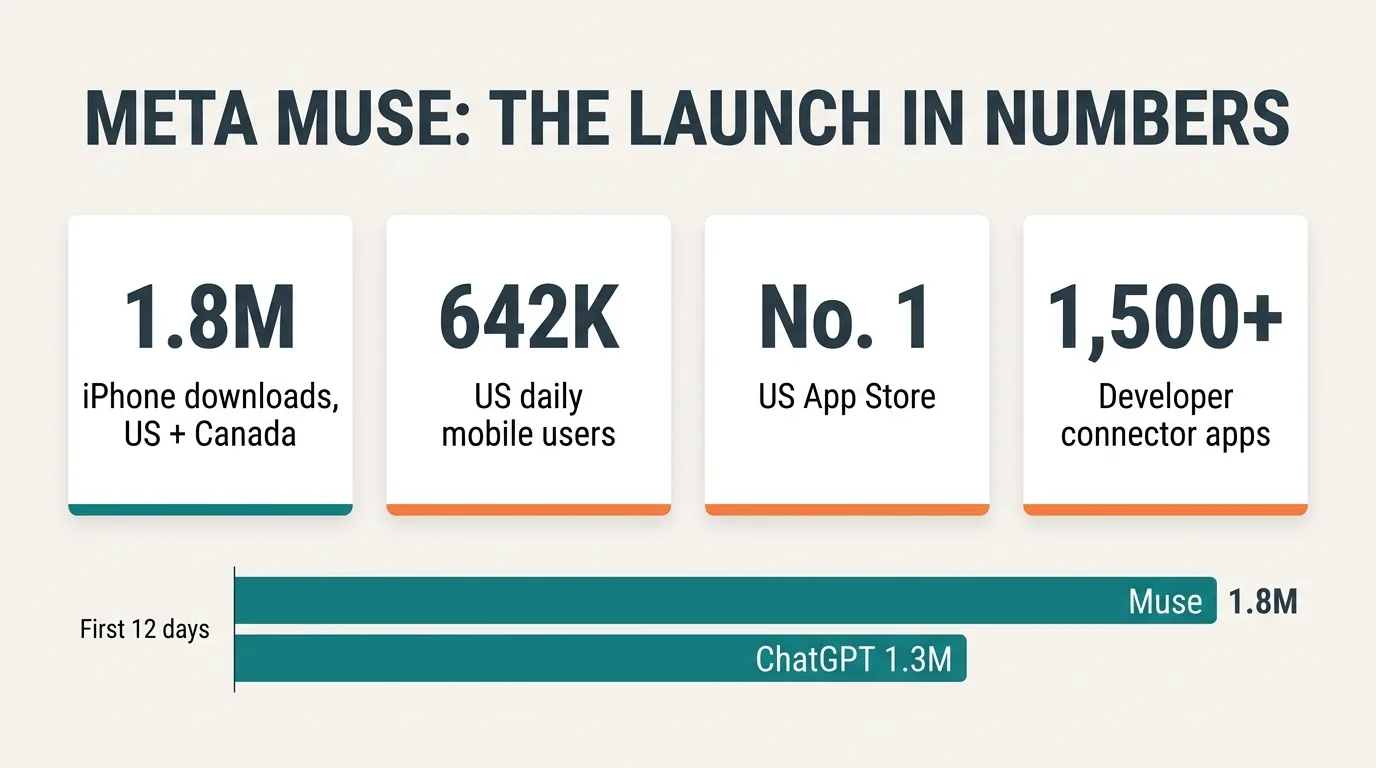
| iPhone downloads, first 12 days, US and Canada | Muse 1.8M vs ChatGPT 1.3M | Apptopia |
| US daily mobile users at the same point | Muse 642,000 vs ChatGPT 231,000 | Apptopia |
| Downloads by September 21 | about 1.5M iOS and 1.1M Android | Sensor Tower |
| ChatGPT across all platforms, same window | 3.1M | Sensor Tower |
| Developer connector applications | 1,500+ in under one week | Meta |
| Wearable ship date | December 2026 (Muse Charm) | Meta |
Two numbers stand out. The first is 642,000 daily users against ChatGPT’s 231,000 at the same stage, per Apptopia. Downloads can be bought with a marketing push; daily use says people are handing Muse real errands. The second is 1,500 connector applications in a week, which is the supply side lining up to plug into the agent.
To be fair to the comparison, ChatGPT still had more downloads across all platforms in the same window, per CNBC’s analysis. Muse has not overtaken ChatGPT. It has had a faster start where it launched. And its biggest advantage is distribution: it sits inside WhatsApp, an app billions of people already open every day, one tap away from the same chat list where your customers talk to you.
How Meta Plans to Make Money From Muse
The most important thing Meta has said about Muse is not a feature. It is the business model. At Connect, Zuckerberg said Meta is making Muse “free for a huge number of tokens, with the expectation that over time we will profit by taking a small fee from transactions.”
That means Meta earns when Muse completes a purchase, a booking, or a payment. It puts Muse directly in the path between your customer and your checkout, with a financial reason to route transactions through merchants who are wired in. Businesses that are easy for Muse to transact with will get the volume. Businesses that are not will get skipped.
The First Pushback: Amazon Blocks Muse
Not every merchant is on board. On September 20, Muse users trying to shop on Amazon started seeing an error: “Continued access by an unauthorized AI agent violates Amazon’s Conditions of Use, to which our customers have agreed.” Amazon blocked the agent after asking Meta to leave Amazon out of Muse’s shopping features, as Bloomberg first reported.
Amazon’s position: “third-party applications that offer to make purchases on behalf of customers from other businesses should operate openly and respect service provider decisions about whether or not to participate.” Its complaints were that Muse does not identify itself while browsing and appears to keep customers’ login credentials, which Meta’s statements about secure credential storage dispute.
Big-company rivalry is part of it, but the questions apply to every business:
- Should an agent have to say it is an agent? Amazon thinks yes.
- Who is liable when an agent places a wrong order? Nobody has a clear answer yet.
- Can a business decline to serve agents? Amazon did. Most businesses cannot afford to.
Amazon can say no because it is the destination. A clinic, a boutique, or a D2C brand on WhatsApp is not in that position. For most businesses, the realistic choice is not whether to serve customer agents but how to serve them on your own terms.
October Update: An Open Standard for How Agents Deal With Businesses
Amazon’s block showed the core problem: a business cannot easily tell a customer’s agent from an unwanted bot, and the agent has no agreed way to say who it is or what it is allowed to do. On October 6, 2026, Meta and Sierra introduced the Personal Agent Protocol, an open standard meant to fix exactly that.
The idea is simple. The consumer decides what access their personal agent gets, and the business sets what agents are allowed to do on its website, through its APIs or with its own AI agent. The first partners include Shopify, Stripe and Walmart, and a draft specification followed with dozens more design partners across banking, retail, travel and payments. The protocol is still early, and payments are expected in a later version.
Meanwhile, accidental blocks are as common as deliberate ones. Bot checks built to stop scrapers can stop a legitimate agent halfway through a checkout, and Cloudflare now blocks AI agents by default on ad-supported pages for new domains. For most businesses, the practical move today is to give agents a reliable way in that does not depend on the website: a chat or WhatsApp agent that can answer, book and take payment, and a phone line that an AI receptionist answers.
We cover the standards, the blocking problem and an 8-step checklist in our guide to agentic commerce.
What Meta Muse Changes for Businesses on WhatsApp and Messenger
Here is the plain picture. Meta has confirmed that Muse runs inside WhatsApp, calls US businesses on the phone, sends email, fills out web forms, and negotiates on its owner’s behalf. Meta has not announced that Muse will open chats with business accounts on WhatsApp or Messenger. But every piece needed for that is already in place: the surface, the permission model, the calling precedent, and a revenue model built on completed transactions. Planning as if it will arrive is the prudent reading.
1. The customer on the other end may be software
Your inbox was designed for people. People read menus, tap buttons, get distracted, and come back tomorrow. An agent does none of that. It arrives with a specific goal (“book a 30-minute consultation next Tuesday afternoon under $80”), reads everything you send, and moves on quickly if your flow does not produce an answer.
Expect three changes in traffic:
- More precise questions. Agents ask exactly what the owner needs, often several things at once.
- Parallel comparison. One agent may ask five competitors the same question in the same minute.
- Less patience for menus. A ten-step button tree built for browsing humans is a wall to an agent with a deadline.
2. Agent-to-agent conversations become normal
More than a million businesses already use Meta Business Agent on WhatsApp and Messenger to reply around the clock, according to Meta, and many more run their own AI agents. Add Muse on the customer side and a growing share of conversations become agent talking to agent, with the humans stepping in only to approve.
That changes what good looks like. Speed and accuracy matter more than tone. A clear, structured answer (“Yes, size 9 in black, in stock, $120, ships in 2 days, returns within 30 days”) beats a friendly paragraph. And the moment an agent needs something only a human can decide, a refund exception or a custom quote, your handoff to a person has to be fast and clean.
3. Your catalog, prices, and policies become machine-read
When a customer’s agent does the shopping, your WhatsApp catalog entries, product pages, price lists, and return policies are read by software before a human ever sees them. Inconsistencies that a person would shrug off become reasons to drop you. If your website says 30-day returns and your chatbot says 14, an agent will notice, and it will flag it to its owner or pick the competitor with the cleaner answer.
This is the conversational version of what SEO was for search. The businesses that win are the ones whose information is consistent, current, and easy to extract.
4. Your phone line gets agent callers first
Calling is the one business-facing capability Meta has already shipped. Since September 17, Muse can place calls to US businesses. Meta has not detailed whether Muse discloses that it is an AI on those calls. If your front desk handles bookings by phone, some of those callers are now agents.
The practical response is to make sure the phone and the chat give the same answers, and to have an AI voice or calling flow that can handle routine requests consistently. A WhatsApp calling flow that runs on the same logic as your chat keeps the two in sync.
5. Transaction fees move the money
Zuckerberg’s “small fee from transactions” is the line to watch. If Muse earns when it completes a purchase, Meta has every reason to make transacting through Muse easy for merchants who plug in, through Stripe, Shopify, Shop Pay, PayPal, and the connector program that received 1,500 applications in a week. Over time that could look like a new sales channel with its own economics, much as marketplaces did for ecommerce.
For WhatsApp-first businesses, this sits on top of what you already pay Meta. You pay for business-initiated templates and, if you use it, for Meta Business Agent by the token. A Muse transaction fee, if one reaches you directly or through your payment partner, would be a third layer. Budget for the possibility now rather than discovering it on an invoice.
6. Identity and trust become your decision
Amazon made a hard choice: agents must identify themselves or stay out. Most businesses will make softer ones, but they still need a policy. Will you accept bookings made by an agent? Will you honor a discount an agent claims to have seen? Will you require a human confirmation for orders above a certain value, or for anything involving health, legal, or financial details?
Write these down. Then build them into your flows, so the answer does not depend on which agent on your team, human or AI, happens to pick up the conversation.
Muse vs Meta Business Agent: Two Sides of One Conversation
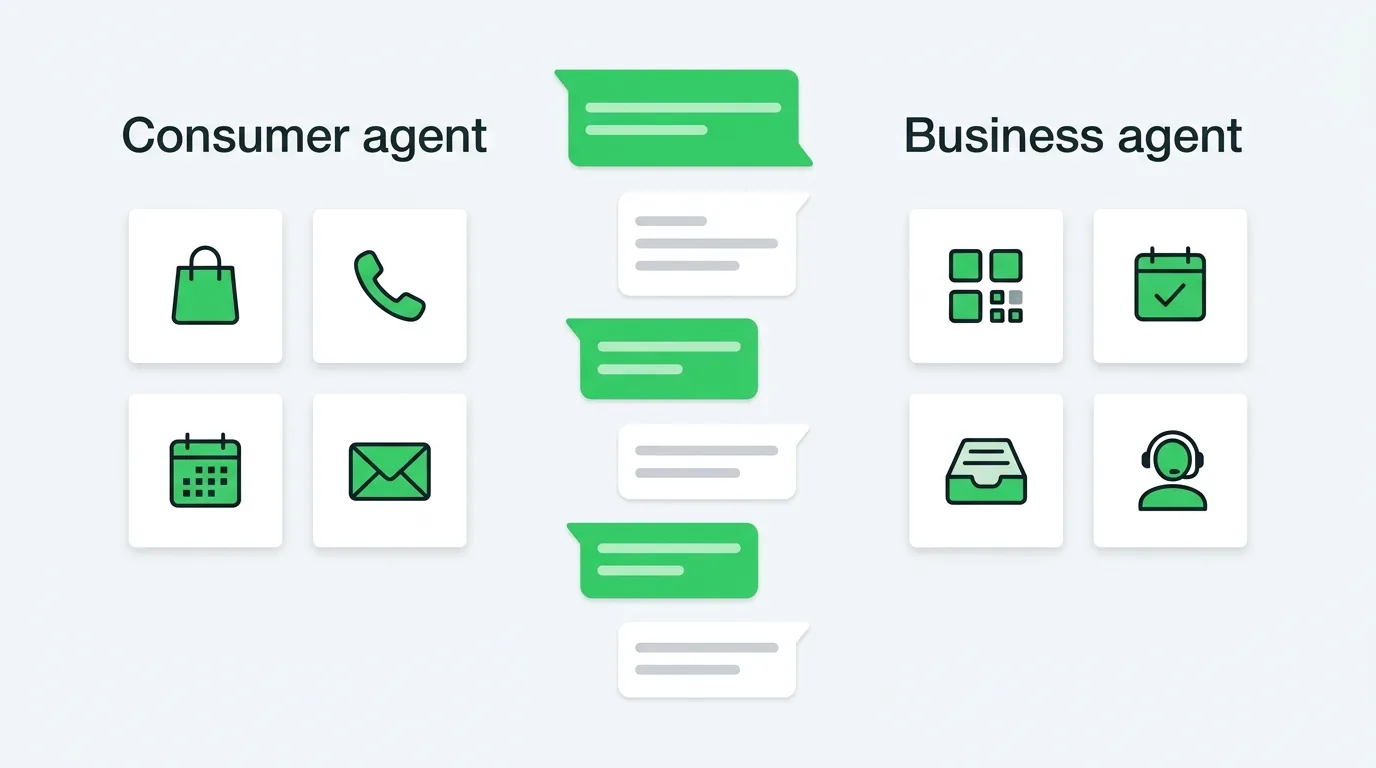
It is easy to confuse the two, because Meta makes both and both live in WhatsApp. They are opposites.
| Feature | Meta Muse | Meta Business Agent |
|---|---|---|
| Works for | The consumer | The business |
| Launched | September 8, 2026 (US) | June 3, 2026 (global) |
| Where it runs | Muse app, web, WhatsApp, Mac, glasses, Muse Charm | WhatsApp, Messenger, and ads |
| What it does | Books, buys, calls, emails, negotiates for its owner | Answers, recommends, books, sells for the business |
| How Meta earns | Paid tiers plus a planned fee on transactions | Token-based pricing charged to the business |
| Business controls | None, it is the customer’s agent | Configured and owned by the business |
| Safety model | Sentinel approvals protect the user | Business knowledge and settings define behavior |
The table makes the strategic point clear. Meta is selling an agent to both sides of your conversation. One represents your customer. One can represent you. Meta earns on both. For a business, the question is not only which agent answers your customers, but who controls the logic, the data, and the handoff when it matters. We compared those trade-offs in detail in Meta Business Agent vs a custom AI agent.
How It Stands for Businesses: Who Gains, Who Is Exposed
Muse will not affect every business equally. Based on what Meta has shipped and announced, here is how different business types stand.
Well positioned: appointment-based services. Salons, clinics, fitness studios, consultants, and repair services live on bookings, and bookings are exactly the errand Muse is built for. If your availability is accurate and bookable in chat, an agent that fills your open slots is a gift. If booking still requires a phone call and a callback, you will lose those customers to someone with a live calendar.
Well positioned, with work to do: retail and D2C brands on WhatsApp. Muse’s commerce partner list is heavy on retail, and Shopify is on it. Brands with clean catalogs, clear stock, and simple checkout will benefit. Brands whose WhatsApp experience is a human replying to “price?” hours later will not.
Exposed: businesses that win on persuasion rather than information. If your conversion depends on a salesperson building rapport over a long chat, an agent that wants a price, a spec, and a delivery date is a harder customer. You will need to decide which parts of the conversation to automate and where a human must step in.
Exposed: businesses with inconsistent information. Anyone whose website, chatbot, catalog, and staff give different answers will be found out quickly. Agents compare, and they remember.
Watching, not acting yet: businesses outside the US. Muse is US-only today. But Meta AI, Meta Business Agent, and WhatsApp features have all expanded globally after US starts, and WhatsApp’s biggest markets are outside the US. The next 6 to 12 months are preparation time, not a reason to ignore it.
A 90-Day Readiness Checklist for WhatsApp and Messenger Businesses
None of this requires waiting for Meta to announce the next step. These are changes that improve your customer experience today and prepare you for agent customers tomorrow.
- Audit your facts. List prices, hours, stock rules, delivery times, and return policy. Make sure your website, WhatsApp catalog, chatbot knowledge base, and staff scripts all say the same thing.
- Put direct answers first. For your top 20 questions, make sure your chat flow can give a complete, one-message answer without forcing a menu walk.
- Make bookings and orders completable in chat. Live availability, a clear confirmation, and a payment link where relevant. Every step that requires a callback is a step an agent will skip.
- Set a policy for agent requests. Decide which actions need human confirmation, which discounts you honor, and what you do when a request looks automated.
- Tighten your human handoff. When an agent hits something only a person can decide, route it to a human with the full conversation attached, fast.
- Align voice and chat. If you take calls, make sure the phone and the chat give identical answers and book into the same calendar.
- Watch your conversation logs. Look for new patterns: very precise questions, many identical questions from different contacts, unusually fast replies. That is how you will see agent traffic arrive.
- Model the costs. Template charges, AI agent tokens, and possible transaction fees. Know your margin per conversation before a new channel changes it.
How to Prepare With ChatMaxima
ChatMaxima is built for exactly this side of the conversation: the business side, run by the business. A few ways it maps to the checklist above.
- One source of truth for your answers. Train your AI agent on your own knowledge base, website, and documents, so the answer a customer’s agent gets on WhatsApp matches what is on your site.
- Flows that complete tasks, not just talk. Build bookings, order lookups, lead capture, and payment links into WhatsApp, Messenger, and Instagram flows in the no-code bot builder, and connect them to your calendar, store, CRM, and payment tools through our integrations.
- Human handoff with context. When a request needs a person, it lands in the shared inbox with the full conversation, so your team can decide quickly.
- Voice and chat on the same logic. WhatsApp calling and voice agents can use the same answers and booking logic as your chat flows.
- Your agent, your rules. You decide what the AI can do on its own, what needs approval, and when to escalate, instead of handing that logic to a platform whose revenue depends on the transaction.
What’s Next for Meta Muse and Business Messaging
Meta Muse is Meta’s personal AI agent: it books, buys, calls, and negotiates for the people who use it, and it lives inside WhatsApp. It launched fast, is already No. 1 in the US, and is expanding into calls, email, glasses, and a wearable. Meta intends to earn on the transactions it completes, and the first big merchant has already pushed back.
For businesses on WhatsApp and Messenger, the takeaway is simple. The customer on the other side of your chat is starting to bring their own agent. It will ask sharper questions, compare faster, and reward businesses whose answers are consistent and whose bookings and orders can be completed in the chat. That is good customer experience with or without Muse. Muse just raises the cost of not having it.
The businesses that prepare now, with clean information, task-completing flows, clear policies, and a fast human handoff, will be the ones agents recommend. If you want to put that in place on WhatsApp, Messenger, and Instagram, see ChatMaxima’s plans and start with the flows your customers ask for most.