
Most small businesses do not have a lead problem. They have a response problem. Enquiries arrive from ads, the website, Instagram and WhatsApp at all hours, and by the time someone replies, the buyer has asked three competitors the same question.
An AI sales agent fixes that. It replies in seconds, asks the questions your best salesperson would ask, recommends the right product, books the call or takes the payment, and hands the warm leads to your team with everything they need. This guide explains what an AI sales agent does at each stage of a sale, how it differs from an AI SDR and an AI sales assistant, and how to set one up for a small business.
It is part of our guide to AI agents for business, which covers 30 examples across every department.
What is an AI sales agent?
An AI sales agent is software that holds sales conversations on its own. It talks to prospects in natural language, decides what to ask next, and takes actions in your systems: it can book a meeting, create a lead in your CRM, send a quote or a payment link, and pass the conversation to a person when it should.
The phrase gets used for three quite different products, so it helps to separate them:
| AI sales agent (inbound) | AI SDR (outbound) | AI sales assistant | |
|---|---|---|---|
| Who starts the conversation | The prospect | The software | The prospect, answered by your rep |
| Main channels | Website chat, WhatsApp, Instagram, phone | Email, LinkedIn | Whatever your team uses |
| What it does | Replies, qualifies, recommends, books, sells | Finds prospects and sends sequences | Drafts replies and summaries for a person |
| Best for | Businesses with inbound enquiries | B2B teams that prospect cold | Teams that want a human in every conversation |
This guide is about the first column: the inbound AI sales agent, which is where most small and mid-sized businesses get value fastest, because the leads are already there and simply waiting too long for an answer.
Why AI sales agents work
Speed decides who wins the lead. The longer an enquiry waits, the colder it gets: Harvard Business Review’s analysis of online sales leads found that response within the first hour makes a lead far more likely to qualify (HBR, 2011), and our guide to speed to lead breaks down why. An AI sales agent answers in seconds, whether the message lands at midnight or midday.
Buyers prefer to get answers themselves. Gartner found that 67% of B2B buyers prefer a rep-free experience (Gartner, March 2026). Consumers are no different: they want prices, availability and next steps without waiting for a callback. An AI sales agent gives them that, and brings a person in when they want one.
Consistency. Your best salesperson asks the right questions every time. An AI sales agent asks them every time too, so no lead is missed because someone was busy, on leave or having a bad day.
What an AI sales agent does at each stage
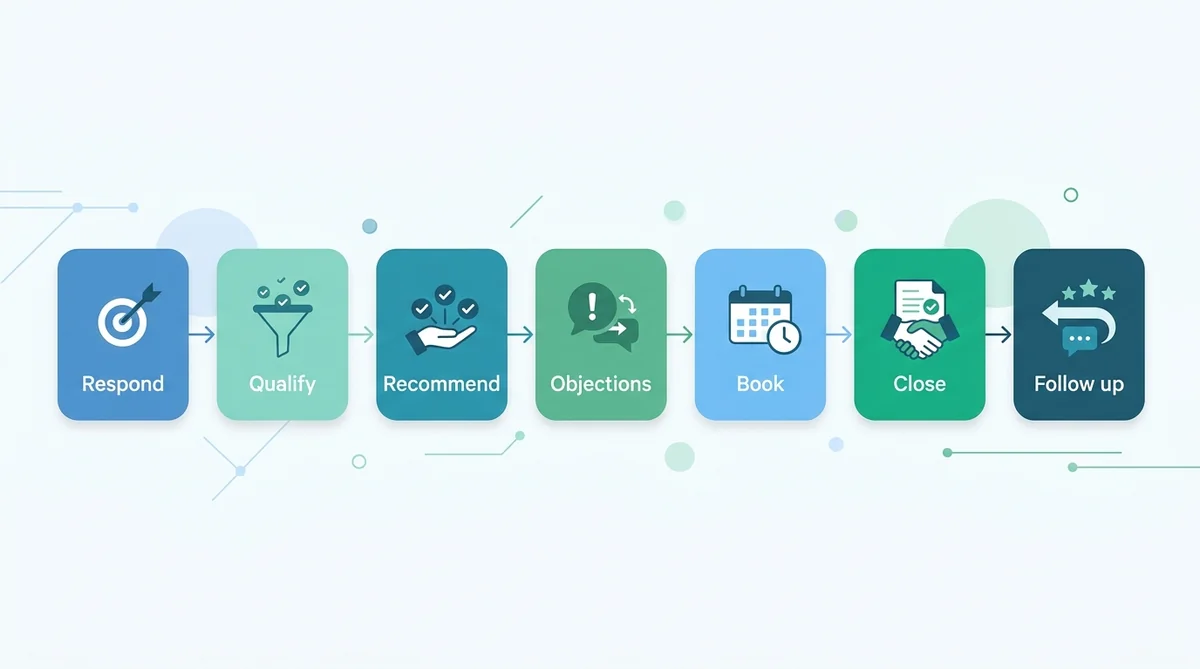
Think of a sale as seven steps. An AI sales agent can take most of them, and knows when to hand over.
| Stage | What the agent does | How it is built on ChatMaxima |
|---|---|---|
| 1. Respond | Replies within seconds on every channel | One bot across web chat, WhatsApp, Instagram and Messenger |
| 2. Qualify | Asks about need, budget, timeline and decision-maker | The AI Agent block with variable extraction |
| 3. Recommend | Matches the buyer to the right product or plan | A product knowledge source or WhatsApp catalog |
| 4. Handle objections | Answers price, delivery and comparison questions from approved content | Knowledge source plus rules in the agent’s instructions |
| 5. Book | Books a call, demo, viewing or visit | The Google Calendar tool |
| 6. Close | Sends a quote or a payment link | Generate PDF, Stripe or Razorpay invoice blocks |
| 7. Follow up and hand off | Chases quiet leads, routes hot ones to a person | Schedule trigger, WhatsApp templates, Talk to Agent |
1. Respond in seconds
The first reply sets the tone. A good AI sales agent greets the visitor by the context it has (the ad they clicked, the page they are on, the product they asked about) and moves straight to helping, rather than sending a menu.
2. Qualify without interrogating
Qualification works best as a conversation, not a form. The agent asks two or three questions at a time, adapts to the answers, and stores what it learns (company size, budget range, timeline, location) as variables. A simple score then decides the next step: book a call, send information, or nurture.
3. Recommend the right option
Buyers rarely know which plan, package or product fits. The agent asks what they need and recommends one option with a reason, using your own product information as its source. On WhatsApp it can show items from your catalog inside the chat.
4. Handle objections honestly
“Is it cheaper elsewhere?” “Can you deliver by Friday?” “What’s the difference between the two plans?” The agent answers from approved content: your pricing page, delivery policy and comparison notes. Tell it explicitly what it may not do, such as inventing discounts or promising dates you cannot meet.
5. Book the next step
For considered purchases, the goal of the conversation is a meeting. The agent checks the sales calendar and books a demo, viewing, consultation or visit in the chat, then sends the confirmation.
6. Close when the buyer is ready
For simpler purchases, the agent can complete the sale: send a quote as a PDF, create an invoice or send a payment link, and record whether it was paid.
7. Follow up and hand off
Leads who go quiet get a timely follow-up through an approved WhatsApp template. Hot leads, large deals and anyone who asks for a person go straight to your team, with the qualification answers and the full conversation attached, so nobody asks the buyer to repeat themselves.
An example conversation
Here is how a short exchange might run for a business that sells and installs home solar systems, after a prospect clicks an ad that opens WhatsApp.
Prospect: Hi, how much for solar panels?
Agent: Hi, thanks for asking! Systems for homes like yours usually start from a few thousand dollars, depending on roof size and power use. Two quick questions so I can give you a closer figure: roughly what is your monthly electricity bill, and do you own the home?
Prospect: About $220 a month, yes we own it.
Agent: Thanks. With a bill that size, most customers choose our mid-size system, which typically covers most of their usage. The exact price depends on a free roof check. Would you like to book one? I have Thursday at 10am or Saturday at 2pm.
Prospect: Saturday works. Can I pay in instalments?
Agent: Yes, we offer monthly payment options, and our advisor will go through them with you on Saturday. You’re booked for Saturday at 2pm. I’ve sent the confirmation here. Is there anything you’d like the advisor to know before the visit?
In three replies the agent answered the price question honestly, qualified the lead (bill size and home ownership), recommended a product, booked the visit and passed a finance question to a person. The sales team receives a booked appointment with the answers attached, not a “please call me back”.
AI sales agent vs AI sales assistant: which do you need?
An AI sales assistant helps your salespeople rather than replacing their conversations: it drafts replies, summarises long threads and suggests next steps, while a person sends every message. On ChatMaxima, the inbox’s AI-assisted replies and conversation summaries do this job.
Most growing businesses use both:
- The AI sales agent handles the first response, qualification, routine questions and bookings, around the clock.
- The AI sales assistant helps your team handle the conversations the agent passes over, faster.
If your deals are large, regulated or highly custom, start with the assistant and let the agent handle only the first response and qualification. If your enquiries are frequent and similar, let the agent take the conversation further.
AI sales agent examples by business type
Real estate. Qualifies buyers on budget, area and timeline, shares matching listings and books viewings with the right agent.
Education and online courses. Answers questions about programmes and fees, checks eligibility and books a counselling call or enrols the student.
B2B services and agencies. Qualifies enquiries on company size, need and budget, and books a discovery call only for good-fit leads.
Ecommerce. Recommends products, answers sizing and delivery questions, and sends the buyer to checkout or a payment link.
Automotive. Answers questions about models and stock, books test drives and service appointments, and routes finance questions to a person.
Health, beauty and wellness. Explains treatments and prices, books consultations, and keeps medical questions with qualified staff.
If your ads send people to WhatsApp, our guide to qualifying click-to-WhatsApp ad leads 24/7 goes deeper on that flow, and our walkthrough of WhatsApp AI agents across the whole sales pipeline covers nurturing and B2B and B2C examples.
How to set up an AI sales agent in 7 steps
- Write down your sales conversation. List the questions your best salesperson asks, the answers that qualify a lead, and the moment they would book a call or ask for payment.
- Define a qualified lead. Agree in writing what counts: for example, budget above a threshold, buying within 90 days, and a decision-maker in the conversation.
- Build the knowledge source. Add your product pages, pricing, comparison notes, delivery terms and FAQs, so the agent answers from your content and not from guesses.
- Connect the tools. The sales calendar for bookings, your CRM (HubSpot, Zoho CRM, GoHighLevel or ChatMaxima’s own MaxCRM) for leads, and invoices or payment links if you sell in chat.
- Write the rules. What the agent may offer, what it must never promise, when to hand over, and how to sound. Short, specific rules beat long prompts.
- Test with real objections. Run scripted conversations: a buyer who only wants the price, one who compares you to a competitor, one who wants a discount, one who wants a person immediately.
- Launch on one channel, then expand. Start where most enquiries arrive, watch the first week closely, then add the other channels.
What to measure
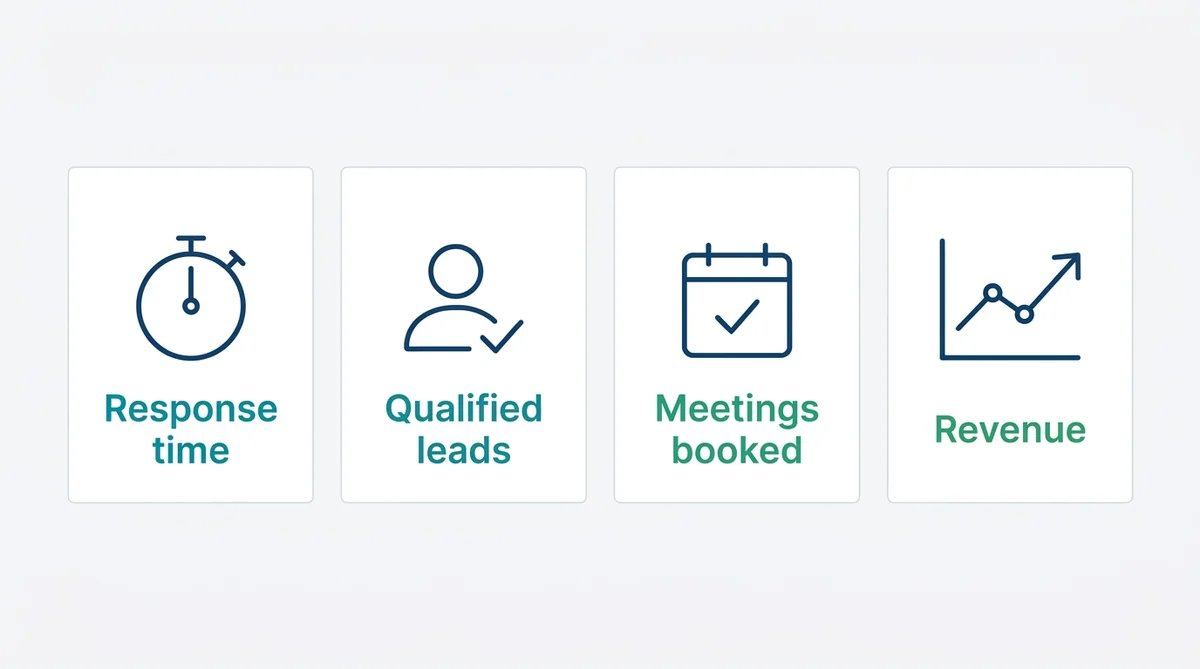
Five numbers tell you whether your AI sales agent is working:
- First response time: seconds, not hours.
- Qualification rate: the share of conversations that meet your definition of a qualified lead.
- Meetings or bookings made by the agent.
- Conversion to sale from agent-handled conversations.
- Revenue per conversation, compared with your baseline before the agent.
Measure the baseline before launch, report the same numbers every month, and look at the conversations where leads dropped out; they show you which answers or rules to improve. Our guide to proving AI ROI explains how to turn these into a monthly report.
Guardrails for AI sales agents
- A person is always reachable. Even buyers who research with AI still want a person in the loop: Gartner reports that 69% of B2B buyers turn to sales reps to validate AI-generated insights (Gartner, May 2026). Make “talk to a person” work at every step, and hand over with the full history.
- No invented offers. The agent quotes only prices, discounts and delivery times from your approved content.
- Be open that it is AI. Say so in the greeting. Buyers forgive an AI; they do not forgive being misled.
- Respect opt-outs and consent. Follow-ups on WhatsApp need opt-in and approved templates; honour “stop” immediately.
- Review the hand-offs. Read a sample of conversations each week, especially the ones handed to people, and fix what caused them.
Mistakes to avoid
- Qualifying like a form. Ten questions in a row lose buyers. Ask two or three, then give something useful.
- No clear next step. Every conversation should end with a booking, a payment, a follow-up date or a hand-off, not “thanks for your interest”.
- Hiding the price. If buyers ask for a price and the agent dodges, they leave. Give a range or a starting price.
- Treating every lead the same. Route hot, high-value leads to a person quickly; let the agent nurture the rest.
- Set and forget. Prices, offers and products change. Update the knowledge source every time they do.
How much does an AI sales agent cost?
There are two ways to pay for one.
Done-for-you AI SDR products usually charge per seat or per contact, often hundreds or thousands of dollars a month, and focus on outbound email. They make sense for B2B teams with large prospect lists.
Platforms you configure yourself charge a monthly subscription plus usage, and you build the agent around your own sales conversation. On ChatMaxima, plans start at $19 a month and extra messages are added in blocks of 10,000. The pricing page shows what each plan includes.
The bigger cost is usually time: a few days to write down your sales conversation, build the knowledge source and test it properly. If you would rather not do that yourself, many agencies build and run sales agents for clients; our guide to pricing AI agent work shows how they charge.
Whichever route you choose, judge it on revenue, not on cost alone. If the agent turns even a handful of extra enquiries a month into customers, it usually pays for itself.
Questions to ask before you choose an AI sales agent
- Does it work on the channels where your buyers already are, especially WhatsApp and your website?
- Can it book meetings into your real calendar and create leads in your CRM?
- Does it answer only from your content, and can you set rules it must follow?
- Can a person take over the conversation instantly, with the full history?
- Can you see every conversation and the reason each lead was handed over?
- Can you change prices, offers and rules yourself, without a developer?
Building an AI sales agent on ChatMaxima
- The MaxIA AI Agent block holds the conversation, extracts qualification answers into variables and calls tools: Google Calendar for bookings, Google Sheets, Stripe, Shopify, WooCommerce, API requests, email and PDF generation.
- Studio adds the logic around it: If / Else on the lead score, CRM blocks for HubSpot, Zoho CRM and GoHighLevel, MaxCRM, invoices and payment links, and a Schedule trigger with WhatsApp templates for follow-ups.
- Channels: website chat, WhatsApp (including click-to-WhatsApp ads), Instagram, Facebook Messenger, Telegram and inbound voice, in one inbox.
- Hand-off: Talk to Agent assigns the conversation to the right salesperson or department, with the full history.
- For your team: AI-assisted replies and conversation summaries in the inbox, the AI sales assistant side of the picture.
What’s next
An AI sales agent will not replace a great salesperson. It makes sure every lead gets the answer a great salesperson would give, in seconds, and that your team spends its time on the buyers who are ready.
Start with the channel where most of your enquiries arrive, write down your best sales conversation, and check the ChatMaxima plans to build your first AI sales agent this week.

