A white label AI platform lets you sell AI agents under your own brand. Your client logs in to your domain, sees your logo, and gets support from your team. The software underneath is someone else’s, and you never have to build or host it.
That is the fastest route into the AI agent business for agencies, freelancers and consultants, because it removes the two expensive parts: building the product and maintaining it. What is left is the part agencies are already good at, which is selling, configuring and looking after clients.
This guide covers what a white label AI platform should give you, how to set up the agency step by step, and how to price your first 10 clients so the numbers work from month one. It is a companion to our list of 25 AI agent business ideas, where the white-label agency is idea 22.
What a white label AI platform is (and what it is not)
There are three ways to make money from someone else’s AI software, and they get confused often:
- Referral or affiliate partner: you send a customer to the vendor and earn a commission. The client knows the vendor, buys from the vendor, and gets support from the vendor.
- Reseller: you sell the vendor’s product, often at a discount, and may handle billing. The product still carries the vendor’s brand.
- White label: you sell the product as your own. Your domain, your logo, your support email, your pricing. The vendor stays invisible to the client.
White label is the most work of the three, because you own the client relationship and the support. It is also the only one where you set the price and keep the margin, and where the client’s loyalty belongs to you rather than the vendor.
Do clients mind that the software is not yours? In practice, rarely. Agencies have white-labelled reporting tools, SEO platforms and email marketing software for years. Clients pay for the outcome and the service around it, not for who wrote the code.
Should you build your own platform instead?
Some agencies consider building their own AI agent platform on top of model APIs. It is possible, but it is a software company, not an agency. You would need to build and maintain WhatsApp, Instagram and voice integrations, a shared inbox, a knowledge base pipeline, billing, permissions and uptime monitoring, and keep up with every Meta and model provider API change.
A white label AI platform turns all of that into a fixed monthly fee. Build your own only if the platform itself is the product you want to sell. If the service is the product, white label is almost always the better trade.
Why 2027 is the window for white label AI agents
Demand is growing faster than the supply of people who can deploy agents well. Gartner expects 40% of enterprise applications to include task-specific AI agents by the end of 2026, up from less than 5% a year earlier. The AI agents market is estimated at $10.9 billion in 2026, growing close to 50% a year (Grand View Research, 2026).
Most of that growth is inside large companies with their own teams. Small and mid-sized businesses want the same results, but they do not have anyone to configure a knowledge base, connect WhatsApp, or rewrite a prompt when the agent gets something wrong. That gap is the agency opportunity.
The timing also favors the agency over the do-it-yourself owner. Only 23% of organizations are scaling AI agents in even one business function (McKinsey, 2026). Most businesses have tried something and stalled, and many would rather pay a monthly retainer than learn another tool.
What to look for in a white label AI platform
Most platforms that call themselves white label differ in what they actually let you rebrand and what they let you sell. Check these ten points before you commit.
- Branded domain. The dashboard should run on your domain or subdomain, such as app.youragency.com, with a valid SSL certificate. A rebranded logo on the vendor’s URL is not white label.
- Full brand assets. Your site name, logos for light and dark themes, a favicon and your support email, everywhere the client looks. Check emails and login pages too, not just the dashboard.
- One workspace per client. Each client needs an isolated workspace with its own channels, contacts, agents and team members. Without this, client data mixes and you cannot hand over logins safely.
- Channel coverage. Your clients’ customers are on WhatsApp, Instagram, website chat and the phone. A platform that only does website chat limits which clients you can sign.
- Voice and text in one place. AI receptionists are one of the easiest services to sell. If voice needs a second vendor, you have two bills, two dashboards and two support queues.
- Model choice. You should be able to pick the AI model per agent and, ideally, connect your own provider keys so AI usage is billed at cost rather than marked up.
- A fast agent builder. Build speed is your margin. A visual builder plus an AI assistant that creates flows from a plain-language description turns a two-day build into an afternoon.
- Human handoff and a shared inbox. Every agent needs a clean way to pass a conversation to a person. In one survey, 89% of consumers said companies should always offer the option to speak to a human (SurveyMonkey, 2025).
- Reporting you can show a client. Conversation volume, resolution rate, handoffs and per-block execution logs. If you cannot prove the agent works, the client will cancel in month three.
- Pricing that scales with you. A flat platform fee with unlimited workspaces is easier to resell than per-client or per-seat pricing, because your cost stays flat while revenue grows.
Three types of white label AI platforms
| Type | What you can sell | Watch out for |
|---|---|---|
| Voice-only | AI receptionists, outbound calling | Per-minute costs; no chat or WhatsApp |
| Chatbot-only | Website and messaging bots | No voice; often weak inbox and handoff |
| All-in-one | Voice, WhatsApp, Instagram, web chat, inbox, CRM | Higher base fee, but one bill for every service |
If you plan to sell more than one service, an all-in-one platform usually wins on margin. You avoid stacking three subscriptions and three learning curves.
White label AI voice agents: the easiest first offer
If you are unsure which service to lead with, a white label AI voice agent set up as a receptionist is a strong first offer. The problem is easy to explain: calls go unanswered while the owner is busy, and each missed call can be a lost customer. The result is easy to measure, because every answered call and every booked appointment shows up in the call log.
A white label AI receptionist answers every call, handles common questions about prices, hours and location, books appointments into the calendar, and saves the caller’s details. Calls it cannot resolve are logged with the full transcript, so the team can follow up. Clinics, salons, law firms and home services companies all buy this, and they understand it without a long explanation.
Price voice with care. Phone numbers and call minutes are usage-based, so include a monthly minute allowance in the package and bill extra minutes at a clear rate. That way a busy month makes you money instead of costing you.
How to start an AI agent agency in 7 steps
Step 1: Pick one niche
Choose a single industry for your first 10 clients. Dental clinics, real estate brokerages, salons, home services and online stores all work. One niche lets you reuse the same agent, the same demo, the same case study and the same sales pitch. That reuse is what makes a one-person agency profitable.
Step 2: Choose your white label AI platform
Score your shortlist against the ten-point checklist above. Run a trial, build one real agent, and connect at least one real channel before you decide. Most problems show up only when a real WhatsApp number or phone line is attached.
Step 3: Set up your brand
Point a subdomain at the platform, upload your logos and favicon, and set your support email. Then log in as a test client and click through every screen, including the login page, password reset email and any notification emails, looking for the vendor’s name.
Step 4: Build one demo agent for one real business
Pick a business in your niche and build their agent with their actual services, prices and opening hours. Record it answering their real questions. A demo that knows the prospect’s own business converts far better than a generic deck.
Step 5: Package two or three offers
Do not sell “AI.” Sell an outcome with a clear scope: “every inquiry answered in under a minute on WhatsApp and Instagram,” or “every call answered and booked into your calendar.” Packaging is covered in the pricing section below.
Step 6: Sign your first three clients with a pilot
Offer a 30-day pilot with one agreed metric, such as response time, booked appointments or tickets resolved without a human. Charge for the pilot, even a reduced fee. Free pilots attract people who never intended to buy.
Step 7: Onboard, report and expand
Send a short monthly report: conversations handled, leads captured, bookings made, and what you improved. Once the first channel is working, offer the next one. Expansion revenue from existing clients is the cheapest revenue you will ever earn.
How to price your first 10 clients
Pricing is where most new agencies go wrong. They price against the software cost instead of against the value to the client, and end up charging $49 for something worth $500.
Package your offers
| Package | What is included | Monthly price | Setup fee |
|---|---|---|---|
| Launch | One channel, one agent, knowledge base, monthly report | $297 | $500 |
| Growth | Up to three channels, lead capture to CRM, monthly optimization | $497 | $750 |
| Growth + Voice | Growth plus an AI receptionist on the client’s phone line | $697 + call costs | $1,000 |
These are example prices for small businesses in North America and Western Europe. Adjust for your market, but keep the structure: a setup fee that covers your build time, and a monthly retainer that covers hosting, monitoring and improvement.
Know your cost stack
Your costs fall into four buckets:
- Platform fee. A flat monthly fee for the white label platform, the same at 3 clients or 30.
- AI model usage. Billed by the model provider per token. For typical small-business volumes this is usually a small share of the retainer, but monitor it per client.
- Channel fees. On WhatsApp, Meta charges business-initiated template messages per message, by country. Decide up front whether the client pays Meta directly or you pass the cost through.
- Voice minutes. Phone numbers and call minutes are usage-based. Price voice packages with minutes “at cost” or with a clear included allowance.
The math at 3, 5 and 10 clients
Assume a realistic mix: half your clients on Launch, the rest on Growth, and one with voice.
| Clients | Mix | Monthly revenue | Setup fees earned |
|---|---|---|---|
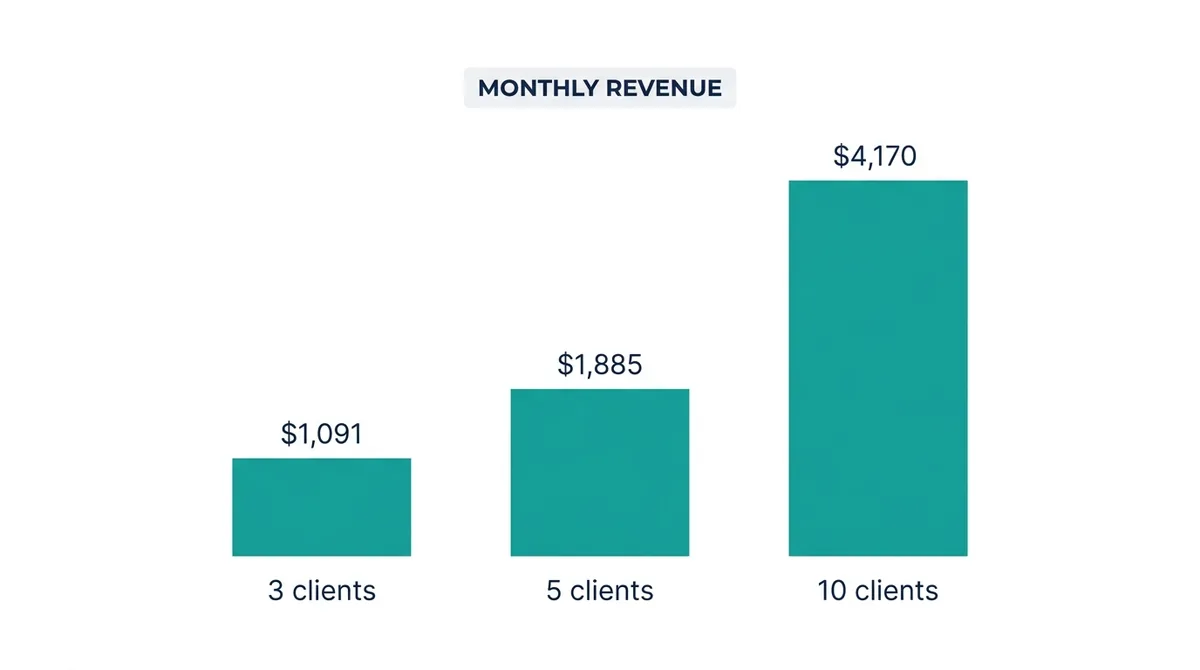
| 3 | 2 Launch, 1 Growth | $1,091 | $1,750 |
| 5 | 3 Launch, 2 Growth | $1,885 | $3,000 |
| 10 | 5 Launch, 4 Growth, 1 Growth + Voice | $4,170 | $6,500 |
At 10 clients, a $499 platform fee is about 12% of monthly revenue. Budget roughly another $300 to $400 a month for AI usage and miscellaneous tools at this size, and you keep around $3,300 a month in gross profit, before your own time. From there, every additional client adds $300 to $700 a month at almost no extra platform cost.
When to raise prices
Raise prices when you have a case study with a real number in it, when you add a second channel, or when your calendar is full. Existing clients can stay on their original price while new clients pay the new one. For a deeper look at building recurring revenue, see our guide to the agency tech stack.
Mistakes that sink new white label AI agencies
Selling to every industry. Each new niche means a new demo, new prompts and new objections. Stay in one lane until you have 10 clients.
Underpricing the setup. Building the knowledge base, connecting channels and testing edge cases is real work. A client who churns in month two should not cost you money.
No human in the loop. Agents that never hand off frustrate customers and embarrass your client. Build the handoff, test it, and show the client how their team picks up a conversation.
Ignoring the per-message and per-minute costs. WhatsApp template fees and voice minutes scale with usage. A busy client on a flat retainer with no usage terms can quietly eat your margin.
Weak reporting. If the client cannot see what the agent did, they will assume it did nothing. A one-page monthly report is the best retention tool you have.
For more on positioning a white-label offer, our white-label chatbots guide covers the sales conversation in more detail.
How white labelling works on ChatMaxima
ChatMaxima is an all-in-one platform: AI agents across WhatsApp, Instagram, Messenger, SMS, website chat, in-app chat and voice, with a shared inbox, ticketing, CRM, broadcasts and a visual builder in one product. Here is how it maps to the checklist.
- Plan. Full platform white labelling is on the Ultra plan, listed at $499 a month on monthly billing at the time of writing, with a one-time white labelling setup. Ultra includes unlimited workspaces, unlimited team members, all channels, and 200,000 messages a month. Check the pricing page for current prices.
- Brand. Your dashboard runs on your own domain or a branded subdomain, with your site name, light and dark logos, compact logos, favicon and support email.
- Clients. Each client gets their own workspace with separate channels, contacts, agents and team logins.
- AI. Choose models from OpenAI, Anthropic, Google Gemini and others per agent, and train agents on a client’s website, documents and FAQs.
- Build speed. The MaxIA Builder Agent creates bot flows from a plain-language description, and execution logs show what each block did, which helps with debugging and client reports.
A practical path is to start on the Max plan, which already includes unlimited workspaces, while you sign your first clients, then move to Ultra once clients expect to see your brand. If you would rather refer clients than run them yourself, the ChatMaxima partner program pays commission for the lifetime of every customer you refer.
What’s next
A white label AI platform turns AI agents from a product you would have to build into a service you can sell this month. Pick one niche, choose a platform that passes the checklist, build one demo for one real business, and price for the outcome, not the software.
Ten clients at a mixed $400 average is a business with roughly $4,000 in monthly recurring revenue and healthy margins, built on a platform fee that does not grow with every client you add.
Ready to build your first agent? Compare ChatMaxima plans and start a 7-day free trial.