
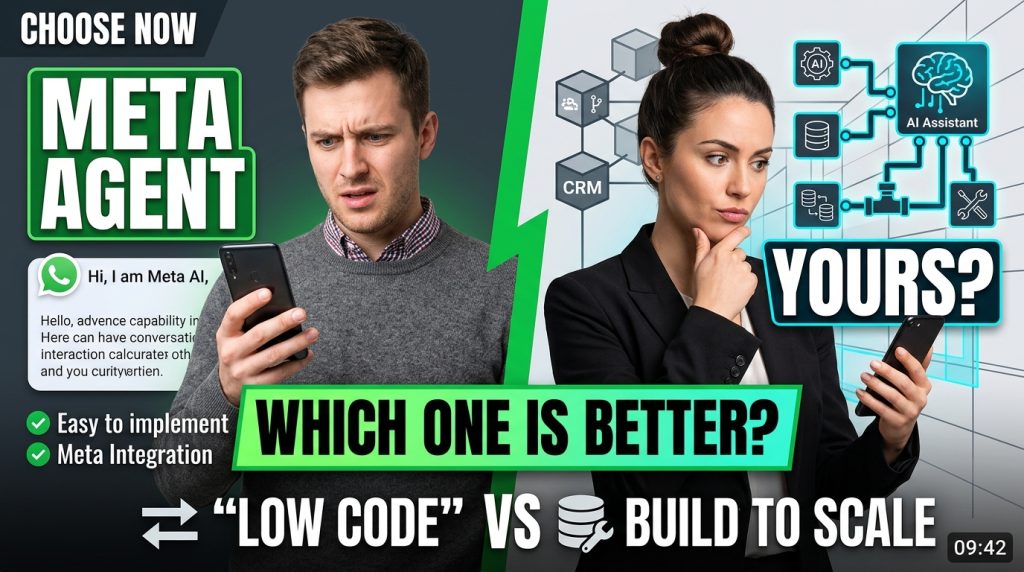
Until June 2026, putting an AI agent on WhatsApp meant building one. You picked a platform, connected your data, wrote the prompts, defined the handoff rules, and paid a vendor. Then Meta shipped its own agent, made it free to switch on, and put it inside the apps your customers already use. The obvious question followed immediately: why would anyone still run a custom AI agent?
The answer is not obvious, and it is not the same for every business. Meta Business Agent and a custom AI agent solve overlapping problems with very different trade-offs on cost, control, data access, channel reach, and what happens when the agent gets something wrong. Meta reports that over one million businesses were already running a version of its agent before the global launch, across more than a billion business threads a day (Meta, 2026). That scale is real. It also tells you nothing about whether it fits your business.
This guide compares the two honestly, including the parts where Meta’s agent is simply the better choice. If you want the background on what the Meta Business Agent Platform is and how its token billing works, read our Meta Business Agent platform explainer first. This post assumes you already know what it is and are trying to decide what to run.
The Two Things You Are Actually Choosing Between
Start by separating the choice properly, because most comparisons blur three products into two.
Meta Business Agent, self-serve tier. You activate it from the WhatsApp Business app, Instagram Pro, or Meta Business Suite. You give it information about your business, set a tone, and it starts answering. Setup takes minutes. Meta owns the model, the guardrails, and the behaviour.
Meta Business Agent Platform. The enterprise layer that opened to partners on July 1, 2026. It exposes API infrastructure, connects to systems like Shopify, Zendesk, and Shopee, and adds enterprise controls, rules, and measurement. This is not the thing you switch on in an afternoon. It is a partner-led build.
A custom AI agent. An agent you run on a business messaging platform of your choice, on the WhatsApp Business API, with your own knowledge base, your own model selection, your own logic, and your own inbox. The platform handles the plumbing; you own the behaviour.
The real comparison for most businesses is the first against the third. The Platform tier is a different budget conversation entirely, and if you are large enough to be having it, you likely already have a partner in the room.
What Meta Business Agent Gets Right
It is worth being fair about this, because the free tier is genuinely strong for a specific profile of business.
Setup cost is effectively zero. No API application, no business verification queue, no platform subscription, no prompt engineering. A small retailer can go from nothing to a working agent inside a lunch break. For a business that currently has no automation at all, that is a step change, not an incremental improvement.
It is native. The agent lives inside Meta’s own surfaces, which means no webhook latency, no middleware to break, and no third-party outage sitting between your customer and your reply. It answers around the clock, in the customer’s local language, in the tone you specify at setup.
It works across WhatsApp, Messenger, and Instagram at once. One configuration, three surfaces. If your customers reach you across all of Meta’s apps, that unified coverage is real value that a single-channel setup does not match.
The internal assistant is underrated. Beyond customer replies, the agent delivers morning briefings on missed chats and surfaces thread insights. For an owner-operator who cannot read every conversation, that alone justifies switching it on.
If you are a sole trader, a local service business, or a small shop with a few dozen conversations a week, you can stop reading here. Turn on Meta Business Agent. A custom agent is overhead you do not need yet.
Where Meta Business Agent Stops
The limits are structural rather than temporary, and they follow from the design rather than from an incomplete rollout.
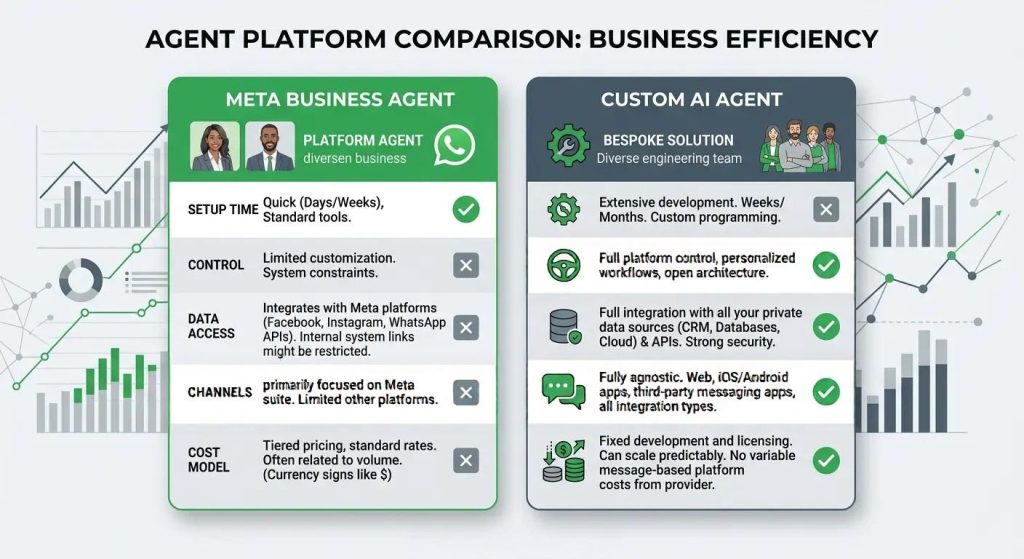
Meta controls the model and the guardrails. The self-serve agent runs on Meta’s model family, inside Meta’s safety rules, with Meta’s definition of what a good answer looks like. You supply information and a tone. You do not supply reasoning steps, escalation logic, or refusal behaviour. When the agent answers a pricing question in a way that undercuts your sales team, your remedy is to rewrite the information you gave it and hope.
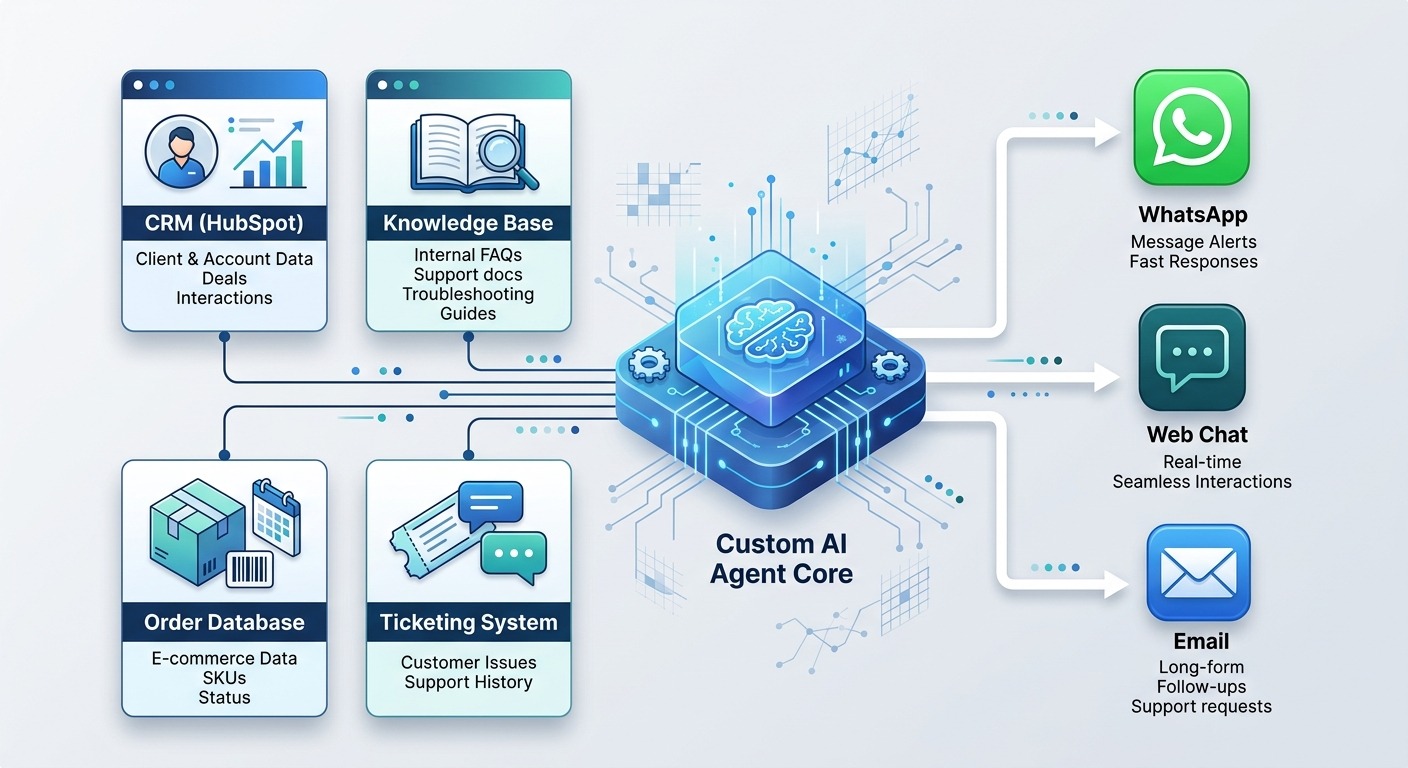
The self-serve tier does not read or write to your systems. No CRM, no ERP, no order database, no ticketing system. That is the single biggest limitation and it is easy to miss during a demo, because a catalog-backed product question looks like a system integration when it is not one. The agent can tell a customer what a product is. It cannot tell them where their order is, what their account balance is, or whether their support ticket was resolved.
It stops at Meta’s borders. WhatsApp, Messenger, and Instagram. No website chat widget, no email, no SMS, no voice, no in-app support in your own mobile app. If your support load is split across channels, an agent that covers three of them leaves the rest unautomated and leaves your team switching between two different systems.
There is no shared context with your human team. When the agent hands off, it hands off inside Meta’s surfaces. A business running a proper shared inbox, ticket history, and agent performance reporting now has conversations happening in two places with two different records.
None of these are complaints about quality. Meta’s agent answers well. They are questions about fit, and they get sharper the more systems your answers depend on.
The Cost Comparison Is Not What It Looks Like
This is where most comparisons go wrong, so it is worth doing the arithmetic properly.
From August 1, 2026, Meta bills the Business Agent by token consumption at $2.00 per million tokens. A typical customer interaction consumes roughly 20,000 to 25,000 tokens, which works out to about $0.04 to $0.05 per conversation. Ten thousand conversations a month therefore lands somewhere around $400 to $500.
That number looks high against raw model pricing and low against most managed platforms, and both readings are wrong, because the rate is doing two jobs at once. Meta’s token rate bundles AI processing and message delivery into a single meter. You are not comparing a model bill to a model bill. You are comparing one blended rate to the sum of two separate ones.
A custom agent splits those costs back apart:
- Model cost. You choose the model, so you choose the price. A short intent-classification step can run on a small cheap model while only genuinely hard questions reach a frontier one. Prompt caching cuts repeated context cost substantially. You are not locked to a single blended rate for every message regardless of difficulty.
- Message cost. You pay WhatsApp conversation and template charges directly, under the standard rate card. Our WhatsApp Business API pricing guide has the current numbers by category and country.
- Platform cost. A predictable subscription for the inbox, builder, integrations, and reporting.
The October 1, 2026 change matters here. Meta resumes charging for service messages, the free-form replies sent inside the 24-hour customer service window. Under a custom agent, those land on your message bill as a separate line. Under Meta’s agent, delivery is already inside the token rate. Whether that makes Meta cheaper or dearer depends entirely on your conversation mix, so model your own volumes before assuming either direction.
The honest summary: at low volume, Meta’s agent is cheaper and simpler, full stop. At high volume with a wide spread of question difficulty, a custom agent gives you levers to pull that a flat blended rate does not. The crossover point is specific to your business, not to a benchmark.
Control, Data, and the Questions Only You Can Answer
The strongest argument for a custom agent has nothing to do with price.
Most of what customers actually ask is account-specific. Where is my order. Why was I charged twice. Can I change my appointment. Is my warranty still valid. Did you receive my document. None of these can be answered from a catalog and a tone setting. They require a live lookup against a system that holds the customer’s record, and increasingly a write back into it.
That is the dividing line. An agent that only answers general questions deflects the easy half of your volume and escalates the rest. An agent wired into your order system, CRM, and ticketing stack resolves the hard half too, which is where the actual cost savings live. Deflecting FAQs was solved years ago; resolving account queries is what moves the number.
This is also why domain depth beats general capability in practice. A generic assistant with a broad model and no business context loses to a narrower agent that knows your catalog, your policies, and your edge cases. We made that argument at length in why vertical AI agents beat ChatGPT for business, and the Meta Business Agent sits on the general side of that line by design.
A custom agent also gives you things that matter more the larger you get: choice of model and the ability to switch when a better or cheaper one ships, control over refusal and escalation behaviour, your own logs and evaluation data, portability if you change platforms, and a clear answer when a compliance team asks where customer data is processed and who trained on it.
The Handoff Is the Part People Underestimate
Every AI agent hands off. The question is what the customer and your team experience when it does.
With the self-serve Meta agent, you decide when a team member steps in, and the conversation continues in Meta’s surface. That works when your team is small and lives in the WhatsApp Business app anyway.
It stops working when you have a real support operation. A team of eight needs assignment rules, queues, ticket history, canned replies, internal notes, tagging, SLA timers, and reporting on who resolved what. It needs the agent’s full conversation to arrive with the ticket rather than the human re-reading it. It needs the customer’s past orders visible in the same pane. That is an inbox product, not an agent feature, and it is the reason most growing businesses end up on a platform regardless of whose model answers first.
The related failure is silent escalation. An agent that cannot resolve an account query and cannot cleanly hand off will keep talking, which is worse than saying nothing. Getting the escalation trigger right, and making it land somewhere a human will actually see, is more valuable than another point of answer accuracy.
A Decision Framework
Run through these in order. The first clear yes usually settles it.
Choose Meta Business Agent if:
- Your conversations are almost entirely on WhatsApp, Instagram, or Messenger
- Most questions are general: hours, products, availability, directions, policies
- You have no CRM or order system that the agent would need to read
- Your team is one to three people working directly in the messaging apps
- You are automating for the first time and want a result this week
Choose a custom AI agent if:
- A meaningful share of questions are account-specific and need a live lookup
- You support customers on channels beyond Meta’s apps
- You have a support team that needs queues, assignment, history, and reporting
- You want control over the model, the escalation logic, and the data
- You are in a regulated space and need to document how customer data is handled
- Your volume is high enough that per-message cost engineering pays for itself
Choose the Business Agent Platform tier if: you are enterprise scale, you have a partner, and you want Meta’s agent wired into hundreds of systems with enterprise guardrails and measurement. This is a procurement project, not a switch.
Most Businesses Will End Up Running Both
The framing of an exclusive choice is mostly a writing convenience. In practice the two coexist, and the sensible pattern is already visible.
Meta’s agent is very good at the top of the funnel. It is free or cheap, native, instant, and multilingual, which makes it well suited to first-touch traffic: an ad click, a profile visit, a cold enquiry, an out-of-hours question. Let it catch and qualify.
A custom agent earns its place deeper in the conversation, where answers depend on your systems and outcomes depend on your process. Order status, account changes, escalation, renewals, complex sales, anything that writes back to a record.
The connective tissue is your integration layer, because both patterns are only as good as the systems they can reach. If you are evaluating this seriously, look at what actually connects to your stack today before you look at model quality, and check the available integrations against the systems your answers depend on. An agent that cannot reach your order database is a very articulate FAQ page.
One practical note on the transition: do not treat this as a rip and replace. Run both against real traffic for a few weeks, measure resolution rate rather than deflection rate, and let the numbers decide the split. Deflection counts conversations the agent ended. Resolution counts problems the customer no longer has, and only the second one shows up in your support costs.
What to Do Before October
Two dates now shape this decision, and both land soon.
August 1, 2026 ended the free window. Meta Business Agent is billed by token from that date, so anyone who switched it on during the trial should check what it is actually costing against real volume rather than assuming the pilot number holds.
October 1, 2026 resumes service message charging. That changes the economics of every free-form reply your team or your agent sends inside the 24-hour window, whichever agent you run. Model it now, not in September.
A reasonable sequence for the next few weeks: pull your last ninety days of conversations and sort them into general questions and account-specific ones. If the general bucket is most of your volume, Meta’s agent covers you and you should switch it on and stop there. If the account-specific bucket is large, you need an agent that can reach your systems, and no amount of tone configuration will close that gap.
Then price both properly. Take your real conversation count, apply Meta’s token rate to it, and compare that against a custom agent’s model cost plus message cost plus platform fee. Do it with your numbers. The published per-conversation estimates are averages across a billion threads and yours will not match them.
If the second path is where you land, our pricing page has the platform side of that calculation, and the WhatsApp message costs sit on top of it under Meta’s standard rate card. The right answer here is genuinely business-specific. What is not business-specific is the need to run the arithmetic before the October billing change makes the question expensive.
Frequently Asked Questions
Meta Business Agent vs custom AI agent, what is the difference?
Meta Business Agent is Meta-hosted and standardized, billed per token, while a custom AI agent runs on your own stack with full control over customization, data, and omnichannel reach.
Is Meta Business Agent cheaper than a custom AI agent?
It depends on volume. Meta Business Agent’s per-token billing ($2.00 per 1M tokens) can add up on long AI replies, while a custom agent typically uses flat or usage-based pricing. Compare against the current rates in our WhatsApp API pricing guide.
Who controls the data and the customer conversation?
With a custom AI agent such as ChatMaxima, you own the conversation flow, CRM records, and human handoff. Meta Business Agent runs inside Meta’s platform, so control and data handling are defined by Meta.
Can I use Meta Business Agent and a custom AI agent together?
Yes. Many businesses layer a custom agent on top for control, escalation, and omnichannel coverage while using Meta’s agent for basic AI replies.
Does Meta Business Agent replace WhatsApp chatbots?
No. It is an additional AI-reply option, not a replacement for a full chatbot, shared inbox, and CRM workflow.