On June 30, 2026, Google released Nano Banana 2 Lite, the newest entry in its Nano Banana image generation line. The pitch is speed and price: it produces images in about four seconds with much lower latency than previous versions, and it costs roughly $0.034 per 1,000 images. Google positions it for high-volume workflows that need to run fast and cheap, which is a polite way of saying it is built for teams that produce a lot of visual content and cannot wait around or overspend for each frame.
For a business that lives on chat, ads, and product content, that combination changes the math on AI image generation in a real way. When an image costs a fraction of a cent and lands in seconds, image creation stops being a bottleneck you plan around and becomes something you do inline, at the moment a customer or a campaign needs it. This post breaks down what Nano Banana 2 Lite actually is, where it fits in Google’s lineup, and how fast, cheap image generation reshapes content workflows for marketing, ecommerce, and chat commerce specifically.
What Nano Banana 2 Lite actually is
Nano Banana 2 Lite is a distilled, speed-first version of Nano Banana 2. It keeps the realistic image generation that the Nano Banana 2 release introduced earlier in 2026, but it trades a little of the heavyweight quality ceiling for a large jump in throughput and a much lower price. Here are the numbers that matter.
- Speed: images in about four seconds, with much lower latency than prior versions.
- Cost: roughly $0.034 per 1,000 images, which Google frames as affordable enough to draft and perfect content at scale.
- Optimized for: high-volume workflows, creative iteration, rapid prototyping, advertising creation, and bulk content production.
- Availability: Google AI Studio, the Gemini API, and Google’s Gemini Enterprise Agent Platform.
To place it in the family, the progression looks like this. The original Nano Banana arrived in summer 2025, powered by Gemini 3.1 Flash. Nano Banana 2 landed in February 2026 with enhanced realism. Nano Banana 2 Lite now takes that realism and makes it fast and cheap for volume, while Nano Banana Pro remains the more powerful option for advanced, high-fidelity work. With the Lite release, Google has moved the original Nano Banana to legacy status and replaced it with the new Lite model.
The mental model is straightforward. Pro is for the hero shot. Lite is for the hundred variations you test before you pick one.
Why cheap and fast changes the workflow, not just the bill
It is tempting to read a price like $0.034 per 1,000 images as a simple cost saving. The bigger shift is what low cost plus low latency does to how work gets done.
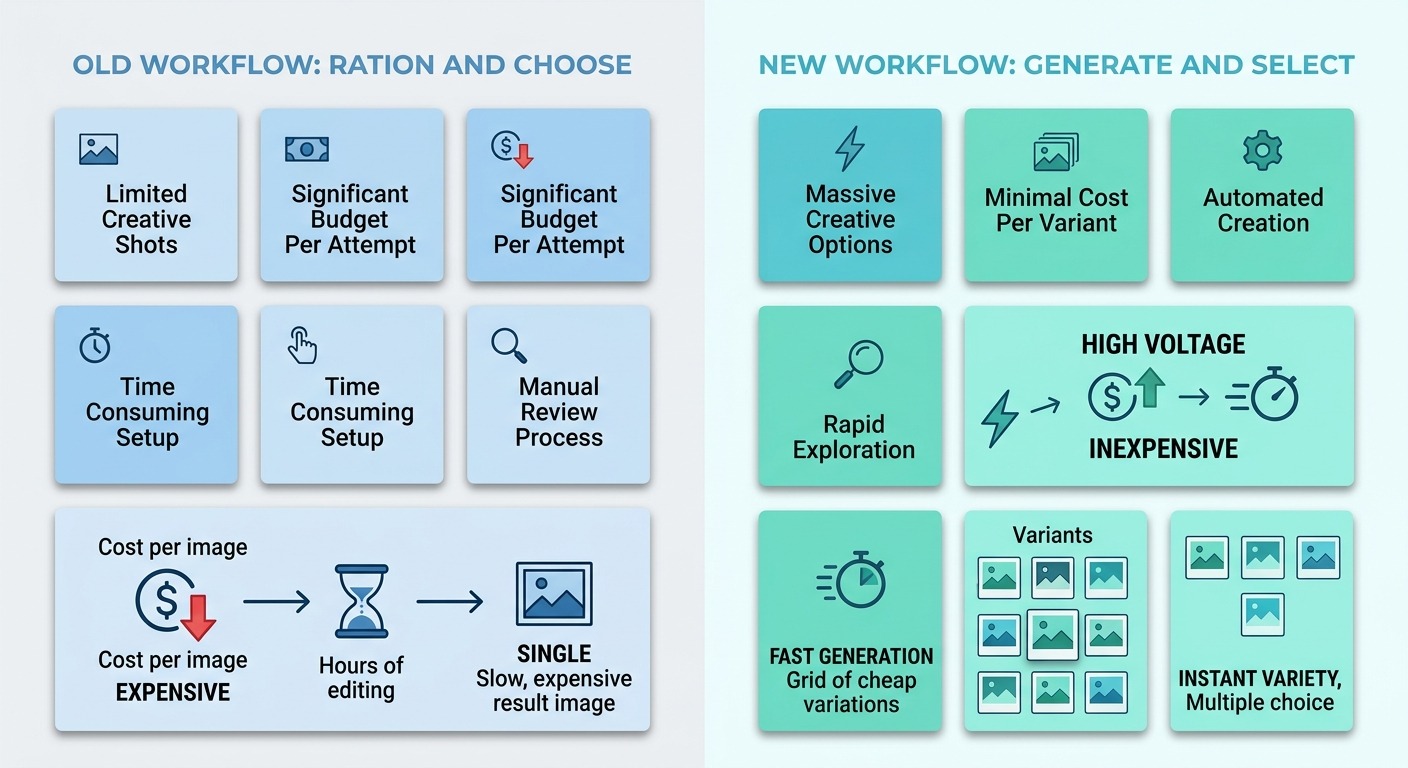
When each image is slow and expensive, you ration it. You brief a designer, wait, review, revise, and ship one carefully chosen asset. That model is fine for a flagship campaign and terrible for the long tail of content a modern business actually needs: dozens of ad variants, per-product visuals, localized creative, seasonal refreshes, and one-off images for a single conversation.
When each image is fast and nearly free, the constraint disappears. You can generate ten variants of an ad, test them, and keep the winner. You can produce a unique visual per product line instead of reusing one stock photo across a catalog. You can regenerate a whole seasonal set overnight. The workflow moves from ration-and-choose to generate-and-select, and that is a different way of working, not just a cheaper one.
This is the same pattern we have already seen in text. AI did not just make writing cheaper, it made it feasible to personalize replies for every customer instead of sending one canned message. Cheap, fast image generation does the equivalent thing for visuals. The businesses that win with it are the ones that redesign their content process around abundance, not the ones that just lower a line item on an invoice.
Where this matters most: chat commerce and WhatsApp
The place this lands hardest is conversational commerce, where a visual often does the selling inside a chat. Think about what a customer conversation actually needs.
- A product image tailored to what the customer just asked about, not a generic catalog shot.
- A quick mockup that shows a product in a color, size, or setting the customer mentioned.
- An ad creative for a campaign that drives people into a WhatsApp or Instagram conversation in the first place.
- A localized visual with the right language, currency, or seasonal context for the market you are messaging.
Every one of those is a high-volume, low-latency job, which is exactly what Nano Banana 2 Lite is tuned for. Four seconds is fast enough to feel responsive inside a live chat, and a fraction of a cent is cheap enough to do it for every conversation rather than only for high-value leads.
This connects directly to how businesses already run paid growth. Our 2026 click-to-WhatsApp ads playbook is built around testing many creative variants to find the ones that convert, and cheap image generation makes that testing loop far tighter. Instead of one creative per ad set, you can generate a batch, launch, read the numbers, and iterate the same day. The same logic applies across the broader stack of WhatsApp marketing software that businesses use to run these campaigns: the tool that generates the message and the tool that generates the image are converging into one flow.
For ecommerce specifically, the impact compounds. A store with a large catalog can generate consistent, on-brand product visuals across every SKU without a photo shoot per item, and refresh them for promotions on demand. We cover the messaging side of that in our guide to WhatsApp automation for ecommerce, and cheap image generation slots straight into those same automated flows as the visual layer.
How to use it well, and where to be careful
Fast and cheap does not mean careless. A few practical guardrails keep a high-volume image workflow from becoming a high-volume liability.
Draft with Lite, finish with Pro
Use the Lite model for exploration: many variants, quick tests, throwaway drafts. When you have a winner that will be seen by a lot of people, consider regenerating the final asset with a higher-fidelity model. This is exactly the split Google is signaling by keeping Nano Banana Pro in the lineup. Lite finds the idea, Pro polishes the one that matters.
Keep a human on brand and accuracy
Volume amplifies mistakes as easily as wins. A model can render a product detail wrong, invent a feature, or drift off brand, and at scale those errors ship fast. Put a quick human review step on anything customer-facing, especially images that imply a real product’s appearance, price, or specification. Cheap generation is a reason to review more, not less.
Mind the disclosure and rights questions
AI-generated visuals carry the usual open questions around labeling, likeness, and usage rights. If an image implies a real person, a real place, or a specific product claim, treat it with the same care you would a photograph. Fast tooling does not change your obligations to customers or regulators.
Instrument the results
Because generation is cheap, you can afford to test aggressively, but only if you measure. Track which generated creatives actually drive clicks, replies, and conversions, and feed that back into what you generate next. Abundance without measurement is just noise. Abundance with a feedback loop is a compounding advantage.
The bigger picture: AI content is becoming inline
Nano Banana 2 Lite is one release, but it points at a clear direction. Text generation, image generation, and soon richer media are collapsing into the same cheap, fast, API-accessible layer that businesses can call at the moment of need. The friction that used to separate having an idea from having the asset is disappearing.
For a conversational platform, that means the line between messaging and content creation keeps blurring. The same flow that answers a customer can increasingly generate the visual that helps close the sale, in the same few seconds, at a cost that rounds to nothing. Google shipping a four-second, sub-cent image model is a milestone on that path, and it will not be the last one this year.
The businesses that benefit are the ones that stop treating images as a scarce, planned resource and start treating them as an abundant, on-demand one, wired into the conversations and campaigns where they actually earn their keep. If you are already running customer conversations and campaigns on ChatMaxima’s plans, cheap, fast image generation is a natural next layer to fold into those flows.